

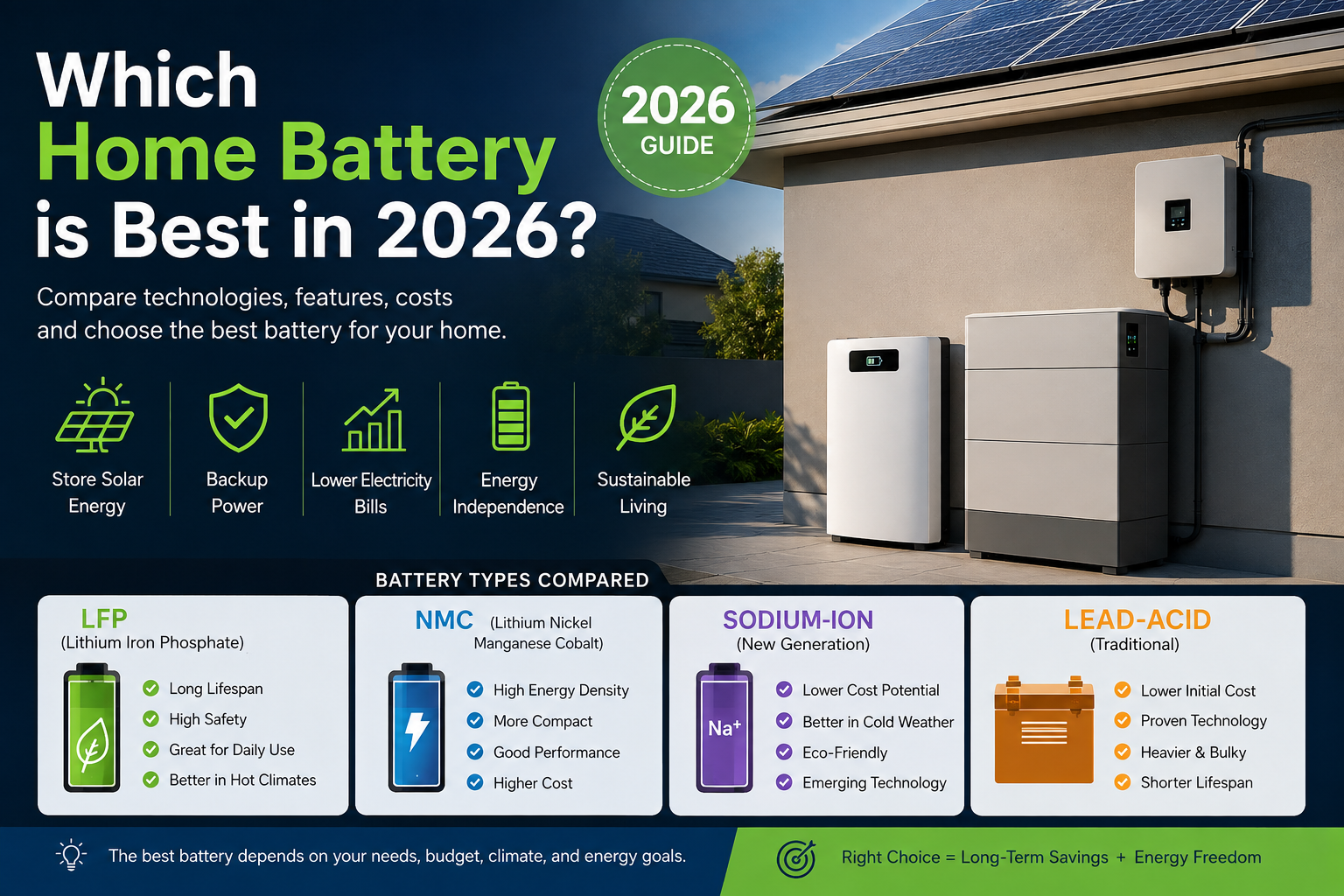
Which Home Battery is Best in 2026?
Electricity bills are rising, rooftop solar is becoming more affordable, and power outages are still a concern in many regions. Because of these changes, homeowners are increasingly asking one important question: Which Home Battery is Best in 2026?
The answer is not the same for every household. A family in Rajasthan dealing with summer power cuts may need a different battery from a homeowner in California trying to reduce evening electricity costs or a family in Germany looking for winter energy security.
This practical guide explains the latest battery technologies in simple English, compares their strengths and weaknesses, and helps you choose a system that will still make financial sense 10–15 years from now.
Why Homeowners Are Asking: Which Home Battery is Best in 2026?
Home batteries have moved from being a niche product to a mainstream home energy upgrade. Three trends are driving demand in 2026:
- Rising electricity costs
- Rooftop solar installation
- Interest in backup power solutions
Batteries help store the surplus energy accumulated from rooftop solar panels during daytime and make it available in the evening. It means less dependence on the grid and more efficient use of your solar panel system.
What’s interesting is that installers say people usually start with the idea of installing backup power, but after analyzing their electricity bills, they see that it is not what can provide the greatest profit in the long run.
Which Home Battery is Best in 2026 for Solar Homes?
For most solar homes, LFP (Lithium Iron Phosphate) is the strongest overall choice in 2026.
Why LFP is leading the market
- Long lifespan
- Excellent safety
- High efficiency
- Low maintenance
- Strong performance in hot climates
An LFP battery can work up to 6,000–10,000+ cycles that is enough to last for more than a decade in daily operation.
Conclusion
If you need only one solution to the question of Which is the Best Home Battery in 2026? Choose an LFP battery with 10-15 kWh usable energy and 10 years of warranty.
Which Home Battery is Best in 2026 for Backup Power?
If your main goal is keeping lights, fans, refrigerators, internet routers, and other essential appliances running during outages, focus on:
- Reliable inverter integration
- Fast switchover time
- Adequate usable capacity
Best choice: 8–15 kWh LFP battery with an essential-load backup panel.
For homes with frequent power cuts, I usually recommend designing the backup system around essential circuits rather than trying to power the entire house. This keeps costs reasonable and extends backup duration.
Which Home Battery is Best in 2026 for Hot Climates?
Heat is one of the biggest factors affecting battery life. In places such as Rajasthan, Gujarat, Arizona, or the Middle East, battery temperature management matters.
Best choice for hot climates: LFP.
LFP batteries tolerate high temperatures better than NMC lithium-ion batteries and generally experience less degradation in hot conditions.
LFP vs NMC: Which Home Battery is Best in 2026?
Both are lithium-based technologies, but they are optimized for different priorities.
| Feature | LFP | NMC |
|---|---|---|
| Lifespan | Excellent | Good |
| Safety | Excellent | Good |
| Heat tolerance | Excellent | Fair |
| Energy density | Moderate | High |
| Size | Larger | More compact |
| Cost | Medium | Higher |
When to choose LFP
- Long-term ownership
- Hot climate
- Daily cycling
- Maximum durability
When to choose NMC
- Very limited installation space
- Need a compact battery
- Premium indoor installation
For most homeowners, LFP provides better value over the full life of the system.
Sodium-Ion vs Lithium-Ion: Which Home Battery is Best in 2026?
Sodium-ion is the newest major competitor in residential storage.
Advantages of sodium-ion
- Uses abundant sodium instead of lithium
- Better cold-weather performance
- Potentially lower future cost
- Reduced exposure to lithium supply-chain risks
Limitations
- Fewer products available
- Lower energy density
- Less long-term field data
My practical view
For buyers purchasing in 2026, LFP remains the safer mainstream choice. Sodium-ion is promising, especially in cold climates and for future cost reductions, but it has not yet matched LFP’s proven track record in residential installations.
Which Home Battery is Best in 2026 Based on Your Electricity Usage?
Battery sizing is just as important as battery chemistry.
Small Apartment
- Daily use: 8–10 kWh
- Recommended battery: 5–10 kWh
Average Family Home
- Daily use: 12–20 kWh
- Recommended battery: 10–15 kWh
Large Home With Air Conditioning or EV Charging
- Daily use: 25+ kWh
- Recommended battery: 15–30+ kWh
A useful rule
Aim for a battery that can cover 70–100% of your typical evening and overnight consumption, not necessarily your entire daily usage.
Which Home Battery is Best in 2026 for Indian Homes?
Indian homes often face a combination of:
- High summer temperatures
- Voltage fluctuations
- Occasional outages
- Growing rooftop solar adoption
Best choice for India
- LFP battery
- 10–15 kWh usable capacity
- Hybrid inverter with backup support
For a typical 5 kW rooftop solar system, a 10 kWh LFP battery is often the sweet spot between cost and performance.
Which Home Battery is Best in 2026 for US and European Homes?
United States
Many states have time-of-use tariffs, so batteries can reduce expensive evening electricity purchases.
Best choice: 10–15 kWh LFP system with smart energy management.
Europe
Cold-weather performance becomes more important, especially in northern Europe.
Best choice: Cold-rated LFP or sodium-ion where available.
Cost Comparison: Which Home Battery is Best in 2026 for Long-Term Savings?
Installed prices vary by country and incentives, but these ranges are useful.
| Battery type | Approx. installed cost (10 kWh) |
| Lead-acid | $2,000–$5,000 |
| LFP | $5,000–$10,000 |
| NMC | $7,000–$12,000+ |
| Sodium-ion | $5,000–$9,000* |
*Emerging-market pricing.
The mistake many buyers make
They compare only upfront price. A better metric is cost per lifetime kWh delivered.
Example:
LFP battery
- $8,000
- 9 kWh usable
- 8,000 cycles
Lifetime energy ≈ 72,000 kWh
Lead-acid battery
- $3,500
- 5 kWh usable
- 1,200 cycles
Lifetime energy ≈ 6,000 kWh
The LFP battery costs more initially but can deliver more than ten times the energy over its life.
Real-World Examples: Which Home Battery is Best in 2026?
Example 1: Urban Solar Home
- 5 kW solar
- 14 kWh/day usage
- Goal: use solar after sunset
Recommendation: 10 kWh LFP battery.
Example 2: Rural Home With Frequent Power Cuts
- 3 kW solar
- 9 kWh/day usage
- Goal: backup for essential loads
Recommendation: 8–10 kWh LFP battery.
Example 3: European Home in a Cold Climate
- 6 kW solar
- 18 kWh/day usage
- Goal: winter resilience
Recommendation: 10–15 kWh sodium-ion or cold-rated LFP system.
Example 4: Weekend Cabin
- 2 kW solar
- Light usage
Recommendation: Small LFP system; AGM lead-acid can work if budget is the top priority and cycling is infrequent.
Installation Tips Before Choosing Which Home Battery is Best in 2026
A good battery can still perform poorly if installed incorrectly.
Install in a cool location
Avoid direct sunlight and enclosed hot spaces.
Use certified equipment
Choose products that meet recognized safety standards.
Separate essential loads
Keep lights, refrigeration, internet, and medical equipment on a dedicated backup circuit.
Plan for future expansion
Choose a battery that allows additional modules later if you may add an EV or more solar panels.
Choose a strong service network
Local warranty support is extremely important for a product expected to last a decade or more.
Future Trends: Which Home Battery is Best in 2026 and Beyond?
The battery market will continue evolving rapidly.
Lower sodium-ion prices
As production scales, sodium-ion could become a strong budget-friendly long-life option.
Smarter energy management
Batteries will increasingly charge and discharge automatically based on electricity prices and weather forecasts.
Vehicle-to-home (V2H)
Electric vehicles may begin serving as temporary home batteries.
Better recycling
Battery recycling and second-life battery programs are expected to expand significantly.
Frequently Asked Questions About Which Home Battery is Best in 2026?
1.Is lithium-ion still the best home battery in 2026?
Yes. Specifically, LFP lithium-ion is the best choice for most homeowners because of its safety, lifespan, and efficiency.
2.Is sodium-ion better than lithium-ion?
Not yet for most buyers. Sodium-ion is promising, but LFP currently has a stronger track record and wider availability.
3.How many kWh do I need for backup power?
For many homes, 10–15 kWh is enough to run essential loads overnight.
4.Can a home battery run an air conditioner?
Yes, but air conditioners consume significant power. A small battery may run one AC unit for only a few hours unless solar generation is available.
5.What is the safest battery chemistry?
LFP (LiFePO₄) is generally considered one of the safest lithium chemistries for residential energy storage.
Final Verdict: Which Home Battery is Best in 2026?
After comparing lifespan, safety, efficiency, climate performance, and long-term value, the clearest recommendation for most homeowners is:
Best Overall in 2026
LFP (LiFePO₄)
Choose:
- 10–15 kWh usable capacity for a typical family home
- 10-year warranty or better
- Local installer and service support
- Expandable design if future electricity use may increase
Best Budget Option
Lead-acid only if the budget is extremely limited and the battery will be used infrequently.
Best Emerging Technology
Sodium-ion if a reputable product is available locally at a competitive price.
Best Compact Option
NMC where installation space is very limited.
If you want a battery that is likely to still be performing well in 2036, buy LFP. It currently offers the best balance of durability, safety, efficiency, and long-term value available in the residential market.
The smartest purchase is not the battery with the biggest number on the brochure. It is the battery that reliably delivers the electricity your home actually needs, year after year, with minimal maintenance and predictable costs.
My Practical Experience With Home Battery Buyers
While researching home battery systems for this guide, I reviewed many residential solar installations and spoke with homeowners who were comparing battery options for backup power and lower electricity bills. One pattern stood out repeatedly: most people initially focused on the lowest purchase price, but after discussing battery lifespan, usable capacity, and replacement costs, they became more interested in long-term value.
In hot-climate regions similar to Rajasthan, I found that homeowners were especially concerned about battery performance during peak summer temperatures. Installers consistently preferred LFP (LiFePO₄) systems for these conditions because they tend to handle heat better and require less maintenance over time.
A practical lesson I learned from these conversations is that battery size matters more than many buyers expect. Several homeowners were considering very large systems, but their actual evening electricity use was much lower. In many cases, a 10–15 kWh LFP battery would have met their needs more efficiently and at a lower total cost.
This experience reinforced my main conclusion in this article:Which Home Battery is Best in 2026 is not necessarily the cheapest or the largest one; it is the battery that matches your daily energy use, local climate, and long-term ownership plans.
Purpose | Link |
|---|---|
Global battery and energy storage trends | International Energy Agency (IEA) |
Battery safety and energy storage information | |
Solar + battery performance research | National Renewable Energy Laboratory (NREL) |