
Top Eco-Conscious Clothing Brands in 2026
Finding genuinely better clothing in 2026 can be harder than it sounds. A brand may use words like eco-friendly, conscious, or responsibly made, but those terms do not automatically tell you how a garment was produced or how long it will last.
For U.S. shoppers comparing options in 10 best Eco-Conscious Clothing Brands In 2026, a better approach is to look beyond the label. Materials, third-party certifications, supply-chain transparency, durability, pricing, and return or shipping policies can all make a difference.
The brands below stand out for different reasons. Some are good starting points for everyday basics, while others make more sense if you’re looking for certified organic materials, recycled fabrics, fair-labor practices, or long-lasting outdoor clothing.
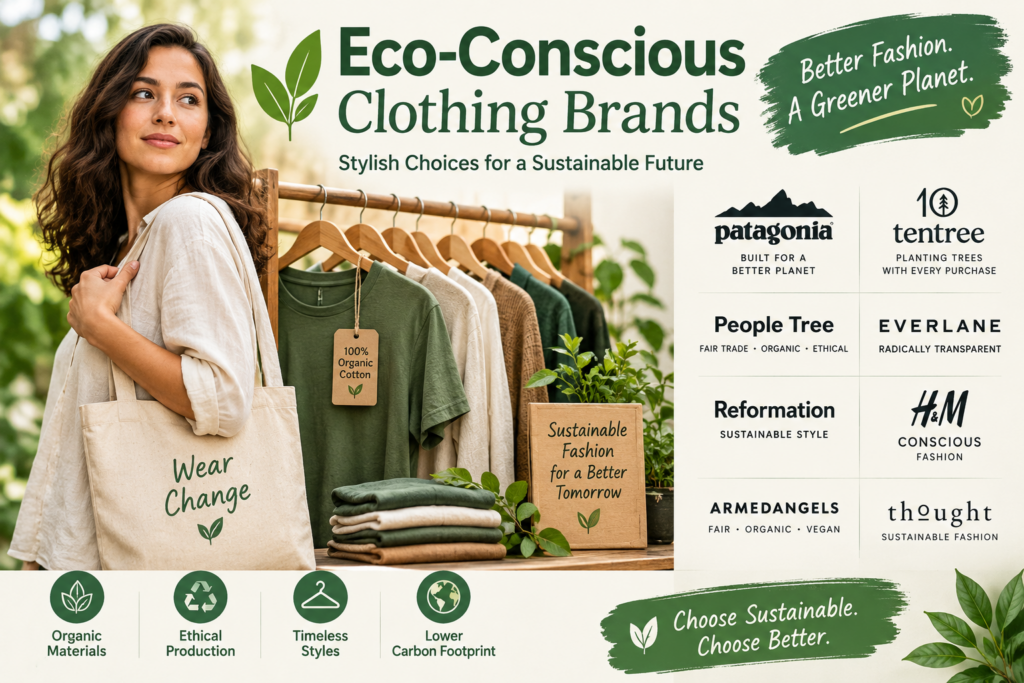
| Brand | Best For | Certifications / Standards* | Typical Price Range | Worldwide Shipping |
|---|---|---|---|---|
| Patagonia | Outdoor clothing and long-lasting basics | Fair Trade Certified™, recycled materials, responsible-material standards | $40–$300+ | Yes |
| Tentree | Affordable everyday clothing | B Corp, Climate Neutral Certified, organic/recycled materials | $25–$120 | Yes |
| Pact | Organic cotton basics | GOTS-certified organic cotton | $20–$100 | Limited / varies |
| Kotn | Everyday cotton essentials | GOTS-certified organic cotton on selected products | $25–$150 | Yes |
| Eileen Fisher | Premium minimalist clothing | Organic/recycled fibers, sustainability programs | $100–$500+ | Yes / varies |
| Outerknown | Casual and coastal-inspired clothing | Fair Labor Association, recycled/organic materials on selected products | $50–$250+ | Yes |
| Quince | Budget-conscious shoppers | Materials and supplier certifications vary by product | $30–$200 | Yes / selected markets |
| Reformation | Trend-focused sustainable fashion | Climate-focused reporting, recycled/organic materials on selected products | $80–$400+ | Yes |
| MATE the Label | Clean-looking everyday basics | GOTS, organic/recycled materials on selected products | $40–$180 | Yes |
| Thought | Natural-fiber clothing | GOTS and other product-specific certifications | $40–$180 | Varies |
*Certifications and standards can apply to specific products, facilities, or parts of a company’s operations rather than every item sold by the brand. Always check the individual product page before assuming an entire collection carries a certification.
What This Table Means for U.S. Shoppers
If you’re shopping from the United States, there isn’t one brand that is automatically the “greenest” choice for everyone. Your best option depends on what you actually need.
Want clothes that can take a beating? Patagonia is worth a look, particularly for outdoor wear and pieces designed for repeated use.
Looking for affordable basics? Pact and Tentree can be easier entry points for shoppers who want organic or recycled materials without moving straight into luxury pricing.
Prefer a minimalist wardrobe? Eileen Fisher is known for simple, timeless designs, although its prices are considerably higher than many mainstream brands.
Want trendier styles? Reformation may appeal more than traditional eco-focused brands, but shoppers should still examine the materials and sustainability information for individual garments rather than judging the entire brand from its reputation.
One important point: certification does not mean a garment has zero environmental impact. Even certified organic cotton requires land, water, processing, transportation, and energy. For most U.S. households, buying fewer unnecessary clothes and wearing the ones they already own longer can be just as meaningful as switching brands.
A Quick Note on “Eco-Friendly” Claims
U.S. shoppers should also be careful with broad environmental language. The Federal Trade Commission (FTC) has guidance for businesses making environmental marketing claims, including claims such as “green” and “eco-friendly.” A vague sustainability statement is not the same thing as independent certification or a clearly documented material claim.
That’s why this guide focuses on details that shoppers can actually investigate—such as GOTS certification, recycled content, organic fibers, labor standards, repair programs, and supply-chain information—instead of treating a green-looking label as proof of sustainability.
In other words, the smartest approach to Sustainable Fashion 2026 isn’t simply asking, “Is this brand sustainable?”
A more useful question is:
“What exactly is this garment made from, who made it, how long will I realistically wear it, and can the brand back up its claims?”
That small change in how you shop can make the comparison much more useful—and can also help you avoid paying extra for sustainability language that doesn’t tell you much.
Our Methodology: How We Evaluated & Scored These Brands
Choosing a sustainable clothing brand isn’t as simple as looking for a recycled-material badge or a “conscious” label. For this Sustainable Fashion 2026 guide, we looked at the details behind each brand’s claims and considered what those claims actually mean for shoppers in the United States.
Our scoring approach focuses on three areas that matter in real-world clothing purchases: what the garment is made from, how it is produced, and what happens to it after purchase.
We also considered publicly available information from brand websites, certification organizations, and relevant U.S. guidance. Where a certification applied only to certain products or materials, we treated it that way rather than assuming the entire brand was certified.
1. Material Authenticity: Organic, Recycled & Regenerative Fibers
Materials were one of our first checks.
We looked for meaningful use of organic cotton, recycled fibers, regenerative or responsibly sourced materials, linen, hemp, and other lower-impact textiles. We also paid attention to whether brands clearly identified the material composition of individual products.
For organic claims, certifications such as GOTS (Global Organic Textile Standard) can provide more useful third-party verification than a simple “organic” statement on a product page. GOTS also covers processing and manufacturing requirements, not just the origin of the fiber.
Recycled materials received similar scrutiny. A shirt made with recycled polyester may reduce reliance on virgin polyester, but that doesn’t automatically make the entire garment sustainable. We considered the broader picture, including fiber type, blends, durability, and the information a brand provides about its materials.
What we asked:
- Does the brand clearly disclose what its clothing is made from?
- Are organic or recycled claims supported by recognized standards?
- Does the company explain where its materials come from?
- Is there evidence of progress toward lower-impact or regenerative materials?
- Are sustainability claims specific rather than vague?
2. Labor Ethics & Supply Chain Transparency
A clothing item can use a preferred fiber and still have serious questions surrounding how it was produced.
That’s why our evaluation also looked at factory information, worker standards, sourcing policies, supplier relationships, and supply-chain transparency.
We gave more weight to brands that explain where their products are manufactured and what standards their suppliers are expected to follow. Programs or certifications involving independent organizations were also considered where relevant.
For U.S. consumers, this matters because “Made responsibly” or “ethical production” can mean very different things from one company to another. A detailed supplier policy is generally more useful than a broad statement about caring for workers.
What we looked for:
- Factory and supplier disclosures
- Labor and human-rights policies
- Fair-trade or similar third-party standards
- Independent audits or verification
- Clear information about manufacturing locations
- Transparency around the company’s supply chain
We did not assume that a brand was ethical simply because it used words such as fair, responsible, or ethical in its marketing.
3. Circularity Initiatives: Repair, Resale & Recycling
The most sustainable clothing item is often the one you already own.
With that in mind, we looked at what brands do to help customers keep clothing in use for longer. Repair services, resale platforms, take-back programs, recycling options, and guidance on garment care all received attention.
Repair is particularly interesting because it addresses a practical problem: people often replace clothing because something small has gone wrong. A brand that helps customers repair a jacket, replace a component, or resell an unwanted garment can potentially extend the useful life of that product.
We also considered whether take-back and recycling programs were clearly explained. A “recycle your clothes” message is less meaningful when a company doesn’t explain what happens after the item is returned.
Our questions included:
- Does the brand offer repairs?
- Is there an official resale or secondhand program?
- Can customers return unwanted clothing?
- Does the company explain how returned items are handled?
- Does it encourage customers to care for and wear garments longer?
How We Used Certifications
Certifications can be helpful, but we didn’t treat them as automatic proof that a brand is sustainable.
For example, GOTS, OEKO-TEX, USDA Organic, and Fair Trade address different parts of the textile and production process. A certification attached to one material or product should not be interpreted as certification of an entire company’s environmental performance.
We also considered U.S. consumer-protection principles when reviewing environmental marketing language. The Federal Trade Commission’s Green Guides are particularly relevant because they provide guidance around environmental claims made in marketing.
This distinction matters. “Made with organic cotton” is a specific material claim. “Good for the planet” is a much broader statement that requires considerably more context.
Our Scoring Philosophy
Rather than declaring one universal “most sustainable” brand, we used the information above to identify where each company performs particularly well—and where shoppers may want to look more closely.
A brand could score strongly for durable outdoor clothing but not be the best choice for affordable basics. Another might have impressive organic-material credentials but offer fewer circularity options.
That’s intentional.
For Sustainable Fashion 2026, our goal is not to tell every U.S. shopper to buy from the same company. It’s to make the comparison easier and help you decide which factors matter most for your budget, wardrobe, and shopping habits.
What We Didn’t Do?
We did not rank brands simply because they use green packaging, have attractive sustainability pages, or describe themselves as “eco-friendly.”
We also avoided treating a single certification, recycled material, carbon claim, or charitable initiative as proof that a company is sustainable across the board.
Our rule was simple: the more specific, transparent, and independently verifiable the information, the more weight we gave it.
That approach makes the rankings more useful for everyday U.S. shoppers—and hopefully a little easier to trust.
10 best Eco-Conscious Clothing Brands in 2026 (In-Depth Review)
There is no single clothing brand that can realistically be called “the most sustainable” for every shopper. A family buying everyday basics has different priorities from someone looking for technical outdoor gear, activewear, or a capsule wardrobe.
For this Sustainable Fashion 2026 review, we looked at the things that matter beyond a green-looking website: material choices, third-party certifications, supply-chain information, durability, repair or resale options, and how clearly each company explains its environmental and social commitments.
We also looked at the practical side for U.S. shoppers—price, product selection, sizing, and whether a brand’s sustainability efforts are actually useful after you buy the clothing.
1. Patagonia — Best Overall for Circular Fashion & Lifetime Repair
If circularity is your biggest priority, Patagonia is difficult to overlook. The company has built repair, reuse, and resale into its business rather than treating them as an afterthought.
Its Worn Wear program lets customers trade in eligible Patagonia clothing and gear for credit, while used products are resold. Patagonia also provides repair services and DIY repair resources. Its repair program says more than 583,000 items have been kept out of landfills through repairs.
The brand also has a substantial Fair Trade Certified™ program. Patagonia says more than 90% of its current line is made in Fair Trade Certified factories, although shoppers should still check the individual product.
Best for: Outdoor clothing, jackets, fleece, hiking gear, and shoppers who want to keep products in use for years.
Typical price: About $40–$300+, depending on the category.
The catch: Patagonia isn’t a budget brand. If you only need a basic T-shirt, there are cheaper options. Its sustainability advantage becomes more compelling when you’re buying something durable enough to use repeatedly.
Our take: The strongest choice on this list for shoppers who believe sustainability starts with buying well and keeping it longer.
2. Pact — Best for Certified Organic Cotton & Affordable Basics
Pact is particularly appealing if you’re trying to build a wardrobe around everyday basics rather than statement pieces.
The brand’s focus on organic cotton makes it relevant to shoppers who specifically want certified organic textiles. GOTS certification is especially useful here because it goes beyond simply saying that a fiber is organic and includes environmental and social criteria across textile processing.
Pact’s lineup includes underwear, T-shirts, leggings, sweatshirts, and other wardrobe staples.
Best for: Organic cotton basics, underwear, family essentials, and shoppers starting their sustainable wardrobe on a moderate budget.
Typical price: Roughly $20–$100.
The catch: Basics are where Pact makes the most sense. You won’t find the same technical outdoor range you’d get from Patagonia.
Our take: A practical starting point for U.S. families who want to replace frequently worn basics with organic-cotton alternatives without immediately moving into premium pricing.
3. tentree — Best for Outdoor Essentials & Direct Reforestation
tentree takes a slightly different approach. Alongside clothing, the company has made tree planting and ecosystem restoration a central part of its business model.
The company reports planting 10 trees for every item sold and says it has planted more than 110 million trees so far. It also publishes an impact report covering areas such as climate, products, nature, people, and transparency.
tentree also reports B Corp certification and publishes information about its certifications and sustainability commitments.
Best for: Casual outdoor clothing, hoodies, basics, and shoppers who like measurable restoration projects.
Typical price: Around $25–$120.
The catch: Tree planting should not be confused with eliminating a garment’s environmental footprint. The clothing itself still requires fibers, water, energy, manufacturing, and transportation.
Our take: tentree is interesting because it connects clothing purchases with restoration work, but shoppers should evaluate the garment and the environmental program separately.
4. MATE the Label — Best for Non-Toxic & Organic Loungewear
MATE the Label focuses heavily on organic and natural materials, clean-looking everyday clothing, and restricted-substance policies.
The company says it is GOTS certified through Control Union and that its products are made in GOTS-certified factories. It also lists factories in countries including India, Sri Lanka, Peru, and Turkey.
Its approach is particularly attractive if your idea of sustainable clothing is simple: fewer pieces, comfortable fabrics, and clothes you can wear repeatedly.
MATE emphasizes organic materials, non-toxic dyes, and seasonless designs intended for long-term use.
Best for: Loungewear, basics, organic cotton, and minimalist everyday wardrobes.
Typical price: About $40–$180.
The catch: The brand sits toward the premium side for basics, so you’ll pay more than you would at a conventional U.S. retailer.
Our take: A good match for shoppers who care about fiber choice, chemical management, and simple designs rather than chasing seasonal trends.
5. Outerknown — Best for Ocean-Conscious Fashion & Lifespan Denim
Outerknown has a strong connection to ocean culture, but its sustainability story goes beyond that branding.
The company says its 2030 roadmap aims to move toward fully circular products, with goals around regenerative and recycled materials, resale, repair, recycling, and supply-chain transparency. Its compliance program is accredited by the Fair Labor Association.
For shoppers, that makes Outerknown particularly interesting if you want casual clothing with a stronger emphasis on material sourcing and product longevity.
Best for: Denim, casual clothing, coastal style, and shoppers interested in circular-fashion programs.
Typical price: Approximately $50–$250+.
The catch: Many pieces are priced well above mainstream fast-fashion alternatives.
Our take: Outerknown is worth considering when you’re willing to spend more on fewer, better-made casual pieces.
6. Reformation — Best for Trend-Forward Style & Lower-Impact Fashion
Reformation is one of the easier brands for a fashion-conscious shopper to recognize. Its appeal is straightforward: you can shop current silhouettes and trend-driven styles without limiting yourself to traditional “eco” aesthetics.
The company publishes sustainability reports and tracks its environmental work over time. Its current sustainability reporting includes a 2025 report and previous years of reporting, which gives shoppers a longer record to examine rather than relying on a single campaign.
Best for: Dresses, contemporary women’s fashion, occasion wear, and shoppers who don’t want sustainable clothing to look overly basic.
Typical price: Roughly $80–$400+.
The catch: “More sustainable” does not mean impact-free. Trend-driven shopping can still encourage consumers to buy more clothes than they need.
Our take: Reformation makes the most sense when you’re replacing a specific item you genuinely need—not when sustainability becomes an excuse for buying more.
7. Kotn — Best for Direct Farm Sourcing & Egyptian Cotton
Kotn stands out for its focus on cotton traceability.
The company says it works directly with thousands of smallholder farmers in Egypt and traces its supply chain from the raw cotton onward. Its current farm information says it works directly with 5,127 smallholder farmers in Egypt.
Kotn also explains its Egyptian cotton sourcing in detail, including Giza 94 cotton used in parts of its knitwear and woven-top collections.
Best for: T-shirts, sweaters, everyday cotton clothing, and shoppers who care about knowing where their fiber comes from.
Typical price: About $25–$150.
The catch: Direct sourcing is valuable, but it doesn’t eliminate every environmental issue associated with cotton production, textile processing, or transportation.
Our take: Kotn is one of the more interesting options for shoppers who want traceability instead of vague “responsibly sourced” language.
8. Boody — Best for Bamboo-Based Essentials & Underwear
Boody is best known for soft everyday essentials, especially underwear, socks, T-shirts, and other basics made primarily with bamboo-derived viscose.
For shoppers, the appeal is less about fashion trends and more about comfortable essentials that can become regular parts of a wardrobe.
Best for: Underwear, socks, basics, and soft everyday layers.
Typical price: Approximately $15–$100.
The catch: Bamboo clothing deserves a little explanation. “Bamboo” does not mean the finished textile is simply natural bamboo fiber. Most bamboo rayon/viscose involves significant chemical processing. That’s why shoppers should look at the actual fiber and certification information, rather than assuming every bamboo garment has the same environmental profile.
Our take: A useful basics brand, but this is one category where consumers should read the fiber label carefully instead of treating the word “bamboo” as a sustainability shortcut.
9. Girlfriend Collective — Best for Size Inclusivity & Recycled Activewear
Girlfriend Collective combines two things that many shoppers actively look for: recycled-material activewear and broad sizing.
Its current U.S. site lists sizes ranging up to 6XL for several collections. The company also uses recycled materials in its performance fabrics and offers both a resale marketplace and a clothing reuse/recycling program.
The brand says some of its recycled fabrics are OEKO-TEX Standard 100 certified and that its products are made in certified factories.
Best for: Leggings, sports bras, activewear, inclusive sizing, and recycled performance fabrics.
Typical price: Around $30–$150.
The catch: Recycled synthetic fibers can still be associated with microfiber shedding, and recycling a garment at the end of its life doesn’t erase the environmental impacts of producing it.
Our take: One of the stronger choices on this list if you need activewear and want size inclusivity plus a circularity option.
10. Organic Basics — Best for Minimalist Wardrobe & Transparency
Organic Basics has traditionally focused on simple wardrobe staples rather than fast-changing seasonal fashion.
That makes the brand particularly relevant to people building a capsule-style wardrobe: fewer T-shirts, underwear, socks, base layers, and other pieces that can be worn repeatedly.
Its appeal is the philosophy as much as the individual garment. Instead of encouraging constant wardrobe turnover, minimalist brands can support a slower approach to consumption—provided the shopper actually wears the pieces frequently.
Best for: Minimalist wardrobes, underwear, basics, and everyday layering pieces.
Typical price: Roughly $20–$150.
The catch: “Organic” still isn’t the same thing as zero-impact clothing. Fiber production, dyeing, sewing, shipping, washing, and eventual disposal all matter.
Our take: A sensible option for shoppers who want to simplify their closet rather than constantly replace it.
Which of These Brands Is Actually Best for You?
The answer depends on what you’re trying to improve.
| If Your Priority Is… | Consider |
|---|---|
| Best overall circular approach | Patagonia |
| Organic cotton basics | Pact |
| Tree planting & restoration | tentree |
| Organic loungewear | MATE the Label |
| Circular casual fashion | Outerknown |
| Trend-forward clothing | Reformation |
| Cotton traceability | Kotn |
| Soft everyday essentials | Boody |
| Inclusive activewear | Girlfriend Collective |
| Minimalist basics | Organic Basics |
One Important Reality Check
There’s a temptation to turn sustainable fashion into a competition: Which brand is the greenest?
For U.S. shoppers, that’s probably the wrong question.
A $200 “sustainable” jacket that sits in your closet isn’t necessarily a better purchase than a $70 jacket you wear for five years. Likewise, replacing a perfectly good wardrobe simply because a new brand uses organic cotton can create unnecessary consumption.
The more useful strategy is to buy less, choose materials carefully, look for credible certifications, take care of your clothes, repair them when possible, and use resale or donation channels when you’re finished with them.
That’s ultimately what makes Sustainable Fashion 2026 practical rather than just another shopping trend.
Fabric Breakdown: Which Materials Are Truly Sustainable?
When you see a clothing label that says organic cotton, recycled polyester, bamboo, or TENCEL™, it is easy to assume one material is automatically better than the others.
Real life is a little more complicated.
Every fabric has trade-offs. Cotton requires land and water. Recycled synthetics can help reduce demand for virgin plastic but remain synthetic fibers. Bamboo can start with a fast-growing plant but usually goes through significant processing before it becomes a soft textile. And TENCEL™ Lyocell is made from wood pulp through a specialized process that recovers most of its solvent.
For shoppers researching Sustainable Fashion 2026, the better question isn’t “Which fabric is 100% sustainable?” There really isn’t one.
Instead, ask: What is the fiber, how was it produced, how long will the garment last, and what happens when I’m finished with it?
Organic Cotton vs. Recycled Synthetics vs. Bamboo Viscose vs. TENCEL™
| Material | Main Advantage | Main Concern | What U.S. Shoppers Should Check |
|---|---|---|---|
| Organic Cotton | Plant-based fiber; organic farming avoids prohibited synthetic pesticides and fertilizers | Still uses land and water; conventional processing can add environmental impacts | Look for credible certification such as GOTS or USDA Organic where applicable |
| Recycled Polyester | Uses recovered plastic material instead of only virgin polyester | Still synthetic and can contribute to microfiber shedding | Check recycled-content percentage and whether the claim is product-specific |
| Bamboo Viscose/Rayon | Bamboo is a rapidly growing plant feedstock | Converting bamboo into rayon/viscose involves chemical processing | Look for the legally accurate fiber name on the label |
| TENCEL™ Lyocell | Wood-based fiber made using a closed-loop process | Still requires wood pulp, processing, energy and transportation | Check whether the garment actually contains TENCEL™ fibers and the percentage |
1. Organic Cotton: A Strong Choice for Everyday Clothing
Organic cotton is one of the easiest materials for U.S. shoppers to understand, but it shouldn’t be treated as a magic word.
The key difference is how the cotton is grown and certified. For shoppers who want stronger verification, GOTS can be more informative than a brand simply describing a shirt as “organic.”
A certified organic cotton garment can still have environmental impacts from spinning, dyeing, finishing, sewing, shipping, and washing. The finished product also matters. A durable cotton shirt worn for several years can make more sense than repeatedly buying inexpensive organic-cotton pieces that quickly lose their shape.
Best for: T-shirts, underwear, bedding, children’s clothing, casual shirts, and everyday basics.
Look for: GOTS certification, clear fiber percentages, and information about where the cotton and garment were produced.
Bottom line: Organic cotton is a sensible choice, particularly when certification and garment durability are both strong.
2. Recycled Synthetics: Useful, But Not Impact-Free
Recycled polyester is usually made from previously used plastic materials, commonly PET bottles or recovered polyester textiles.
The advantage is straightforward: using recycled feedstock can reduce reliance on virgin polyester. But the word “recycled” doesn’t automatically mean “sustainable.”
The FTC’s Green Guides specifically recommend that recycled-content claims be clear about what percentage of a product is actually made from recycled material.
There’s another issue that matters particularly for activewear: synthetic fibers can shed tiny fibers during washing.
That doesn’t mean you should throw away every polyester garment you own. In fact, replacing usable clothing simply because it contains synthetic fibers can create another form of unnecessary consumption.
Instead, consider how often you’ll wear the item, how long it is likely to last, and whether the brand provides useful information about its recycled content and garment care.
Best for: Leggings, running clothes, swimsuits, fleece, jackets, and performance gear where stretch and moisture management matter.
Look for: Recycled-content percentages, recognized certifications where applicable, durable construction, and practical washing instructions.
Bottom line: Recycled synthetics can be a reasonable compromise for performance clothing—but recycled does not mean impact-free.
3. Bamboo Viscose: Don’t Let the Word “Bamboo” Do All the Selling
This is one area where U.S. shoppers should be especially careful.
Bamboo grows quickly, which sounds impressive on a clothing label. But most soft bamboo clothing sold in the United States is rayon or viscose made from bamboo-derived cellulose, rather than fabric made directly from the original bamboo plant.
The FTC has specifically addressed bamboo textiles. Under U.S. textile labeling guidance, products made from rayon or viscose using bamboo as the plant source should be described accordingly rather than simply marketed as bamboo fiber. The agency has also taken enforcement action over misleading bamboo environmental claims.
That’s an important distinction.
Bamboo as a crop and bamboo viscose as a textile are two different parts of the story. Turning plant cellulose into a soft regenerated fiber requires chemical processing.
So when you see a shirt advertised as a “bamboo eco-friendly” product, check the actual fiber label before making a judgment.
Best for: Soft underwear, sleepwear, T-shirts, and lightweight basics.
Look for: The legally accurate fiber name, processing information, and credible certifications.
Bottom line: Bamboo viscose can be comfortable and useful, but don’t assume the word bamboo automatically means low-impact clothing.
4. TENCEL™ Lyocell: One of the More Interesting Cellulosic Fibers
TENCEL™ is a branded fiber family from Lenzing, rather than a generic name for every type of lyocell.
TENCEL™ Lyocell is made from wood pulp sourced from what the company describes as responsibly managed forests. Its production uses a closed-loop process that recovers more than 99.8% of the solvent for reuse.
That production system is one reason TENCEL™ Lyocell gets attention in sustainable fashion.
It also has practical benefits. The fabric is soft, smooth, and commonly used in shirts, dresses, underwear, sleepwear, and other clothing where comfort and drape matter.
Still, shoppers shouldn’t turn it into another “perfect fabric.” The garment has to be manufactured, dyed, transported, washed, and eventually disposed of.
Best for: Dresses, shirts, underwear, sleepwear, and lightweight everyday clothing.
Look for: The actual fiber composition and whether the product uses TENCEL™ Lyocell rather than simply using generic “lyocell” language.
Bottom line: TENCEL™ Lyocell is a compelling option when you want a soft, wood-based regenerated fiber with a documented closed-loop production process.
So, Which Fabric Is the Most Sustainable?
There isn’t a universal winner.
If you want organic natural fiber, certified organic cotton is a strong starting point.
If you need high-performance activewear, recycled polyester can make practical sense.
If you’re considering bamboo clothing, read the fiber label carefully and don’t confuse the plant with the finished rayon or viscose textile.
If you want a soft regenerated fiber, TENCEL™ Lyocell is worth considering because of its documented production process.
But there’s one factor that often gets forgotten:
Durability Matters More Than the Label
Imagine two T-shirts.
One is made from a highly preferred fiber but stretches out after six months. The other uses a less fashionable fiber but stays comfortable for five years.
If you keep wearing the second shirt, its useful life can change the overall picture.
That’s why our approach to Sustainable Fashion 2026 doesn’t stop at fiber selection. Material + manufacturing + durability + care + years of use give you a much more realistic picture.
Microplastics & Environmental Impact in Activewear
Activewear deserves its own discussion because performance fabrics are frequently made from synthetic fibers such as polyester, nylon, and elastane.
These materials provide qualities that cotton often can’t match—stretch, quick drying, abrasion resistance, and moisture management. For running, cycling, hiking, gym workouts, or sports, those characteristics can be genuinely useful.
The trade-off is that synthetic textiles can shed microscopic fibers during washing.
That doesn’t mean every synthetic garment should be avoided. A better strategy is to wash performance clothing only when necessary, follow the care label, avoid unnecessarily harsh washing, and keep garments in use for as long as they remain functional.
For U.S. shoppers, this is also a good example of why environmental claims need context. The FTC warns against broad, unqualified claims such as “eco-friendly” because they can imply much wider environmental benefits than a company may actually be able to substantiate.
A Simple Activewear Buying Rule
Before buying another pair of leggings, ask yourself:
Will I actually wear these enough to justify another garment?
If the answer is yes, prioritize:
- Durable construction
- A good fit that you’ll actually use
- Recycled content where it makes sense
- Responsible washing and garment care
- Long-term use over constant replacement
That approach is much more realistic than trying to find a completely impact-free fabric.
The Bottom Line for U.S. Shoppers
The best fabric choice depends on the job the clothing needs to do.
Organic cotton is a strong everyday option when certification and durability are present. Recycled synthetics can make sense for performance clothing, but they’re still synthetic. Bamboo viscose requires more scrutiny than its marketing often suggests. And TENCEL™ Lyocell is an interesting choice for shoppers who want a soft regenerated fiber with a documented closed-loop manufacturing process.
Most importantly, don’t let a single word on a hangtag make the entire sustainability decision for you.
Check the fiber content, certification, construction, care requirements, expected lifespan, and brand transparency. Then buy what you’ll genuinely wear.
That’s a much more useful way to shop for sustainable clothing in 2026.
Greenwashing Red Flags: 5 Things to Check Before You Buy
Shopping for sustainable clothing in the U.S. can feel surprisingly confusing. One shirt says “eco-friendly.” Another says “consciously made.” A third promises recycled materials, ethical production, and a smaller carbon footprint.
But a green label is not automatically proof of a greener product.
For shoppers researching Sustainable Fashion 2026, the smartest move is to slow down and look at what a brand can actually show you. Is there a specific material claim? A recognized certification? A supplier list? A repair or resale program? Or is the page mostly made up of broad environmental language?
The five checks below can help you separate useful information from marketing fluff.
1. Watch Out for Vague “Eco-Friendly” Language
Words such as eco-friendly, green, clean, conscious, planet-friendly, responsible, and sustainable can sound reassuring—but they don’t tell you much by themselves.
The FTC’s Green Guides specifically caution against broad, unqualified environmental claims such as “green” or “eco-friendly.” The agency recommends that environmental benefits be specific and clearly substantiated.
For example, there’s a meaningful difference between:
“Made with 80% recycled polyester.”
and
“Better for the planet.”
The first gives you something concrete to investigate. The second leaves you guessing.
U.S. shopper tip: When you see a broad claim, look for the evidence behind it. If the brand doesn’t explain what the claim actually means, don’t give the wording more weight than it deserves.
2. Don’t Confuse a Certification With an Entirely Sustainable Brand
Certifications can be extremely useful—but they aren’t all measuring the same thing.
A certification might apply to:
- A particular fabric
- One product
- A manufacturing facility
- A specific environmental attribute
- Chemical or product safety
- Labor conditions
- The company’s overall business practices
That distinction is easy to miss when you’re shopping online.
Key Certifications to Know
| Certification / Standard | What It Can Tell You | What It Does Not Automatically Mean |
|---|---|---|
| GOTS | Organic textile processing and production requirements, including environmental and social criteria | Every product from the brand is organic or sustainable |
| B Corp | A company’s broader social and environmental performance is assessed through B Lab’s certification process | Every individual garment is environmentally superior |
| Fair Trade | Specific fair-trade requirements, depending on the applicable standard and certification | The entire garment has minimal environmental impact |
| OEKO-TEX® STANDARD 100 | Textile components have been tested for harmful substances | The garment is automatically low-carbon or organic |
This is why a good Sustainable Fashion 2026 buying decision shouldn’t stop when you see a certification logo.
Ask what exactly has been certified?
GOTS
The Global Organic Textile Standard (GOTS) is particularly relevant when you’re shopping for organic textiles. It addresses organic fibers and requirements throughout textile processing and manufacturing, rather than simply telling you that the original cotton was grown organically.
For shoppers, that’s a much more useful signal than a brand using the word “organic” without explaining the certification.
B Corp
B Corp is different.
It relates to the company, rather than acting as a certification that every shirt, pair of jeans, or jacket is environmentally superior.
That’s an important distinction. A B Corp can demonstrate that a business has been assessed against broader social and environmental standards, but you should still check the individual garment’s material and manufacturing information.
Fair Trade
Fair Trade standards can address economic and social conditions within particular supply chains. The exact meaning depends on the relevant Fairtrade standard and product.
For clothing, don’t assume that seeing the words “fair trade” means every part of the garment—from fiber production through final manufacturing—has been covered by the same certification.
OEKO-TEX® STANDARD 100
OEKO-TEX® STANDARD 100 has a different focus again.
It tests textiles and their components for harmful substances. OEKO-TEX describes it as a textile safety standard covering components from yarn through finished product.
That can be useful if you’re concerned about substances in clothing that comes into close contact with your skin.
But OEKO-TEX STANDARD 100 is not the same thing as organic certification or a complete sustainability certification.
That’s exactly why reading the certification’s purpose matters.
3. Look at the Actual Material Percentage
One of the easiest greenwashing traps is a sustainability claim that sounds bigger than the actual product.
A brand might advertise a jacket as “made with recycled materials,” but what percentage is recycled?
Is it:
- 100% recycled polyester?
- 50% recycled content?
- Recycled fabric only in one panel?
- Recycled packaging rather than the garment?
These are very different claims.
The FTC advises consumers to check whether recycled-content claims refer to the product or its packaging and whether the amount of recycled material is disclosed.
The same principle works for organic cotton.
A product described as “organic cotton” isn’t necessarily made entirely from organic cotton. Open the product details and check the actual fiber composition.
Simple rule: Don’t just read the headline. Read the fiber content.
4. Ask Where the Clothes Are Actually Made
A brand can have beautiful sustainability goals and still provide very little information about its supply chain.
That’s why manufacturing transparency matters.
Before buying, see whether the company tells you:
- Where the garment was made
- Where the fabric was produced
- Where fibers or raw materials come from
- Whether factories are independently audited
- What labor standards suppliers must follow
- Whether the brand publishes supplier or factory information
A company doesn’t need to disclose every supplier’s private business information to be transparent. But meaningful information should exist somewhere beyond a vague sentence saying “we work with responsible partners.”
For U.S. consumers, this is particularly useful when comparing two brands that appear equally “green” at first glance.
The brand providing specific information gives you something you can actually evaluate.
5. Be Skeptical of “Carbon Neutral,” “Zero Waste,” and “100% Sustainable”
Absolute environmental claims deserve extra attention.
A clothing company has many stages to consider: fiber production, spinning, dyeing, manufacturing, packaging, transportation, retail, washing, and end-of-life disposal.
So when a product is described as having “zero impact” or being “100% sustainable,” ask what the company actually measured.
The FTC says environmental marketing claims need competent and reliable evidence, and broad claims can mislead consumers when the underlying benefit is unclear or overstated.
Carbon claims deserve similar scrutiny. If a company relies heavily on offsets, look for information about what is being offset, how reductions are calculated, and whether the claim is about the product, company, or a particular activity.
The takeaway: A smaller, clearly explained environmental improvement is often more useful than a huge claim with little supporting information.
How to Verify a Brand’s Sustainability Claims
You don’t need to become a textile scientist to fact-check a clothing brand.
A five-minute check can reveal a lot.
Step 1: Open the Product Page
Don’t rely only on the homepage.
Look for:
- Fiber composition
- Country of manufacture
- Certification information
- Recycled-content percentage
- Care instructions
- Product-specific sustainability claims
The product page is often more informative than the brand’s sustainability slogan.
Step 2: Click the Certification
If a brand displays a certification logo, find out:
Who issued it?
What does it certify?
Does the certification apply to this exact product?
Is there a certificate number or verification system?
This matters because the FTC notes that environmental certifications and seals should clearly communicate their basis; certification alone doesn’t substantiate every environmental claim a company makes.
Step 3: Check the Brand’s Sustainability Report
Larger brands often publish sustainability or impact reports.
Don’t just look for impressive numbers. Look for:
- Reporting years
- Measurement methods
- Specific targets
- Progress against previous targets
- Areas where the company admits it still has work to do
A company willing to show both progress and shortcomings can give you a more realistic picture than one that only publishes success stories.
Step 4: Compare the Claim With the Actual Product
This is where many shoppers can catch exaggerated marketing.
If a brand says it uses recycled materials, check the percentage.
If it says “organic,” check the fiber composition and certification.
If it says “made responsibly,” look for manufacturing and labor information.
If it says “recyclable,” ask whether the garment can actually be recycled through a realistic program available to consumers.
The FTC specifically notes that recyclable claims may need qualification when appropriate recycling facilities aren’t available to a substantial majority of consumers.
A Simple Greenwashing Checklist for U.S. Shoppers
Before clicking “Add to Cart,” ask these seven questions:
☐ What is this garment actually made from?
☐ What percentage of the material has the claimed environmental attribute?
☐ Is there a credible third-party certification?
☐ What exactly does that certification cover?
☐ Does the brand explain where the garment was made?
☐ Can I find evidence behind the brand’s environmental claims?
☐ Will I wear this often enough to justify buying it?
That final question is easy to overlook.
A perfectly certified shirt that you wear twice isn’t necessarily a better purchase than a well-made shirt that becomes a five-year staple.
The Bottom Line
Greenwashing isn’t always an obvious lie. Sometimes it is simply a small positive attribute presented as if it represents the entire environmental story.
That’s why the best defense is not memorizing every sustainability term. It’s learning to ask better questions.
For U.S. shoppers following Sustainable Fashion 2026, start with the product itself: materials, certification, manufacturing, durability, and evidence.
If a brand can clearly explain those things, you’ve got something useful to work with.
If all you get is a green leaf, a recycled-looking logo, and the words “good for the planet,” keep digging.
Price vs. Longevity: Is Eco-Conscious Clothing Worth It?
A $25 T-shirt can look like the obvious bargain.
But what if you replace it three times in two years?
Meanwhile, a $75 shirt that stays in your rotation for several years may end up costing less per wear. This is where the conversation around Sustainable Fashion 2026 gets more practical. The price tag matters, but so does how often you actually use the garment.
Instead of asking only “How much does this cost?”, try asking:
“How much does each wear cost me?”
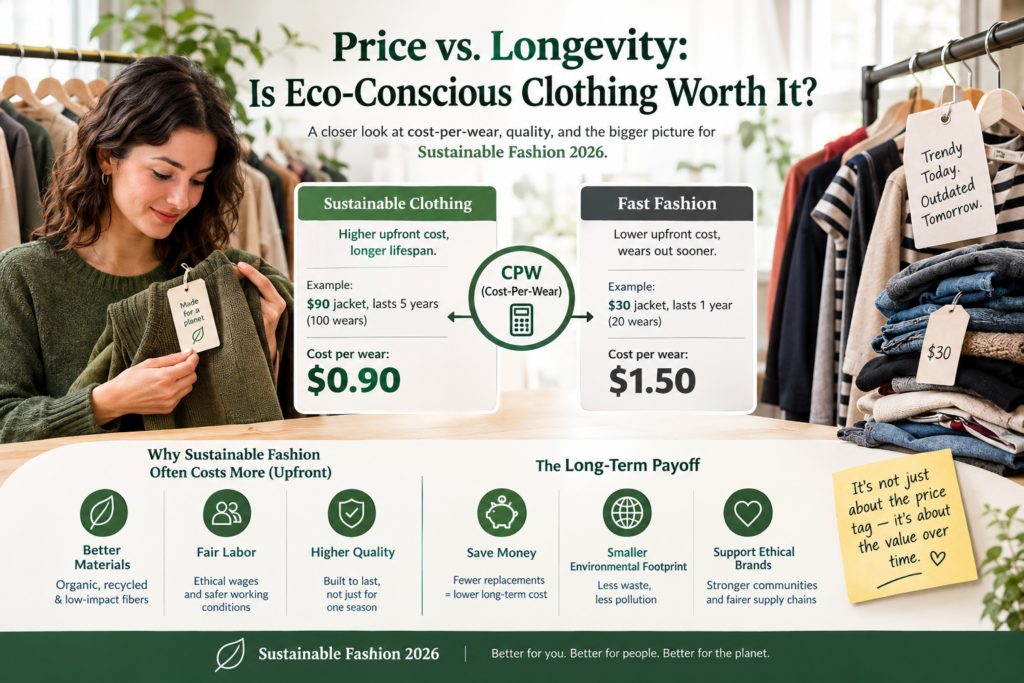
That’s the basic idea behind Cost-Per-Wear (CPW).
What Is Cost-Per-Wear?
The calculation is simple:
Cost-Per-Wear = Purchase Price ÷ Number of Times You Wear It
For example:
- $30 T-shirt worn 10 times = $3 per wear
- $60 T-shirt worn 40 times = $1.50 per wear
- $100 jacket worn 100 times = $1 per wear
The more you wear something, the lower its cost per wear becomes.
Of course, CPW doesn’t measure the full environmental impact of a garment. It is simply a useful way to think about value and longevity. A $20 item that you rarely wear may be worse value than a $90 piece that becomes your everyday favorite.
Cost-Per-Wear: Eco-Conscious Clothing vs. Fast Fashion
Let’s look at a realistic U.S. shopping example.
| Clothing Item | Purchase Price | Estimated Wears | Cost Per Wear |
|---|---|---|---|
| Fast-fashion T-shirt | $20 | 10 | $2.00 |
| Better-quality T-shirt | $50 | 40 | $1.25 |
| Premium durable T-shirt | $80 | 80 | $1.00 |
| Fast-fashion jacket | $60 | 15 | $4.00 |
| Durable jacket | $180 | 100 | $1.80 |
These aren’t guarantees. They’re simple examples showing how longevity can change the economics of a purchase.
A more expensive garment doesn’t automatically win.
If you spend $80 on a “sustainable” sweater and wear it twice, that’s $40 per wear. If you buy a $35 sweater and wear it 50 times, that’s only 70 cents per wear.
So the real goal isn’t to buy the most expensive eco-conscious product.
It’s to buy something you’ll actually wear.
Why Durability Matters in Sustainable Fashion
Durability is easy to overlook because it’s difficult to market.
A brand can put “organic cotton” on a product page. It can advertise recycled fibers. It can highlight a sustainability certification.
But none of those things tell you exactly how long you’ll keep wearing the garment.
Before buying, look at practical details such as:
- Fabric weight and construction
- Stitching around high-stress areas
- Zippers, buttons, and seams
- Whether the fabric feels suitable for repeated washing
- Care requirements
- Repair availability
- Warranty or guarantee policies
- Customer reviews mentioning shrinkage, pilling, stretching, or fading
For a U.S. shopper, these details can be more useful than a long sustainability statement.
A $70 pair of jeans that still fits well after years of regular wear may provide considerably more value than several $30 pairs that quickly lose their shape.
Fast Fashion Isn’t Always the Cheapest Option
Fast fashion often wins on the initial price.
That’s its biggest attraction.
You can find a T-shirt for $10–$20, a dress for $30, or a jacket for $50. For families working with a tight clothing budget, those prices can matter.
But purchase price isn’t the entire equation.
Suppose you buy a $20 shirt and replace it every year for five years. You’ve spent $100.
A $70 shirt that you wear comfortably for those same five years costs $14 per year.
That doesn’t prove the $70 shirt is environmentally better in every situation. It simply shows why longevity deserves a place alongside price when you’re comparing clothing.
When Paying More Actually Makes Sense
Spending more can be worthwhile when the higher price comes with something you’ll use.
Consider paying more when:
You wear the item frequently.
A jacket you use every week deserves more attention than an occasional party outfit.
The construction is noticeably better.
Strong seams, quality hardware, and durable fabric can make a difference over time.
The brand offers repair or resale options.
Repair services can help keep clothing in use instead of replacing it after minor damage.
The style isn’t likely to become irrelevant quickly.
Classic pieces tend to have more opportunities for repeated wear.
The fit is excellent.
The most sustainable garment is not useful if it stays at the back of your closet because you don’t like wearing it.
When Paying More Doesn’t Make Sense
“Eco-conscious” doesn’t automatically justify a premium price.
Think twice if:
- You’re buying mainly because the item is labeled sustainable.
- You already own several similar pieces.
- The garment requires special care you’ll probably avoid.
- The product doesn’t fit properly.
- The design is so trend-driven that you may stop wearing it quickly.
- The brand provides little evidence for its sustainability claims.
- The higher price doesn’t appear to provide better durability or functionality.
This is where greenwashing and overconsumption can overlap.
Buying five new “sustainable” outfits you don’t need isn’t necessarily a better strategy than keeping the clothes you already own.
A Simple U.S. Shopper’s Cost-Per-Wear Test
Before spending $100, try this quick calculation.
Ask yourself three questions:
1. How often will I realistically wear it?
Be honest.
Not “How often could I wear it?”
Ask: “How often did I actually wear similar clothes last year?”
2. How long do I expect to keep it?
If you expect to wear a $100 jacket 50 times, that’s $2 per wear.
If you think you’ll wear it 100 times, it’s $1 per wear.
3. Does the quality support that expectation?
Check the construction, fabric, care requirements, and repair options.
If the garment looks unlikely to survive your normal routine, the CPW estimate may be overly optimistic.
Cost-Per-Wear Example: A $100 Jacket
Imagine you’re choosing between two jackets.
Option A: $50 jacket
You expect to wear it 15 times before replacing it.
$50 ÷ 15 = $3.33 per wear
Option B: $150 durable jacket
You expect to wear it 100 times.
$150 ÷ 100 = $1.50 per wear
The second jacket costs three times more upfront, but the estimated cost per wear is less than half.
That’s why a sustainable shopping decision should consider useful life, not just the number on the price tag.
Don’t Forget the Cost of Care
There is another part of the equation that CPW doesn’t always capture: maintenance.
A garment that needs frequent dry cleaning can cost more to own than one that can be washed at home.
Look at the care label before buying.
For everyday clothing, consider:
- Machine washing vs. dry cleaning
- Cold-water washing
- Air drying vs. machine drying
- Special detergents
- Repairs
- Replacement buttons or hardware
Lower-maintenance clothing can be easier to keep in rotation, especially for busy American families.
And if a garment can be safely washed and dried according to its care instructions without complicated maintenance, that’s a practical advantage.
The Environmental Side of “Buy Better, Buy Less”
Cost-per-wear is a financial calculation, not an environmental measurement.
Still, it connects to an important idea in sustainable fashion: extending the useful life of clothing.
Every new garment requires resources to produce, process, package, transport, and eventually dispose of. Wearing an existing garment longer can avoid the need to purchase a replacement immediately.
That’s why sustainable shopping isn’t simply about finding the “greenest” brand.
Sometimes the best purchase is nothing at all.
If your current jeans still fit, your jacket still works, and your favorite sweater hasn’t fallen apart, continuing to use them may be the most practical choice.
Our Take: Is Eco-Conscious Clothing Worth the Extra Cost?
Sometimes—but not automatically.
A higher-priced garment can be a smart purchase when it offers better construction, useful features, repairability, and a realistic lifespan that matches how you dress.
But paying $150 for a shirt just because it carries a sustainability message isn’t automatically good value.
For U.S. shoppers navigating Sustainable Fashion 2026, a better formula is:
Price + Durability + Frequency of Use + Care Cost + Repairability = Real Value
If a piece checks those boxes and you genuinely need it, paying more can make sense.
If you’re buying it because the label says “eco-friendly,” pause.
The most sustainable bargain may simply be the garment you already own—and actually wear.
Frequently Asked Questions (FAQs)
What are the best non-toxic clothing brands?
For shoppers trying to reduce exposure to certain chemicals in clothing, look for brands that use certified organic fibers and credible textile-safety standards, rather than relying on the phrase “non-toxic” alone.
Brands worth researching include MATE the Label, Pact, Q for Quinn, and selected products from other organic-focused brands. Look for certifications such as GOTS and OEKO-TEX® STANDARD 100, depending on what you’re trying to verify.
OEKO-TEX® STANDARD 100 focuses on testing textile components for harmful substances, while OEKO-TEX® ORGANIC COTTON provides additional verification for organic cotton.
Quick tip: “Organic” and “non-toxic” aren’t interchangeable. Check the actual fiber composition, certification, dyes or finishes where disclosed, and the product’s intended skin contact.
Is lululemon ethical?
lululemon has made significant efforts around supply-chain standards, but it would be difficult to describe the entire brand as completely ethical.
The company says its suppliers must follow its Vendor Code of Ethics, which covers labor rights, workplace safety, forced labor, child labor, and human trafficking. It also conducts assessments of Tier 1 and Tier 2 supplier facilities and works with third-party assessors, including the Fair Labor Association.
Its 2025 Modern Slavery Statement also describes a responsible-supply-chain program and human-rights due diligence.
However, independent assessments can identify areas where the company still has room to improve. Good On You currently rates lululemon “It’s a Start” overall and highlights concerns including living-wage evidence and supply-chain issues.
Bottom line: lululemon has real supply-chain policies and oversight, but shoppers who prioritize strong labor and environmental performance should look beyond the brand’s own sustainability claims.
What are some ethical alternative clothing brands?
If you’re looking for alternatives to conventional fast fashion, consider brands based on the specific thing you care about.
- Patagonia — outdoor clothing, repair and resale
- Pact — organic cotton basics
- MATE the Label — organic everyday clothing
- tentree — casual clothing and environmental restoration
- Kotn — cotton traceability and everyday basics
- Girlfriend Collective — recycled activewear and inclusive sizing
- Outerknown — casual clothing and circularity initiatives
- Reformation — trend-focused clothing with sustainability reporting
There are also smaller U.S. brands worth exploring. Current 2026 ethical-fashion directories include brands such as Subset, Christy Dawn, KENT, and Outerknown, with evaluations based on factors including workers, environmental impact, and animal welfare.
Best approach: Don’t choose a brand simply because it appears on an “ethical” list. Compare its materials, certifications, factory information, durability, repair options, and transparency.
Is Zara ethical now?
Not completely. Zara’s parent company, Inditex, has made measurable progress, but that doesn’t make Zara a fully ethical or sustainable fashion brand.
Inditex’s latest reporting says 88% of the fibers used in its products came from materials classified as having a lower environmental impact, including recycled fibers and fibers from organic or regenerative farming methods. It also reports that Zara Pre-Owned circularity services operate in 17 markets.
Those are meaningful developments, but they don’t answer every question about fast-fashion production, worker conditions, garment longevity, overproduction, or overall consumption.
For a U.S. shopper, the better question is not simply “Is Zara sustainable now?” It’s “Is this particular Zara item something I will wear frequently and keep for a long time?”
Bottom line: Zara has introduced more sustainability and circularity measures, but shoppers shouldn’t interpret those changes as proof that fast fashion has become fully ethical.
What is the most eco-friendly clothing company?
There isn’t one universally “most eco-friendly” clothing company.
Patagonia is one of the strongest all-around choices for shoppers who prioritize durability, repair, resale, and environmental responsibility. Other brands may be better depending on your priority—for example, Pact for organic basics, Kotn for cotton traceability, or Girlfriend Collective for recycled activewear.
The important distinction is that no clothing company has zero environmental impact. Even organic or recycled garments require raw materials, manufacturing, transportation, washing, and eventually end-of-life handling.
For Sustainable Fashion 2026, a better strategy is to choose the company that performs well on the factors that matter most to you—and then buy fewer pieces that you’ll actually use.
What are the healthiest clothes to wear?
For everyday clothing, there isn’t one fabric that can be labeled the “healthiest” for everyone.
If your priority is reducing exposure to certain substances, consider certified organic cotton and textiles tested under recognized safety standards such as OEKO-TEX® STANDARD 100. OEKO-TEX’s testing requirements vary according to how closely a textile comes into contact with the body, with stricter requirements for products such as baby clothing and direct-skin-contact textiles.
For everyday wear, practical choices can include:
- Certified organic cotton
- Linen
- Hemp
- Wool from responsible sources, if you tolerate animal fibers
- TENCEL™ Lyocell or other well-documented regenerated fibers
- OEKO-TEX®-tested textiles when chemical-safety testing is a priority
But remember: “natural” does not automatically mean safer, and “synthetic” does not automatically mean harmful.
Dyes, finishes, coatings, processing chemicals, and how a garment is manufactured can all matter. If you have a specific allergy or skin sensitivity, check the garment’s materials and finishes carefully and follow advice from an appropriate healthcare professional.
What should I look for when buying sustainable clothing in the U.S.?
Start with five things:
1. Check the fiber composition.
Don’t rely on the front-of-package sustainability message.
2. Look for relevant certifications.
GOTS, OEKO-TEX®, Fair Trade, and other standards address different issues, so understand what each one actually verifies.
3. Investigate the brand’s supply chain.
Look for factory information, labor policies, and meaningful reporting.
4. Think about longevity.
A garment you’ll wear 100 times can make more sense than one you’ll wear twice—even if the second garment has a better-sounding sustainability label.
5. Be skeptical of vague environmental claims.
The FTC’s Green Guides are particularly relevant to U.S. environmental marketing claims. A specific, verifiable claim is much more useful than simply calling a product “green” or “eco-friendly.”
Ultimately, the smartest approach to Sustainable Fashion 2026 is not finding a perfect brand. It’s learning how to recognize credible information, buy intentionally, and keep your clothes in use for as long as possible.
Recommended External Resources
- Federal Trade Commission (FTC) — Green Guides
The FTC Green Guides explain how environmental marketing claims should be presented and substantiated. This is especially useful when evaluating broad claims such as “eco-friendly,” “green,” recycled content, and environmental certifications.
FTC — Green Guides - U.S. Department of Agriculture (USDA) — Organic Textiles
The USDA explains how organic claims apply to textiles in the United States, including when specific fibers can be identified as organic and how GOTS-certified textiles may be sold as organic in the U.S.
USDA — Organic Textiles - Global Organic Textile Standard (GOTS)
GOTS is a widely recognized textile standard that can help shoppers understand organic fiber and processing requirements. Consumers should still check whether the specific product or supply chain is covered by the certification.
Global Organic Textile Standard (GOTS) - Fair Trade USA — Standards & Requirements
Fair Trade USA provides information about the social, environmental, and economic requirements that certified products, producers, and businesses must meet. Its factory production standards are particularly relevant when evaluating apparel and home goods.
Fair Trade USA — Standards & Requirements - Federal Trade Commission — Clothing and Textiles
The FTC provides U.S. guidance on clothing labels, fiber-content claims, care labels, bamboo textile claims, and environmental marketing practices. This can help shoppers better understand the information provided on clothing products.
FTC — Clothing and Textiles
Final Verdict: Making Practical Choices in 2026
Navigating sustainable fashion in 2026 does not require ideological perfection or discarding your current wardrobe. It comes down to making practical, informed purchasing choices when you genuinely need new clothing.
Instead of searching for a single “flawless” eco-brand, focus on matching a company’s specific strengths to your everyday wardrobe needs:
For technical durability and lifetime repairs: Start with Patagonia.
For certified organic everyday basics: Look at Pact or Kotn.
For size-inclusive activewear with recycled materials: Explore Girlfriend Collective.
For transparent, non-toxic loungewear: Compare MATE the Label.
The most effective step any shopper can take isn’t simply changing where they shop—it’s buying thoughtfully, verifying material certifications, caring for garments properly, and wearing every item as long as possible.
When researching Sustainable Fashion 2026, it is easy to rely on a brand’s own sustainability claims. A better approach is to compare those claims with independent standards, certification requirements, and U.S. consumer-protection guidance. The FTC, USDA, GOTS, and Fair Trade USA resources above provide a useful starting point for checking what terms and certifications actually mean.