
Sustainable Fashion 2026:A Practical Guide for US Shoppers
Sustainable Fashion 2026 is moving beyond simple labels like “eco-friendly” or “green.” For U.S. shoppers, the bigger shift is toward clothing that lasts longer, uses more responsibly sourced materials, provides clearer product information, and makes environmental claims that can actually be explained or supported.
In practical terms, sustainable fashion in 2026 means looking at the whole life of a garment—from the fiber and manufacturing process to how long the item lasts, how often it is worn, and what happens when it is no longer wanted. Buying fewer, better-made pieces, choosing secondhand clothing, repairing damaged garments, and checking credible certifications can often be more meaningful than relying on a marketing slogan.
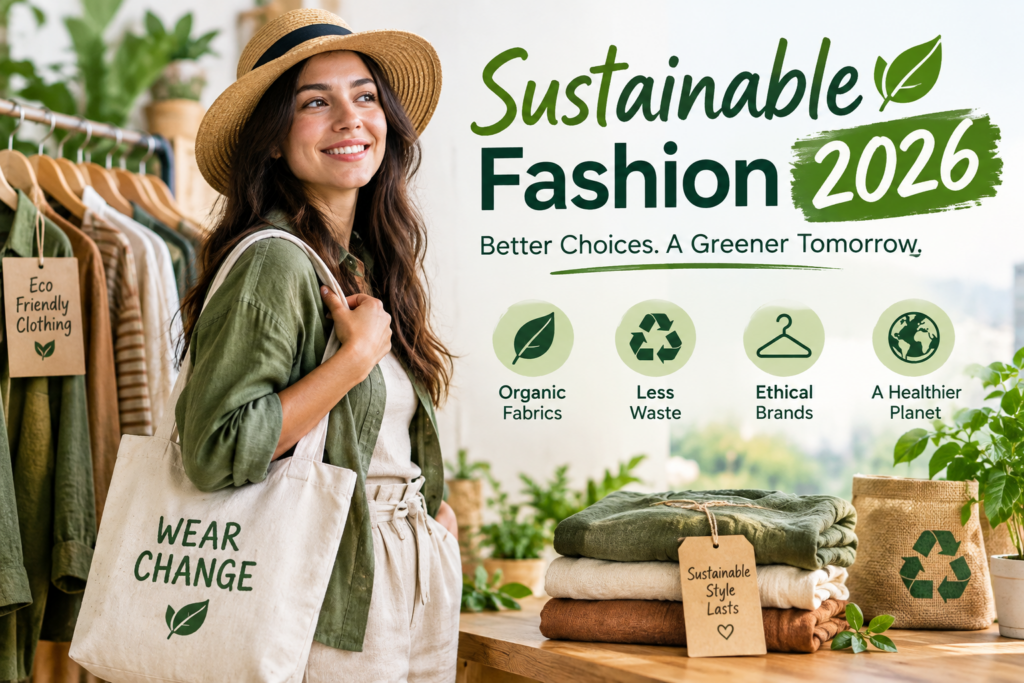 Practical sustainable fashion choices for a more conscious wardrobe in 2026.
For American consumers, transparency is becoming especially important. The Federal Trade Commission (FTC) Green Guides caution businesses against broad, unqualified environmental claims such as “eco-friendly” when those claims cannot be adequately substantiated. The FTC also provides guidance on claims involving recycled content, recyclable products, certifications, and other environmental attributes.
Organic labeling is another area where shoppers should pay attention to the exact wording. The USDA explains that textiles meeting the Global Organic Textile Standard (GOTS) may be sold as organic in the United States, while a finished textile generally cannot claim to be USDA Organic or display the USDA Organic seal unless it is certified under USDA organic regulations.
What is changing in Sustainable Fashion 2026?
- Durability is getting more attention: A $100 jacket that lasts for years can make more sense than repeatedly replacing cheaper garments.
- Secondhand fashion is becoming part of everyday shopping: Thrift stores, resale platforms, vintage stores, and clothing swaps give consumers more ways to extend the useful life of clothing.
- Material transparency matters: Shoppers are increasingly looking beyond a “sustainable” label and checking whether a product uses organic cotton, recycled fibers, wool, linen, or other materials—and what the certification actually covers.
- Certifications are more useful than vague claims: Standards and third-party certifications can provide more information than an unsupported “green” badge.
- Repair and reuse are practical sustainability strategies: Keeping a favorite pair of jeans or jacket in use longer can reduce the need to purchase a replacement.
- Greenwashing is receiving more scrutiny: U.S. consumers should be cautious about broad environmental claims that do not clearly explain what makes the garment environmentally preferable.
There is also a real waste problem behind the conversation. The U.S. Environmental Protection Agency estimates that 17 million tons of textiles entered the municipal solid waste stream in 2018, with 11.3 million tons going to landfills. That makes clothing longevity, reuse, and responsible end-of-life options important parts of the sustainable-fashion conversation.
The simplest takeaway: In 2026, sustainable fashion is less about finding a “perfect” green product and more about making better-informed choices—buying what you will actually wear, choosing quality over unnecessary replacements, looking for credible certifications, and questioning environmental claims that sound too good to be true.
Fast Fashion vs. Sustainable Fashion: The Real Environmental Impact
The difference between fast fashion and sustainable fashion in 2026 is not simply about choosing “cheap” clothing over “expensive” clothing. The bigger issue is how clothes are designed, produced, purchased, worn, and eventually discarded.
Fast fashion makes it easy to buy a new outfit for $20, follow a trend for a few weeks, and replace it when the next style appears. Sustainable fashion takes a different approach: buy fewer pieces, use them longer, consider the materials and manufacturing behind them, and avoid treating clothing as disposable.
For U.S. shoppers, that distinction matters because the environmental impact of clothing does not end at the checkout counter.
Fast Fashion vs. Sustainable Fashion at a Glance
| Factor | Fast Fashion | Sustainable Fashion |
|---|---|---|
| Shopping model | Frequent purchases and rapid trends | More intentional, longer-term purchases |
| Garment lifespan | Often designed around changing trends | Focus on durability and extended use |
| Materials | May prioritize low-cost synthetic or conventional fibers | May use recycled, organic, certified, or lower-impact materials |
| Consumer behavior | Buy more, replace sooner | Buy less, reuse, repair, resell, or donate |
| Environmental claims | Can rely heavily on marketing language | Better claims should explain specific attributes and supporting standards |
| End of life | More likely to become waste when unwanted | Greater emphasis on reuse, resale, repair, and appropriate recycling |
| Best question for shoppers | “How cheap is it?” | “How long will I actually use it?” |
Why Fast Fashion Has a Bigger Environmental Footprint
Fast fashion’s biggest problem is the volume and speed of consumption.
When clothing is produced quickly to respond to short-lived trends, the system encourages consumers to buy more frequently. A low price can make replacing a shirt, dress, or pair of jeans feel easier than repairing or keeping an older item.
There is also an important distinction between a garment being inexpensive and being environmentally inexpensive. A $15 shirt may be affordable at the register, but its environmental footprint can involve fiber production, dyeing, processing, manufacturing, packaging, transportation, washing, and eventual disposal.
The U.S. Environmental Protection Agency has separately tracked textiles within the municipal solid waste stream, illustrating why clothing disposal is an important part of the American waste conversation.
Is Sustainable Fashion Actually Better?
Usually, the answer depends on what you are comparing.
A sustainable-fashion label by itself does not automatically make one garment better than another. A piece made with recycled material may have a different environmental profile from a durable secondhand garment. Likewise, buying a new “eco-friendly” jacket every season is not necessarily a better strategy than keeping a well-made jacket for several years.
That is why Sustainable Fashion 2026 should be viewed as a broader consumer approach rather than a single material, brand, or certification.
A useful rule for American shoppers is simple:
The most sustainable clothing purchase is often the one you will wear regularly and keep in use for a long time.
Buying secondhand, repairing a damaged garment, choosing versatile pieces, and avoiding unnecessary purchases can sometimes have a bigger practical impact than simply switching from one new clothing label to another.
The U.S. Greenwashing Problem
This is where shoppers need to slow down and read the label.
The Federal Trade Commission (FTC) says marketers should not make broad, unqualified environmental claims such as “green” or “eco-friendly” when those claims cannot be substantiated. The FTC’s Green Guides also address claims involving recycled content, recyclable products, renewable materials, certifications, and other environmental attributes.
For example, there is a meaningful difference between:
- “Eco-friendly jacket”
- “Jacket made with 50% recycled polyester”
- “Made with GOTS-certified organic fibers”
The second and third statements give consumers more specific information that can be investigated.
That does not mean a certified or recycled product has zero environmental impact. It simply gives the shopper a clearer basis for evaluating the claim.
What About Organic Cotton?
“Organic” is another term worth checking carefully.
The USDA explains that textile products meeting the Global Organic Textile Standard (GOTS) may be sold as organic in the United States. However, a finished textile cannot claim or imply that it is USDA Organic, or use the USDA Organic seal, unless the finished product is certified under USDA organic regulations.
So, when shopping online, don’t stop at the word organic. Look for information about what is actually certified and by whom.
What Should U.S. Consumers Look for in 2026?
Instead of asking whether a brand is simply “sustainable,” consider these questions:
1. Is the clothing made to last?
Check stitching, fabric weight, seams, zippers, and whether the design is something you can realistically wear for several years.
2. Can you verify the material claim?
Look for specific information such as recycled content percentages or recognized certifications rather than vague environmental language.
3. Will you actually wear it?
A sustainable material does not solve the problem of buying something that sits unused in your closet.
4. Can it be repaired?
Replaceable buttons, strong seams, and repairable construction can extend a garment’s useful life.
5. Is secondhand an option?
Thrift stores, resale platforms, consignment shops, and clothing swaps can keep existing garments in circulation without requiring a new item to be manufactured.
6. What happens when you are finished with it?
Check whether the brand, local organization, or community program provides a realistic reuse or recycling option. Don’t assume every textile labeled “recyclable” can simply go into a household recycling bin.
Fast Fashion Isn’t Automatically “Bad,” and Sustainable Fashion Isn’t Automatically “Perfect”
This is an important distinction.
A realistic sustainability discussion should avoid presenting fashion as a simple good-versus-bad choice. Consumers have different budgets, body types, work requirements, family needs, and access to secondhand stores or repair services.
For a family trying to manage a tight monthly budget, buying a $25 pair of jeans that lasts for years may be more practical than spending $100 on a garment marketed as sustainable.
The better goal is informed consumption.
Look at durability. Check the material. Understand the certification. Question exaggerated claims. Consider secondhand. And most importantly, think about how often the item will actually be worn.
The Bottom Line
Fast fashion is built around speed, low prices, frequent newness, and high purchase volume. Sustainable fashion puts more emphasis on durability, responsible materials, transparency, reuse, repair, and longer product life.
For American consumers in 2026, the smartest approach is not to chase a perfect “green” wardrobe. It is to become a more careful shopper.
Before buying another $30 outfit, ask yourself one simple question:
“Will I still want to wear this a year from now?”
If the answer is yes, the purchase may make more sense. If the answer is probably not, leaving it on the rack could be the more sustainable decision.
What Is Sustainable Fashion 2026?
Sustainable Fashion 2026 refers to a more responsible way of designing, making, buying, wearing, and eventually disposing of clothing. Instead of focusing only on whether a shirt, pair of jeans, or jacket is marketed as “eco-friendly,” it looks at the product’s materials, durability, manufacturing practices, environmental claims, and useful life.
For U.S. consumers, sustainable fashion is increasingly about making better-informed clothing choices rather than trying to build a perfectly sustainable closet.
That can mean buying fewer pieces, choosing clothing that can handle regular wear, shopping secondhand, repairing damaged items, looking for credible certifications, and questioning vague environmental claims.
What Makes Fashion More Sustainable?
There is no single material or label that automatically makes a garment sustainable. A more useful way to evaluate clothing is to consider several factors together:
- Materials: Does the garment use recycled, organic, renewable, or otherwise responsibly sourced fibers?
- Durability: Is it well made enough to remain useful for years rather than a few wears?
- Production: Can the brand provide meaningful information about how and where the garment is made?
- Certifications: Is a relevant environmental or social claim backed by a recognized standard or certification?
- Consumer use: Will you actually wear the item regularly?
- End of life: Can it be repaired, reused, resold, donated, or appropriately recycled?
This whole-life perspective is important. A garment is not automatically a better environmental choice simply because its product page contains the word sustainable.
What Does Sustainable Fashion Mean for U.S. Shoppers?
For an American shopper, the practical meaning can be surprisingly simple.
Imagine you need a winter coat. You could buy a $40 coat because it is trending online, wear it a handful of times, and replace it next season. Or you could spend more on a durable coat that fits your needs, maintain it properly, and wear it for several winters.
The second choice may make more sense from a sustainability perspective—not because a higher price automatically means a better product, but because keeping useful clothing in service longer can reduce the need for frequent replacement.
The same principle applies to families shopping for children’s clothes, workwear, activewear, denim, and everyday basics.
Sustainable Fashion Is Not the Same as “Eco-Friendly”
This distinction matters when reading clothing advertisements.
The U.S. Federal Trade Commission (FTC) warns businesses about broad environmental marketing claims. Its Green Guides address claims such as “green” and “eco-friendly,” along with specific claims involving recycled content, recyclable products, renewable materials, certifications, and other environmental attributes.
So instead of taking a statement such as:
“Made with sustainable materials.”
at face value, a shopper can ask:
Which material? How much of it? What standard supports the claim? Who certified it?
That small change in thinking can make online clothing shopping much easier to evaluate.
Are Certifications Important?
They can be useful, particularly when a claim is difficult for an ordinary shopper to verify independently.
For example, GOTS (Global Organic Textile Standard) provides criteria covering organic fibers and processing throughout the textile supply chain. U.S. consumers may also encounter USDA organic terminology, but these labels should not be treated as interchangeable.
The USDA explains that textile products meeting GOTS requirements can be sold as organic in the United States, while finished textile products generally cannot claim to be USDA Organic or use the USDA Organic seal unless they meet applicable USDA organic requirements.
The lesson is straightforward: read the certification claim carefully instead of assuming every “organic” or “sustainable” label means the same thing.
What About B Corp Certification?
U.S. shoppers may also come across B Corp when researching fashion brands.
B Corp certification is different from a fiber or textile certification. It evaluates a company’s broader social and environmental performance, governance, and accountability rather than simply certifying that a particular shirt is made from an environmentally preferable material.
That means a B Corp logo can be useful information about the company, but it should not automatically be interpreted as proof that every individual garment from that company has the same environmental characteristics.
Does Buying Sustainable Fashion Mean Spending More?
Not necessarily.
One of the most practical parts of sustainable fashion is that you do not have to replace your entire wardrobe with expensive “eco” products.
A U.S. household can start with relatively simple decisions:
- Wear existing clothes more often.
- Repair small damage instead of immediately replacing the item.
- Shop thrift and resale stores.
- Choose versatile clothing that works across multiple occasions.
- Compare fabric and construction before buying.
- Look for specific, verifiable environmental claims.
- Avoid purchases driven purely by short-lived trends.
In many cases, the most sustainable purchase is the one you do not need to make.
Why Sustainable Fashion Matters in the United States
Textile waste is a significant part of the broader U.S. waste discussion. The U.S. Environmental Protection Agency tracks textiles within municipal solid waste and provides data on how much textile material enters the waste stream and how it is managed.
That makes reuse, longer garment life, donation, resale, repair, and responsible end-of-life management important parts of the conversation.
It also explains why sustainable fashion should not be reduced to a shopping trend. How long clothing stays useful can matter just as much as what is printed on the hangtag.
A Simple Definition to Remember
If you want the short answer:
Sustainable fashion is an approach to clothing that aims to reduce unnecessary environmental and social impacts by considering materials, production, durability, use, reuse, and end-of-life—not just the marketing label on the product.
For Sustainable Fashion 2026, the biggest shift is toward more informed consumption. U.S. shoppers do not need to make every purchase perfect. They need better information, clearer claims, and practical habits that help clothing stay useful for longer.
Before buying, ask three questions:
Will I wear it? Will it last? Can I verify the claims?
Those three questions can be more useful than simply looking for a green leaf on the product page.
Sustainable Fabrics & Biomaterials Comparison (2026 Guide)
When comparing materials for Sustainable Fashion 2026, there is no single “greenest” fabric. Organic cotton, hemp, recycled fibers, and newer biomaterials such as mycelium each have different advantages and trade-offs.
For U.S. shoppers, the better question is not simply “Which fabric is sustainable?” but “What is this garment made from, how was the claim verified, and how long will I use it?”
Mycelium vs. Organic Cotton vs. Hemp vs. Recycled Materials
| Material | Key Advantage | Main Limitation | Good For |
|---|---|---|---|
| Mycelium | Mushroom-based biomaterial that can offer an alternative to some leather products | Many products use additional coatings, backings, or synthetic components | Bags, shoes, accessories |
| Organic Cotton | Certified organic production avoids prohibited synthetic pesticides and fertilizers | Cotton still requires land, water, processing, and energy | T-shirts, denim, everyday clothing |
| Hemp | Strong natural fiber with useful durability and versatility | Processing and supply-chain impacts vary | Shirts, pants, jackets, blends |
| Recycled Polyester | Uses recycled feedstock instead of relying entirely on virgin polyester | Remains a synthetic fiber and can release microfibers during washing | Activewear, fleece, outerwear |
| Recycled Cotton/Wool | Gives existing textile fibers another useful life | Fiber quality and availability can vary | Denim, sweaters, casual clothing |
Which Material Should U.S. Shoppers Choose?
For natural fibers: Organic cotton and hemp are practical options, especially when the garment is durable and frequently worn.
For leather alternatives: Mycelium-based materials are an interesting emerging option, but check the complete material composition rather than assuming “mushroom leather” means 100% mycelium.
For recycled content: Look for specific percentages. “Made with recycled materials” tells you far less than a clearly stated recycled-content percentage.
Certification can also help. GOTS (Global Organic Textile Standard) is relevant when evaluating organic textile claims, while USDA organic labeling follows specific federal requirements. The USDA notes that textile products meeting GOTS requirements can be sold as organic in the U.S., but finished textiles cannot simply use the USDA Organic seal unless they meet applicable USDA organic certification requirements.
The FTC’s Green Guides also make clear why shoppers should be cautious with broad environmental claims such as “eco-friendly” or “green.” Specific, verifiable claims are much more useful when comparing products.
The Practical Takeaway:
Don’t choose a fabric based on its name alone. Fiber content, certification, durability, manufacturing, and how long the garment stays in use all matter.
For most U.S. consumers, a well-made garment that gets worn for years can be a smarter sustainability choice than repeatedly replacing clothing simply because each new item is marketed as “eco-friendly.”
How to Build a Sustainable Wardrobe on a Budget (US Shopper Guide)
Building a sustainable wardrobe in 2026 does not mean spending $200 on every “eco-friendly” shirt. For most U.S. shoppers, Sustainable Fashion 2026 can start with a simpler strategy: buy fewer pieces, choose items you will actually wear, take care of them, and use resale markets whenever buying new is unnecessary.
Use Cost Per Wear Before You Buy
One of the easiest ways to judge whether a clothing purchase offers good value is Cost Per Wear (CPW).
CPW = Purchase Price ÷ Number of Times You Wear the Item
For example:
- $30 jeans worn 10 times = $3 per wear
- $80 jeans worn 80 times = $1 per wear
- $150 coat worn 100 times = $1.50 per wear
The $150 coat costs more upfront, but if you wear it regularly for several years, its cost per wear can be lower than a cheaper item that quickly ends up unused.
CPW is not a complete measure of environmental impact—it does not account for materials, manufacturing, washing, or disposal—but it is a useful U.S. shopper’s budgeting tool for avoiding impulse purchases.
Build Your Wardrobe Around What You Already Wear
Before buying anything, look through your closet.
If you already own three black T-shirts but rarely wear your bright-colored tops, buying another black T-shirt because it is labeled sustainable probably doesn’t solve the real problem.
Instead:
- Identify the clothes you wear most.
- Replace only genuinely worn-out pieces.
- Choose versatile colors and styles.
- Repair small problems when practical.
- Donate, resell, or reuse unwanted clothing responsibly.
This approach can save money while reducing unnecessary consumption.
Shop U.S. Resale and Thrifting Platforms
Buying secondhand can be one of the most budget-friendly ways to extend the useful life of clothing.
Popular platforms used by U.S. shoppers include ThredUp, Poshmark, and Depop. Each has a somewhat different shopping experience, so compare the total price—including shipping and any applicable fees—before deciding that a resale item is cheaper than a new one.
ThredUp offers a large online secondhand marketplace focused on clothing and accessories.
Poshmark allows individuals to buy and sell fashion and other items directly through its marketplace.
Depop has a strong focus on secondhand, vintage, and trend-driven fashion.
For expensive purchases, check condition, measurements, seller information, return rules, and shipping costs before paying. A $25 resale item is not necessarily a bargain if you cannot wear it comfortably or the final checkout price approaches that of a new alternative.
A Simple Budget Rule:
If you’re trying to make your wardrobe more sustainable without increasing your spending, try this:
Need → Check your closet → Check resale → Compare quality → Buy only if it makes sense.
You don’t need a completely new wardrobe to participate in sustainable fashion.
In many cases, the most budget-friendly sustainable choice is to keep wearing what you already own. When something genuinely needs replacing, prioritize durability, versatility, transparent material information, and realistic cost per wear rather than simply choosing the product with the most impressive environmental marketing.
Decoding Eco-Labels & Certifications
If you are shopping for Sustainable Fashion 2026 in the U.S., certification logos can make clothing labels look reassuring—but they do not all mean the same thing.
A common mistake is treating GOTS, OEKO-TEX, USDA Organic, and Fair Trade as interchangeable. They cover different parts of a product’s story, so knowing what each one actually verifies can help you avoid misleading assumptions.
GOTS vs. OEKO-TEX vs. USDA Organic vs. Fair Trade
| Certification | What It Primarily Covers | What It Can Tell You | What It Does Not Automatically Mean |
|---|---|---|---|
| GOTS | Organic textile processing plus environmental and social criteria | The certified textile supply chain meets GOTS requirements, including organic-fiber requirements and processing controls | Every product carrying an “organic” claim is GOTS certified |
| OEKO-TEX STANDARD 100 | Testing textiles for harmful substances | The certified article has passed tests for harmful substances based on its product class | The garment is organic or automatically environmentally sustainable |
| USDA Organic | U.S. federal organic production and labeling requirements | Organic claims meet applicable USDA requirements when properly certified | Every textile with organic fiber is allowed to use the USDA Organic seal |
| Fair Trade Certified | Social, economic, and environmental standards in certified supply chains | Certified factories or producers meet applicable Fair Trade requirements | The garment is automatically made from organic or recycled fibers |
1. GOTS: Best for Evaluating Organic Textiles
GOTS (Global Organic Textile Standard) is particularly useful when you want to understand more than just the fiber in a garment. Its requirements cover textile processing and manufacturing, including environmental and social criteria.
GOTS Version 8.0 was released in 2026, with implementation of the updated standard ramping up during the year.
For shoppers, one useful detail is the label grade. GOTS products labeled “Organic” contain at least 95% certified organic fibers, while “Made with Organic” products contain at least 70% certified organic fibers.
2. OEKO-TEX: Focused on Harmful Substances
OEKO-TEX STANDARD 100 answers a different question:
“Has this textile been tested for harmful substances?”
According to OEKO-TEX, certified products are tested against a list of more than 1,000 harmful substances, with requirements varying according to how much skin contact the product has.
That makes OEKO-TEX useful when you’re concerned about textile safety, but the label should not be interpreted as proof that a garment is organic or has a minimal environmental footprint.
3. USDA Organic: Understand the U.S. Labeling Rules
USDA Organic is especially important for American shoppers because organic labeling is governed by federal requirements.
The USDA states that textiles meeting GOTS requirements may be sold as organic in the United States. However, unless a finished textile is certified under USDA organic regulations, it cannot claim or imply that the finished product itself is USDA Organic or use the USDA Organic seal.
So, “made with organic cotton” and “USDA Organic” are not interchangeable claims.
4. Fair Trade: Look at the People Behind the Clothing
Fair Trade certification focuses on a different part of sustainability: workers, production conditions, economic standards, and community development.
Fair Trade USA says its certified factories must meet social, environmental, and economic requirements, with more than 100 compliance criteria covering areas such as social responsibility, environmental responsibility, employee empowerment, and economic development.
This matters because a clothing product can use an environmentally preferable fiber while still raising questions about how workers were treated during manufacturing.
How Should a U.S. Shopper Read These Labels?
Think of the certifications as answering different questions:
- GOTS: Is this textile made within a certified organic and controlled textile supply chain?
- OEKO-TEX: Has the textile been tested for harmful substances?
- USDA Organic: Does the organic claim meet U.S. federal organic labeling requirements?
- Fair Trade: Are applicable social, economic, and environmental production standards being met?
And don’t assume that a certification makes a garment “100% sustainable.”
The FTC’s Green Guides caution against broad, unqualified environmental claims such as “green” or “eco-friendly” and emphasize that environmental claims should be specific and substantiated.
The practical rule: Don’t shop for the logo alone. Check what the certification covers, which part of the product is certified, and whether the brand’s broader sustainability claims are specific and verifiable.
Greenwashing in Fashion: How to Spot Fake Sustainability Claims
Shopping for sustainable clothing in 2026 can be confusing. Words like “eco-friendly,” “green,” and “planet-friendly” sound good, but they do not always explain what makes a product better.
For U.S. shoppers, the safest approach is to look beyond the marketing. Check the material, certification, manufacturing information, and evidence behind the claim.
Common Red Flags & Marketing Traps
Watch for these common warning signs:
- “Eco-friendly” with no explanation: Look for the specific environmental benefit.
- “Made with recycled materials”: Check what percentage is actually recycled.
- “Sustainable” collection: See whether the claim applies to the entire product or only one material.
- “Chemical-free”: Look for specific testing or product-safety standards instead.
- “Zero waste”: Find out exactly what the company means by zero waste.
- “Carbon neutral”: Check how emissions were calculated and whether the claim is independently supported.
- Unfamiliar sustainability badges: Look for the organization behind the certification.
The FTC Green Guides are especially relevant for U.S. consumers because they provide guidance on environmental marketing claims.
Check the Label Before You Buy
Instead of trusting a large sustainability headline, look at the details:
Fiber: Is it organic cotton, hemp, recycled polyester, or another specific material?
Percentage: How much of the garment is actually made from that material?
Certification: Is there a recognized standard such as GOTS, USDA Organic, OEKO-TEX STANDARD 100, or a relevant Fair Trade certification?
Durability: Is the garment designed for repeated wear and repair?
Transparency: Does the brand explain where and how the product is made?
Remember, no single certification proves that an entire garment is sustainable. Different standards cover different things.
Tools and Apps to Verify Brand Sustainability
You do not need dozens of apps. A few reliable resources can help.
- FTC Green Guides: Useful for understanding U.S. environmental marketing claims.
- EPA: Helpful for information on reuse, waste reduction, and recycling.
- Good On You: Provides brand ratings covering areas such as environmental impact, labor, and animal welfare.
- Textile Exchange: Offers research and information about fibers and textile materials.
- Brand sustainability reports: Check supplier information, material sourcing, environmental targets, and progress reports.
Third-party ratings can be useful, but they should be treated as one research source rather than absolute proof.
A 5-Minute Greenwashing Check
Before clicking “Add to Cart,” ask:
- What is this garment made from?
- What exactly is the sustainability claim?
- Is there evidence behind it?
- Does the claim apply to this specific product?
- Will I actually wear it regularly?
That final question matters. A supposedly sustainable garment that stays unworn in your closet is still a poor purchase.
In Sustainable Fashion 2026, being a conscious shopper does not mean believing every green label. It means asking better questions.
Specific claim + credible evidence + relevant certification + long-term use is a much stronger sustainability signal than attractive marketing alone.
Care & Repair: Extending the Life of Your Clothes
One of the easiest ways to practice Sustainable Fashion 2026 does not involve buying anything new. It starts with taking better care of the clothes you already own.
A favorite pair of jeans, a winter coat, or a well-fitting T-shirt can often stay useful much longer when it is washed properly, stored correctly, and repaired before a small problem becomes a big one.
This matters for U.S. households because clothing costs add up quickly. Extending the life of garments can reduce unnecessary replacement purchases while helping you get more value from the clothes already in your closet.
The goal is not to make every garment last forever. Some clothing eventually becomes too damaged or worn to use. The smarter approach is to keep usable clothing in service for as long as reasonably possible, then choose the best next step—repair, reuse, resale, donation, or recycling.
Eco-Friendly Laundry & Maintenance Tips
Laundry is one of the most regular parts of clothing care, so small changes can become meaningful habits over time.
Wash Clothes Only When They Need It
Not every garment needs a full wash after every wear.
A jacket worn for a few hours may only need to be aired out. A sweater worn over a shirt may also be wearable again if it is clean and odor-free.
Of course, underwear, socks, workout clothes, and heavily soiled garments generally need more frequent washing.
The practical rule is simple:
Wash when necessary, not automatically.
Fewer unnecessary wash cycles can also mean less water, energy, detergent, and mechanical wear on clothing.
Follow the Care Label
The care label is easy to ignore, especially when you are in a hurry. Don’t.
Look for instructions about:
- Machine washing
- Hand washing
- Water temperature
- Bleaching
- Drying
- Ironing
- Dry cleaning
Following those instructions can help prevent shrinking, fading, stretching, and premature damage.
A garment that requires delicate care is not necessarily a bad purchase—but it may not be a good match for someone who prefers simple laundry routines.
Use Cooler Water When Appropriate
For many everyday garments, cold or cooler washing can be a practical choice when it is consistent with the care instructions and cleaning needs.
Hot water can be useful for certain heavily soiled items or specific laundry situations, but using the hottest setting for every load is rarely necessary.
For everyday clothing, think:
Right temperature + right detergent + right cycle.
Avoid Over-Drying
The dryer is convenient, but excessive heat can be hard on some fabrics.
Over-drying may contribute to:
- Shrinkage
- Fabric wear
- Fading
- Elastic deterioration
- Damage to delicate materials
When appropriate for the garment, air drying can be a gentler alternative.
You can use a drying rack, clothesline, or hanger depending on the fabric and care instructions.
For American households, this can be especially practical during warmer weather when outdoor or indoor air drying is easy.
Clean Your Washing Machine
Your clothes can only get as clean as the machine allows.
Periodically check your washer according to the manufacturer’s maintenance instructions. Remove lint, clean accessible filters where applicable, and keep the door or lid open between loads when recommended to reduce moisture buildup.
A cleaner machine can also help prevent unpleasant odors from transferring to clothing.
Use the Right Amount of Detergent
More detergent does not necessarily mean cleaner clothes.
Using excessive detergent can leave residue on fabrics and may make rinsing more difficult.
Follow the detergent manufacturer’s dosage guidance and consider the size and soil level of the load.
If you have a high-efficiency washer, use detergent specifically designed for that type of machine.
How to Protect Clothes Between Washes
Good clothing care continues after laundry day.
Store Clothes Properly
Give garments enough room to breathe when possible.
For sweaters and heavier knits, folding can help prevent stretching. Structured jackets and coats may benefit from appropriate hangers.
For seasonal clothing, make sure garments are clean and completely dry before long-term storage.
Treat Stains Early
A fresh stain is often easier to deal with than an old one.
Blot rather than aggressively rubbing many stains, and check the garment’s care instructions before applying a cleaning product.
If you are unsure about a delicate or expensive garment, professional cleaning may be safer than experimenting with household chemicals.
Repair Small Problems Quickly
A missing button might take five minutes to fix.
A small tear can become a large tear if you continue wearing the garment without repairing it.
Keep basic supplies at home:
- Needles
- Matching thread
- Spare buttons
- Small scissors
- Safety pins
- Fabric patches
- Seam ripper
You do not need to become an expert tailor. Learning a few basic repairs can make a surprising difference.
DIY Repairs, Upcycling, & Clothing Recyclers in the US
Repair is one of the most practical parts of a circular wardrobe.
Instead of thinking:
Damaged = Trash
try:
Damaged = Can It Be Fixed?
Easy Clothing Repairs You Can Do at Home
Replace a Button
This is probably one of the easiest clothing repairs to learn.
Keep spare buttons from new garments instead of throwing them away. If you lose a button later, you may already have a close match.
Fix a Small Seam
A loose seam does not always require a professional tailor.
For simple woven garments, a few careful stitches can prevent the opening from becoming larger.
If the fabric is under significant tension, however, a stronger repair or professional alteration may be the better option.
Patch Small Holes
Patches can extend the life of jeans, jackets, workwear, and children’s clothing.
A patch does not have to look perfect. In fact, visible mending has become part of the appeal of some modern repair and upcycling styles.
Repair or Replace a Zipper
A broken zipper can make an otherwise useful garment difficult to wear.
Depending on the problem, you may be able to replace the zipper pull yourself. A completely damaged zipper may require a tailor, alteration shop, or professional repair service.
Upcycling: Give Old Clothing a Different Job
Upcycling means finding a new use or purpose for something that might otherwise be discarded.
For example:
- Turn old T-shirts into cleaning rags.
- Use worn denim for small storage pockets.
- Transform oversized shirts into casual projects.
- Turn damaged fabric into patches.
- Repurpose clothing for craft projects.
- Use old textiles for household cleaning.
The important distinction is that upcycling should ideally replace the need for another material or product, rather than becoming another excuse to buy supplies you do not need.
Sometimes the simplest solution is the best one.
When Clothing Is Too Damaged to Wear
Eventually, every garment reaches the end of its useful life.
That does not necessarily mean the regular trash is the only option.
First consider whether the textile can be:
Repaired → Reused → Donated → Resold → Repurposed → Recycled
If none of those options is practical, disposal may be necessary.
Don’t Put Every Textile in Your Recycling Bin
This is an important point for U.S. households.
Most curbside recycling programs are designed primarily for materials such as paper, cardboard, metal, glass, and certain plastics—not ordinary clothing and textiles.
Do not assume that putting clothing into your blue recycling bin means it will be recycled.
Local rules vary, so check your city or county’s waste-management guidance before putting textiles in a curbside bin.
The U.S. Environmental Protection Agency provides consumer information about reducing, reusing, donating, and recycling materials, including textiles and clothing.
How to Evaluate Any Fashion Brand: An Unbiased Checklist
Not every fashion brand that uses the word sustainable is genuinely sustainable—and not every brand without a “green” collection is doing nothing right. For Sustainable Fashion 2026, the smarter approach is to look at evidence instead of marketing.
Use this simple checklist before buying from any fashion brand in the United States.
1. Check the Material
Start with the actual fiber content, not the product description. Look for specific information such as organic cotton, recycled polyester, linen, or recycled wool—and check the percentage used.
If a brand simply says “eco-friendly fabric” without explaining what that means, consider it a warning sign.
2. Verify Environmental Claims
Words like green, clean, conscious, and planet-friendly can sound impressive but are often too broad to tell you much.
The FTC Green Guides advise businesses to make environmental claims that are truthful, clear, and properly supported. When a brand claims a product is “sustainable,” ask: Sustainable in what way—and where is the evidence?
3. Check Certifications
Look for recognized standards rather than relying on a logo alone.
For example, GOTS can verify specific organic textile requirements, while USDA Organic applies to qualifying agricultural products and processes. Always check what the certification actually covers.
4. Investigate the Supply Chain
A trustworthy brand should provide meaningful information about where its clothing is made, its suppliers, factory standards, and sourcing practices.
No information doesn’t automatically prove wrongdoing—but extensive sustainability claims with almost no supporting details deserve caution.
5. Think Beyond the Fabric
Ask whether the clothing is designed to last. Check construction, care requirements, repair options, warranties, and customer reviews.
A durable $90 jacket that you wear for years may be a more practical choice than repeatedly replacing cheaper clothing marketed as “eco-friendly.”
6. Look at the Whole Business
Finally, check how often the brand launches new collections, whether it supports repair or resale, and what happens to returned or unwanted clothing.
The best question isn’t “Is this brand sustainable?” It’s “Can this brand prove the specific claims it’s making?”
That mindset helps US shoppers make more informed choices without blindly trusting—or unfairly dismissing—any fashion brand.
Frequently Asked Questions (FAQs)
Is sustainable fashion actually more expensive?
Not always. Some sustainably made clothing has a higher upfront price, but durable pieces can offer better value when worn frequently. Secondhand shopping, repairing clothes, and avoiding unnecessary purchases can also keep costs down.
A simple way to compare value is cost per wear. For example, a $60 jacket worn 60 times costs about $1 per wear, while a $25 jacket worn only five times costs $5 per wear.
How can I transition to an eco-friendly wardrobe on a budget?
You do not need to replace your entire wardrobe. Start with the clothes you already own and identify what is genuinely missing.
When you need something new, check thrift stores, consignment shops, and resale platforms first. Choose versatile pieces that work with several outfits, and prioritize quality over short-lived trends. Building your wardrobe gradually is usually easier on your budget.
What is the most sustainable way to buy clothes?
One of the most practical approaches is to use what you already own first. When you need something, consider borrowing or buying secondhand before purchasing new.
If you buy new, look at the garment’s fiber content, construction, durability, care requirements, and the evidence behind the brand’s environmental claims. There is no single fabric or brand that is automatically the most sustainable in every situation.
How can I make my clothes last longer?
Follow the care label, wash clothes only when needed, avoid unnecessary high heat, and store garments properly. Treat stains early and repair small problems such as loose buttons, small tears, or damaged seams before they become bigger issues.
Extending the useful life of clothing is one of the simplest ways to make your wardrobe more sustainable.
How can I tell if a fashion brand is really sustainable?
Look beyond words such as “green,” “clean,” or “eco-friendly.” Check whether the brand clearly explains its materials, manufacturing practices, certifications, and environmental claims.
U.S. shoppers can also refer to the FTC Green Guides when evaluating environmental marketing claims. Certifications such as GOTS, USDA Organic, and OEKO-TEX STANDARD 100 can provide useful information, but each covers different aspects of a product or supply chain.
Is secondhand clothing more sustainable than buying new?
Secondhand clothing can be a practical way to keep existing garments in use and avoid purchasing a new item. Thrift stores, consignment stores, and online resale platforms give shoppers more options.
However, the best choice depends on the garment and whether you will actually wear it. Buying a secondhand item that sits unused in your closet does not create much value.
What certifications should I look for when buying sustainable clothing?
It depends on what you want to verify. GOTS can help identify certified organic textiles and processing requirements within its scope. USDA Organic relates to organic agricultural products and can apply to certain textile fibers. OEKO-TEX STANDARD 100 focuses on testing textiles and components for harmful substances.
Other labels, such as Fair Trade programs or B Corp certification, address different areas. Always check what the specific certification actually covers rather than assuming one label proves that an entire garment is “sustainable.”
Conclusion
Sustainable Fashion 2026 is not about replacing your entire closet with expensive “eco-friendly” products. It is about making smarter choices—buying fewer clothes, choosing durable pieces, shopping secondhand, caring for what you own, and checking sustainability claims before trusting them.
For U.S. shoppers, even small changes can make a difference. Start with what you already have, buy only when you genuinely need something, and focus on clothing you will actually wear for years.
Recommended External Resources
- FTC Green Guides – Environmental Marketing Claims
An official U.S. resource that explains how environmental marketing claims such as “eco-friendly,” “green,” and recycled-content claims should be presented and evaluated.
FTC Green Guides – Environmental Marketing Claims - FTC – Eco-Friendly and Green Marketing Claims
A consumer-focused guide that helps U.S. shoppers understand and evaluate environmental claims when purchasing products.
FTC Consumer Guide to Green Marketing Claims - USDA – Organic Textiles
Official USDA information explaining organic textile claims and how organic agricultural standards can apply to textile fibers such as organic cotton.
USDA Organic Textiles - OEKO-TEX – STANDARD 100
Official information about STANDARD 100, which tests textile products and components for harmful substances. It should not be treated as a blanket certification of overall sustainability.
OEKO-TEX STANDARD 100
15 Best eco-friendly products in 2026