
Cleaning your home does not have to mean filling the cabinets with harsh-smelling sprays and complicated ingredient lists. More U.S. households are looking for cleaning products that are effective for everyday messes while also fitting a lower-waste and more mindful lifestyle. The challenge is knowing which products are actually worth buying.
That is where this guide to the 10 Best Non-Toxic Cleaning Products of 2026 can help. Instead of judging a cleaner only by words like “natural,” “green,” or “eco-friendly,” we’ll look at practical factors such as ingredient transparency, cleaning performance, packaging, refill options, price, and relevant U.S. programs or certifications.
Whether you’re a busy family, a renter with limited storage, or a homeowner trying to reduce unnecessary waste, the goal is simple: find cleaning products that do the job without making your shopping decision more complicated than it needs to be.
Top Non-Toxic Cleaning Picks at a Glance
If you want to compare the 10 Best Non-Toxic Cleaning Products of 2026 quickly, start with the table below. The best option depends on what you clean most often, whether you prefer concentrates or ready-to-use formulas, and how much you want to spend per use.
| Product | Primary Use | Key Certification / Program | Refill Type | Approx. Cost per Ounce |
|---|---|---|---|---|
| Branch Basics Concentrate | All-purpose cleaning | Ingredient transparency; refill-focused system | Concentrate refill | ~$0.50–$0.70/oz* |
| Blueland Multi-Surface Cleaner | Counters & everyday surfaces | EPA Safer Choice* | Tablets | ~$0.40–$0.60/oz* |
| ATTITUDE All-Purpose Cleaner | Kitchen & household surfaces | ECOLOGO®* | Liquid refill | ~$0.20–$0.35/oz* |
| Seventh Generation Free & Clear Cleaner | Everyday household cleaning | EPA Safer Choice* | Liquid | ~$0.15–$0.25/oz* |
| ECOS All-Purpose Cleaner | General household cleaning | EPA Safer Choice* | Liquid | ~$0.10–$0.20/oz* |
| Dr. Bronner’s Sal Suds | Floors & household surfaces | USDA Organic ingredients in applicable products* | Concentrated liquid | ~$0.25–$0.40/oz* |
| Better Life All-Purpose Cleaner | Counters & surfaces | Leaping Bunny* | Liquid | ~$0.15–$0.30/oz* |
| Meliora All-Purpose Home Cleaner | General cleaning | B Corp company; refill-focused | Powder/refill | ~$0.20–$0.40/oz* |
| Puracy Multi-Surface Cleaner | Everyday surface cleaning | Leaping Bunny* | Liquid/refill options | ~$0.15–$0.30/oz* |
| Force of Nature Cleaner | Multi-surface cleaning | EPA-registered antimicrobial system* | Electrolyzed concentrate | ~$0.10–$0.25/oz* |
Buying tip: Before choosing a “non-toxic” cleaner, check whether the product carries a relevant EPA Safer Choice label and review the manufacturer’s current ingredient and safety information. You can also use the FTC’s Green Guides to better understand broad environmental claims.
Quick Decision Guide
- Want fewer plastic bottles? Look first at tablet, powder, or concentrated refill systems.
- Need a budget-friendly everyday cleaner? Compare the cost per diluted ounce rather than the shelf price.
- Prefer fragrance-free options? Look specifically for “Free & Clear” or fragrance-free formulas and check the current ingredient list.
- Want an EPA-backed option? Look for products carrying the appropriate EPA Safer Choice or Design for the Environment label rather than relying only on “green” marketing.
- Trying to cut household waste? A reusable spray bottle paired with concentrates or tablets can be more practical than repeatedly buying ready-to-use bottles.
One Important Label Check
“Non-toxic” is not a universal U.S. certification for household cleaners. A product can use that phrase in marketing without it meaning that every ingredient has been independently certified as harmless in every situation.
For a more informed purchase, look at the actual ingredients, directions, warnings, certification details, packaging, and cost per use. The FTC Green Guides are also useful background when evaluating broad environmental claims such as “eco-friendly” or “green.”
For families and renters, that extra minute of label checking can make a bigger difference than simply choosing the cleaner with the most attractive sustainability claim.
Why Upgrade to Non-Toxic Cleaning Products in 2026?
For many U.S. households, switching to non-toxic cleaning products is less about throwing out every cleaner under the sink and more about making better choices over time. If a product is used on kitchen counters, bathroom surfaces, floors, or laundry several times a week, its ingredients, fragrance, packaging, and overall value are worth considering.
One area that deserves attention is indoor air quality (IAQ). Cleaning products, air fresheners, and fragranced household products can release volatile organic compounds (VOCs) into indoor air. The impact depends on the specific chemicals, concentration, ventilation, and how frequently a product is used. That doesn’t mean every conventional cleaner is dangerous, but it does give consumers a good reason to read labels and avoid unnecessary exposure where practical.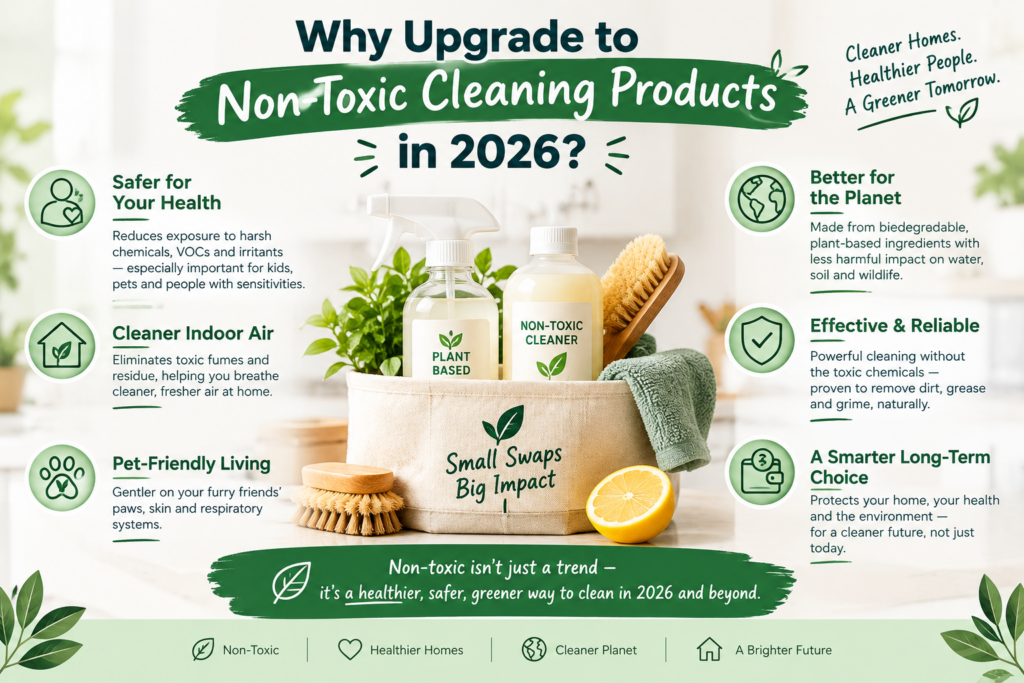
Indoor Air Quality: Why VOCs and Fragrance Matter
Indoor air can contain pollutants from many everyday sources, including cleaning products. Some cleaners and fragranced products release VOCs, which are chemicals that can evaporate into the air at room temperature.
For a typical household, simple habits can help reduce exposure:
- Ventilate while cleaning, especially in small bathrooms or rooms with limited airflow.
- Follow the product’s label directions and dilution instructions.
- Avoid mixing cleaning chemicals unless the manufacturer specifically says it is safe.
- Consider fragrance-free products if you prefer to minimize unnecessary fragrance exposure.
- Store concentrated cleaners securely and away from children and pets.
- Use only the amount needed for the cleaning task rather than automatically applying more.
The goal isn’t to make a home completely “chemical-free”—that isn’t realistic, because everything from water to the air itself consists of chemicals. A more useful goal is to reduce unnecessary exposure while choosing products that work for the job.
Understanding U.S. Safety and Sustainability Certifications
Certification labels can make shopping easier, but they don’t all mean the same thing. One of the biggest mistakes consumers make is treating every green or ethical label as proof that a product is “non-toxic.”
Here’s the difference:
| Certification / Label | What It Generally Tells You | What It Does Not Automatically Mean |
|---|---|---|
| EPA Safer Choice | EPA evaluates products and ingredients against specific program criteria | It does not mean the product is completely chemical-free |
| USDA Certified Biobased | Indicates a qualifying percentage of the product’s carbon content is from renewable biological sources | It is not the same as an organic or non-toxic certification |
| EWG Verified | EWG’s own product verification program evaluates products against its criteria | It is not a U.S. government certification |
| MADE SAFE® | Private certification focused on screening products against its ingredient and environmental criteria | It is not an EPA safety approval |
| Leaping Bunny | Indicates a company/product meets the program’s cruelty-free criteria | It does not certify cleaning performance or ingredient toxicity |
EPA Safer Choice
For U.S. shoppers, EPA Safer Choice is one of the most useful labels to understand. The EPA evaluates products against specific criteria, including the ingredients used in the formulation. Products that qualify can carry the Safer Choice label.
That makes it more meaningful than simply seeing “eco-friendly” printed on the front of a bottle.
However, Safer Choice does not mean “chemical-free.” All cleaning products contain chemicals, and the EPA program is designed around safer chemical ingredients and product criteria—not the idea that chemicals can be eliminated altogether.
USDA Biobased
The USDA Certified Biobased Product program focuses on how much of a product’s carbon content comes from renewable biological sources.
This can be useful when you’re interested in renewable feedstocks and reducing reliance on petroleum-based materials. But don’t confuse biobased with non-toxic. They describe different characteristics.
A biobased product can still contain ingredients that require normal precautions, so read the label and follow the manufacturer’s directions.
EWG Verified
EWG Verified is a private verification program operated by the Environmental Working Group. It is not a federal certification.
For shoppers who already use EWG’s ingredient-rating approach, the label can provide another screening signal when comparing household products. Still, it should be considered alongside the actual product label, ingredients, intended use, and manufacturer’s instructions.
MADE SAFE®
MADE SAFE® is another private certification that evaluates products using its own screening standards. Its approach focuses heavily on avoiding certain chemicals of concern and considering potential impacts on human health and ecosystems.
Like EWG Verified, MADE SAFE is not an EPA approval. That’s an important distinction when evaluating product claims.
Leaping Bunny
Leaping Bunny addresses a different issue: animal testing.
The certification can be valuable if cruelty-free purchasing is important to your household, but it doesn’t tell you whether a cleaner has low VOC emissions, uses refill packaging, or meets EPA Safer Choice criteria.
In other words, one product can have a cruelty-free certification without being certified under an ingredient-safety program—and that’s perfectly possible because the programs are measuring different things.
The Smart Way to Read Cleaning Labels in 2026
When choosing from the 10 Best Non-Toxic Cleaning Products of 2026, don’t look for one magical label. Look at the whole picture.
A practical checklist:
- Check the intended use. A kitchen cleaner isn’t automatically suitable for every surface.
- Read the ingredient information provided by the manufacturer.
- Look for relevant certifications rather than assuming all green labels mean the same thing.
- Consider fragrance. Choose fragrance-free if that better fits your household preferences.
- Check the packaging. Concentrates, tablets, powders, and refill systems can reduce repeated bottle purchases.
- Compare cost per use. A $10 concentrate may provide considerably more cleaning solution than a $10 ready-to-use bottle.
- Follow the label. More cleaner isn’t necessarily better.
- Never mix cleaners casually. Some combinations can create hazardous gases.
Quick Takeaway
The best non-toxic cleaning choice isn’t necessarily the product with the biggest “green” claim on the label. For U.S. households, a better approach is to consider ingredient transparency, relevant certification, cleaning performance, fragrance preferences, packaging waste, and cost together.
That approach helps families spend their money wisely while making practical changes to everyday cleaning habits—without expecting one certification or marketing phrase to answer every safety and sustainability question.
Top 10 Best Non-Toxic Cleaning Products of 2026: Detailed Reviews
The products below are not ranked simply by how “green” their packaging looks. Each one has a different strength—from refillable concentrates and tablet systems to a registered disinfecting system and a traditional powder cleanser.
One important note: “non-toxic” is not a standardized U.S. government certification. The certifications listed below apply to particular products, formulas, or companies, so check the current product label before buying.
Quick Comparison: 10 Best Non-Toxic Cleaning Products of 2026
| Product | Primary Use | Key Certification / Program | Refill Type | Approx. Cost per Ounce* |
|---|---|---|---|---|
| Branch Basics Starter Kit | Whole-home, multi-surface cleaning | Brand ingredient transparency | Concentrate | ~$1.00–$2.00/oz |
| Blueland Clean Essentials Kit | Everyday surfaces | EPA Safer Choice, USDA BioPreferred, Leaping Bunny* | Tablets | ~$0.50–$1.00/oz |
| Force of Nature Starter Kit | Disinfecting & sanitizing | EPA-registered antimicrobial system | Electrolyzed solution system | ~$0.20–$0.50/oz |
| Dr. Bronner’s Sal Suds | Heavy-duty household cleaning | Ingredient-focused; biodegradable formula | Concentrated liquid | ~$0.30–$0.50/oz |
| Better Life All-Purpose Cleaner, Fragrance-Free | Everyday surfaces | Cruelty-free claims; product-specific verification recommended | Ready-to-use liquid | ~$0.20–$0.35/oz |
| Grove Co. Multi-Purpose Concentrate | Sealed surfaces & kitchen cleaning | USDA Certified Biobased; B Corp company | Glass concentrate refill | ~$0.25/oz after dilution* |
| Puracy Multi-Surface Cleaner | Everyday multi-surface cleaning | USDA Biobased; PETA cruelty-free | Liquid/refill options | ~$0.20–$0.35/oz |
| ATTITUDE Nature+ Bathroom Cleaner | Bathroom & tile cleaning | Product-specific certification varies | Liquid/refill options | ~$0.25–$0.40/oz |
| Cleancult All-Purpose Cleaner | General household cleaning | Packaging-focused refill system | Paper carton refill | ~$0.25–$0.40/oz |
| Bon Ami Powder Cleanser | Cookware, sinks & hard surfaces | Biodegradable formula; natural mineral abrasives | Powder | ~$0.15–$0.25/oz |
*Approximate costs can change with package size, retailer, subscription pricing, and promotions. For concentrates, cost per ounce of the original concentrate is not directly comparable with the cost per ounce of ready-to-use cleaner, so cost per diluted ounce is the better comparison.
1.Best Overall All-Purpose Spray: Branch Basics Starter Kit
Best for: Families that want one concentrated cleaning system for multiple areas of the home.
Branch Basics takes a different approach from traditional ready-to-use sprays. Its concentrate is diluted with water in reusable bottles, allowing one product to cover multiple cleaning tasks. The current formula lists ingredients including decyl glucoside, coco-glucoside, sodium citrate, sodium bicarbonate, and sodium gluconate.
The starter kit is particularly appealing if you want to reduce the number of separate cleaners sitting under the kitchen sink. Its reusable bottle system also means you’re not repeatedly buying a full bottle of diluted cleaner.
Why it stands out:
- Concentrated formula for multiple household applications
- Reusable spray bottles
- Fragrance-free positioning
- Plant- and mineral-based ingredients
- Useful for kitchens, bathrooms, laundry, and general household cleaning
Watch out for: The upfront starter-kit price is higher than buying a single conventional spray. The value improves when you actually use the concentrate across several cleaning jobs.
Best choice for: A household trying to simplify its cleaning cabinet rather than collect a separate bottle for every surface.
2.Best Zero-Waste & Plastic-Reducing Pick: Blueland Clean Essentials Kit
Best for: Renters and homeowners who want a tablet-based refill system.
Blueland’s cleaning system uses tablets that are dissolved in water inside reusable bottles. Its cleaning sprays have been associated with certifications including EPA Safer Choice, USDA BioPreferred, Cradle to Cradle, and Leaping Bunny, although certification applies to specific products rather than automatically to every item sold by the company.
This format is especially convenient if storage space is tight. A few small refill tablets take up considerably less room than multiple full-size spray bottles.
Why it stands out:
- Reusable spray bottles
- Tablet refill format
- Less shipping weight than ready-to-use liquid
- Multiple relevant certifications on qualifying products
- Good fit for small apartments and homes with limited storage
Blueland also says its cleaning formulas have undergone independent third-party performance testing.
Best choice for: People who want to reduce repeated plastic bottle purchases without switching to a complicated DIY cleaning routine.
3.Best EPA-Registered Disinfectant: Force of Nature Starter Kit
Best for: Households that specifically need an antimicrobial/disinfecting product.
Force of Nature is different from a standard all-purpose cleaner. Its system generates an active cleaning solution using an electrolysis process, rather than simply supplying a conventional ready-to-use spray.
That distinction matters. If you’re buying a product because you need disinfection, look for the appropriate EPA registration and follow the product label. “Natural” or “non-toxic” marketing should never replace checking whether a product is actually registered for the germ-killing claim you need.
Why it stands out:
- Designed for antimicrobial cleaning
- On-demand preparation system
- Reduces the need to store large quantities of ready-to-use liquid
- Useful for households that want a dedicated disinfecting option
Important: Disinfectants are regulated differently from ordinary cleaners. Always follow the EPA-registered product’s directions, required contact time, and approved uses. Never assume that an ordinary surface cleaner is a disinfectant.
4. Best Budget-Friendly Concentrate: Dr. Bronner’s Sal Suds Biodegradable Cleaner
Best for: Households looking for a concentrated cleaner that can handle tougher everyday jobs.
Sal Suds is a concentrated household cleaner that can be diluted for different cleaning tasks. That makes it useful for shoppers who care more about versatility and cost per use than having a dedicated spray for every room.
The concentrated format also means you’re not transporting as much water compared with a ready-to-use cleaner.
Why it stands out:
- Concentrated formula
- Suitable for multiple household cleaning tasks
- Long-standing brand with detailed ingredient information
- Can be diluted according to the intended cleaning task
- A little product can go further than a ready-to-use spray
Best choice for: Budget-conscious households that don’t mind mixing their own cleaning solution.
Tip: Don’t assume concentrated means stronger is always better. Follow the manufacturer’s dilution instructions for the surface you’re cleaning.
5. Best Unscented Pick: Better Life All-Purpose Cleaner, Fragrance-Free
Best for: Shoppers who prefer an unscented household cleaner.
If fragrance is something you would rather skip, a fragrance-free formula is a straightforward place to start. Better Life’s fragrance-free all-purpose cleaner is designed for everyday surface cleaning without added parfum/fragrance.
This can be useful in homes where several fragranced products are already being used. Choosing an unscented cleaner doesn’t make a product universally “safer,” but it can help consumers who specifically want to avoid added fragrance.
Why it stands out:
- Fragrance-free option
- Convenient ready-to-use format
- Designed for everyday household surfaces
- Easier than mixing a concentrate
- Practical for regular kitchen and bathroom cleanup
Best choice for: Families that want a simple, unscented spray without moving to a tablet or powder system.
6.Best Refill-by-Mail System: Grove Co. Multi-Purpose Cleaner Concentrate
Best for: Households that want recurring refills and less single-use plastic.
Grove Co.’s Multi-Purpose Cleaner Concentrate is mixed with water to create a ready-to-use cleaner. The current product information says 1 ounce of concentrate makes 16 ounces of cleaner, and the concentrate comes in recyclable glass packaging.
Grove also identifies the formula as 92% plant-derived and lists USDA Certified Biobased among its product credentials. The company is also a Certified B Corporation and carries Leaping Bunny certification at the company/brand level.
Why it stands out:
- Concentrate-and-refill format
- Recyclable glass concentrate bottle
- Subscription option available
- USDA Certified Biobased
- Good fit for regular household cleaning
One thing to consider: The formula contains natural-origin fragrance and preservatives, so shoppers who specifically want fragrance-free cleaning should check the exact variant and ingredient list rather than assuming every Grove cleaner is unscented.
7.Best Plant- and Enzyme-Focused Cleaner: Puracy Multi-Surface Cleaner
Best for: Everyday cleaning when you want a plant-forward formula and broad surface compatibility.
Puracy’s multi-surface cleaner is designed for everyday messes such as dust, grime, grease, fingerprints, and smudges. The current product information lists ingredients such as decyl glucoside and citric acid and identifies the product as USDA Biobased and PETA cruelty-free.
Puracy also highlights enzymes across its product range as stain-fighting ingredients.
Why it stands out:
- Suitable for many household surfaces
- Plant- and mineral-derived ingredients
- USDA Biobased certification
- Cruelty-free certification
- Refill options can help reduce packaging
Best choice for: Families looking for an everyday cleaner that feels more ingredient-conscious without requiring a DIY formula.
8.Best Heavy-Duty Bathroom & Tile Cleaner: ATTITUDE Nature+ Technology Bathroom Cleaner
Best for: Soap scum, bathroom surfaces, and regular tile cleaning.
Bathrooms need a slightly different cleaning strategy from dusting a countertop. Soap residue, hard-water deposits, and grime can build up quickly, particularly around showers and tubs.
ATTITUDE’s Nature+ bathroom-cleaning range uses ingredients such as citric acid in applicable formulations, making it a useful option for shoppers looking for an acid-based approach to bathroom buildup.
Why it stands out:
- Designed specifically for bathroom surfaces
- Citric-acid-based cleaning approach
- Useful for soap scum and everyday bathroom residue
- Available in refill-oriented formats in some markets
Best choice for: Homes where bathroom buildup is a bigger concern than general-purpose surface cleaning.
Safety note: Acidic bathroom cleaners should not be mixed with chlorine bleach or other incompatible cleaning products. Always follow the label.
9.Best Eco Paper Carton Refill: Cleancult All-Purpose Cleaner
Best for: Shoppers who want a refill system instead of buying another complete spray bottle.
Cleancult’s current product range includes All Purpose Cleaner Refills in carton packaging, alongside reusable and filled aluminum formats.
The refill concept is straightforward: keep the bottle and replace the cleaning liquid rather than repeatedly purchasing another complete package.
Why it stands out:
- Carton refill format
- Reusable bottle system
- Reduces the need for repeated spray-bottle purchases
- Convenient for regular household cleaning
- Good option for shoppers prioritizing packaging reduction
Best choice for: Households that want a familiar liquid cleaner but would rather refill a bottle than replace it.
10.Best Natural Mineral Scouring Powder: Bon Ami Powder Cleanser
Best for: Stuck-on food, sinks, cookware, tubs, and other hard surfaces that need gentle scrubbing.
Sometimes a spray simply isn’t enough. A powder cleanser can provide physical scrubbing power without requiring a heavy-duty liquid formula.
Bon Ami Powder Cleanser uses feldspar and limestone as soft abrasives, along with ingredients including calcium carbonate, sodium carbonate, sodium bicarbonate, and a surfactant. The manufacturer says it can be used on surfaces including cookware, sinks, bathtubs, grout, and glass-top stoves.
Why it stands out:
- Powder format
- Mineral-based abrasives
- Useful for stubborn residue and scuff marks
- Long shelf life compared with some liquid cleaners
- No bulky plastic spray bottle
Best choice for: Kitchens and bathrooms where physical scrubbing is more important than having a multipurpose spray.
Important: “Scratch-free” should never be treated as universal. Always check the manufacturer’s surface guidance and test an inconspicuous area, particularly on delicate finishes.
Which of These 10 Should You Buy?
There isn’t one perfect cleaner for every American household.
- Best overall system: Branch Basics
- Best tablet refill system: Blueland
- Best for disinfection: Force of Nature
- Best concentrated cleaner for value: Sal Suds
- Best fragrance-free everyday option: Better Life
- Best subscription/refill option: Grove Co.
- Best plant-focused multi-surface option: Puracy
- Best bathroom-focused cleaner: ATTITUDE
- Best carton refill system: Cleancult
- Best powder scrubber: Bon Ami
For the biggest reduction in packaging, concentrate and refill systems generally deserve a closer look. For the lowest upfront cost, a conventional bottle or powder may make more sense. And if you need disinfection, choose based on the EPA-registered label and intended use—not simply because a product is marketed as natural or non-toxic.
That is the more practical way to approach the 10 Best Non-Toxic Cleaning Products of 2026: match the cleaner to the job, verify the claims that matter to you, and calculate the real cost of keeping your home clean.
Toxic Ingredients to Avoid in Household Cleaners: The “Red List”
When choosing from the 10 Best Non-Toxic Cleaning Products of 2026, the ingredient list can tell you more than a large “green” claim on the front of the bottle. You do not need to memorize every chemical name, either. A few ingredient categories are worth recognizing because they can affect how a cleaner should be handled, stored, or used inside your home.
One important distinction: “toxic” is not a regulatory category that automatically applies to every product containing a particular ingredient. Risk depends on the chemical, concentration, route of exposure, and how the product is used. The goal of a household “red list” is therefore not to label every conventional cleaner as dangerous, but to help shoppers identify ingredients they may reasonably want to avoid or use with extra care.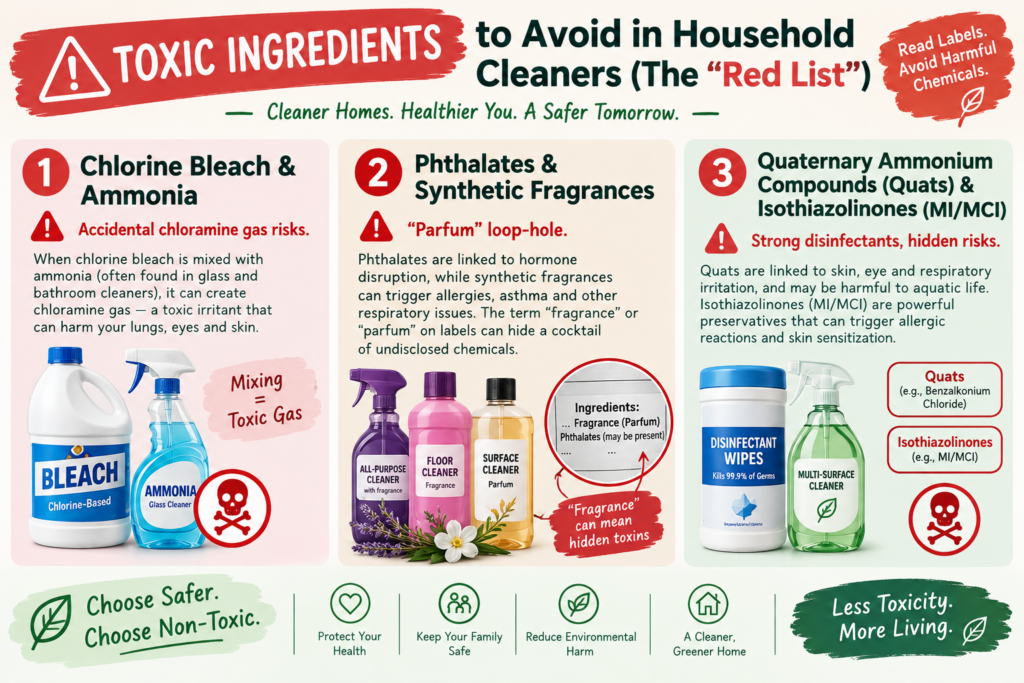
Quick Red List: Ingredients Worth Checking
| Ingredient / Category | Why It Gets Attention | Practical Household Approach |
|---|---|---|
| Chlorine bleach | Can irritate the eyes, skin, and respiratory system; dangerous gases can form when mixed with certain cleaners | Never mix with ammonia, acids, or other incompatible cleaners |
| Ammonia | Strong fumes can irritate the eyes and airways | Use ventilation and never mix with chlorine bleach |
| Phthalates | Certain phthalates are associated with health concerns and may be used in fragrance formulations | Consider fragrance-free products and check ingredient disclosures |
| Synthetic fragrance / “parfum” | “Fragrance” can represent a mixture of fragrance ingredients rather than one single chemical | Choose fragrance-free when you want to minimize added fragrance |
| Quaternary ammonium compounds (“quats”) | Common in disinfecting and sanitizing products; repeated exposure can be an occupational concern | Use only when the disinfecting function is actually needed and follow the label |
| Methylisothiazolinone (MI) | Preservative associated with allergic contact dermatitis | Consider avoiding it if you are sensitive to this preservative |
| Methylchloroisothiazolinone (MCI) | Preservative that can also cause allergic contact dermatitis in susceptible people | Check ingredient labels, particularly in frequently used products |
1. Chlorine Bleach & Ammonia: The Mixing Mistake to Never Make
This is the most important safety point on the list.
Never mix chlorine bleach with ammonia-containing cleaners. The combination can produce chloramine gases, which can cause coughing, eye irritation, breathing difficulty, and other potentially serious effects.
The same basic rule applies to mixing bleach with other household chemicals unless the product label specifically says the combination is safe. For example, bleach should not casually be combined with acidic cleaners.
A safer routine is simple:
- Use one cleaning product at a time.
- Read the label before use.
- Keep the room ventilated.
- Never pour different cleaners into the same bottle.
- Store bleach and other strong cleaners in their original containers.
- Keep products away from children and pets.
If accidental mixing produces strong fumes, leave the area and get fresh air rather than trying to neutralize the mixture yourself.
For everyday cleaning, you may not need a bleach-based product at all. But when disinfection is genuinely required, follow the product’s EPA-approved label directions rather than substituting a homemade mixture.
2. Phthalates & Synthetic Fragrance: Look Beyond “Parfum”
Fragrance is one of the trickier parts of a cleaning-product label.
A bottle may prominently advertise a pleasant scent while the ingredient information simply uses terms such as “fragrance” or “parfum.” Depending on the applicable labeling requirements, consumers may not see every individual fragrance component listed separately.
That does not mean every fragranced cleaner contains phthalates, nor does it mean every fragrance is harmful. The more useful takeaway is that shoppers who want to minimize fragrance exposure should look for a clearly labeled fragrance-free or unscented option and check the manufacturer’s ingredient information.
If fragrance is not important to you, there is little reason to pay extra for it.
For families trying to simplify their cleaning routine, fragrance-free products can also make it easier to identify which product is causing an unwanted scent or irritation if a problem occurs.
3. Quaternary Ammonium Compounds: Useful, But Not an Everyday Necessity
Quaternary ammonium compounds—often called quats—are widely used as antimicrobial ingredients in disinfectants and sanitizing products.
They have a legitimate purpose. The problem is that consumers sometimes use disinfecting products for jobs where ordinary cleaning would be enough.
For example, wiping away crumbs, dust, or routine kitchen grime does not automatically require a disinfectant. A properly formulated cleaner can handle ordinary dirt without relying on an antimicrobial active ingredient.
If you do need a disinfectant, choose an EPA-registered product appropriate for the surface and intended pathogen claim, and follow its label instructions carefully. The label specifies important details such as where the product can be used and how long the surface needs to remain visibly wet.
That is a much better approach than assuming every “antibacterial” spray is automatically better for everyday cleaning.
4. Isothiazolinones: MI and MCI
Methylisothiazolinone (MI) and methylchloroisothiazolinone (MCI) are preservatives used in some water-based products to help prevent microbial growth.
Their main concern for consumers is skin sensitization and allergic contact dermatitis in susceptible individuals. This is particularly relevant if you frequently handle cleaning products without gloves or already know that your skin reacts to certain preservatives.
If you are trying to avoid these ingredients, check the full ingredient list rather than relying on claims such as “natural” or “plant-based.”
A plant-derived ingredient does not automatically make an entire formula suitable for everyone, and a synthetic ingredient is not automatically dangerous simply because it is synthetic. The formulation and exposure matter.
What About EPA Safer Choice?
If you’re comparing products in this guide, EPA Safer Choice can be a useful screening tool. The program evaluates qualifying products and their ingredients against specific criteria.
However, don’t interpret the label as meaning “contains no chemicals” or “risk-free.” Cleaning products are chemical mixtures by nature, and safe use still depends on following the product label.
For consumers, the strongest approach is to combine certification information with:
- Ingredient transparency
- Product-specific directions
- Appropriate ventilation
- Fragrance preferences
- Surface compatibility
- Packaging and refill options
- Cost per use
The Simple Rule for a Lower-Exposure Cleaning Cabinet
You don’t have to replace every product in your home tomorrow.
Start with the cleaners you use most often. Look for fragrance-free alternatives if that is a priority, avoid unnecessary disinfectant use, and choose concentrated or refillable products when they make financial and environmental sense.
Most importantly, never mix household cleaners unless the label specifically instructs you to do so.
That practical approach is more useful than chasing a “chemical-free” label. There is no chemical-free household—but there are smarter ways to choose, store, and use the products you bring into it.
Buyer’s Guide: How to Choose the Right Cleaning Products for Your Home
Choosing among the 10 Best Non-Toxic Cleaning Products of 2026 is easier when you focus on how the product will actually be used. A refill system may look more expensive at checkout but cost less per finished ounce. A powerful bathroom cleaner may work brilliantly on tile but be a poor choice for natural stone. And even a gentle-looking cleaner needs to be stored properly.
Here are the practical checks worth making before you buy.
Single-Use Plastic vs. Concentrates: Calculate the True Cost
A $6 ready-to-use spray isn’t necessarily cheaper than a $12 concentrate. The important number is cost per finished fluid ounce.
Use this simple calculation:
Cost per finished fl. oz. = Total product price ÷ Total finished cleaner produced
For example:
| Cleaning Format | Example Price | Finished Cleaner | Approx. Cost per Finished fl. oz. |
|---|---|---|---|
| Ready-to-use spray | $6 | 24 fl. oz. | $0.25 |
| Concentrate | $12 | 64 fl. oz. | $0.19 |
| Tablet system | $15 | 96 fl. oz. | $0.16 |
| Powder concentrate | $10 | 80 fl. oz. | $0.13 |
These are examples rather than current product prices. Actual costs vary by brand, package size, retailer, subscription, and promotions.
Concentrates can also reduce the amount of water and packaging transported from the manufacturer to your home. Refillable bottles, tablets, powders, and concentrates may therefore appeal to households trying to reduce packaging waste.
But there is a catch: don’t compare concentrate ounces directly with ready-to-use ounces. A 16-ounce bottle of concentrate may produce several times its volume in finished cleaning solution.
Surface Compatibility Guide
The safest cleaner isn’t necessarily the strongest one. Different surfaces have different tolerances for acids, abrasives, solvents, and alkaline ingredients.
| Surface | Generally Safer Starting Point | What to Watch For |
|---|---|---|
| Granite | Mild, pH-appropriate stone cleaner or manufacturer-approved cleaner | Avoid harsh acids and abrasive powders unless the surface manufacturer says they’re suitable |
| Marble | Stone-specific, pH-neutral cleaner | Vinegar, lemon juice, and other acids can etch calcium-based stone |
| Sealed wood | Damp microfiber cloth or cleaner approved for the specific finish | Avoid excessive water and products that can damage the finish |
| Glass | Glass cleaner or mild soap solution | Abrasive powders can scratch some glass surfaces |
| Stainless steel | Mild dish soap or manufacturer-approved stainless-steel cleaner | Avoid abrasive scrubbing and check the grain direction when wiping |
Always check the manufacturer’s care instructions first, particularly for expensive countertops, specialty finishes, engineered surfaces, and newly installed flooring.
Granite and Marble Are Not the Same
This distinction matters.
Granite is generally more resistant to acids than marble, but that doesn’t mean every acidic household cleaner is appropriate for every granite countertop. Marble is particularly vulnerable to acidic substances because its calcium carbonate composition can react with acids, leading to dull spots or etching.
If you’re unsure, choose a cleaner specifically labeled for the stone and test it on a small, inconspicuous area first.
Sealed Wood Needs Less Liquid
For sealed wood floors, cabinets, and furniture, more cleaner isn’t better. Excess moisture can work its way into seams or damage certain finishes.
A lightly damp microfiber cloth is often enough for routine dust and surface dirt. If you use a cleaning product, follow the flooring or furniture manufacturer’s instructions and avoid soaking the surface.
Stainless Steel: Watch the Abrasives
Stainless steel can look tough, but its finish can show scratches surprisingly easily. For routine cleaning, a soft cloth and a suitable mild cleaner are usually a better starting point than an aggressive scouring powder.
Wiping with the grain can also help maintain the appearance of brushed stainless steel.
Proper Storage & Shelf Life of Natural Cleaners
“Natural” or plant-based does not mean a cleaner lasts forever. Once a product is opened or diluted, its stability can depend on its ingredients, preservatives, packaging, temperature, and exposure to contamination.
For better storage:
- Keep cleaning products in their original labeled containers whenever possible.
- Follow the manufacturer’s storage instructions.
- Avoid leaving cleaners in extreme heat or freezing temperatures unless the label says the product can tolerate them.
- Keep concentrates securely closed.
- Store products away from children and pets.
- Don’t transfer cleaners into an unlabeled bottle.
- Avoid storing cleaning products next to food or medications.
- For diluted concentrates, follow the manufacturer’s guidance on how long the prepared solution should be kept.
Should You Make Natural Cleaners at Home?
DIY cleaning recipes can seem inexpensive, but homemade mixtures aren’t automatically safer or more effective. They also lack the controlled formulation and labeling information found on commercial products.
One rule is non-negotiable: never mix bleach with ammonia, acids, or other household cleaners unless the product label specifically instructs you to do so.
If you prefer a lower-waste approach, a commercially formulated concentrate or tablet system can be a simpler middle ground. You reuse the bottle while the manufacturer handles the formulation.
Quick Buying Checklist
Before adding a cleaner to your cart, ask:
- Will it work on the surface I actually need to clean?
- What is the cost per finished fluid ounce or per use?
- Does it have a refill, concentrate, tablet, or powder option?
- Are the ingredients and directions clearly disclosed?
- Does the product have a relevant certification, such as EPA Safer Choice, where applicable?
- Does the packaging create unnecessary waste?
- Can I store it safely in my home?
The best choice from the 10 Best Non-Toxic Cleaning Products of 2026 isn’t necessarily the cheapest bottle on the shelf. It’s the product that fits the surface, cleaning task, household budget, and storage routine—while giving you enough information to make a confident purchase.
DIY Alternatives: Simple 2-Ingredient Recipes That Work
If you are trying to make your cleaning routine less wasteful, you do not always need another bottle under the sink. A few basic ingredients can handle specific household jobs surprisingly well. The key is using the right ingredient for the right problem rather than assuming every homemade cleaner works on every surface.
These simple recipes can complement the commercial products featured in the 10 Best Non-Toxic Cleaning Products of 2026, especially when you want an inexpensive option for occasional cleaning tasks.
Quick takeaway: Vinegar is useful for mineral buildup and some everyday cleaning jobs, baking soda provides mild abrasive action, and citric acid is particularly useful against hard-water scale. However, vinegar and baking soda neutralize each other when mixed, so using them separately is generally more useful than combining them into one bottle.
White Vinegar & Baking Soda: Use Them Separately
White distilled vinegar and baking soda are two familiar pantry staples, but they work in different ways.
White vinegar contains acetic acid, which can help dissolve mineral deposits and soap residue. Baking soda is mildly abrasive and can help lift grime when used as a paste.
Simple Baking Soda Surface Paste
Ingredients:
- 2 tablespoons baking soda
- 1–2 teaspoons water
How to use it:
- Mix the baking soda and water into a loose paste.
- Apply a small amount to a suitable hard surface.
- Gently scrub with a soft sponge or cloth.
- Wipe away the residue with clean water.
- Dry the surface.
This can be useful for stainless-steel sinks, ceramic surfaces, and some kitchen or bathroom areas. Always check the manufacturer’s care instructions first and test an inconspicuous spot.
Do not use baking soda as a general scrub on delicate finishes simply because it is “natural.” Mild abrasives can still dull or scratch certain surfaces.
Simple White Vinegar Spray
Ingredients:
- 1 cup white distilled vinegar
- 1 cup water
Mix the ingredients in a clearly labeled spray bottle and use the solution for appropriate hard, non-porous surfaces where vinegar is compatible.
Vinegar can be particularly useful for mineral deposits and hard-water residue, but it is not suitable for every countertop or floor.
Avoid vinegar on marble, limestone, and other acid-sensitive natural stone. The acid can etch the surface and leave a dull mark.
What About the Famous Vinegar + Baking Soda Drain Trick?
The bubbling reaction looks impressive, but it is mostly chemistry in action—not proof that the mixture is a powerful drain cleaner.
When acidic vinegar reacts with alkaline baking soda, they largely neutralize each other and produce carbon dioxide bubbles, water, and sodium acetate. The fizz can help loosen some surface debris, but it doesn’t make the resulting liquid a powerful grease or clog remover.
For a slow or clogged drain, don’t assume this homemade reaction is a substitute for proper drain maintenance or a product specifically designed for the problem.
And never combine either ingredient with chlorine bleach or other incompatible cleaning chemicals.
Citric Acid Hard-Water Scale Remover
Hard-water deposits are a different problem. That white crust around a faucet, showerhead, or bathroom fixture is often made up largely of mineral deposits, and an acidic solution can help dissolve them.
Citric acid is a useful alternative to vinegar when you want a concentrated powder that can be mixed only when needed.
Simple 2-Ingredient Citric Acid Cleaner
Ingredients:
- 1 tablespoon citric acid powder
- 1 cup warm water
How to use it:
- Add the citric acid to the warm water.
- Stir until the powder has dissolved.
- Apply the solution to compatible hard-water deposits.
- Allow it to sit briefly rather than letting it dry completely.
- Wipe or gently scrub the residue away.
- Rinse the surface thoroughly with clean water.
For stubborn mineral buildup, a longer contact time may help, but always follow the care instructions for the surface or fixture.
Where Citric Acid Works Best
This simple mixture can be useful for:
- Shower fixtures
- Faucets
- Glass shower doors
- Some ceramic bathroom surfaces
- Mineral deposits around sinks
- Hard-water scale on compatible fixtures
Do not use citric acid on marble, limestone, travertine, or other acid-sensitive stone. It can etch these materials.
It is also smart to test the solution on a small hidden area before treating a visible surface.
DIY Cleaner Safety Checklist
Homemade cleaners are simple, but “DIY” does not automatically mean risk-free.
- Never mix bleach with vinegar or other acids.
- Never mix bleach with ammonia-containing products.
- Keep homemade solutions in clearly labeled containers.
- Don’t store homemade cleaners in food or beverage containers.
- Keep them away from children and pets.
- Make small batches rather than storing diluted solutions indefinitely.
- Check the surface manufacturer’s cleaning recommendations first.
- Don’t use homemade recipes as substitutes for an EPA-registered disinfectant when disinfection is specifically required.
DIY vs. Store-Bought: Which Makes More Sense?
For occasional mineral buildup or light scrubbing, a two-ingredient DIY solution can be inexpensive and create little packaging waste. But commercial cleaners still have an advantage when you need a precisely formulated product, specialized surface compatibility, or a verified disinfecting claim.
A practical household doesn’t have to choose one approach exclusively. Use DIY ingredients for simple jobs where they make sense, and choose a purpose-built cleaner when the task requires specialized performance or regulated antimicrobial claims.
That balanced approach can keep cleaning costs manageable while reducing the number of unnecessary products and bottles in your home.
Frequently Asked Questions: Best Non-Toxic Cleaning Products of 2026
Do non-toxic cleaners actually kill bacteria and viruses?
Some can, but cleaning and disinfecting are not the same thing. A cleaner may remove dirt, grease, and many germs from a surface without being approved to kill specific bacteria or viruses.
If you specifically need to disinfect a high-touch surface, check the product label for an EPA registration number and follow the listed directions, including the required contact or dwell time. EPA-registered disinfectants are evaluated for the organisms and uses stated on their labels.
For everyday household cleaning, a good non-toxic or lower-concern cleaner can be a practical choice when your main goal is removing grime rather than disinfecting. For situations where disinfection is recommended, such as certain illness-related cleaning tasks, choose a product whose label specifically supports that use.
Quick takeaway:
Non-toxic does not automatically mean disinfectant. Look for EPA registration and the appropriate kill claims when germ control is the priority.
Are natural cleaners safe for marble and granite countertops?
Not necessarily. “Natural” does not tell you whether a cleaner is suitable for a particular stone surface. Marble is especially sensitive to acids, including common DIY ingredients such as vinegar and lemon juice. Acidic cleaners can dull or etch the surface.
Granite is generally more resistant, but the safest approach is still to follow the countertop manufacturer’s care instructions and choose a cleaner specifically labeled for natural stone when appropriate.
For everyday maintenance:
- Marble: Use a pH-neutral stone cleaner or the product recommended by the stone manufacturer.
- Granite: Use a mild stone-safe cleaner and avoid harsh abrasives unless the manufacturer says otherwise.
- DIY vinegar sprays: Avoid them on marble, limestone, travertine, and other acid-sensitive stones.
- Unknown stone/sealant: Test any new product on a small, inconspicuous area first.
This is an important distinction when comparing the 10 Best Non-Toxic Cleaning Products of 2026. A cleaner can have a simple ingredient profile and still be the wrong choice for a particular countertop.
Bottom line: Choose based on surface compatibility first, “natural” labeling second.
Why do some plant-based cleaners require “dwell time”?
Dwell time, also called contact time, is the amount of time a product needs to remain visibly wet on a surface to achieve the performance stated on its label.
This matters most with products designed to sanitize or disinfect. Wiping a product away immediately may not give its active ingredients enough time to work against the microorganisms listed on the label.
For example, if a disinfectant label specifies a 5-minute contact time, the surface generally needs to remain wet for that period for the stated disinfection claim to apply. Always follow the specific product label rather than assuming every cleaner has the same timing.
One common mistake is thinking that “plant-based” means a product works instantly. It doesn’t. The source of an ingredient and the product’s tested performance are two different things.
When using a disinfecting product, check:
- The EPA registration information.
- The microorganisms the product claims to kill.
- The required contact/dwell time.
- Whether the product is approved for your particular surface.
- Any ventilation, PPE, or rinsing instructions on the label.
Quick Answer: What Should You Look For in a Non-Toxic Cleaner?
For U.S. shoppers, don’t rely on the words natural, green, plant-based, or non-toxic alone. Instead, look at the complete product information.
| What to Check | Why It Matters |
|---|---|
| Ingredients | Helps you understand fragrance, preservatives, solvents, and other formulation choices |
| EPA Safer Choice | A useful EPA program for identifying qualifying products whose ingredients meet the program’s criteria |
| EPA Registration | Important when you need a disinfectant with specific germ-killing claims |
| Surface compatibility | Prevents damage to marble, wood, stone, stainless steel, and other materials |
| Refill format | Concentrates, tablets, and refills can reduce packaging waste |
| Cost per finished ounce | Makes different formats easier to compare fairly |
| Label directions | Provides the correct dilution, application, contact time, and safety instructions |
The EPA Safer Choice program can be a useful starting point for shoppers who want products screened against EPA ingredient and performance criteria. However, Safer Choice is not the same thing as “chemical-free,” and it is not a blanket claim that a product is harmless in every situation.
Explore More Eco-Friendly Living Guides
If you enjoyed this guide on non-toxic home care, check out our top-rated sustainable lifestyle articles to complete your eco-friendly journey:
 10 Best Eco-Conscious Clothing Brands in 2026 — Discover ethical fashion brands that prioritize sustainable fabrics and fair trade practices.
- Sustainable Fashion 2026: The Ultimate Guide to Eco-Friendly Style — Learn how to build a timeless capsule wardrobe without compromising on ethics or quality.
Natural Cleaning Products 2026 —Best Safe Choices for Your Home