
Are Detergent Sheets Really Plastic-Free? (2026 Guide)
Detergent sheets have taken over laundry aisles and Instagram ads alike. Thin, pre-measured, and marketed as the “zero-waste” answer to bulky plastic jugs. But if you’ve read the ingredient label — or seen a headline questioning the “plastic-free” claim — you’ve probably wondered whether these sheets are actually solving the plastic problem or just hiding it.
Short answer: it’s complicated, and the marketing often gets ahead of the science.
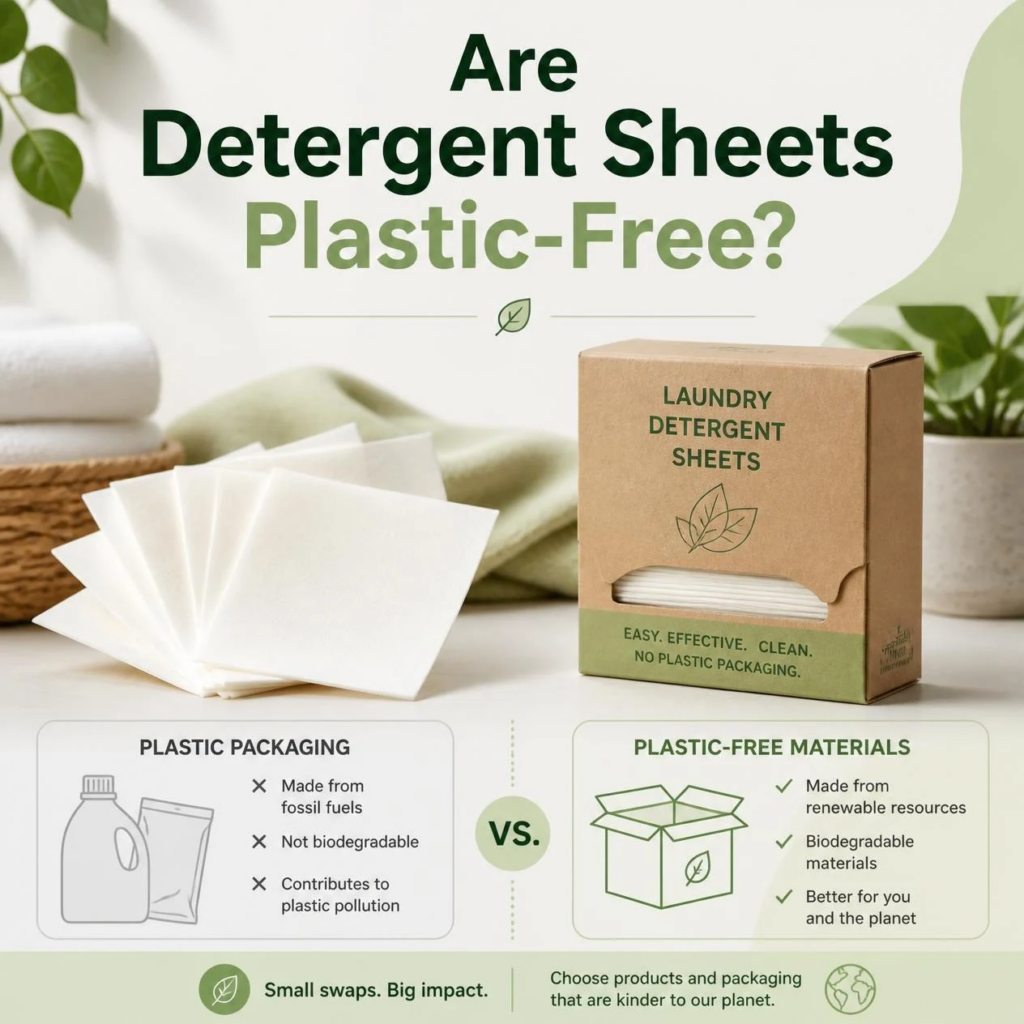
Quick Answer: Most laundry detergent sheets are not plastic-free. They’re typically made with polyvinyl alcohol (PVA or PVOH), a synthetic, petroleum-derived polymer. PVA dissolves in water, but dissolving isn’t the same as biodegrading — and independent researchers, industry groups, and consumer advocates disagree about how completely it actually breaks down in real-world wastewater systems.
Below, we’ll break down what’s actually in these sheets, what U.S. regulators say, and how to shop smart without falling for greenwashing.
The TL;DR Box (Save This)
| Question | Answer |
|---|---|
| Are detergent sheets plastic? | Most contain PVA, a synthetic polymer classified as a plastic by chemical definition |
| Does PVA fully biodegrade? | Disputed — depends on water temperature, wastewater treatment infrastructure, and PVA grade |
| Is “plastic-free” on the label accurate? | Often misleading; “dissolves” ≠ “biodegrades,” and few brands publish third-party test data |
| Who regulates these claims? | The FTC (advertising claims) oversees this area, though enforcement of “plastic-free” wording specifically is still evolving |
| Best certification to look for | OECD 301 series “ready biodegradability” test results, published and third-party verified |
| Bottom line for shoppers | Detergent sheets can still cut packaging waste and shipping weight — just don’t buy them for a “plastic-free” claim alone |
What’s Actually Inside a Detergent Sheet?
Pull a sheet out of the box and it feels almost like a fabric softener sheet or a thin piece of paper. That texture is doing a lot of marketing work, because it doesn’t look or feel like plastic. But the material holding the concentrated cleaning agents together is usually PVA — a synthetic, water-soluble polymer originally developed for industrial uses like packaging film, medical sutures, and textile sizing.
Here’s the part that trips people up: PVA is genuinely water-soluble. Drop a sheet in your washer and it dissolves within minutes, unlike a plastic bag or bottle. That soluble film is exactly why marketers call these sheets “plastic-free” — the sheet disappears, and you never see a piece of hard plastic in the wash. But dissolving only means the polymer has broken into smaller molecular chains suspended in water. It has entered the wastewater stream — and whether it truly biodegrades from there depends on what happens next. Earthmother
Dissolve vs. biodegrade — the distinction that matters:
- Dissolve: The solid sheet disperses into water. This happens fast, usually within a normal wash cycle.
- Biodegrade: Microorganisms break the polymer down into water, carbon dioxide, and biomass, with nothing toxic or persistent left behind. This can take much longer and depends heavily on environmental conditions.
Full biodegradation of PVA generally requires specific microbes, warmer temperatures, and enough time — conditions that show up reliably in industrial wastewater treatment plants but not necessarily in every municipal system, in septic tanks, or in natural waterways. If your local treatment plant doesn’t have the right microbial conditions, or if wastewater bypasses treatment (which happens during storm overflow events in a lot of older American cities), the PVA can end up in rivers, lakes, or soil largely intact. Earthmother
Is PVA Actually “Plastic”? Two Sides of a Real Debate
This isn’t a fringe internet argument — it’s an active dispute between environmental researchers and the cleaning products industry, and honest coverage should show both sides.
The case that PVA is a problem
Environmental groups, including nonprofits focused on single-use plastic, argue that by chemical definition, PVA is a synthetic polymer and therefore a plastic — full stop. One widely cited estimate put annual U.S. sales of detergent pods and sheets at around 20 billion units, with an estimated 21 million pounds of intact PVA particles reaching U.S. municipal wastewater in a single recent year. Critics also point out an uncomfortable conflict of interest: much of the research concluding PVA is safe and biodegradable has been funded by industry trade groups that sell PVA-based products, which doesn’t necessarily make the findings wrong, but it does mean independent replication matters. Beyond PlasticsBranch Basics
The case that PVA is not a conventional plastic problem
The American Cleaning Institute (ACI), the main U.S. trade association for the cleaning products industry, pushes back hard on the “plastic pollution” framing. ACI states that the detergent-grade PVA used in pods and sheets has had its environmental and mammalian safety confirmed by EPA, FDA, and other international agencies, and that it does not behave like conventional persistent plastics. The group also disputes the oft-cited pollution estimates, arguing that some studies rest on modeling assumptions rather than direct measurement, and that they didn’t follow EPA guidance for scaling lab degradation rates up to full-size treatment plants. American Cleaning InstituteAmerican Cleaning Institute
Separately, a 2025 industry-aligned research summary reiterated that detergent-grade PVA is engineered specifically to dissolve rather than fragment into microplastics, and that controlled studies found it readily biodegradable under wastewater treatment plant conditions. msu
Where independent reviewers land
Neutral consumer-facing outlets tend to land in the middle. One recent analysis noted that research into detergent-grade PVA’s environmental impact is ongoing, with studies reaching different conclusions depending on test conditions and the specific polymer grade used. Its practical advice: treat “plastic-free” claims skeptically unless a brand backs them with clear ingredient disclosure and independent test results, since the difference between dissolving and biodegrading is often where marketing gets misleading. DutchNews.nlDutchNews.nl
The honest takeaway: PVA is a chemically synthetic polymer. Whether it counts as an “environmental plastic problem” on the scale of a water bottle depends on grade, dose, wastewater infrastructure, and testing methodology — and reasonable scientists currently disagree. Anyone telling you it’s a fully settled question, in either direction, is oversimplifying.
What U.S. Regulators Actually Say
This is where a lot of marketing copy gets ahead of reality, so let’s separate what regulators have confirmed from what brands imply.
- FTC Green Guides: The Federal Trade Commission’s Green Guides set the general rules for environmental marketing claims in the U.S. — they require that terms like “biodegradable” or “non-toxic” be substantiated and not misleading to a reasonable consumer. The Guides don’t currently have a bright-line rule specific to “plastic-free” detergent sheet claims, which is part of why brand language varies so widely. If you see an unqualified “plastic-free” claim with no supporting data, that’s a yellow flag under the Guides’ general substantiation standard.
- EPA: The Environmental Protection Agency doesn’t run a certification program that stamps individual detergent sheet brands as “plastic-free” or “not plastic-free.” Industry sources cite EPA scientific review as supportive of detergent-grade PVA’s safety profile, but that’s a safety and toxicity assessment — not the same as an environmental marketing endorsement.
- EPA Safer Choice: This is EPA’s actual consumer-facing certification for cleaning products, and it evaluates ingredient safety for human and environmental health — not plastic content specifically. A Safer Choice label tells you the formula avoids certain hazardous chemicals; it doesn’t tell you whether the carrier material is petroleum-based plastic.
- OECD 301 biodegradability tests: This is the international testing standard most credible brands should be citing if they claim biodegradability. Look for a described “ready biodegradability” test run at a realistic temperature, typically around 68–77°F, with a stated biodegradation percentage over a set time window. A brand that says “biodegradable” without pointing to this kind of published, third-party test isn’t giving you much to verify. DutchNews.nl
No U.S. agency currently issues a “plastic-free” seal for laundry products the way USDA Organic certifies food or ENERGY STAR certifies appliances. That gap is exactly why brand claims vary so much — there’s no single government authority forcing consistency.
Detergent Sheets vs. Pods vs. Liquid vs. Powder: A Real Comparison
If plastic content is only part of your decision, here’s how the major formats stack up on the things that actually affect your household budget and waste footprint.
| Format | Contains PVA/plastic film? | Packaging waste | Shipping weight/emissions | Typical cost per load (2026 U.S. pricing) |
|---|---|---|---|---|
| Detergent sheets | Yes, usually (PVA carrier) | Very low — thin cardboard box | Very low, lightweight | ~$0.25–$0.45 |
| Detergent pods | Yes, usually (PVA film wrap) | Low-to-moderate — plastic tub | Low-moderate | ~$0.25–$0.40 |
| Liquid detergent | No PVA, but bottle is plastic | High — HDPE jugs | High, mostly water weight | ~$0.15–$0.35 |
| Powder detergent | Usually no PVA | Moderate — cardboard box or plastic bag | Low-moderate | ~$0.10–$0.25 |
A few things jump out here. Liquid detergent’s plastic problem is different but arguably just as real: HDPE laundry jugs in the U.S. are recycled at only around 5–6%, and because liquid formulas run up to 90% water by weight, they’re expensive to ship and carry a heavier carbon footprint than concentrated formats. So if your main goal is cutting visible single-use plastic packaging and reducing shipping emissions, sheets and powders both have a real edge over jugs — that part of the marketing checks out. It’s specifically the “plastic-free” wording tied to the sheet material itself that deserves scrutiny. Green Llama
A Quick Decision Framework
Use this if you just want a practical answer without reading a chemistry paper:
- Priority is cutting single-use plastic packaging (bottles, jugs)? → Sheets and powder both work well here, regardless of the PVA debate.
- Priority is avoiding synthetic polymers entirely, including dissolved ones? → Choose a plant-starch or cellulose-based sheet (a small but growing category), or go with a powder detergent, which typically skips PVA altogether.
- Priority is minimum cost per load? → Powder usually wins, often running $0.10–$0.25 a load versus $0.25–$0.45 for sheets.
- Priority is convenience and no measuring? → Sheets and pods both deliver, with sheets edging out pods on shipping weight and packaging.
- You’re on a septic system or live somewhere with older wastewater infrastructure? → Worth weighing that PVA’s biodegradability depends partly on treatment plant conditions your household doesn’t control.
How to Vet a “Plastic-Free” Brand Before You Buy
Since there’s no single certifying body policing this claim, the burden falls on shoppers to check the receipts. Here’s a practical checklist:
- Check the ingredient list for PVA, PVOH, or “polyvinyl alcohol.” If it’s there, the sheet is not free of synthetic polymer, regardless of what the box says.
- Look for a cited biodegradability test, not just the word “biodegradable.” Credible brands reference OECD 301 (or an equivalent) with specific pass percentages and test temperatures.
- Be skeptical of “dissolves completely” language. A sheet that says it “dissolves in water” is a strong hint that it contains PVA — that phrase describes the film’s known behavior, not proof of full environmental breakdown. Earthmother
- Search for the brand’s actual environmental disclosures, not just marketing copy. Some companies have quietly removed technical explanations of their PVA use from their websites after facing criticism, which is itself worth noting when you’re deciding who to trust.
- Watch for vague “eco-friendly” or “green” language with no specifics. Under FTC Green Guide principles, unqualified environmental claims are supposed to be backed by evidence — brands that skip the evidence are leaning on the vibe, not the data.
- Consider plant-based alternatives if PVA is a dealbreaker for you. A small number of brands use starch- or cellulose-derived carrier films instead of PVA. These are genuinely closer to “plastic-free” in the traditional sense, though they tend to cost more and can be less durable in humid storage conditions.
The Household Budget Angle
For a typical American family doing 6–8 loads of laundry a week, the format you choose adds up over a year:
- Detergent sheets at roughly $0.35/load average: about $120–$150/year
- Powder detergent at roughly $0.18/load average: about $60–$75/year
- Liquid detergent at roughly $0.22/load average (accounting for over-pouring, which is common): about $70–$90/year
- Pods at roughly $0.32/load average: about $110–$135/year
Sheets and pods tend to sit at the premium end of the price range, partly because you’re paying for convenience and partly because the manufacturing process for the dissolvable film isn’t cheap. If budget is your top concern, powder detergent remains the most cost-effective mainstream option for most households — and it typically skips the PVA question entirely.
Common Questions
Does “plastic-free” on a detergent sheet box mean anything legally in the U.S.?
Not in a strictly enforced sense. The FTC’s Green Guides require environmental claims to be substantiated, but there’s no dedicated federal rule specifically defining “plastic-free” for laundry products, and no third-party certification body currently verifies the claim the way USDA Organic verifies food labeling.
Is PVA safe to have in my wash water and on my skin?
Regulatory and industry sources describe detergent-grade PVA as having a favorable safety profile for direct human contact, distinct from the separate environmental biodegradability debate. If you have sensitive skin or specific chemical sensitivities, that’s a conversation for a dermatologist rather than a packaging label.
Are there detergent sheets that are actually plastic-free?
A limited number of brands use plant-starch or cellulose-based film instead of PVA. These come closer to a legitimate plastic-free claim, but they’re a smaller, pricier niche — and you should still ask for test data rather than taking the label at face value.
Should I stop using detergent sheets because of this?
Not necessarily. They still reduce packaging waste and shipping weight compared to liquid jugs, which is a real environmental upside. Just don’t choose them specifically because you believe they’re plastic-free — choose them for the packaging and convenience benefits, with eyes open about the PVA question.
What’s the single best thing I can do as a shopper here?
Look past the front-of-box claim and check whether the brand publishes actual biodegradability test data. If they don’t, treat “plastic-free” as marketing language rather than a verified fact.
Bottom Line
Most laundry detergent sheets on U.S. shelves in 2026 are not truly plastic-free — they’re made with PVA, a synthetic polymer that dissolves quickly but whose full biodegradation is still genuinely disputed among researchers, regulators, and the cleaning industry. That doesn’t make sheets a scam; it makes the “plastic-free” claim overstated. They still deliver real benefits over plastic jugs: less packaging, lighter shipping, and lower visible waste. Just buy them for what they actually do well, and treat unverified “plastic-free” claims on the box the same way you’d treat any other marketing promise — worth double-checking before you pay a premium for it.
Explore More Eco-Friendly Living Guides
If you enjoyed this guide on non-toxic home care, check out our top-rated sustainable lifestyle articles to complete your eco-friendly journey:
 10 Best Eco-Conscious Clothing Brands in 2026 — Discover ethical fashion brands that prioritize sustainable fabrics and fair trade practices.
- Sustainable Fashion 2026: The Ultimate Guide to Eco-Friendly Style — Learn how to build a timeless capsule wardrobe without compromising on ethics or quality.
10 Best Plastic Free Laundry Detergents in US
—Best Safe Choices for Your Home