
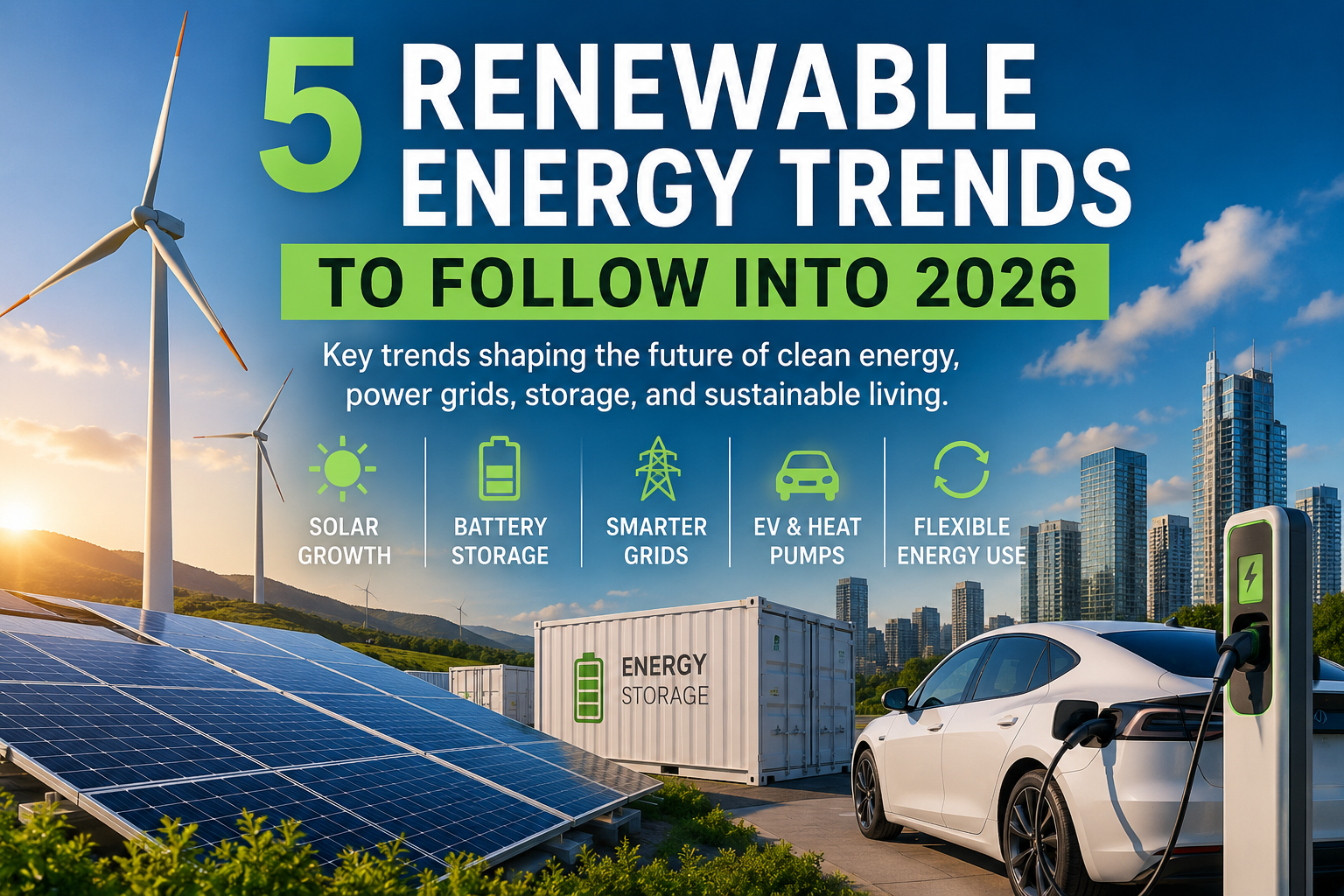
5 Renewable Energy Trends to Follow Into 2026.
Updated: August 18, 2026
The pace of innovation in the renewable energy market has never been faster. More solar panels are being installed around the world, while battery storage is helping households and businesses store electricity for longer periods. At the same time, countries are investing in their power infrastructure to transport and manage the growing amount of electricity being generated. Electric vehicles, heat pumps, and other technologies are also creating new ways to use renewable energy.
For homeowners, businesses, and anyone interested in the future of clean energy, understanding these changes can help make sense of where the renewable energy sector is heading. The 5 renewable energy trends to follow into 2026 show why the renewable energy transition is no longer just about solar and wind. Energy storage, modern power grids, flexible electricity use, and the wider adoption of renewable energy are becoming increasingly important.
In this guide, we explore the most important renewable energy trends 2026 and explain what they could mean for households, businesses, and the wider energy market. We will also look at the key developments, opportunities, and challenges that are shaping the future of renewable energy.
Quick Answer:
The 5 renewable energy trends to follow into 2026 are the rapid expansion of solar power, the growing role of battery storage, major investment in electricity grids and flexibility, the rise of distributed and hybrid renewable systems, and the wider use of renewable energy in transport and heating.
These trends are not simply predictions. Several are already visible in recent global energy data. IRENA reported that the world added 692 GW of renewable power capacity in 2025, taking total renewable capacity to 5,149 GW. Solar accounted for about 511 GW of those additions, while wind added almost 159 GW.
At the same time, the International Energy Agency expects global renewable power capacity to increase by around 4,600 GW between 2025 and 2030, with solar PV making up almost 80% of that expansion.
The important point for 2026 is that renewable energy is no longer only about building more wind turbines and solar panels. Storage, grids, electric vehicles, heat pumps, flexible electricity use, and better integration are becoming equally important.
Table of Contents:
- What Is Driving Renewable Energy Growth in 2026?
- Trend 1: Solar Power Continues to Lead Renewable Energy Growth
- Trend 2: Battery Storage Becomes More Important
- Trend 3: Grids and Flexibility Move to the Center
- Trend 4: Distributed and Hybrid Renewable Systems Expand
- Trend 5: Renewable Energy Moves Further Into Transport and Heating
- Renewable Energy Trends 2026: A Quick Comparison
- What These Trends Mean for Homeowners and Businesses
- Challenges That Could Slow Renewable Energy Growth
- What Should We Watch Through the Rest of 2026?
- Frequently Asked Questions
- Conclusion
What Is Driving Renewable Energy Growth in 2026?
Renewable energy is expanding because several parts of the energy system are changing at the same time.
Solar and wind are adding large amounts of new electricity generation. Electricity demand is also increasing as more vehicles, heating systems, industrial equipment, and digital infrastructure become dependent on electricity.
This creates a new challenge.
It is no longer enough to simply generate more clean electricity. Power systems also need to store it, move it, manage it, and use it at the right time.
The IEA’s Electricity 2026 report highlights this change. Solar PV and wind are expected to increase their combined share of global electricity generation from 17% in 2025 to 27% by 2030. At the same time, more than 2,500 GW of renewable, storage, and large-load projects are reported to be waiting in grid connection queues worldwide.
That is why the most important renewable energy trends 2026 are broader than generation technology alone.
Trend 1: Solar Power Continues to Lead Renewable Energy Growth.
Solar power is likely to remain the biggest story in renewable energy during 2026.
The reason is simple: solar PV can be deployed at many different scales. A homeowner can install panels on a roof, a business can use a larger rooftop system, and utilities can build large solar farms.
Recent data shows just how quickly this market is growing.
According to IRENA, the world added around 511 GW of solar power capacity in 2025, representing roughly three-quarters of all renewable capacity added that year. Solar PV made up almost all of those solar additions.
The IEA also expects solar PV to account for almost 80% of global renewable power capacity expansion between 2025 and 2030.

Why is solar growing so quickly?
Several factors are supporting solar deployment:
- Solar panels can be installed at different scales.
- Rooftop solar allows electricity to be generated close to where it is used.
- Utility-scale solar can be developed relatively quickly compared with some large infrastructure projects.
- Manufacturing has expanded significantly.
- Solar can be combined with batteries and other technologies.
- Many countries view domestic renewable generation as a way to improve energy security.
The growth is not identical everywhere, however.
China remains a major force in global solar deployment, while the United States, India, Europe, the Middle East, Australia, and other markets are also expanding solar capacity.
What does this mean for homeowners?
For households, the solar market is becoming more than a simple question of whether panels generate enough electricity.
People are increasingly considering:
- Solar panels plus battery storage
- Solar self-consumption
- Time-of-use electricity prices
- Electric vehicle charging
- Smart energy management
- Roof space and local sunlight
- Electricity export rules
A solar system that produces electricity during the day may become more useful when paired with technologies that allow households to use more of that electricity later.
The important limitation
Solar’s rapid growth does not mean every solar project will be financially attractive.
Installation costs, financing, electricity prices, grid connection rules, local incentives, export compensation, and available sunlight can all affect the economics.
So, one of the biggest renewable energy trends 2026 is not simply more solar. It is better integration of solar into homes, businesses, and electricity systems.
Trend 2: Battery Storage Becomes More Important.
Solar and wind have one major characteristic that traditional power plants do not: their output depends on natural conditions.
Solar generation changes throughout the day. Wind generation changes with weather conditions.
Battery storage can help bridge the gap between when electricity is produced and when it is needed.
That makes batteries one of the most important supporting technologies for renewable energy.
The IEA reports that utility-scale battery storage additions reached a record 63 GW in 2024, bringing total installed utility-scale battery capacity to 124 GW. It also reported that battery storage project costs fell by about 40% in 2024 to around USD 150 per kWh.
These figures are not a forecast for every market, but they show why storage is becoming increasingly important.

How does battery storage support renewable energy?
Imagine a solar farm producing a large amount of electricity around midday.
Electricity demand may not be at its highest at that exact time.
Instead of allowing all the electricity to be used immediately, some can be stored and released later when demand increases.
At a household level, the same idea can apply.
A home with solar panels might:
- Generate electricity during daylight hours.
- Use some electricity immediately.
- Send surplus electricity into a battery.
- Use stored electricity later in the evening.
- Potentially reduce electricity purchased from the grid.
The exact financial benefit depends on local electricity prices, tariffs, battery costs, incentives, and export rules.
Batteries are becoming part of a larger system.
Another important change is that batteries are not only being used with solar panels.
They can support:
- Grid balancing
- Renewable energy integration
- Electricity demand management
- EV charging
- Backup power
- Peak-demand reduction
- Local energy systems
The IEA says global energy storage capacity would need to increase sixfold to 1,500 GW by 2030 in its pathway for achieving the COP28 goal of tripling renewable capacity while maintaining electricity security.
This does not mean every country must install the same amount of storage. Storage requirements vary by electricity demand, renewable generation, grid design, interconnections, and other flexibility resources.
What to watch in 2026?
Look beyond battery prices.
Important developments include:
- Longer-duration storage
- Utility-scale batteries
- Home batteries
- Battery recycling
- Better energy management
- Grid-connected storage
- More flexible electricity tariffs
The key trend is that renewable energy and energy storage are increasingly being planned as complementary technologies.
Trend 3: Grids and Flexibility Move to the Center.
One of the less visible but most important renewable energy trends 2026 is the growing importance of electricity grids.
Solar panels and wind turbines can be built faster than some grid infrastructure can be planned and completed.
This creates a problem.
A renewable energy project may be ready to produce electricity, but if the local transmission or distribution network cannot accept that electricity, the project may face delays.
The IEA says more than 2,500 GW of renewable, storage, and large-load projects are currently stalled in grid connection queues worldwide. It also estimates that annual grid investment would need to rise by roughly 50% by 2030 from today’s USD 400 billion level to meet forecast electricity demand.

This makes grid development a major part of the renewable energy story.
Why do renewable energy projects need stronger grids?
Solar and wind resources are not always located close to population centers.
For example, a large solar project may be built in an area with excellent sunlight but relatively low local electricity demand.
Electricity may then need to travel long distances through transmission networks.
At the same time, cities are adding new electricity demand from:
- Electric vehicles
- Heat pumps
- Data centers
- Industrial electrification
- Air conditioning
- Electric heating
The grid therefore has to handle both more generation and more demand.
Flexibility is becoming just as important.
A modern electricity system needs to respond to changing supply and demand.
Flexibility can come from several sources:
| Flexibility option | What it can do |
|---|---|
| Battery storage | Store electricity and release it later |
| Demand response | Shift electricity use to better times |
| Stronger transmission | Move electricity between regions |
| Smart EV charging | Charge vehicles when electricity is more available |
| Flexible heating | Shift some heating demand |
| Hydropower | Adjust output where system conditions allow |
| Better forecasting | Improve planning for variable generation |
The IEA describes demand response as an increasingly important tool as solar, wind, EVs, heat pumps, and other electricity-dependent technologies expand.
Why this matters to ordinary electricity users?
Grid flexibility can eventually affect the way households use electricity.
For example, a smart system could encourage a home to charge an EV or run certain appliances when electricity is cheaper or more readily available.
That could make electricity consumption more flexible instead of treating demand as something that never changes.
So, when following renewable energy trends into 2026, it is worth watching grids, smart meters, demand response, storage, and flexible electricity pricing alongside solar and wind.
Trend 4: Distributed and Hybrid Renewable Systems Expand.
Renewable energy is becoming increasingly distributed.
Instead of relying only on large power plants, electricity can come from many smaller systems located closer to consumers.
Examples include:
- Rooftop solar
- Community solar
- Small commercial solar
- Home batteries
- Solar-plus-storage systems
- Microgrids
- Hybrid renewable projects

This model can be especially useful where grid infrastructure is limited or where local electricity demand is growing.
What is a hybrid renewable energy system?
A hybrid system combines different technologies to improve how energy is produced and used.
One example is:
Solar + wind + battery storage
Solar may generate more electricity during sunny daytime hours, while wind production may occur at different times. A battery can help store surplus electricity.
Another example is:
Solar + battery + EV charging
A household or business can use solar electricity to charge an EV and store some surplus electricity for later use.
The exact combination depends on local conditions.
Why are hybrid systems becoming more attractive?
A single renewable technology does not always match electricity demand perfectly.
Combining technologies can improve the overall energy profile.
For example:
- Solar can produce strongly during daylight.
- Wind may produce at night or during different weather conditions.
- Batteries can shift electricity over time.
- Flexible loads can change when electricity is consumed.
The goal is not necessarily to become completely independent from the grid.
In many cases, the more practical objective is to use renewable electricity more efficiently while reducing exposure to expensive or high-demand periods.
Distributed energy also has limitations.
Local renewable systems still depend on:
- Upfront investment
- Available space
- Local regulations
- Equipment quality
- Grid connection
- Maintenance
- Weather
- Electricity tariffs
A battery does not automatically make every solar system financially worthwhile.
Consumers should compare the total cost of equipment, installation, financing, maintenance, expected electricity savings, and local incentives before making a decision.
Trend 5: Renewable Energy Moves Further Into Transport and Heating.
Renewable energy is increasingly moving beyond electricity generation.
Two important areas are transport and heating.
This matters because the energy transition is not only about replacing fossil-fuel power plants.
Cars, buildings, factories, and other sectors also consume large amounts of energy.
Renewable energy and transport.
Electric vehicles create a connection between renewable electricity and transportation.
When an EV is charged with electricity generated from renewable sources, renewable energy becomes part of the transportation system.
The IEA expects renewable energy consumption in transport to increase by around 50% between 2025 and 2030. Renewable electricity used by EVs is expected to provide the largest share of this growth, followed by biofuels.

Other renewable fuels will also have roles.
These include:
- Biofuels
- Biomethane
- Renewable hydrogen
- Hydrogen-based fuels
- Sustainable aviation fuels
However, these technologies should not be treated as interchangeable.
Different transport sectors have different requirements.
Battery-electric vehicles are particularly relevant for many road applications, while renewable fuels may have a larger role in areas that are more difficult to electrify directly, including parts of aviation and shipping.
Renewable energy and heating.
Heating is another major opportunity.
Heat pumps can use electricity to move heat from the surrounding environment into buildings.
When powered by an increasingly renewable electricity system, heat pumps can become an important part of lower-carbon heating.
The IEA expects renewable heat consumption to increase by more than 42% globally from 2025 to 2030. Renewable electricity is expected to provide a major part of this growth, particularly in buildings and industry.
In buildings, the IEA expects modern renewable heat use to expand significantly, with renewable electricity becoming increasingly important.
Industrial heat is also changing.
Some industries are exploring:
- Electric boilers
- Industrial heat pumps
- Electric furnaces
- Renewable electricity for process heat
- Biomass residues
- Geothermal heat
This trend shows that renewable energy is gradually becoming connected to more parts of everyday life and the wider economy.
Renewable Energy Trends 2026: A Quick Comparison
| Trend | Why it matters | What to watch in 2026 |
|---|---|---|
| Solar power | Main source of new renewable capacity | Solar deployment, costs, rooftop systems and large projects |
| Battery storage | Helps match supply with demand | Utility batteries, home storage and longer-duration systems |
| Grids and flexibility | Allows more renewable electricity to be connected and managed | Grid investment, connection queues and demand response |
| Distributed and hybrid systems | Brings generation, storage and demand closer together | Solar-plus-storage, microgrids and smart energy systems |
| Renewable transport and heating | Expands clean energy beyond electricity generation | EV charging, heat pumps, renewable fuels and industrial electrification |
What These Trends Mean for Homeowners and Businesses
The renewable energy market can sometimes feel like it is driven entirely by large power plants and government policy.
But many of these changes are already relevant at the household and business level.
For homeowners.
People considering renewable energy may want to look at the complete energy system rather than solar panels alone.
Questions worth asking include:
- How much electricity does the property use?
- When is electricity used during the day?
- Would a battery increase self-consumption?
- Is an EV planned?
- Could a heat pump be useful?
- What are the local electricity rates?
- How is exported electricity compensated?
- What incentives are available?
- How long is the expected payback period?
The right answer will vary from one household to another.
For businesses.
Businesses have additional opportunities.
Commercial buildings with large daytime electricity demand may be able to use rooftop solar directly.
Companies with suitable electricity loads may also explore:
- Solar generation
- Battery storage
- EV fleets
- Smart charging
- Energy management
- Demand response
- Renewable electricity contracts
For energy-intensive businesses, the value of renewable energy may also involve energy security and exposure to electricity price changes, not only emissions reductions.
Challenges That Could Slow Renewable Energy Growth.
Renewable energy is growing quickly, but the transition is not guaranteed to be smooth.
Several challenges deserve attention.
1. Grid congestion:
A lack of transmission and distribution capacity can delay renewable projects.
The IEA identifies grid connection queues as a major global bottleneck.
2. Financing:
Renewable projects require significant upfront investment.
Higher financing costs can make some projects less attractive even when technology costs are competitive.
3. Supply chains:
Solar panels, batteries, wind turbines, transformers, cables, and other equipment require large industrial supply chains.
Changes in trade policy or manufacturing capacity can affect project costs and delivery schedules.
4. Permitting:
A renewable project can require land approvals, environmental assessments, grid connections, construction permits, and other regulatory steps.
Slow permitting can delay deployment.
5. Weather variability:
Solar and wind output naturally changes.
This does not make renewable energy unreliable by itself, but it means electricity systems need adequate flexibility, forecasting, storage, transmission, and other balancing resources.
6. Policy changes:
Renewable energy investment often depends on national and local policy.
Changes to incentives, taxes, permitting rules, grid regulations, or clean-energy targets can change the outlook for specific markets.
The IEA’s 2025 renewable forecast illustrates this point: its global 2025–2030 renewable capacity forecast was revised downward by 5% compared with the previous year because of policy, regulatory, and market changes.
This is an important reminder: renewable energy forecasts are forecasts, not guarantees.
What Should We Watch Through the Rest of 2026?
If you want to keep track of the renewable energy market without following every industry announcement, focus on a few practical indicators.
Watch solar deployment:
Solar remains the largest driver of renewable capacity growth.
Watch battery deployment:
Storage will show how electricity systems are adapting to higher shares of solar and wind.
Watch grid investment:
Grid development could become one of the biggest constraints on renewable expansion.
Watch electricity demand:
EVs, cooling, heating, industry, and data centers are all changing electricity demand.
Watch policy:
Government policies can quickly affect renewable investment.
Watch the relationship between generation and demand:
A future with abundant solar electricity will require ways to use that electricity effectively.
That could mean batteries, EV charging, heat pumps, flexible industrial demand, transmission, and other solutions.
Are These Renewable Energy Trends Guaranteed?
No.
This distinction is important.
The trends discussed in this article are based on current deployment data, official forecasts, policy developments, and technology changes. They should not be interpreted as guaranteed outcomes.
For example, solar is clearly expanding rapidly, but individual solar markets can experience periods of slower growth.
Battery storage is growing quickly, but its economics vary between countries.
Grid investment is receiving more attention, but permitting and construction can take years.
Renewable fuels are expanding in some sectors, but their commercial development is still uneven.
In other words, the overall direction can be strong while individual technologies, countries, and projects experience very different results.
Frequently Asked Questions.
1. What are the biggest renewable energy trends to follow into 2026?
The biggest renewable energy trends to follow into 2026 include rapid solar growth, battery energy storage, stronger electricity grids, distributed energy systems, and the growing use of renewable electricity in electric vehicles, heating, and industry.
2. What is the fastest-growing renewable energy source in 2026?
Solar power is currently the leading source of new renewable power capacity globally. Its relatively flexible deployment, expanding manufacturing capacity, and use in both large solar farms and rooftop systems are supporting continued growth.
3. Why is battery storage becoming so important for renewable energy?
Battery storage helps solve one of the main challenges of solar and wind power: electricity is not always generated when people need it. Batteries can store surplus electricity and release it later, helping improve flexibility and making it easier to integrate renewable energy into the power grid.
4. How will electricity grids affect renewable energy growth in 2026?
Electricity grids will play a major role because new solar, wind, batteries, EVs, and other technologies are increasing both electricity supply and demand. Grid upgrades and faster connections can help renewable energy projects deliver electricity to where it is needed.
5. Will solar and battery storage become more common in homes in 2026?
Solar and battery storage are expected to remain important options for households, but their value depends on factors such as electricity prices, installation costs, local regulations, available sunlight, incentives, and how much electricity a household uses. A solar-plus-battery system is not automatically the best choice for every home.
6. What role will electric vehicles play in renewable energy?
Electric vehicles can increase demand for electricity while also creating an opportunity to use more renewable power for transportation. Smart charging can help EV owners charge when electricity is more available or less expensive, depending on the local electricity market.
7. Will renewable energy replace fossil fuels by 2030?
Renewable energy is expected to grow substantially through 2030, but it would be misleading to say that fossil fuels will completely disappear by then. Electricity, transport, heating, and industry are transitioning at different speeds, and the pace varies significantly between countries.
8. What should consumers watch in renewable energy during 2026?
Consumers should watch developments in solar prices, battery storage, electricity tariffs, grid upgrades, EV charging, heat pumps, and government energy policies. These factors can influence both the adoption and financial value of renewable energy technologies.
Conclusion:
The renewable energy sector is changing quickly, and 2026 is an important year to watch. Solar power, battery storage, smarter grids, flexible electricity use, EVs, and heat pumps are all shaping how clean energy will be produced and used.
The 5 renewable energy trends to follow into 2026 show that the future is not about one technology alone. The real progress will come from connecting renewable generation with better storage, stronger grids, and smarter energy use.
For homeowners, businesses, and anyone following the clean-energy transition, these are the developments worth watching as renewable energy continues to become a bigger part of everyday life.
The IEA expects renewable power capacity to expand by about 4,600 GW from 2025 to 2030, while IRENA’s latest data shows that global renewable capacity additions reached a record 692 GW in 2025.
Those figures suggest that renewable energy will remain one of the most important areas to watch through 2026 and beyond.
However, the transition will not happen automatically. Grid investment, sensible policies, financing, supply chains, permitting, storage, and responsible planning will all influence how quickly renewable energy can grow.
For readers trying to understand the future of energy, that is perhaps the most useful takeaway: the renewable energy transition is becoming less about a single technology and more about how many technologies work together.
About the Author:
At SustainTechNow, we focus on making sustainable technology, renewable energy, and climate-related topics easier to understand.
Our content is researched using publicly available information from trusted sources such as government agencies, international energy organizations, research institutions, and other reliable publications. We aim to explain complex topics in simple language and clearly distinguish established facts from forecasts and changing industry developments.
This article is intended for general information and should not be treated as financial, engineering, or professional energy advice.
TOPCon vs HJT Solar Panels Efficiency 2026
Smart Water Level Monitoring Systems for Eco Friendly Homes
Recommended External Sources:
For publication, the strongest supporting sources for this article are official and primary sources:
- International Energy Agency — Renewables 2026— Global renewable-energy forecasts through 2030.
- International Energy Agency — Electricity 2026 — Current electricity, grid, storage, and flexibility outlook.
- IRENA — Renewable Capacity Statistics 2026 — Global renewable capacity data through 2025.
- IRENA — Renewable Energy Statistics 2026 — Global renewable energy statistics and historical data.