

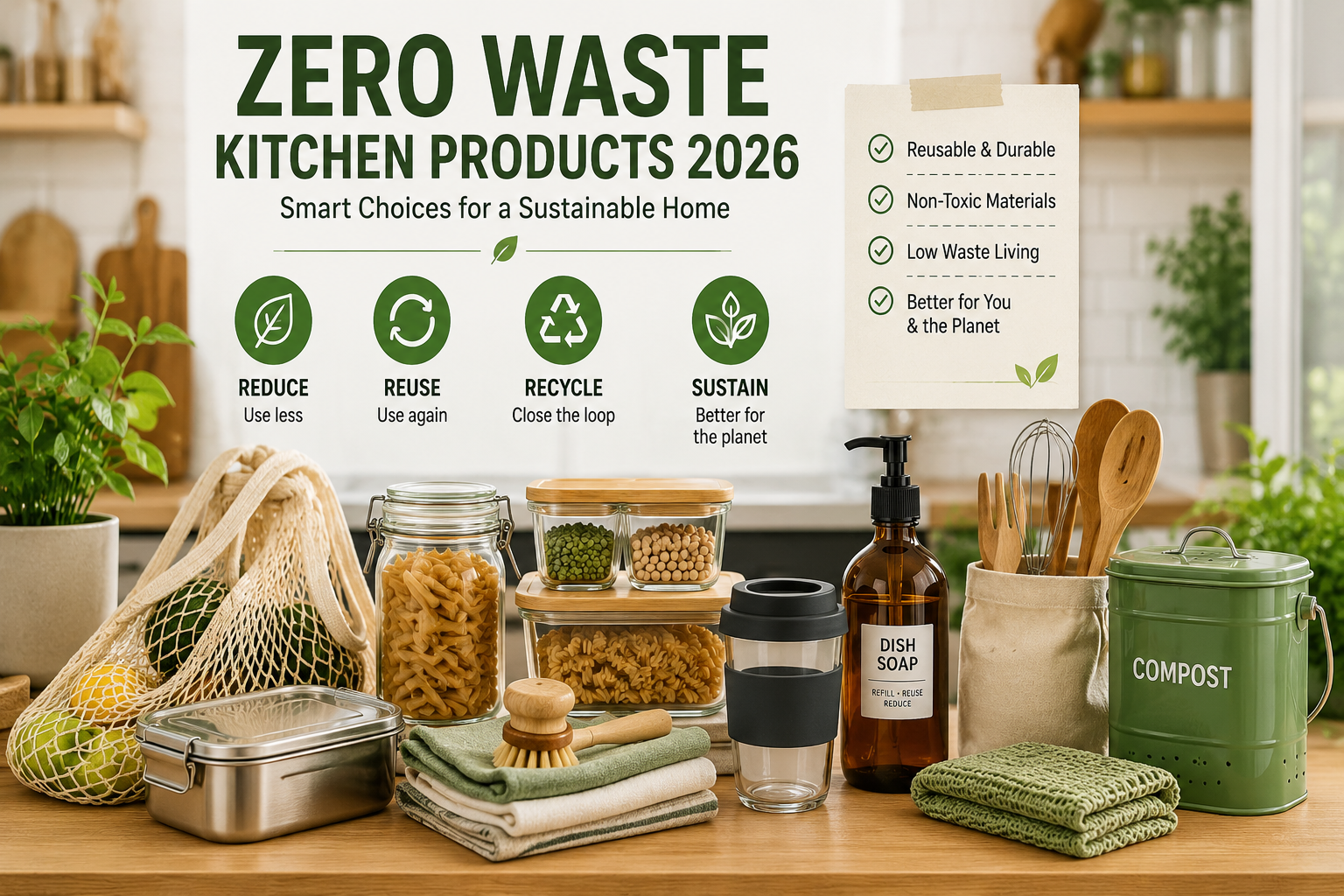
Zero Waste Kitchen Products 2026: Practical Sustainable Choices for a Low-Waste Home
Publication date: August 18, 2026
A kitchen can look clean and organized while still producing a surprising amount of everyday waste—from disposable food bags and paper towels to plastic packaging and forgotten leftovers. The good news is that creating a lower-waste kitchen does not require expensive renovations or replacing everything you already own. The right zero waste kitchen products 2026 can help you reduce single-use items, store food more efficiently, and build practical habits that last.
From reusable food containers and washable kitchen cloths to refillable dispensers and durable storage solutions, today’s sustainable kitchen products make it easier to cut unnecessary waste without making everyday cooking complicated. In this guide, we’ll look at the most useful options, what to consider before buying them, and how to create a more sustainable kitchen without turning zero-waste living into unnecessary shopping.
Table of Contents:
- Quick Answer: What Are the Best Zero Waste Kitchen Products in 2026?
- What Does a Zero Waste Kitchen Really Mean?
- Why Zero Waste Kitchen Products Matter
- Best Zero Waste Kitchen Products 2026
- Reusable Food Storage Products
- Reusable Alternatives to Disposable Kitchen Items
- Kitchen Products That Help Reduce Food Waste
- Reusable Cleaning Products for a Lower-Waste Kitchen
- How to Choose Sustainable Kitchen Products
- Pros and Cons of Zero Waste Kitchen Products
- Materials: Which Choices Make Sense?
- Common Zero-Waste Shopping Mistakes
- How to Build a Zero Waste Kitchen on a Budget
- Are Zero Waste Products Always More Sustainable?
- Frequently Asked Questions
- Conclusion
Quick Answer: What Are the Best Zero Waste Kitchen Products in 2026?
The most useful zero waste kitchen products 2026 are not necessarily the newest or most expensive items. In most homes, the practical starting point is products that replace frequently discarded items and can be used repeatedly.
Useful options include:
- Reusable food containers
- Reusable silicone or fabric food bags
- Glass jars and containers
- Reusable produce bags
- Cloth kitchen towels
- Washable cleaning cloths
- Refillable soap dispensers
- Durable dish brushes with replaceable heads
- Reusable food covers
- Compost or food-scrap collection containers
- Reusable shopping and grocery bags
- Reusable coffee and tea accessories
- Food storage organizers that make older food easier to see
- Durable cooking utensils designed for long-term use
The most important point is simple: buying less and using what you already own is often more aligned with zero-waste living than replacing perfectly good kitchen items with new “eco” products.
Environmental claims also need to be examined carefully. The U.S. Federal Trade Commission warns that broad claims such as “eco-friendly” can give consumers an overly broad impression of environmental benefits, while claims such as recyclable, compostable, or made with recycled content need appropriate support and qualification.
What Does a Zero Waste Kitchen Really Mean?
A zero waste kitchen is a kitchen designed to reduce the amount of material sent to landfill, incineration, or other disposal systems.
The phrase “zero waste” does not mean that a household will literally produce no waste. Food packaging, broken products, unavoidable food scraps, and other materials can still occur.
Instead, the goal is to rethink everyday habits around:
- Buying
- Storing
- Cooking
- Eating
- Cleaning
- Reusing
- Repairing
- Recycling
- Composting
- Disposal
This is why sustainable kitchen products should be viewed as tools rather than a complete solution.
For example, a reusable container can replace disposable packaging many times. But if someone buys a large collection of containers they rarely use, the purchase itself may add unnecessary material consumption.
Why Zero Waste Kitchen Products Matter?
The kitchen is one of the easiest areas of the home to improve because it combines food, packaging, cleaning supplies, disposable products, and everyday consumption.
A small change can become a repeated habit.
For example:
Disposable paper towel → washable kitchen cloth
Single-use food bag → reusable food bag
Disposable food wrap → reusable food cover
New plastic storage containers → existing jars or durable containers
Individually packaged cleaning products → refillable system
The benefit comes from repeated use.
However, environmental impact depends on more than whether something is reusable. Manufacturing materials, transportation, product lifespan, cleaning requirements, and end-of-life options can all matter.
This is an important reason to avoid simplistic statements such as “reusable always means better.”
Best Zero Waste Kitchen Products 2026.
The following categories are practical starting points for a low-waste kitchen.
| Product | What it replaces | Why it can be useful | What to check |
|---|---|---|---|
| Reusable food containers | Disposable containers | Long-term food storage | Durability, repairability, material |
| Reusable food bags | Single-use bags | Useful for snacks and food storage | Seal quality and washing |
| Glass jars | Disposable storage packaging | Can be reused for many purposes | Weight and breakability |
| Cloth towels | Paper towels | Washable and reusable | Fabric durability |
| Reusable food covers | Disposable wrap | Keeps food covered | Ease of cleaning |
| Produce bags | Disposable produce bags | Useful for loose produce | Washability |
| Refillable soap dispenser | New soap bottles | Supports refill systems | Refill availability |
| Replaceable-head dish brush | Disposable brush | Reduces full-product replacement | Replacement heads |
| Food-scrap container | Loose food waste | Keeps scraps organized | Easy cleaning and suitable size |
| Reusable shopping bags | Disposable shopping bags | Designed for repeated trips | Strength and lifespan |
There is no single “best” product for every household. The right choice depends on what you currently throw away most often.
Reusable Food Storage Products.
Food storage is one of the most useful areas for introducing zero waste kitchen products 2026 into everyday routines.

1. Reusable Food Containers.
Durable containers can replace disposable takeaway containers, food bags, and some plastic wrap.
Glass containers are popular because they can be used for storage and, where the manufacturer’s instructions allow it, reheating. Plastic containers can also be practical when they are durable and properly maintained.
When choosing a container, consider:
- Size
- Lid quality
- Ease of cleaning
- Stackability
- Durability
- Replacement lid availability
- Whether the material suits your intended use
Avoid buying a large matching set simply because it looks attractive.
Start with the sizes you actually need.
2. Reusable Food Bags.
Reusable bags can be useful for:
- Sandwiches
- Snacks
- Cut vegetables
- Bread
- Small leftovers
- Freezer storage, where the product is specifically designed for it
A reusable bag is most useful when it is easy enough to wash and dry that you will actually keep using it.
If cleaning the bag is inconvenient, it may end up sitting unused.
3. Glass Jars.
Before purchasing new storage containers, look around your kitchen.
Glass jars from foods such as sauces, pickles, or other packaged products may be suitable for reuse depending on their condition and intended use.
They can hold:
- Dry foods
- Spices
- Beans
- Grains
- Homemade mixes
- Small kitchen ingredients
This is one of the simplest zero-waste habits because it extends the useful life of something you already own.
Reusable Alternatives to Disposable Kitchen Items.
A zero-waste kitchen does not require replacing everything at once.
Instead, identify the disposable items you use most frequently.
Paper Towels.
Washable kitchen cloths can replace many everyday paper-towel tasks.
A practical system might include:
- Several washable cloths
- One container for clean cloths
- One place for used cloths
- Regular washing
The goal is convenience.
If reusable cloths are difficult to find or clean, people are less likely to use them consistently.
Food Wrap.
Reusable food covers can reduce reliance on disposable food wrap.
Options include washable covers and reusable containers.
The best option depends on what you usually store.
For a bowl of leftovers, a fitted reusable cover may be convenient. For food that needs to travel, a container may work better.
Disposable Shopping Bags.
Reusable grocery bags are among the simplest sustainable kitchen products to adopt.
The key is remembering them.
Keep bags somewhere visible, such as:
- Near the entrance
- In a car
- With other shopping supplies
- Near your regular grocery storage area
A reusable bag that is forgotten at home cannot replace a disposable bag during the shopping trip.
Kitchen Products That Help Reduce Food Waste
Zero waste is not only about packaging.
Preventing edible food from being thrown away is an important part of a lower-waste kitchen.
That means some of the most useful products are ordinary storage and organization tools.
Transparent Food Containers.
Transparent containers make leftovers easier to see.
This can reduce the “forgotten food” problem because food is visible when you open the refrigerator.
Labeling containers with the date can also help you remember when food was stored.
Produce Storage Containers.
Some foods last better when stored appropriately.
Rather than buying specialized products for every type of produce, first understand how the foods you regularly purchase should be stored.
The U.S. Department of Agriculture provides food-safety and storage guidance that can help households make informed decisions about storing and handling food.
For a zero-waste kitchen, the objective is not simply to make food last forever. It is to reduce unnecessary spoilage while maintaining safe food-handling practices.
Freezer Containers.
Freezing suitable foods can help households use food later rather than discarding it.
Use containers or bags specifically suitable for freezing, follow manufacturer guidance, and leave appropriate space for expansion where needed.
Reusable Cleaning Products for a Lower-Waste Kitchen.
Cleaning can generate a surprising amount of packaging and disposable material.
A lower-waste approach can include.
Washable Cleaning Cloths:
Use washable cloths for surfaces instead of relying entirely on disposable wipes or paper towels.
Refillable Soap Dispensers:
Instead of purchasing a new dispenser every time, choose a durable dispenser that can be refilled.
But look beyond the container.
A refill system only makes practical sense if refills are actually available and the overall system is convenient.
Replaceable-Head Brushes:
A brush with a replaceable head can be more useful than throwing away the entire handle when the head wears out.
This illustrates a useful design principle:
Replace the worn part instead of replacing the whole product.
That principle can apply to kitchen brushes, cleaning tools, and other household products.
How to Choose Sustainable Kitchen Products.
The term “sustainable” can mean different things depending on what is being measured.
A product may use recycled material but have a short lifespan. Another may be extremely durable but difficult to recycle at the end of its useful life.
1. Will I Use It Frequently?
A reusable product is most useful when it replaces something you regularly consume.
2. Is It Durable?
Look for products designed for repeated use.
3. Can It Be Repaired?
Replaceable components can extend useful life.
4. Can It Be Refilled?
Refill systems may reduce packaging waste when the system is practical and genuinely reduces material use.
5. Can I Recycle It Locally?
Recycling depends on local collection systems.
A material being technically recyclable does not automatically mean it is accepted in your local recycling program.
The FTC specifically cautions that recyclable claims should be qualified when appropriate recycling facilities are not sufficiently available to consumers.
6. Is the Environmental Claim Specific?
Be cautious with vague labels such as:
- Eco-friendly
- Green
- Planet-safe
- Sustainable
- Earth-friendly
A specific claim is generally more useful.
For example:
“Made with 50% recycled material”
is more informative than simply saying:
“Eco-friendly.”
The FTC’s Green Guides emphasize that broad environmental claims can be misleading when consumers may interpret them as suggesting broad environmental benefits.
Pros and Cons of Zero Waste Kitchen Products.
Choosing zero waste kitchen products 2026 can make everyday kitchen habits more sustainable, but there are both advantages and limitations to consider. Reusable products can reduce dependence on disposable items, while durable products may last for years. However, buying too many “eco-friendly” products or replacing items that still work can create unnecessary consumption.
Pros
1. Less Single-Use Waste.
Reusable food containers, shopping bags, kitchen cloths, and food covers can reduce the need for many disposable products.
2. Can Save Money Over Time.
A durable product may cost more at first, but repeated use can make it more economical than continually buying disposable alternatives.
3. Encourages Better Kitchen Habits.
Having reusable products within easy reach can make habits such as reusing, storing leftovers, and avoiding unnecessary packaging easier.
4. Helps Reduce Packaging.
Refillable products and reusable storage options can reduce the amount of packaging entering your home.
5. Can Support a More Organized Kitchen.
Reusable containers, jars, and storage systems can make food and kitchen supplies easier to organize and find.
Cons:
1. Higher Upfront Cost.
Some sustainable kitchen products cost more initially than their disposable alternatives.
2. They Need Regular Cleaning.
Reusable bags, containers, bottles, and cloths need to be washed and maintained. If they are inconvenient to clean, they may not be used consistently.
3. Buying Too Much Can Defeat the Purpose.
A common mistake is purchasing a large collection of new “zero-waste” products without actually needing them. Using products you already own is often the better starting point.
4. Not Every Material Has the Same Environmental Impact.
Glass, stainless steel, plastic, silicone, bamboo, and other materials have different advantages and limitations. A product should not be considered automatically sustainable simply because it uses a particular material.
5. Recycling and Composting Depend on Location.
A product may be technically recyclable or compostable but not accepted by your local waste-management system. Always check local guidelines before relying on these claims.
The goal of a zero-waste kitchen is not to buy as many “green” products as possible. The better approach is to buy fewer, choose durable products, use them regularly, and keep existing items in use for as long as practical.
Materials: Which Choices Make Sense?
There is no single winner when it comes to kitchen materials.
Glass.
Advantages:
- Reusable
- Easy to see through
- Suitable for many food-storage applications
- Does not depend on disposable packaging
Limitations:
- Heavy
- Can break
- Requires careful handling
Stainless Steel.
Advantages:
- Durable
- Useful for many kitchen applications
- Resistant to corrosion under normal conditions
Limitations:
- Can cost more initially
- Not transparent
- Different products have different manufacturing and end-of-life characteristics
Silicone.
Silicone is commonly used for reusable bags, food covers, baking products, and other kitchen applications.
Its usefulness depends heavily on product quality and how long it remains in service.
Plastic.
Plastic is not automatically incompatible with a lower-waste kitchen.
A durable plastic container that is used for years can be more useful than repeatedly purchasing disposable items.
The important questions are:
- Is it durable?
- Will I use it?
- Is it appropriate for the intended food-storage purpose?
- Can parts be replaced?
- What happens when it reaches the end of its life?
Bamboo and Other Plant-Based Materials.
Plant-based materials can be useful, but consumers should avoid assuming that “plant-based” automatically means compostable or environmentally harmless.
The entire product and its disposal route matter.
Common Zero-Waste Shopping Mistakes.
A zero-waste lifestyle can accidentally become a shopping hobby.
That is one of the biggest mistakes to avoid.
Mistake 1: Buying Too Many Reusable Products.
You do not need ten versions of the same item.
Buy according to actual household needs.
Mistake 2: Replacing Useful Products Too Early.
If your existing kitchen towel, container, utensil, or storage box still works, continuing to use it may be more sensible than replacing it with a newer “eco” alternative.
Mistake 3: Believing Every Green Label.
A leaf symbol or environmental phrase does not automatically tell you how a product performs across its entire life cycle.
Look for specific, verifiable information.
Mistake 4: Ignoring Local Recycling.
A product can be recyclable in theory but difficult to recycle where you live.
Check local waste-management instructions.
Mistake 5: Forgetting Food Waste.
Someone can avoid plastic straws and buy reusable bags while still throwing away large amounts of edible food.
A broader approach looks at the whole kitchen.
How to Build a Zero Waste Kitchen on a Budget.
You do not need to spend hundreds of dollars to begin.
Try this simple progression.
Step 1: Observe Your Waste
For one or two weeks, notice what your kitchen throws away most often.
Is it:
- Food packaging?
- Paper towels?
- Food scraps?
- Plastic bags?
- Disposable containers?
- Takeaway packaging?
Step 2: Choose One Problem.
Do not try to change everything at once.
If paper towels are your biggest recurring waste, start with washable cloths.
If disposable food containers are common, start with durable storage containers.
Step 3: Use What You Already Have.
Old jars, containers, towels, and shopping bags may already solve some of the problems.
Step 4: Buy Only the Missing Tool.
Once you know what you actually need, purchase one durable product that addresses that problem.
Step 5: Create a Routine.
The product matters less than the habit.
For example:
Shopping → unpack → store → wash reusable bags → return bags to the shopping area
The routine makes reuse automatic.
Are Zero Waste Products Always More Sustainable?
No.
This is an important limitation.
The environmental impact of a product can depend on:
- Material extraction
- Manufacturing
- Product lifespan
- Transportation
- Cleaning
- Packaging
- Frequency of use
- Repairability
- Recycling or disposal
Therefore, it is difficult to make a universal statement that one material or product is always environmentally superior.
Consider a simple example.
Someone owns five perfectly functional food containers. They discover a new “sustainable” container set and replace all five.
The household may now own more products without necessarily reducing waste.
A different household might buy one durable container because it replaces hundreds of disposable containers over time.
The second purchase has a clearer practical purpose.
This is why zero waste kitchen products 2026 should be approached as part of a consumption strategy rather than as a shopping category.
A Simple Zero-Waste Kitchen Setup for 2026
If you are starting from scratch, a practical setup might include:
- A few durable food containers
- Several washable kitchen cloths
- Reusable shopping bags
- A few reusable food-storage bags
- A refillable soap dispenser
- A durable dish brush
- A small food-scrap collection container
- Reusable food covers
- A small set of reusable produce bags
- Existing jars reused for dry storage
You do not need all ten.
The best starting point is the item that solves a real recurring waste problem in your kitchen.
What Should You Look for on Product Labels?
When choosing zero waste kitchen products 2026, do not rely only on words such as “eco-friendly,” “green,” or “sustainable.” These terms can sound convincing but may not explain what environmental benefit a product actually provides. Instead, look for specific and verifiable information about the material, durability, reuse, recycling, or composting process.
1. Recycled Content:
If a product says it is made with recycled material, check whether the label provides a specific percentage or explains what type of recycled material is used.
For example, “made with 50% recycled material” gives you more useful information than simply saying “eco-friendly.”
2. Recyclable:
A recyclable label does not necessarily mean the product can be recycled everywhere.
Recycling systems vary between countries, cities, and municipalities. Before buying, check whether your local recycling service accepts that particular material.
3. Compostable:
Be careful with the word “compostable.”
Some products are designed for commercial or industrial composting rather than ordinary home composting. If you want to compost a product at home, check that the manufacturer specifically states that it is suitable for home composting and follow your local composting guidance.
4. Refillable:
A refillable product can be useful when the refill system genuinely reduces packaging and is convenient enough to use regularly.
For example, a durable soap dispenser that can be refilled may help reduce the need to purchase a new dispenser each time.
5. Durability and Warranty:
For sustainable kitchen products, durability is often more useful than an attractive environmental label.
Look for information such as:
- Product warranty
- Expected use or care instructions
- Replacement parts
- Replaceable components
- Repair options
- Manufacturer support
A product that remains useful for years can be more practical than one that needs frequent replacement.
6. Material Information:
Check what the product is actually made from.
Common kitchen materials include:
- Glass
- Stainless steel
- Plastic
- Silicone
- Bamboo
- Cotton
- Wood
No single material is automatically the best choice for every situation. Consider how durable it is, how you will use it, how it should be cleaned, and what happens when it reaches the end of its useful life.
7. Specific Environmental Claims.
Be cautious about broad phrases such as:
- “100% eco-friendly”
- “Planet safe”
- “Green product”
- “Zero impact”
- “Good for the planet”
A specific claim is easier to understand and evaluate than a broad environmental promise.
The U.S. Federal Trade Commission’s Green Guides address environmental marketing claims, including recyclable, compostable, recycled-content, and refillable claims. They emphasize that environmental claims should be supported and should not give consumers a misleading impression of a product’s overall environmental benefits.
Expert or Official Perspective: What Should Consumers Trust?
For environmental product claims, official guidance is more useful than attractive marketing language.
The U.S. Federal Trade Commission’s Green Guides are particularly relevant to consumers and publishers discussing environmental claims. They cover areas including recyclable, compostable, recycled-content, refillable, renewable-material, and general environmental claims.
The important lesson is not that every sustainable product is misleading.
It is that consumers should ask what specific environmental benefit is being claimed and what evidence supports it.
For food safety and household food storage, government food-safety guidance should take priority over social-media tips or unsupported product claims.
For readers outside the United States, local waste-management authorities should be checked because recycling and composting infrastructure differs significantly between countries and even between municipalities.
Frequently Asked Questions.
1. What are the best zero waste kitchen products 2026?
The best options are generally durable reusable products that replace items you regularly throw away. Useful categories include reusable containers, washable cloths, food-storage bags, refillable dispensers, reusable food covers, and durable cleaning tools.
2. Are zero waste kitchen products actually better for the environment?
They can be, particularly when they replace frequently used disposable products and are used for a long time. However, no product should be considered automatically better simply because it is labeled reusable or sustainable.
3. What is the easiest zero-waste kitchen product to start with?
Washable kitchen cloths and reusable shopping bags are simple starting points because they can replace common single-use items without requiring major changes to the kitchen.
4. Is glass better than plastic for a zero-waste kitchen?
Not in every situation. Glass is durable and useful for many storage applications but is heavier and breakable. A durable plastic container that is used for years can also support a lower-waste kitchen.
5. Are compostable kitchen products always compostable at home?
No. Some products require specific commercial or industrial composting conditions. Always check the manufacturer’s instructions and your local composting system.
The FTC specifically recommends qualifying compostable claims when home composting is not appropriate or when relevant composting facilities are not widely available.
6. How can I make my kitchen zero waste without spending much money?
Start by using what you already have. Reuse suitable jars, switch to washable cloths, carry existing reusable bags, plan food purchases carefully, and buy new products only when they solve a recurring waste problem.
7. What does “sustainable kitchen products” mean?
It generally refers to kitchen products designed or selected with factors such as durability, reuse, repairability, refillability, material use, or end-of-life considerations in mind. The term itself is broad, so specific product information matters.
8. Should I replace all my kitchen products with zero-waste alternatives?
No. Replacing functioning products simply to obtain a newer “eco” version can create unnecessary consumption. Use existing products until replacement is genuinely needed, then choose a durable option.
Conclusion:
A lower-waste kitchen does not require perfection or a complete collection of specialized products.
The most useful approach to zero waste kitchen products 2026 is to focus on repeated everyday actions: buying only what you need, storing food properly, reusing suitable containers, replacing disposable products where practical, choosing durable goods, and disposing of unavoidable waste responsibly.
The strongest sustainable kitchen products are not necessarily the products with the most attractive environmental packaging or the biggest “green” label. They are products that solve a real household problem, remain useful for a long time, and help reduce unnecessary consumption.
Before buying anything new, ask three questions:
Do I need it?
Will I use it regularly?
Can I keep it in use for a long time?
That simple approach can make a zero-waste kitchen more affordable, realistic, and sustainable in everyday life.

5 Renewable Energy Trends to Follow Into 2026

TOPCon vs HJT Solar Panels Efficiency 2026
Recommended External Sources.
- U.S. Federal Trade Commission — Green Guides
Useful for understanding environmental marketing claims such as recyclable, compostable, recycled content, refillable, and broad “eco-friendly” claims. - U.S. Federal Trade Commission — Environmental Marketing
Useful for checking whether environmental product claims are adequately supported. - EPA — Sustainable Materials Management
- FTC — Green Guides
For a global audience, pair U.S. guidance with local government or waste-management sources where recommendations depend on local recycling or composting infrastructure.