
what is renewable energy sources in 2026?
When people ask what is renewable energy sources in 2026, the simple answer is energy that comes from natural resources that can replenish themselves over time. Solar power, wind energy, hydropower, geothermal energy, and biomass are some of the main examples. What has changed in 2026 is not the basic idea, but how quickly these energy sources are becoming part of everyday electricity systems.
From rooftop solar in India to large wind farms in the UK and utility-scale solar projects across the USA, renewable energy is now closely connected with energy costs, grid reliability, climate goals, and energy independence. At the same time, technologies such as battery storage and smart grids are making it easier to use renewable electricity when the sun is not shining or the wind is not blowing.
In this guide, we’ll look at what renewable energy sources are in 2026, how they work, the major types, their advantages and limitations, and why they matter for households, businesses, and governments in the USA, UK, and India. The goal is to keep things practical and easy to understand—not just focus on technical definitions.
Why Is Renewable Energy Important?
Renewable energy has become much more than an environmental topic in 2026. It is now closely linked with electricity prices, energy security, jobs, and the way countries plan for a more reliable power system. This is why understanding what is renewable energy sources in 2026 also means looking at why these energy sources matter in everyday life.
One major benefit is that renewable energy comes from resources that naturally replenish, such as sunlight, wind, flowing water, and heat from the Earth. Unlike fossil fuels, these resources do not depend on extracting a finite supply of coal, oil, or natural gas.
1. It Helps Reduce Carbon Emissions
Solar and wind power can generate electricity without directly producing carbon dioxide during operation. For countries working to reduce greenhouse gas emissions, renewable energy is an important part of the transition away from fossil fuels.
The impact can look different by region. In India, for example, solar power is particularly useful because many parts of the country receive strong sunlight for much of the year. The USA and UK are also expanding renewable generation through large-scale solar, wind, and other clean-energy projects.
2. It Can Improve Energy Security
Countries that rely heavily on imported fuels can be exposed to international price changes and supply disruptions. Renewable energy offers another route: generating more electricity from resources available within the country.
For households, the same idea can apply on a smaller scale. A rooftop solar system paired with battery storage can give a home more control over when and how it uses electricity.
3. Renewable Energy Is Creating New Opportunities
The renewable-energy transition is also creating demand for workers in areas such as solar installation, wind-turbine maintenance, battery storage, electrical engineering, manufacturing, and energy management.
That makes renewable energy relevant not only to governments and environmental groups, but also to businesses and people considering future career opportunities.
4. Solar and Wind Costs Have Become More Competitive
The economics of renewable energy have changed significantly over the past decade. Improvements in technology, manufacturing, and project development have helped solar and wind become increasingly competitive in many markets.
However, the cheapest option is not automatically the best option everywhere. Local electricity prices, grid access, financing, land availability, weather conditions, and energy-storage requirements can all affect the final cost.
5. It Supports a More Diverse Energy Mix
No single energy source can solve every electricity challenge. Solar production falls at night, wind output changes with weather, and hydropower depends on suitable water resources.
That is why modern energy planning increasingly looks at a combination of renewable generation, battery storage, stronger electricity grids, and other reliable power sources.
In simple terms: renewable energy is important because it can help countries reduce emissions, strengthen energy security, create economic opportunities, and build a more flexible electricity system. The exact benefits—and the challenges—depend on where the energy system is located, which is why the USA, UK, and India may follow different paths even while moving toward the same broader goal.
Top 6 Renewable Energy Sources in 2026
When looking at what is renewable energy sources in 2026, it helps to go beyond the basic definition and understand the technologies actually being used around the world. Renewable energy is not one single technology. Different regions use different resources depending on their climate, geography, infrastructure, and energy needs.
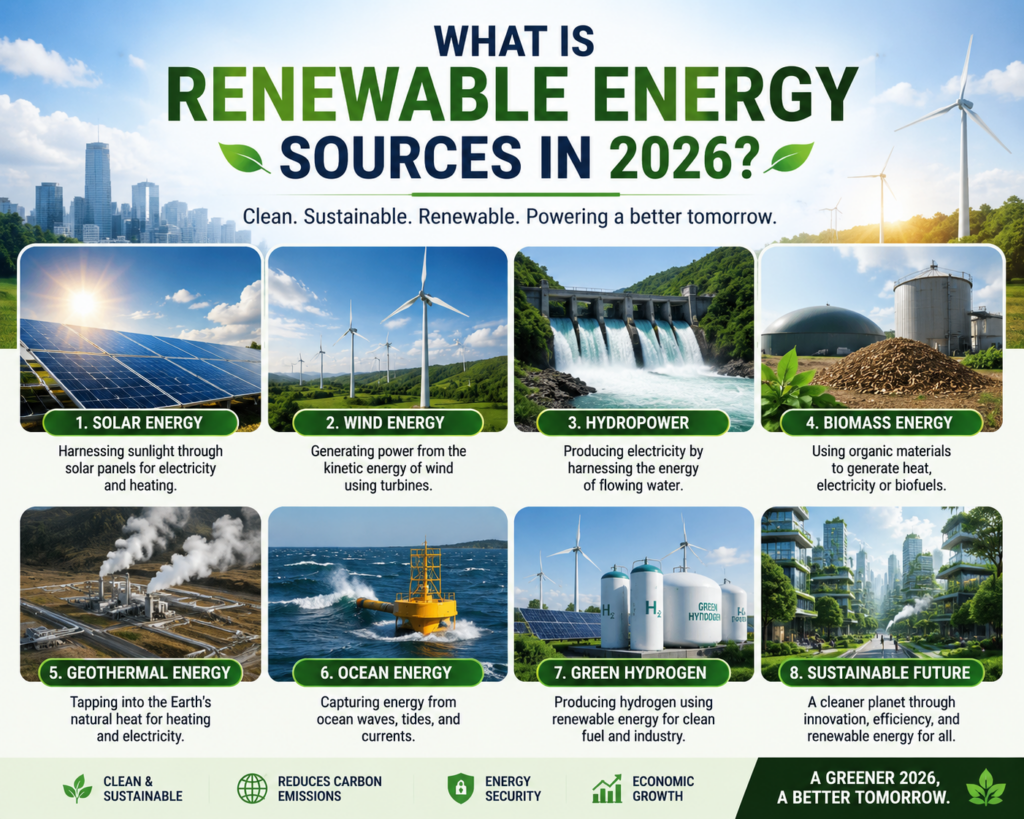
Here are the six major renewable energy sources to know in 2026.
1. Solar Energy (Photovoltaic & Solar Thermal)
Solar energy uses sunlight to produce electricity or useful heat. Photovoltaic (PV) panels convert sunlight directly into electricity, while solar thermal systems capture the sun’s heat for water heating, industrial processes, or electricity generation.
Solar PV is particularly easy to recognize because it can be installed at very different scales—from a small rooftop system on a home in India to large solar farms in the USA.
The UK also continues to use solar power despite receiving less sunlight than many parts of the world. Modern panels can still generate electricity under cloudy conditions, although output is generally higher with stronger sunlight.
Best suited for: Homes, businesses, utility-scale electricity generation, and water heating.
Main limitation: Solar generation varies with daylight and weather, so batteries or grid support can be useful.
2. Wind Energy (Onshore vs. Offshore)
Wind turbines convert the movement of air into electricity. There are two main forms: onshore wind, built on land, and offshore wind, installed in seas or large bodies of water.
Onshore projects can be relatively cost-effective where suitable land and strong wind resources are available. Offshore turbines can access stronger and more consistent winds, but construction and maintenance are usually more complex and expensive.
Wind power is particularly important in the UK, where offshore wind has become a major part of the country’s clean-energy strategy. The USA has significant onshore wind resources, especially across central states, while India has established wind projects in several states.
Best suited for: Large-scale electricity generation in areas with reliable wind resources.
Main limitation: Wind output changes with weather, and projects can face challenges involving land use, transmission, and local planning.
3. Hydroelectric Power
Hydroelectric power generates electricity by using moving or falling water to turn turbines. Large dams are the most familiar example, although smaller run-of-river systems can also produce electricity.
Hydropower has one major advantage over some other renewable sources: reservoirs can provide a degree of control over when electricity is generated. This can make hydro valuable for balancing electricity demand.
Countries and regions with suitable rivers, elevation changes, and water resources can benefit greatly from hydropower. India, the USA, and the UK all have established hydropower facilities, although their potential and scale differ considerably.
Best suited for: Reliable electricity generation and, in some cases, grid balancing.
Main limitation: Suitable sites are limited, and large projects can affect rivers, ecosystems, and nearby communities.
4. Biomass & Bioenergy
Biomass energy comes from organic materials such as agricultural residues, wood, food waste, and other biological resources. These materials can be burned directly or processed into fuels such as biogas and biofuels.
Biomass can be useful because some organic waste that would otherwise be discarded can become an energy resource. In India, agricultural residues and biogas have particular relevance. The USA and UK also use different forms of biomass and bioenergy in electricity, heating, and transport.
However, biomass is not automatically carbon-neutral. Its overall environmental impact depends on where the material comes from, how it is produced, transported, and used, and whether the resource can be sustainably replenished.
Best suited for: Waste-to-energy, heating, biogas, and certain transport fuels.
Main limitation: Sustainability depends heavily on the source and production method.
5. Geothermal Energy
Geothermal energy uses heat from beneath the Earth’s surface. It can provide electricity in areas with suitable underground heat resources and can also be used directly for heating.
Unlike solar and wind, geothermal systems can operate continuously when properly designed and managed. This makes them interesting for regions where suitable geological conditions exist.
The USA is one of the leading countries for geothermal electricity generation. The technology is also used in other countries, while geothermal heating can be practical in locations with accessible underground heat.
Best suited for: Reliable electricity generation and heating in suitable geological regions.
Main limitation: High-quality geothermal resources are geographically limited, and drilling can be expensive.
6. Ocean & Tidal Power
Ocean energy includes technologies that use tides, waves, and other forms of marine movement to generate electricity. Tidal power is one of the more established forms because tides are highly predictable.
The UK has strong natural potential for marine energy because of its coastline and tidal conditions. Other countries, including the USA and India, are also exploring marine-energy opportunities, although the technology remains much less widespread than solar, wind, and hydropower.
Ocean energy is promising because tides follow predictable cycles, but marine environments are challenging places to build and maintain equipment.
Best suited for: Coastal regions with strong tidal or wave resources.
Main limitation: High costs, difficult marine conditions, environmental considerations, and relatively limited commercial deployment.
Quick Comparison:
| Renewable Source | Main Resource | Common Use | Key Advantage | Main Challenge |
|---|---|---|---|---|
| Solar | Sunlight | Electricity & heating | Easy to scale | Day/night variation |
| Wind | Moving air | Electricity | Strong large-scale potential | Variable output |
| Hydropower | Moving/falling water | Electricity | Can provide controllable power | Environmental impacts |
| Biomass | Organic material | Heat, power & fuels | Can use waste materials | Sustainability varies |
| Geothermal | Earth’s heat | Power & heating | Can provide steady output | Location and drilling costs |
| Ocean & tidal | Tides & waves | Electricity | Tidal output is predictable | Technology and cost |
Which Renewable Energy Source Is Best?
There is no single renewable energy source that is best for every country or household. Solar may be the most practical choice for a home with a suitable roof, while wind and hydropower can make more sense for large-scale projects in resource-rich locations.
That is the important point when understanding what is renewable energy sources in 2026: the future of clean energy is likely to involve a mix of technologies rather than relying on one source alone. Solar, wind, hydro, bioenergy, geothermal, and marine power can each play a different role depending on local conditions.
Renewable Energy vs. Non-Renewable Energy
One of the easiest ways to understand what is renewable energy sources in 2026 is to compare renewable energy with non-renewable energy. The basic difference is simple: renewable resources are naturally replenished, while non-renewable resources such as coal, oil, natural gas, and uranium exist in finite supplies and take a very long time to form.
But the real difference goes beyond whether a resource can be replaced. Cost, reliability, emissions, land use, infrastructure, and local conditions all matter when countries decide how to build their energy systems.
Key Differences: Renewable vs. Non-Renewable Energy
| Factor | Renewable Energy | Non-Renewable Energy |
|---|---|---|
| Main sources | Solar, wind, hydro, geothermal, biomass, ocean energy | Coal, oil, natural gas, uranium |
| Availability | Naturally replenished | Finite or limited supply |
| Carbon emissions | Generally low during operation | Fossil fuels produce significant emissions when burned |
| Fuel requirement | Sun, wind, water, heat, or organic materials | Fuel must be extracted, processed, and supplied |
| Energy output | Can vary depending on resource and weather | Often more controllable, depending on technology |
| Infrastructure | Solar panels, wind turbines, dams, grids, storage | Power plants, mines, wells, pipelines, fuel networks |
| Environmental impact | Usually lower operational emissions, but impacts still exist | Higher environmental impact for fossil fuels, including air pollution and greenhouse gases |
| Long-term availability | Resources are continually replenished | Resources can eventually be depleted |
| Typical examples | Solar PV, wind farms, hydropower | Coal plants, gas plants, oil-based fuels |
Carbon Footprint & Environmental Impact
Carbon footprint is an important part of the renewable-versus-non-renewable discussion, but it should not be reduced to a simple “renewable is good, fossil fuel is bad” comparison.
Solar and wind power produce electricity without directly burning fossil fuels during operation. Hydropower, geothermal energy, and some forms of biomass can also provide relatively low-emission energy, although their overall environmental impact depends on how and where they are developed.
The International Energy Agency reported that the rapid deployment of solar PV, wind, nuclear power, electric cars, and heat pumps helped avoid around 3 gigatonnes of CO₂ emissions in 2025. Solar PV accounted for the largest share of those avoided emissions.
Fossil fuels are different because burning coal, oil, and natural gas releases greenhouse gases and other air pollutants. Their environmental footprint also includes extraction, transportation, processing, and the infrastructure required to supply them.
Does Renewable Energy Have Zero Environmental Impact?
This is an important point for anyone researching renewable energy in 2026. Solar panels require raw materials and manufacturing, wind farms require land or marine space, hydropower projects can affect rivers and ecosystems, and biomass can create environmental concerns depending on its feedstock and production methods.
The U.S. Environmental Protection Agency also notes that renewable technologies can have environmental trade-offs. Large hydropower projects, for example, can affect fisheries and land use.
So, a better way to look at renewable energy is lower emissions and different environmental impacts, rather than “zero impact.”
What Does This Mean for the USA, UK, and India?
The balance between renewable and non-renewable energy looks different in each country.
USA: The country has significant solar, wind, hydropower, geothermal, and biomass resources. At the same time, fossil fuels remain an important part of the energy system. The U.S. Energy Information Administration identifies solar, wind, hydropower, biomass, and geothermal among the country’s major renewable energy sources.
UK: The UK’s geography gives it particularly strong opportunities for wind power, especially offshore wind. Renewable electricity is therefore an important part of its strategy for reducing dependence on fossil-fuel generation.
India: India has strong solar potential and is rapidly expanding renewable capacity, while coal remains an important source of electricity. IEA data show that strong renewable growth contributed to a decline in India’s power-sector emissions in 2025, although future electricity demand and continued coal use remain important factors.
The Bottom Line:
Renewable and non-renewable energy are not simply two interchangeable categories. They have different strengths, costs, environmental impacts, and reliability characteristics.
For 2026 and beyond, the bigger trend is toward a more diverse energy mix in which solar, wind, hydropower, storage, and other low-emission technologies increasingly reduce the need for fossil-fuel generation. The exact combination will continue to vary between the USA, UK, India, and other markets.
Advantages and Challenges of Renewable Energy
Renewable energy has come a long way, but it is not a perfect replacement for every other energy source. If you are trying to understand what is renewable energy sources in 2026, it is useful to look at both sides of the picture: what clean energy can offer and where the technology still faces practical challenges.
For the USA, UK, and India, the situation is slightly different. Each country has different weather conditions, electricity demand, grid infrastructure, policies, and natural resources. So the best renewable-energy solution is not necessarily the same everywhere.
Benefits of Clean Energy
1. Lower Operational Emissions
Solar, wind, and hydropower can generate electricity without burning coal, oil, or natural gas during operation. Increasing the share of low-emission electricity can therefore help reduce the carbon intensity of power systems.
The IEA expects renewable electricity generation to overtake coal-fired generation globally in 2026, showing how quickly the electricity mix is changing.
2. Better Energy Security
Renewable resources such as sunlight and wind are available domestically in many countries. Increasing local generation can reduce exposure to imported fossil-fuel prices and supply disruptions.
This is particularly relevant for countries looking to strengthen energy independence while electricity demand continues to grow.
3. More Clean-Energy Jobs and Investment
The expansion of solar farms, wind projects, battery systems, transmission networks, and energy-efficiency technologies is creating new opportunities across manufacturing, engineering, construction, installation, maintenance, and energy management.
For workers and businesses, renewable energy is therefore not just an environmental story. It is becoming an important economic sector.
4. Solar Can Work at Different Scales
One practical advantage of solar energy is its flexibility. A homeowner can install a relatively small rooftop system, while utilities can develop very large solar projects.
This makes solar particularly relevant to India, where rooftop and utility-scale solar can both play a role, as well as to the USA and UK.
5. Renewable Energy Can Work With Battery Storage
Solar and wind output can change throughout the day. Battery storage helps solve part of this problem by storing electricity when renewable generation is high and releasing it when demand rises.
According to the IEA, utility-scale batteries are increasingly being used for grid balancing, renewable-energy integration, capacity support, and shifting electricity toward periods of higher demand.
Current Limitations of Renewable Energy
Renewable energy also has challenges that should not be ignored.
1. Solar and Wind Are Variable
Solar panels do not generate electricity at night, while their output can fall during cloudy weather. Wind turbines depend on available wind.
That does not make these technologies unreliable by themselves, but it means the wider electricity system needs enough flexibility to match supply with demand.
2. Grid Capacity Can Become a Bottleneck
Building renewable generation is only part of the job. Electricity also needs to reach homes, businesses, factories, and other users.
The IEA reports that more than 2,500 GW of renewable, storage, and large-load projects were waiting in grid-connection queues worldwide, highlighting how important transmission and distribution upgrades have become.
This issue matters in all three target markets. A solar or wind project can be technically ready but still face delays if the local grid cannot accommodate its output.
3. Energy Storage Still Has Limits
Battery storage is one of the most practical solutions for managing variable renewable generation, but batteries are not a magic fix.
Most battery systems are designed for specific durations. Short-duration batteries can help shift electricity over several hours, but longer periods of low solar or wind output may require additional solutions such as pumped-storage hydropower, stronger interconnections, demand flexibility, or other forms of firm generation.
The IEA notes that battery storage is especially useful for short-term flexibility, with many systems providing roughly 1–8 hours of continuous support depending on the application.
4. Batteries Depend on Supply Chains
Battery manufacturing requires materials such as lithium, nickel, cobalt, graphite, and other critical minerals. Processing and manufacturing are also concentrated in particular countries, creating supply-chain and geopolitical considerations.
This means that expanding battery storage requires not only more factories, but also responsible mineral sourcing, recycling, and diversified supply chains.
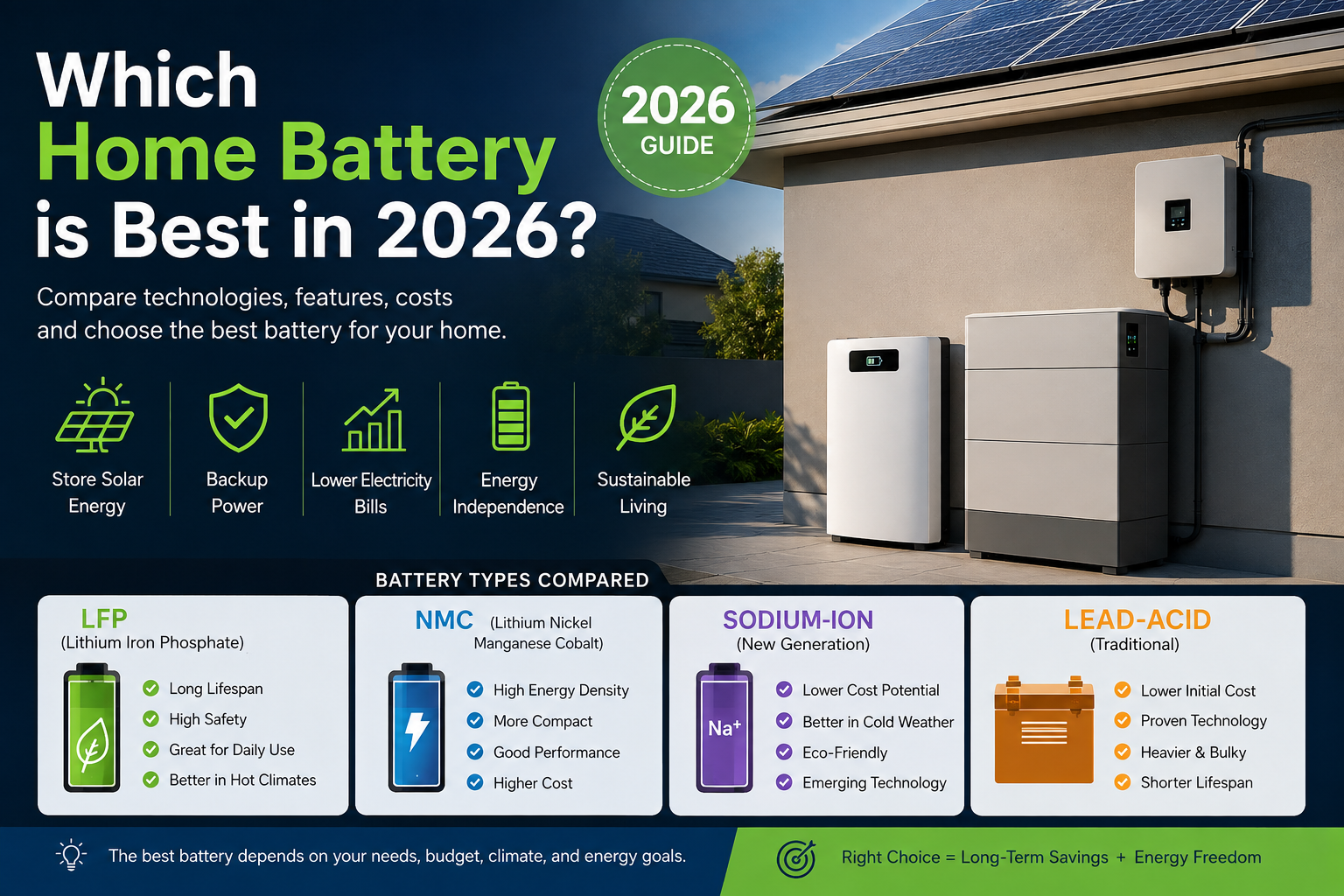
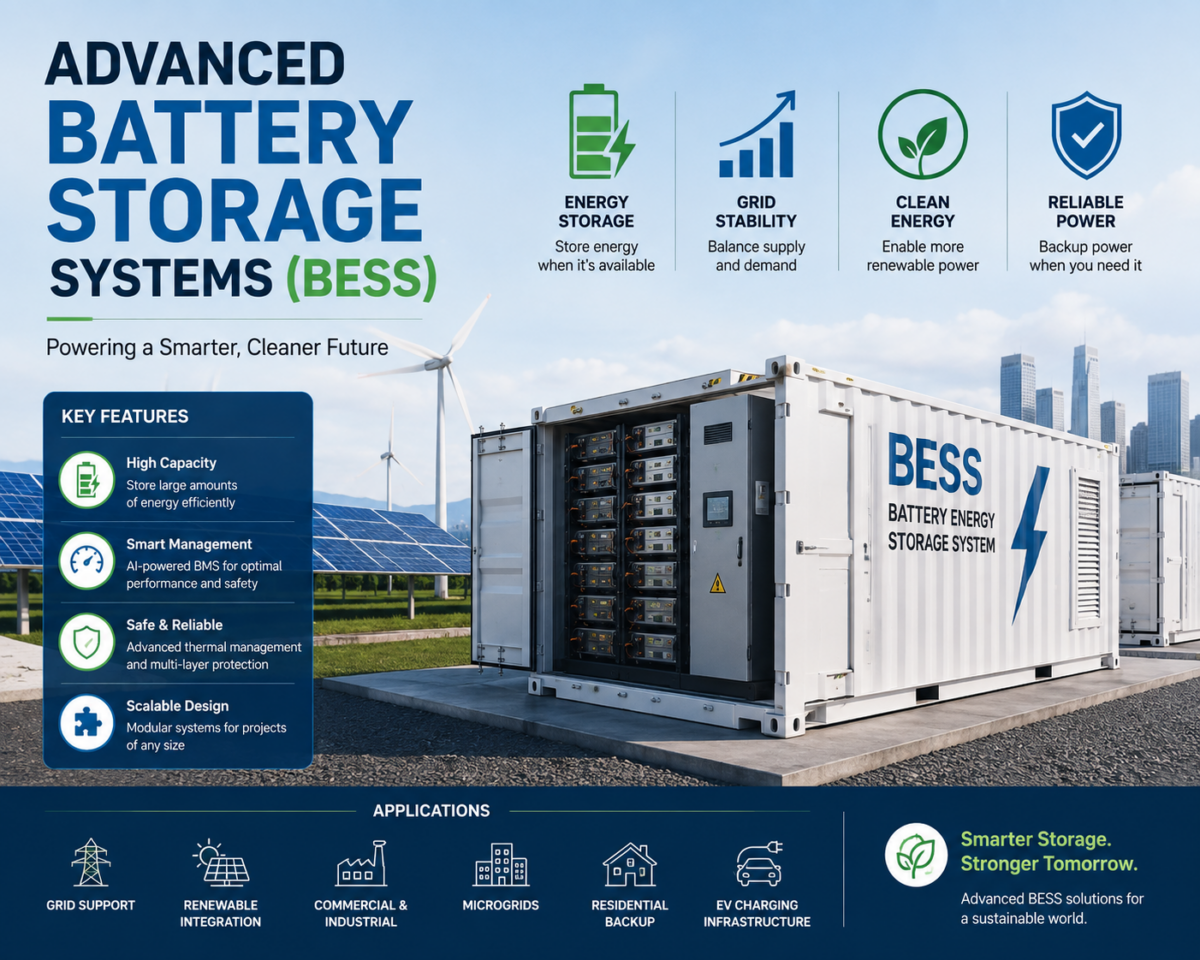
How Battery Storage Helps?
A simple way to understand battery storage is to think of it as a bridge between when renewable electricity is produced and when people actually need it.
For example:
Sunny afternoon → Solar produces surplus electricity → Battery charges → Evening demand rises → Battery discharges
This can be useful for a household with rooftop solar, but the same principle works at utility scale.
In the USA, large battery projects are increasingly being used alongside solar and wind. In the UK, battery storage is becoming an important source of short-term flexibility. India is also looking at batteries and pumped-storage hydropower as renewable generation expands.
The challenge is to build enough storage and grid flexibility at the right locations and for the right duration—not simply to install as many batteries as possible.
The Practical Takeaway:
Renewable energy offers clear advantages: lower operational emissions, greater use of domestic resources, energy diversification, and new economic opportunities. But its successful expansion depends on more than installing solar panels and wind turbines.
Grids, battery storage, demand flexibility, transmission, and good energy planning all have to develop alongside renewable generation.
That is the bigger picture behind what is renewable energy sources in 2026. The transition is already well underway, but making clean electricity reliable and affordable at scale will require a combination of technologies rather than one single solution.
Future Trends & Technological Innovations
The renewable-energy story in 2026 is moving beyond simply installing more solar panels and wind turbines. The next stage is about making clean electricity smarter, more flexible, and easier to store.
That is an important part of understanding what is renewable energy sources in 2026. Renewable power is increasingly being connected with battery storage, smart grids, green hydrogen, electric vehicles, flexible electricity demand, and digital energy-management systems.
The pace will not be identical everywhere. The USA, UK, and India have different energy needs and policies, but all three are investing in technologies that can support a more flexible low-carbon energy system.
1. Green Hydrogen Could Support Hard-to-Electrify Sectors
Green hydrogen is produced by using renewable electricity to split water into hydrogen and oxygen through electrolysis. Unlike solar or wind electricity, hydrogen can potentially be stored and transported for later use.
Its biggest opportunity may be in sectors where direct electrification is difficult, including some industrial processes, shipping, aviation fuels, and heavy transport.
India has made green hydrogen a major part of its clean-energy strategy. The National Green Hydrogen Mission aims to develop India as a global hub for green hydrogen production, use, and exports, with a target of 5 million metric tonnes of annual production capacity by 2030.
The UK is also developing a low-carbon hydrogen industry and has an ambition for up to 10 GW of low-carbon hydrogen production capacity by 2030, with at least half coming from electrolytic hydrogen.
The USA has also been developing hydrogen hubs and clean-hydrogen technologies, although policy support and project economics continue to influence how quickly the sector scales.
2. Smart Grids Will Become More Important
A traditional electricity grid was largely designed around relatively predictable, centralized power plants. Renewable energy changes that model.
Solar production can rise sharply during the middle of the day. Wind output can change with weather. At the same time, electricity demand is becoming more dynamic as electric vehicles, heat pumps, data centers, and other technologies become more common.
Smart grids use sensors, digital controls, automation, forecasting, and two-way communication to manage these changes more efficiently.
The IEA expects renewable electricity generation to overtake coal globally in 2026. It also highlights grid modernization, system flexibility, and better use of existing infrastructure as increasingly important for integrating growing amounts of wind and solar power.
In practical terms, a smarter grid could help utilities answer questions such as:
- When should a battery charge?
- When is electricity demand likely to peak?
- How much solar or wind power will be available?
- Can an electric vehicle charge when electricity is cheaper?
- Where does the grid need additional capacity?
This is where renewable energy starts becoming a digital energy system, rather than just a collection of power plants.
3. Battery Storage Will Work Alongside Renewable Energy
Battery storage is likely to remain one of the most important technologies supporting solar and wind.
Instead of wasting surplus electricity when renewable generation is high, batteries can store some of it and release it later when demand increases.
For example:
High solar generation → Battery charges → Evening demand rises → Battery discharges
The same idea works at a much larger scale for utility grids.
However, batteries are not designed to solve every storage problem. Short-duration batteries are particularly useful for daily balancing, while longer periods of low renewable generation may require other solutions, including pumped-storage hydropower, long-duration storage, stronger transmission networks, demand response, and flexible generation.
4. AI and Better Forecasting Could Improve Grid Management
Another emerging trend is the use of artificial intelligence and advanced data analytics.
Forecasting systems can analyze weather, electricity demand, historical generation, and market conditions to estimate how much solar and wind power may be available.
That information can help grid operators plan ahead instead of reacting after a sudden change in supply.
For consumers, similar technology is already appearing in smart energy-management systems that automatically decide when to use solar power, charge batteries, or shift certain electricity-intensive activities.
The technology is still developing, but the direction is clear: better data can make variable renewable energy easier to manage.
Government Subsidies & Global Renewable Energy Targets
Technology alone will not determine how quickly renewable energy grows. Government policy remains a major factor.
Subsidies, tax incentives, auctions, grants, contracts, clean-energy standards, transmission investment, and hydrogen-support programmes can all influence whether a new project is financially viable.
At the same time, government support is changing. Some countries are moving from broad subsidies toward competitive auctions and targeted incentives, while others are adjusting programmes because costs, energy-security priorities, and political conditions have changed.
The IEA’s 2026 Global Hydrogen Review notes that governments have identified substantial public funding for low-emissions hydrogen, but also stresses that policy implementation, infrastructure, demand creation, and clearer long-term frameworks are needed for the sector to scale.
USA: Focus on Scale, Technology and Grid Investment
The US renewable-energy market is large and diverse. Solar, wind, battery storage, geothermal, hydropower, and emerging clean-energy technologies all have roles to play.
Federal policy can influence investment, but individual states also have their own renewable-energy standards, incentives, and grid policies. This creates a market where the pace of development can vary significantly from one region to another.
For American households and businesses, the practical question is increasingly not simply whether renewable energy is available, but whether solar, storage, EV charging, and smart energy systems make financial sense at a particular location.
UK: Clean Power 2030 Is a Major Policy Milestone
The UK has set out an ambitious pathway toward a clean power system by 2030.
Its Clean Power 2030 Action Plan includes substantial planned capacity for offshore wind, onshore wind, solar, batteries, and long-duration storage. The plan also recognizes the importance of hydrogen and other flexibility technologies for maintaining a reliable electricity system.
This is particularly significant because the UK has strong offshore-wind resources but also needs flexible technologies and grid upgrades to manage variable generation.
India: Solar, Non-Fossil Capacity and Green Hydrogen
India’s renewable-energy expansion is closely connected with energy security, rising electricity demand, domestic manufacturing, and reducing dependence on imported fossil fuels.
The country’s 2030 goals include 500 GW of non-fossil electricity capacity, alongside other clean-energy and emissions-related targets. India’s National Green Hydrogen Mission also targets 5 million tonnes of annual green-hydrogen production capacity by 2030.
For Indian consumers, solar is likely to remain particularly important because rooftop systems, large solar parks, batteries, and increasingly digital energy-management solutions can serve different parts of the market.
What Could Renewable Energy Look Like by 2030?
The most realistic future is probably not one where a single technology dominates everything.
Instead, the energy system could become a combination of:
Solar + Wind + Batteries + Smart Grids + Hydropower + Green Hydrogen + Demand Flexibility
Solar and wind can provide large amounts of low-emission electricity. Batteries can handle many short-term fluctuations. Hydropower and long-duration storage can provide additional flexibility where conditions allow. Green hydrogen could help tackle some industrial and long-duration energy challenges.
The IEA expects renewables to provide the largest share of global electricity generation by 2030, while also emphasizing that grids and flexibility will need to expand alongside renewable capacity.
The Bigger Picture:
The future of renewable energy is therefore not just about producing more clean electricity. It is about building an energy system that can produce, store, move, and use that electricity intelligently.
For someone asking what is renewable energy sources in 2026, this is perhaps the most important takeaway: the renewable-energy transition is becoming increasingly connected to storage, hydrogen, digital technology, smarter grids, and long-term government policy.
The technologies will continue to evolve, and the exact mix will look different in the USA, UK, India, and other parts of the world. But the overall direction is toward a more flexible and increasingly low-emission energy system.
Frequently Asked Questions (FAQs)
1. What are renewable energy sources in 2026?
Renewable energy sources are energy resources that naturally replenish over time, such as sunlight, wind, flowing water, geothermal heat, biomass, and ocean energy. In 2026, solar and wind are expanding particularly quickly, while hydropower, bioenergy, geothermal, and marine energy continue to play important roles in different regions.
2. What is the main renewable energy source in 2026?
Solar PV is one of the fastest-growing renewable energy technologies in 2026. Global solar PV generation is forecast to increase by around 600 TWh in 2026, and solar is expected to overtake wind as the world’s second-largest renewable source of electricity generation after hydropower.
3. Why is renewable energy important in 2026?
Renewable energy can help countries reduce dependence on fossil fuels, diversify electricity supplies, and lower emissions. It is also becoming important for meeting rising electricity demand. In 2025, low-emissions sources—including renewables and nuclear—provided nearly 60% of the growth in global energy demand.
4. Is renewable energy better than fossil fuels?
Renewable energy generally has much lower operational greenhouse-gas emissions than fossil-fuel generation, but “better” depends on what is being measured. Cost, reliability, land use, resource availability, grid requirements, and environmental impacts all matter.
The practical trend is toward using more renewable electricity alongside storage, stronger grids, and other technologies rather than expecting one energy source to solve every problem.
5. Which renewable energy is best for homes?
For many homes, rooftop solar is one of the most practical renewable-energy options because it can generate electricity directly where it is consumed. A battery can also store excess solar power for later use.
However, the right choice depends on factors such as roof space, local sunlight, electricity prices, available incentives, and whether the home has a suitable connection to the grid.
6. What renewable energy is most suitable for India?
Solar energy is particularly important for India because of the country’s strong solar resource and rapidly expanding solar capacity. IEA forecasts that solar PV will meet around half of India’s additional electricity-demand growth through 2030, with solar’s share of generation approaching 18% by 2030.
Wind, hydropower, biomass, and other renewable technologies will also contribute depending on regional resources and infrastructure.
7. What renewable energy is important in the UK?
Wind energy is especially significant in the UK, including offshore wind. The country also uses solar, hydropower, biomass, and other renewable technologies.
According to the IEA, renewables supplied 55% of UK electricity generation in 2025, after the country closed its last coal-fired power station in 2024.
8. What renewable energy is growing in the USA?
Solar PV is expected to see substantial growth in the United States through 2030. The IEA forecasts more than 400 GW of net renewable capacity additions in the US between 2026 and 2030, with about 70% coming from solar PV. Wind is also expected to continue growing.
9. Can renewable energy provide electricity 24/7?
Renewable energy can contribute to a 24/7 electricity system, but individual sources such as solar and wind do not produce constant output.
This is where batteries, hydropower, transmission networks, demand response, interconnections, and other flexible resources become important. The goal is to balance electricity supply and demand even when renewable generation changes.
10. What are the disadvantages of renewable energy?
The main challenges include variable solar and wind generation, grid-connection delays, storage requirements, land or marine impacts, upfront investment, and the need for suitable natural resources.
These challenges do not mean renewable energy is impractical. They simply mean that expanding renewable generation also requires investment in grids, storage, forecasting, and system flexibility.
11. Is renewable energy really clean?
Renewable energy is generally considered low-emission rather than completely impact-free. Manufacturing solar panels, wind turbines, batteries, and other equipment requires raw materials and energy.
There can also be local environmental effects from land use, mining, hydropower development, and construction. The overall advantage is that renewable technologies can generate energy with far lower direct emissions than conventional fossil-fuel combustion.
12. What is the future of renewable energy?
Renewable energy is expected to remain one of the main drivers of electricity-system growth through 2030. The IEA forecasts that renewables will grow strongly during 2026–2030, with solar PV and wind together increasing their share of global electricity generation substantially.
The future will likely involve more than solar panels and wind turbines. Batteries, smart grids, green hydrogen, long-duration storage, electric vehicles, and flexible electricity demand will all have roles to play.
13. Can renewable energy reduce carbon emissions?
Yes. Increasing renewable generation can displace some fossil-fuel electricity and therefore reduce associated emissions. The IEA estimates that the deployment of solar PV, wind, nuclear power, electric cars, and heat pumps since 2019 avoided around 3 billion tonnes of CO₂ emissions in 2025.
The actual reduction depends on what type of generation is being replaced and how the electricity system operates.
14. Will renewable energy replace fossil fuels completely?
It is unlikely that one technology will simply replace every fossil-fuel use. Electricity, transport, industry, heating, and aviation have different technical requirements.
The more realistic direction is a gradual shift toward a combination of renewable electricity, storage, electrification, efficiency improvements, low-emission fuels, and other technologies. Renewable energy is expected to provide the largest share of global electricity generation by 2030, although coal is still forecast to remain the largest single electricity source at that point.
Quick Answer:
In simple terms, what is renewable energy sources in 2026? They are naturally replenishing sources such as solar, wind, hydropower, biomass, geothermal, and ocean energy that are increasingly being integrated into modern electricity systems.
For the USA, UK, and India, the technology mix will look different because each country has different resources, policies, grids, and energy-demand patterns. But the overall direction is clear: renewable energy is becoming a much larger part of the global electricity system, while storage and grid flexibility are becoming just as important for making that transition work reliably.
Recommended External Resources
| Resource | Best For | Link |
|---|---|---|
| U.S. Energy Information Administration (EIA) | Renewable energy types, U.S. energy data and explanations | Renewable Energy Explained – EIA |
| International Energy Agency (IEA) | Global renewable-energy trends, electricity and clean-energy data | International Energy Agency |
| UK Government – Clean Power 2030 | UK renewable-energy targets, grids and clean-power plans | Clean Power 2030 Action Plan – GOV.UK |
| UK Government – Solar Roadmap | UK solar deployment and 2030 solar plans | UK Solar Roadmap |
| India MNRE | India’s renewable-energy policies, programmes and official information | Ministry of New and Renewable Energy – India |
| U.S. EIA – Energy & Environment | Environmental impact of renewable and non-renewable energy | Energy and the Environment – EIA |

7 Best Plastic-Free Laundry Detergents in 2026
Advanced Battery Storage Systems (BESS)
About the Author:
Hi, I’m Govind Singh, a passionate blogger and digital content creator. While I am not a professional sustainability consultant, I specialize in researching and compiling reliable data from authoritative global and government sources—such as the International Energy Agency (IEA), U.S. Energy Information Administration (EIA), and India’s Ministry of New and Renewable Energy (MNRE). My goal is to break down complex energy trends into clear, practical, and easy-to-understand guides for everyday readers.