

Best eco friendly sunscreen in Australia 2026
Australia’s strong sunshine is one of the reasons sunscreen is such an everyday essential. When the UV Index reaches 3 or above, Cancer Council Australia recommends using SPF 50 or SPF 50+, broad-spectrum, water-resistant sunscreen along with clothing, shade, a hat and sunglasses.
We evaluated these sunscreens based on real-world Australian beach conditions, TGA listings, and ingredient transparency.
But in 2026, many Australians are looking beyond SPF alone. They also want sunscreen that feels comfortable on the skin, suits an active beach lifestyle, and has a more considered approach to ingredients, packaging and environmental impact. That is where choosing the Best Eco Friendly Sunscreen in Australia (2026) becomes a little more complicated.
Terms such as “reef-safe,” “natural,” “organic,” and “eco-friendly” can sound reassuring, but they do not all mean the same thing. In Australia, primary sunscreens are regulated as therapeutic goods by the Therapeutic Goods Administration (TGA), and products need to meet the relevant Australian/New Zealand sunscreen requirements. Cancer Council recommends checking that a sunscreen is TGA-approved and choosing SPF 50 or SPF 50+, broad-spectrum and water-resistant protection.
The environmental side also deserves a closer look. The ACCC says environmental claims must be truthful, accurate and supported by reasonable grounds, while broad claims such as “eco-friendly” or “sustainable” can be misleading if they give consumers an exaggerated impression of a product’s environmental benefits.
So, this guide takes a practical approach. Instead of simply choosing products because they have a green-looking label, we’ll look at TGA status, SPF protection, broad-spectrum coverage, water resistance, ingredients, packaging and credible environmental claims to identify the strongest eco-conscious sunscreen options available to Australian consumers in 2026.
The goal is simple: find sunscreen that protects your skin properly first, while also making a more thoughtful environmental choice where the evidence supports it.
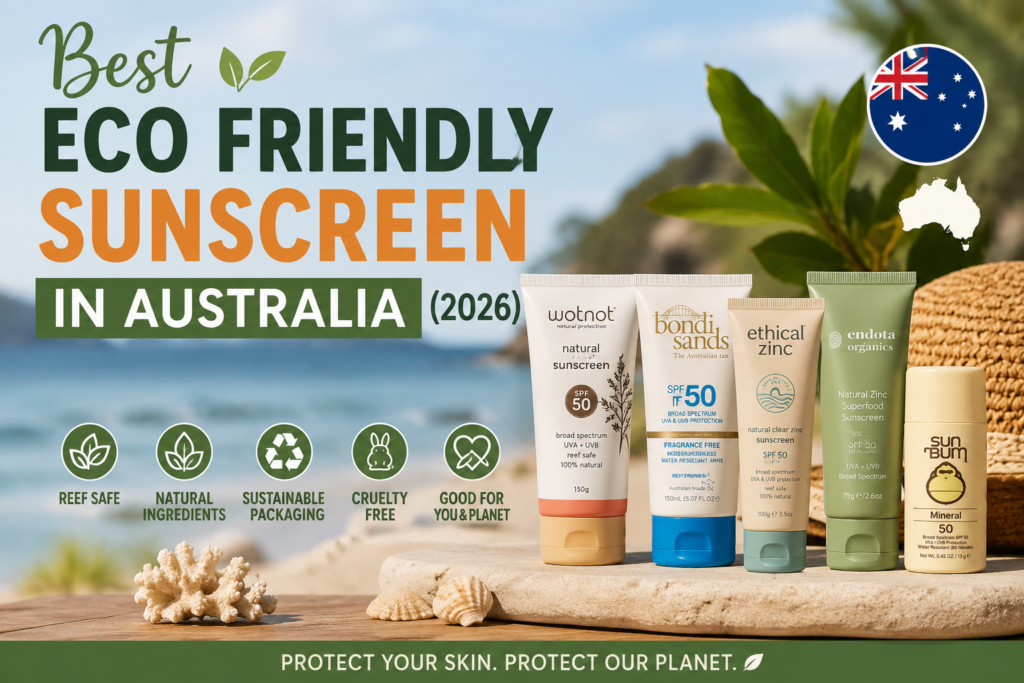
Chemical vs. Mineral Sunscreens: What’s Better for the Planet?
If you’re searching for the Best Eco Friendly Sunscreen in Australia (2026), the first thing to know is that “chemical” and “mineral” do not automatically mean “bad” and “good” for the environment.
Australian sunscreens are regulated differently from ordinary cosmetics. Sunscreens can only be sold in Australia when they are included on the TGA’s Australian Register of Therapeutic Goods (ARTG) and comply with the applicable Australian sunscreen standard. The TGA also assesses approved sunscreen active ingredients for safety and effectiveness.
So, for an Australian buyer, the better approach is to look at the actual UV filters, the evidence behind environmental claims, the product’s TGA status, and the overall formulation rather than relying on a green label or the words “reef-safe”.
Chemical Filters: What About Oxybenzone, Octinoxate and Octocrylene?
Chemical, or organic, UV filters absorb UV radiation and convert it into a small amount of heat. They are widely used in sunscreen formulations around the world.
Some ingredients have attracted environmental attention, particularly oxybenzone (benzophenone-3) and octinoxate (ethylhexyl methoxycinnamate) because of research into their potential effects on coral and marine organisms.
Octocrylene has also been discussed in the environmental-sunscreen debate. However, it would be too simplistic to say that every chemical sunscreen is environmentally harmful or that removing one ingredient automatically makes a product reef-safe.
This distinction matters in Australia. In 2025, the ACCC commenced Federal Court proceedings against Edgewell over alleged “reef friendly” claims made for certain Banana Boat and Hawaiian Tropic sunscreens. The ACCC alleged that some products contained other ingredients that could harm or risk harming reefs, despite the products being promoted as reef friendly.
Practical takeaway: Don’t choose a sunscreen simply because it says “oxybenzone-free” or “reef-safe”. Look at the complete ingredient list and the evidence supporting the environmental claim.
Mineral Filters: Zinc Oxide and Titanium Dioxide
Mineral sunscreens generally use zinc oxide and/or titanium dioxide as their active UV filters. Instead of relying on organic UV filters, these inorganic filters interact with UV radiation at the skin’s surface.
For shoppers who prioritise environmental considerations, mineral formulas can be worth considering—especially when they use zinc oxide or titanium dioxide and avoid unsupported broad environmental claims.
But “mineral” is not the same thing as “automatically reef-safe”.
The environmental behaviour of a sunscreen depends on more than its headline active ingredient. Particle size, concentration, formulation, how the product is used, and the receiving environment can all matter.
Is Non-Nano Zinc Oxide Better Than Nano Zinc Oxide?
This is one of the most common questions Australian shoppers have.
The term “non-nano” generally refers to zinc oxide particles that are not engineered or present primarily at nanoscale dimensions. Nano zinc oxide contains much smaller particles and can make a sunscreen feel lighter and appear less white on the skin.
From a skin-safety perspective, nano does not automatically mean dangerous. ARPANSA notes that a TGA review found the weight of evidence suggested sunscreen nanoparticles do not reach viable skin cells and remain mainly on the skin surface and outer layer of non-viable cells.
For someone choosing an eco-conscious sunscreen, however, there is another question: what happens to these particles after sunscreen is washed off into water?
That is more complicated than a simple nano-versus-non-nano label. Environmental effects depend on concentration, particle behaviour, formulation, exposure and the specific aquatic environment.
Nano vs. Non-Nano Zinc Oxide: Quick Comparison
| Feature | Nano Zinc Oxide | Non-Nano Zinc Oxide |
|---|---|---|
| Particle size | Smaller, nanoscale particles | Larger particles |
| Skin appearance | Usually less visible/whiter cast | Can leave a more noticeable white cast |
| Texture | Often lighter and easier to spread | Can feel thicker depending on formulation |
| Skin absorption concern | TGA review found current evidence does not indicate penetration into viable skin cells | Generally remains on the skin surface |
| Environmental question | Requires consideration of particle behaviour after wash-off | Often preferred by environmentally conscious shoppers, but not automatically impact-free |
| Best approach | Check the complete formulation and evidence | Check the complete formulation and evidence |
So, Which Is Better for the Environment?
There isn’t a scientifically responsible one-word answer.
If your priority is reducing potential environmental concerns, a well-formulated mineral sunscreen containing zinc oxide or titanium dioxide can be a reasonable option to investigate. But don’t treat “mineral”, “natural” or “reef-safe” as proof that a product has no environmental impact.
The ACCC specifically advises businesses that environmental claims should be truthful, accurate and supported by reasonable grounds. It also warns that broad claims such as “eco-friendly” can create a misleading impression when they don’t explain the product’s actual environmental benefits.
What Should Australian Shoppers Look For?
When comparing eco-conscious sunscreens in Australia, use this simple checklist:
- Check the TGA/ARTG status of the sunscreen.
- Look for SPF 50 or SPF 50+, broad-spectrum protection and water resistance where appropriate for your activity.
- Check the active UV filters, rather than judging the product by its front-label marketing.
- If choosing mineral sunscreen, consider zinc oxide and/or titanium dioxide.
- Treat “reef-safe” and “reef-friendly” as claims that need evidence—not as official guarantees.
- Check whether the brand explains its packaging and environmental claims clearly.
- Don’t assume that natural, organic or mineral automatically means environmentally harmless.
- Remember that protecting your skin from Australia’s UV exposure remains the primary purpose of sunscreen.
The bottom line: For the Australian market in 2026, the best eco-conscious sunscreen is not necessarily the one with the greenest packaging or the biggest “reef-safe” claim. A better choice is a properly regulated sunscreen that provides strong UV protection while making specific, transparent and evidence-backed environmental choices.
TGA Approval & Standards in Australia
When you are looking for the Best Eco Friendly Sunscreen in Australia (2026), the word “eco-friendly” should not be your first checkpoint. In Australia, the more important question is: Is the sunscreen legally supplied, correctly labelled and listed in the ARTG?
For most primary sunscreens, the answer can be checked through the AUST number printed on the product label. This gives Australian shoppers a practical way to verify that the sunscreen is part of the Australian regulatory system.
What Does the AUST L Number Mean?
Look at the front label of the sunscreen for an identification number beginning with “AUST L”.
For example, it may appear as:
AUST L XXXXX
The “L” generally indicates that the product is a listed medicine in the Australian Register of Therapeutic Goods (ARTG). Most therapeutic sunscreens use this listed pathway.
The number is useful because you can search it in the public ARTG database and check details such as the product name and active ingredients.
There is an important point for shoppers in 2026: don’t just look for any AUST number. Make sure the product name and intended use on the label match the ARTG record. In January 2026, the TGA specifically warned about cases where an AUST number was being used with product information that did not match the corresponding ARTG entry.
Quick Australian shopper check:
- Look for the AUST number.
- Search the number in the ARTG database.
- Check that the product name matches.
- Check the listed ingredients where available.
- Check the SPF and directions on the actual product label.
Does “Natural” Sunscreen Still Need TGA Regulation?
Yes — if the product is being marketed primarily as a sunscreen and falls within the therapeutic sunscreen category, calling it “natural,” “organic” or “eco-friendly” does not remove it from Australian sunscreen regulations.
This distinction matters.
A product can contain mineral ingredients such as zinc oxide and still need to comply with the relevant Australian requirements if it is a therapeutic sunscreen. Similarly, a product marketed with natural ingredients does not automatically receive an exemption from TGA regulation.
However, there is a technical exception worth knowing about. Some secondary sunscreens, such as certain moisturisers, foundations and lip products with lower SPF claims, can be excluded from therapeutic-goods regulation under specific conditions. They still have to meet applicable Australian sunscreen and consumer-product requirements.
So, for an Australian shopper, the better rule is:
“Natural” describes the product’s positioning or ingredients; it does not automatically prove regulatory compliance.
That is especially relevant when comparing products promoted as the Best Eco Friendly Sunscreen in Australia (2026).
Is AUST L the Same as “TGA Certified”?
Not exactly.
This is a common misunderstanding.
Most listed therapeutic sunscreens are included in the ARTG through the listed medicine pathway. TGA explains that these products are generally not pre-market evaluated by TGA. Instead, the sponsor must legally certify that the product meets applicable safety, quality and efficacy requirements and uses permitted ingredients and claims. TGA can subsequently take regulatory action if problems are identified.
So, in an accurate Australian article, it is better to write:
“TGA-regulated and ARTG-listed”
rather than making a blanket statement such as:
“Every AUST L sunscreen is individually TGA-certified before sale.”
That small wording difference makes the information more trustworthy.
Water Resistance: 40 Minutes vs 4 Hours
Water resistance is another area where Australian shoppers can easily get confused.
A sunscreen labelled as water resistant is not waterproof. Sunscreen gradually washes off during swimming and can also be removed through sweating, rubbing and towel drying. Australian regulatory guidance does not allow products to simply claim they are “waterproof” or “sweat proof.”
You may see products marketed with water-resistance periods such as:
- 40 minutes
- 80 minutes
- 4 hours
The important thing is to follow the specific water-resistance claim and application instructions on the product label rather than assuming every SPF50+ sunscreen provides the same protection in water.
For example, a sunscreen listed as “Water Resistant 4HRS” is a real type of Australian product claim; the TGA’s ARTG database contains products with this wording.
But 4 hours does not mean you can apply sunscreen once in the morning and forget about it all day. Reapplication is still important, particularly after swimming, sweating or towel drying.
What Changed With the Australian Sunscreen Standard?
Australia’s sunscreen rules are closely linked to the Australian/New Zealand sunscreen standard.
The TGA adopted the 2021 Sunscreen Standard, with new sunscreen products included in the ARTG from 1 July 2024 required to comply with the 2021 standard. Older products have had transition arrangements for certain requirements.
For consumers, this reinforces why checking the label matters. A compliant sunscreen label should provide key information such as:
- SPF rating
- Broad-spectrum protection
- Active ingredients
- Directions for use
- Water-resistance information where applicable
- AUST identification number
- Relevant warnings and storage information
What Should Australian Shoppers Look For in 2026?
If you’re comparing eco-conscious sunscreens for an Australian beach day, hiking trip or everyday commute, don’t judge the product only by its “green” packaging.
A more useful checklist is:
| What to check | Why it matters |
|---|---|
| AUST L / AUST number | Helps verify the regulated sunscreen’s ARTG listing |
| SPF 50+ | Provides very high labelled protection under Australian standards |
| Broad spectrum | Covers both UVA and UVB |
| Water resistance | Useful for swimming and heavy sweating |
| Active ingredients | Helps you understand whether the formula is mineral, chemical or hybrid |
| Environmental claims | “Eco-friendly” or “reef-safe” should be backed by evidence |
| Directions | Correct application and reapplication are essential |
| Product name vs ARTG record | Helps identify potential labelling discrepancies |
The TGA currently advises consumers to look for an AUST number and follow the product’s label directions. It also stresses that sunscreen should be used alongside shade, protective clothing, hats and sunglasses.
Bottom Line:
For Australians, the Best Eco Friendly Sunscreen in Australia (2026) isn’t simply the product with the most attractive “natural” or sustainable branding.
Start with regulatory compliance and sun protection, then look at the environmental side.
Check the AUST number. Verify the ARTG information when needed. Look for broad-spectrum protection and an appropriate SPF, and pay attention to the product’s actual water-resistance claim. Only after those basics are satisfied should you compare packaging, ingredients and environmental claims.
That approach gives you a much more realistic way to balance skin protection, Australian regulations and environmental responsibility.
Top Eco-Friendly Sunscreens in Australia (2026 Buyers’ List)
Finding the Best Eco Friendly Sunscreen in Australia (2026) is not really about picking the bottle with the biggest “natural” or “reef-safe” label.
Australian conditions are different. Strong UV, beach days, swimming, outdoor work and long summer afternoons all put sunscreen through a real test. So, for this list, the focus is on the things that actually matter to an Australian buyer: SPF level, broad-spectrum protection, water resistance, mineral filters, packaging, Australian manufacturing, sensitive-skin suitability and the evidence behind environmental claims.
One more thing is worth saying upfront: “reef-safe” is not an official sunscreen certification in Australia. Treat it as a brand or marketing claim and check the actual active ingredients and product information instead. This is also consistent with Reef Safe Australia’s own environmental-claims guidance.
Quick Comparison:
| Category | Our Pick | Why It Stands Out |
|---|---|---|
| Best Overall Eco-Friendly Sunscreen | Little Urchin Natural Clear Zinc SPF 50+ | Non-nano zinc, broad-spectrum, 4-hour water resistance and recycled-plastic tube |
| Best for Water Sports & Snorkelling | Reef Safe Australia Surf & Snorkel SPF 50+ | Non-nano zinc, SPF50+, 80-minute water resistance and designed for ocean activities |
| Best Plastic-Conscious Option | MOTHER SPF Face & Body SPF 50 | Australian-made, solar-powered production claims and recycled-plastic tubes |
| Best Tinted Face Sunscreen | Little Urchin Natural Face Light-Medium Tint SPF 50+ | Non-nano zinc, tinted finish and designed specifically for facial use |
| Best Family & Sensitive-Skin Mineral Sunscreen | EcoZinc Mineral Face & Body SPF50 | Non-nano zinc, Australian-made and positioned for families and sensitive skin |
These are category recommendations, not a claim that one sunscreen is universally “best” for every person. Formulations, prices and packaging can change, so check the current product label before buying.
1. Best Overall Eco-Friendly Sunscreen: Little Urchin Natural Clear Zinc SPF 50+
Best for: Everyday Australian use, families, beach trips and people who prefer a mineral sunscreen.
Little Urchin is a strong all-rounder because it combines several features Australian shoppers commonly look for in an eco-conscious sunscreen.
Its Natural Clear Zinc SPF 50+ uses non-nano zinc oxide as the active ingredient, provides broad-spectrum UVA and UVB protection and is marketed as 4-hour water resistant. The brand also describes the product as vegan, fragrance-free and suitable for sensitive skin.
The packaging is another reason it stands out. Little Urchin says its tube uses recycled plastic and is made in Australia using solar power.
Why we picked it:
- SPF 50+
- Broad-spectrum UVA/UVB protection
- Non-nano zinc oxide
- 4-hour water-resistance claim
- Vegan formula
- Fragrance-free
- Suitable for sensitive skin
- Recycled-plastic tube
- Australian-made positioning
Good fit for: Someone who wants one mineral sunscreen for everyday life, holidays and outdoor activities without moving into a heavily tinted formula.
One thing to consider: Mineral zinc sunscreens can still feel different from lightweight chemical sunscreens. If you dislike any visible cast or richer texture, try a face-specific or tinted formula first.
2. Best Reef-Conscious Sunscreen for Water Sports: Reef Safe Australia Surf & Snorkel SPF 50+
Best for: Surfing, snorkelling, swimming and regular ocean activities.
For people spending a lot of time in the water, the Reef Safe Zinc Mineral Surf & Snorkel SPF 50+ is an interesting Australian option.
The product uses non-nano zinc oxide as its mineral UV filter and is listed by the TGA under AUST L 526394, according to the brand. It has an SPF 50+ rating and an 80-minute water-resistance claim. It is also made in Brisbane.
Reef Safe Australia says its formulas do not use chemical UV filters and explains that its “reef safe” positioning is based on its formulation approach rather than claiming that sunscreen has zero environmental impact. That’s an important distinction.
Why it makes sense for water sports:
- SPF 50+
- Broad-spectrum protection
- Non-nano zinc oxide
- 80-minute water resistance
- Designed specifically for surf and snorkelling
- Australian made
- No chemical UV filters according to the brand
Best use case: Great Barrier Reef trips, surfing, snorkelling, beach holidays and other situations where sunscreen is likely to come into contact with seawater.
Still, don’t interpret “reef-safe” as a guarantee that a sunscreen has zero environmental impact. There is no sunscreen that should be treated as completely impact-free.
3. Best Plastic-Conscious Option: MOTHER SPF Face & Body SPF 50
Best for: Eco-conscious shoppers who care about ingredients, Australian manufacturing and packaging.
MOTHER SPF takes a slightly different approach from a typical beach sunscreen brand. Its products are positioned more like skincare, with mineral sun protection combined with natural and organic ingredients.
The current MOTHER SPF Face & Body SPF 50 uses non-nano zinc oxide and is described by the brand as an Australian-made product. MOTHER SPF also states that its production uses solar power and that its tubes are made from recycled plastic diverted from landfill.
The product is listed as 2-hour water resistant, so it is better thought of as an everyday face-and-body sunscreen rather than the first choice for a long surf session.
Why eco-conscious shoppers may like it:
- SPF 50
- Mineral/non-nano zinc formula
- Australian made
- Vegan positioning
- Fragrance-free
- Natural/organic ingredient positioning
- Recycled-plastic packaging
- Solar-powered production claims
Best for: Daily commuting, outdoor walks, casual beach use and people who want sunscreen that feels closer to a skincare product.
Water-sports note: If you’re going surfing or spending hours swimming, choose a product with a water-resistance claim suited to that activity rather than choosing purely on sustainability credentials.
4. Best Tinted Eco-Friendly Sunscreen for Face: Little Urchin Natural Face Light-Medium Tint SPF 50+
Best for: Everyday facial sunscreen, makeup users and people who prefer some tint instead of a traditional white mineral finish.
Face sunscreen is a different buying decision from body sunscreen. Texture matters more. So does how the product looks once it is blended into the skin.
Little Urchin’s Natural Face Light-Medium Tint SPF 50+ is a non-nano zinc formula developed specifically for facial use. The brand describes it as broad-spectrum and suitable for daily facial sun protection.
The tint can be useful for people who don’t want the typical appearance associated with some zinc sunscreens.
Why it stands out:
- SPF 50+
- Non-nano zinc
- Broad-spectrum protection
- Tinted finish
- Designed for facial use
- Vegan positioning
- Suitable for everyday wear
Best for: Office workers, commuters, outdoor lunches and anyone who wants mineral SPF that can sit more naturally on the face.
Practical tip: Tinted mineral sunscreens can look different depending on skin tone. If possible, test the shade before committing to a full-size product.
5. Best Family & Sensitive-Skin Mineral Sunscreen: EcoZinc Mineral Face & Body SPF50
Best for: Families, outdoor workers and shoppers looking for an Australian-made non-nano zinc sunscreen.
EcoZinc’s Mineral Face & Body SPF50 uses non-nano zinc oxide as its active ingredient and is marketed as a broad-spectrum mineral sunscreen. The company says the product is made in Rocklea, Queensland and is suitable for sensitive skin.
The brand also states that the product has an 80-minute water-resistance claim and provides the AUST L number 407959 for its 100g clear sunscreen.
That makes it particularly interesting for Australian households where sunscreen is used frequently rather than occasionally.
Key features:
- SPF 50
- Broad-spectrum protection
- Non-nano zinc oxide
- Australian made
- Suitable for sensitive skin, according to the brand
- 80-minute water-resistance claim
- Recyclable packaging
- Family and outdoor-worker positioning
Best for: Families, gardening, outdoor work, fishing, camping and everyday Queensland or Australian outdoor exposure.
Which One Should You Choose?
There isn’t one sunscreen that wins every category.
Your best choice depends on where you will use it and what matters most to you.
Choose Little Urchin if…
You want an everyday mineral sunscreen with SPF 50+, non-nano zinc and a longer water-resistance claim.
Choose Reef Safe Australia if…
Your weekend involves surfing, snorkelling or spending a lot of time in the ocean. Its Surf & Snorkel SPF 50+ is specifically designed around that use case and has an 80-minute water-resistance claim.
Choose MOTHER SPF if…
You care strongly about skincare feel, Australian manufacturing and sustainability-related production and packaging claims, and you mainly need everyday protection rather than extended water exposure.
Choose Little Urchin Tinted Face SPF if…
Your main priority is facial sunscreen with a tint rather than a conventional body formula.
Choose EcoZinc if…
You want an Australian-made non-nano zinc SPF50 aimed at everyday family and outdoor use.
A Quick Note About “Reef-Safe” and “Eco-Friendly”
This is probably the most important takeaway from this buyers’ list.
Don’t buy a sunscreen simply because the front of the tube says “reef safe,” “natural” or “eco-friendly.”
Those words don’t tell you everything about the formulation or its environmental footprint.
Instead, turn the bottle around and check:
- What are the active UV filters?
- Is it broad spectrum?
- What is the SPF rating?
- How long is it water resistant?
- Is the product TGA-listed where required?
- Can the brand explain its environmental claims?
- What is the packaging actually made from?
- Are you buying it for everyday use or prolonged water exposure?
This approach is particularly useful in Australia, where sunscreen is not just a beauty product. It is an important part of everyday UV protection.
Our 2026 Verdict:
For most Australian shoppers, Little Urchin Natural Clear Zinc SPF 50+ is a strong all-round choice in this category because of its combination of non-nano zinc, SPF 50+, broad-spectrum protection, water resistance and recycled-plastic packaging claims.
For surfing and snorkelling, Reef Safe Australia’s Surf & Snorkel SPF 50+ is more purpose-built for water activities.
For eco-conscious everyday skincare, MOTHER SPF is worth considering, particularly if Australian manufacturing and packaging are important to you.
And for families looking for a straightforward non-nano zinc SPF50, EcoZinc is another Australian-made option to put on the shortlist.
Most importantly, don’t let the sustainability story replace the basics: use enough sunscreen, reapply as directed, and combine it with shade, protective clothing, a hat and sunglasses.
Key Ingredients to Avoid in Eco-Friendly Sunscreens.
Choosing the Best Eco Friendly Sunscreen in Australia (2026) is not as simple as finding a product labelled “natural” or “reef safe”.
If you’re shopping for sunscreen in Australia, it helps to look at the active UV filters and the full ingredient list rather than relying only on the front of the bottle. Some sunscreen ingredients have raised environmental concerns in scientific research or have been restricted in particular locations, while others are mainly a concern for shoppers trying to minimise synthetic ingredients.
There is also an important Australian context here. The ACCC says environmental claims must be truthful, accurate and supported by reasonable grounds. In other words, a sunscreen shouldn’t automatically be considered environmentally friendly just because it leaves certain ingredients out.
1. Oxybenzone (Benzophenone-3)
Oxybenzone, also known as benzophenone-3, is a chemical UV filter that has received considerable attention because of research into its potential effects on coral reefs and marine environments.
It is also one of the ingredients that often appears in discussions about “reef-safe” sunscreen.
But there is a useful Australian nuance here: “contains no oxybenzone” does not automatically mean a sunscreen is reef-safe or environmentally harmless.
The ACCC’s case involving Banana Boat and Hawaiian Tropic is a good example. The regulator alleged that products promoted as “reef friendly” contained other ingredients, including octocrylene, homosalate, 4-MBC and avobenzone, that could harm or pose a risk to reefs and marine life.
For eco-conscious shoppers: If reducing potential marine-environment concerns is a priority, checking whether oxybenzone is present is reasonable—but don’t stop there.
2. Octinoxate
Octinoxate, also called ethylhexyl methoxycinnamate, is another chemical UV filter frequently discussed in relation to marine ecosystems.
It has been restricted in some jurisdictions, which is one reason Australian shoppers may come across “octinoxate-free” claims when comparing mineral or reef-conscious sunscreens.
However, it’s important not to turn that into an overly broad statement such as “all chemical sunscreen is harmful.” Australia’s regulatory system is different, and a sunscreen ingredient being controversial in one jurisdiction does not automatically mean every product containing it is illegal or unsafe in Australia.
For someone specifically searching for an eco-conscious sunscreen, avoiding octinoxate can be a personal environmental preference—but the overall formula and evidence behind the manufacturer’s environmental claims matter too.
3. 4-MBC (4-Methylbenzylidene Camphor)
4-MBC, also known as 4-methylbenzylidene camphor or enzacamene, deserves particular attention when you are comparing environmental claims.
The ingredient has been discussed in relation to potential environmental effects, and it was one of the ingredients specifically identified in the ACCC’s proceedings concerning alleged “reef friendly” sunscreen claims.
This is a useful reminder that looking only for the absence of oxybenzone and octinoxate can give consumers an incomplete picture.
Simple buying rule: If marine environmental impact is one of your priorities, check the complete active-ingredient list rather than relying on a “reef-safe” badge.
What About Parabens and Synthetic Preservatives?
Preservatives are a slightly different issue.
Parabens are used to prevent microbial growth and help keep cosmetic and personal-care products stable. Some eco-conscious shoppers prefer to avoid them because of concerns around synthetic ingredients and their environmental footprint.
But “paraben-free” should not automatically be interpreted as “safer” or “better for the environment.”
A sunscreen still needs an effective preservation system. Removing one preservative simply means the manufacturer may use another.
So, when comparing an eco-friendly sunscreen, don’t judge the product on one ingredient alone. Look at the complete formulation, packaging, manufacturing claims and evidence.
For Australian consumers, the same principle applies to claims such as “organic.” The ACCC notes that organic certification is not legally required simply to use an organic claim in Australia, but businesses making those claims must still be able to substantiate them.
A Better Way to Read “Paraben-Free”
Instead of thinking:
Paraben-free = automatically eco-friendly
think:
Paraben-free = one formulation characteristic worth considering.
That is a much more realistic way to compare products.
Microplastics: Check More Than the Ingredient List
Microplastics are another concern for environmentally conscious sunscreen shoppers, particularly when products are used frequently and washed into aquatic environments.
The challenge is that consumers cannot always identify every potentially relevant plastic ingredient simply by looking for the word “plastic” on the packaging.
Some polymers are used for texture, film formation, stability or water resistance. Their environmental behaviour can vary considerably.
That’s why a good eco-friendly sunscreen review should avoid making blanket statements such as:
“Any synthetic polymer makes a sunscreen environmentally harmful.”
The reality is more complicated.
If reducing plastic pollution is important to you, look for brands that clearly explain their formulation choices and packaging rather than relying on a vague “ocean friendly” label.
Synthetic Fragrances: More of a Skin-Comfort Consideration
Synthetic fragrance is another ingredient some Australian shoppers prefer to avoid.
This is especially relevant if you’re buying sunscreen for sensitive or reactive skin, because fragrance can be an unnecessary extra when the main purpose of the product is UV protection.
A fragrance-free sunscreen may therefore be a sensible choice for someone who wants a simpler formula.
But again, fragrance-free does not automatically equal eco-friendly.
Some naturally derived fragrance ingredients can still have environmental impacts, while a synthetic ingredient is not automatically environmentally damaging simply because it is synthetic.
For an eco-conscious buyer, the better approach is to consider both:
- skin tolerance, and
- credible environmental evidence.
Ingredients Worth Checking at a Glance.
| Ingredient / category | Why shoppers may avoid it | What to remember |
|---|---|---|
| Oxybenzone | Marine-environment concerns | Absence alone doesn’t prove “reef safe” |
| Octinoxate | Marine-environment concerns | Check the complete formula |
| 4-MBC | Environmental concerns and regulatory attention | Was specifically mentioned in ACCC reef-friendly proceedings |
| Parabens | Some shoppers prefer to minimise them | Paraben-free doesn’t automatically mean safer |
| Synthetic preservatives | Eco-conscious shoppers may prefer simpler formulations | Sunscreen still needs effective preservation |
| Microplastics / some synthetic polymers | Plastic-pollution concerns | Environmental impact depends on the specific material |
| Synthetic fragrance | Can be unnecessary for sensitive skin | Fragrance-free is not automatically more eco-friendly |
Don’t Fall for the “One Bad Ingredient” Trap
This is where sunscreen shopping gets a little tricky.
Imagine two products:
Sunscreen A says “Oxybenzone-Free” in large letters but provides very little information about the rest of its environmental impact.
Sunscreen B explains its UV filters, packaging materials, manufacturing practices and limitations of its environmental claims.
For an Australian eco-conscious shopper, Sunscreen B may actually provide more useful information, even if its marketing sounds less impressive.
That’s because the ACCC warns against broad, vague environmental claims such as “eco-friendly” or “sustainable” when they don’t clearly explain what environmental benefit is being claimed.
This matters even more in 2026. The ACCC has said that environmental and sustainability claims, including greenwashing, remain an enforcement priority, and it has specifically referenced its action concerning alleged “reef friendly” claims for sunscreens.
What Should Australian Shoppers Look for Instead?
If you want to narrow down the Best Eco Friendly Sunscreen in Australia (2026), use this quick checklist:
1. Check the active UV filters
Don’t rely only on marketing claims.
2. Look for SPF 50+ and broad-spectrum protection
Environmental credentials shouldn’t come at the expense of basic sun protection.
3. Check water resistance for your activity
A beach day, swimming session and everyday commute have different requirements.
4. Look at the entire formula
Avoid judging a product from one “free-from” claim.
5. Check the packaging
Is the tube made from recycled material? Is it recyclable? Are the manufacturer’s claims specific?
6. Question “reef-safe” claims
Ask what the claim actually means and what evidence supports it.
7. Consider fragrance-free if your skin is sensitive
This can make the product easier to tolerate, although it isn’t an environmental guarantee.
8. Verify Australian regulatory information
For therapeutic sunscreens, check the AUST number and product information rather than relying solely on marketing.
The Bottom Line:
There isn’t a perfect “zero-impact” sunscreen.
For Australian shoppers, the smarter approach is to look beyond words such as natural, organic, clean, green and reef-safe. Check the active UV filters, understand the product’s water-resistance claim, consider the full ingredient list and look for specific evidence behind environmental statements.
If your priority is reducing potential marine-environment concerns, oxybenzone, octinoxate and 4-MBC are reasonable ingredients to check carefully. But don’t assume that removing those three ingredients automatically makes a product environmentally harmless.
The most credible eco-friendly sunscreen choice is usually the one that gets the basics right—strong UV protection, appropriate water resistance, transparent ingredients and specific, evidence-backed sustainability claims—rather than the one with the loudest green marketing.
How to Apply & Reapply Mineral Sunscreen Effectively
Even the Best Eco Friendly Sunscreen in Australia (2026) won’t give its advertised level of protection if you use too little or apply it unevenly.
This is probably the most common sunscreen mistake. People buy an SPF 50+ mineral sunscreen, rub on a thin layer, and assume they’re fully protected. In reality, how you apply sunscreen matters just as much as which bottle you choose.
For Australians, that matters even more during beach days, hiking, outdoor work and summer activities when UV levels can become very high.
1. Apply Mineral Sunscreen 20 Minutes Before Going Outside
For primary therapeutic sunscreens, Australian guidance recommends applying sunscreen generously about 20 minutes before sun exposure.
Start with clean, dry skin.
Don’t wait until you’re already standing on the beach to apply it. That’s especially easy to forget when you’re heading out for a morning swim.
A simple routine is:
Shower → dry your skin → apply sunscreen → get dressed → head outside.
Give the sunscreen time to settle on your skin before exposure.
And remember: sunscreen shouldn’t be your only layer of protection. Cancer Council recommends combining sunscreen with protective clothing, a broad-brimmed hat, shade and sunglasses.
2. Use Enough Sunscreen — This Is Where Most People Go Wrong
Mineral sunscreen can feel thicker than some lightweight chemical formulas, so it’s tempting to use less.
Don’t.
Cancer Council Australia recommends around 35 mL, or 7 teaspoons, for an average adult’s full-body application. That’s roughly one teaspoon for each arm, each leg, the front and back of the body, and the face, neck and ears.
The easy Australian quantity guide.
| Body area | Approximate amount |
|---|---|
| One arm | 1 teaspoon |
| Other arm | 1 teaspoon |
| One leg | 1 teaspoon |
| Other leg | 1 teaspoon |
| Front of torso | 1 teaspoon |
| Back of torso | 1 teaspoon |
| Face, neck & ears | 1 teaspoon |
| Total | About 7 teaspoons / 35 mL |
You don’t necessarily need to measure seven teaspoons every morning. The point is to understand just how generous a full-body application needs to be.
For a face-only application, use enough to create an even layer over the face, ears and neck rather than trying to make one tiny pump last all day.
3. How to Apply Mineral Sunscreen Without a Heavy White Cast
This is one of the biggest complaints about zinc-based sunscreen.
The solution isn’t to use less.
Instead, apply it in thin, even sections.
Try the “small sections” method
Put sunscreen onto your fingers and divide your face into areas:
- forehead
- right cheek
- left cheek
- nose
- chin
- ears
- neck
Apply a small amount to each section, then gently spread it.
If you put a large blob on your face all at once, you may end up rubbing aggressively to make it disappear. That can create patchy coverage and make the formula look heavier.
Don’t aggressively rub it until it’s invisible
With mineral sunscreen, the goal is even coverage, not making every trace of the product disappear.
Some non-nano zinc formulas naturally leave more visible residue than others.
If your sunscreen consistently leaves too much white cast, consider trying:
- a tinted mineral formula
- a facial zinc sunscreen
- a more lightweight mineral formulation
- a shade designed for your skin tone
But don’t solve the white-cast problem by cutting the amount dramatically.
4. Layering Mineral Sunscreen: A Better Technique
If you’re using moisturiser, serum or makeup, give each layer a little time to settle.
A simple morning routine could look like:
Cleanser → moisturiser → mineral sunscreen → makeup
The sunscreen should generally be the final dedicated skincare step before makeup.
When applying it, use two thinner passes rather than one thick blob if that makes it easier to spread evenly.
For example:
First layer: Cover the face, ears and neck evenly.
Second layer: Check areas that are easy to miss—around the nose, hairline, jawline, ears and sides of the neck.
The second pass shouldn’t be an excuse to use only half the recommended amount. Your total application still needs to be generous.
5. Don’t Forget These Commonly Missed Areas
You might be surprised how often these areas get skipped:
- Ears
- Back of the neck
- Hairline
- Around the nose
- Tops of the feet
- Backs of the hands
- Shoulders
- Upper chest
- Eyelids, if the product label permits use there
Cancer Council specifically highlights covering exposed areas including the face, neck and ears.
For outdoor activities, pay extra attention to shoulders, neck and the tops of your feet. These areas can get plenty of UV exposure while you’re walking, cycling, fishing or sitting on the beach.
6. When Should You Reapply Sunscreen?
This is where the “4-hour water resistant” label can cause confusion.
For Australian consumers, the practical rule is straightforward:
Reapply every 2 hours when outdoors.
Also reapply after swimming, sweating heavily or towel drying. TGA guidance says sunscreen should be reapplied frequently, with lotion sunscreens generally reapplied at least every two hours and more often with water exposure or perspiration.
Cancer Council recommends the same two-hour approach.
So even if your sunscreen says “4 hours water resistant,” don’t interpret that as four hours of uninterrupted real-world protection.
Water, sweat, rubbing, sand and towel drying can reduce the amount remaining on your skin. Cancer Council specifically notes that laboratory water-resistance testing doesn’t perfectly represent real-life beach conditions.
7. What If You’re Going Swimming?
Use a sunscreen that is labelled water resistant and follow the specific directions on the bottle.
Before getting into the water:
Apply generously → wait around 20 minutes before sun exposure → swim → towel dry → reapply.
Don’t wait for your skin to start feeling dry or tight before applying more.
And if you’re spending several hours at the beach, don’t forget the other SunSmart measures: protective clothing, shade, a hat and sunglasses.
8. Mineral Sunscreen and Makeup: How to Make It Work
For daily face use, this is where a good tinted mineral sunscreen can make life easier.
If you’re wearing makeup:
- Apply your normal skincare.
- Apply the required amount of sunscreen.
- Spread it evenly across the face and neck.
- Allow it to settle.
- Apply makeup gently rather than rubbing aggressively.
A tinted mineral sunscreen can also reduce the visible white cast compared with an untinted zinc formula.
However, makeup with SPF shouldn’t automatically replace your dedicated sunscreen application. If you’re relying on sunscreen for outdoor protection, use a properly labelled sunscreen and follow its directions.
9. A Simple Beach-Day Routine for Australians
If you’re heading to Bondi, the Gold Coast, Perth beaches, the Great Barrier Reef or simply spending the afternoon outdoors, keep the routine simple.
Before leaving home
20 minutes before sun exposure:
- Apply sunscreen generously to clean, dry skin.
- Cover all exposed areas.
- Don’t forget your ears, neck and hands.
- Put on protective clothing where practical.
- Take a broad-brimmed hat and sunglasses.
During the day
Every 2 hours outdoors:
- Reapply sunscreen.
- Reapply sooner after swimming, heavy sweating or towel drying.
- Move into shade when possible.
- Keep protective clothing and a hat on.
This follows the practical advice from Cancer Council and the TGA rather than relying solely on the SPF number printed on the bottle.
10. Quick Mistakes to Avoid
❌ Applying sunscreen only when you reach the beach
Apply it before exposure, ideally around 20 minutes beforehand.
❌ Using a tiny amount because mineral sunscreen feels thick
Less product means less coverage.
❌ Rubbing until the white cast completely disappears
Focus on even coverage rather than removing every visible trace.
❌ Applying once in the morning
Reapply at least every two hours when outdoors and after swimming, sweating or towel drying.
❌ Assuming “4-hour water resistant” means all-day protection
It doesn’t. Real-world conditions can remove sunscreen much sooner.
❌ Relying on sunscreen alone
Australian sun protection guidance recommends combining sunscreen with clothing, a hat, shade and sunglasses.
The Bottom Line:
The best eco-friendly sunscreen is only useful if you apply enough of it and reapply it properly.
For Australian conditions, the simple routine is: apply generously to clean, dry skin about 20 minutes before sun exposure, cover every exposed area, use roughly 7 teaspoons for an average adult’s full-body application, and reapply every two hours or after swimming, sweating or towel drying.
So when choosing the Best Eco Friendly Sunscreen in Australia (2026), don’t stop at the ingredients or packaging. Pick a sunscreen you’ll actually enjoy using—and then use enough of it to make that choice worthwhile.
And remember, sunscreen is only one part of sun protection. In Australia, Slip, Slop, Slap, Seek and Slide still matters.
Additional Ocean Protection Tips
If you’re heading to the beach, surfing at the Gold Coast, snorkelling on the Great Barrier Reef, or simply spending a long afternoon beside the water, sunscreen shouldn’t be your only line of defence.
This is especially important when choosing the Best Eco Friendly Sunscreen in Australia (2026). A good sunscreen can help protect exposed skin, but physical barriers such as UPF clothing, a rashguard, a wide-brimmed hat and shade can reduce how much UV reaches your skin in the first place.
1. Wear a Rashguard or UPF 50+ Swim Top
A rashguard is one of the easiest additions to a beach-day routine.
Instead of relying on sunscreen over your shoulders, chest and back for several hours, a long-sleeve rashguard or swim shirt creates a physical barrier between your skin and UV radiation.
For stronger protection, look for UPF 50 or UPF 50+ clothing. Cancer Council Australia describes UPF 50 and 50+ as providing excellent protection, with the fabric blocking around 98% of UV radiation under the relevant testing conditions.
For Australian beach activities, look for:
- Long sleeves
- High or crew neckline
- Good coverage across the shoulders and back
- UPF 50 or UPF 50+ rating
- A comfortable fit that doesn’t stretch excessively
- Fabric designed for swimming or outdoor use
A rashguard doesn’t mean you can forget sunscreen. Your face, ears, neck, hands and other exposed areas still need protection.
2. Choose Sun-Protective Clothing, Not Just Any T-Shirt
A regular T-shirt can provide some UV protection, but coverage depends on the fabric, colour, weave and whether the material becomes stretched or wet.
For better protection, Cancer Council recommends clothing that covers more skin, such as long sleeves and longer trousers, and notes that UPF-rated clothing provides a clearer indication of its UV protection performance.
If you’re buying a UPF garment specifically for Australian sun exposure, UPF 50+ is a sensible target.
This can be particularly useful for:
- Surfing
- Fishing
- Sailing
- Kayaking
- Snorkelling
- Beach volleyball
- Long coastal walks
- Outdoor work near the water
3. Don’t Forget the Hat
A wide-brimmed hat is surprisingly useful at the beach.
Choose a style that shades your face, ears and neck. Cancer Council recommends a broad-brimmed hat with a brim of around 7.5 cm or more; bucket and legionnaire-style hats can also provide useful coverage.
A baseball cap may look convenient, but it leaves the ears and sides/back of the neck exposed.
That’s not ideal when you’re spending hours outdoors.
Beach-day tip: If you are already wearing a rashguard, adding a broad-brimmed hat gives you another layer of physical protection without needing to keep applying sunscreen to covered areas.
4. Use Shade Whenever You Can
Shade is easy to overlook because people often think of sunscreen as the main solution.
It isn’t.
A beach umbrella, shade tent, covered picnic area or natural shade can reduce direct UV exposure. But UV can still reach you through scattered or reflected radiation, particularly around bright surfaces and water. Cancer Council therefore recommends using shade together with clothing, sunscreen, a hat and sunglasses.
If you’re planning a long beach session, think about shade before you arrive rather than after your skin starts feeling hot.
5. Reapply Sunscreen After Swimming
This is one rule worth remembering.
Swimming → towel drying → sunscreen reapplication.
Don’t wait until the next scheduled two-hour application if you’ve just been swimming or have wiped your skin with a towel.
Cancer Council recommends reapplying sunscreen every two hours and after swimming, sweating or towel drying. The TGA similarly advises more frequent application during water activities and after towelling.
Even if the bottle says “water resistant,” some sunscreen can still be removed through water, sweat, rubbing and towel drying.
What About “4 Hours Water Resistant”?
This is where Australian shoppers can easily misread a sunscreen label.
A 4-hour water-resistance claim does not mean four hours of uninterrupted sun protection.
Cancer Council specifically explains that the “4 hours water resistant” wording comes from laboratory testing and does not fully represent real-life conditions such as swimming, towel drying, sand, physical activity and sweating. It still recommends reapplying every two hours.
So, for a long day at the beach:
Apply → swim → towel dry → reapply.
Simple.
6. Protect Your Eyes Too
Water and sand can make a bright beach environment even more uncomfortable, so don’t forget sunglasses.
Choose close-fitting sunglasses that meet the relevant Australian Standard. Cancer Council recommends sunglasses as one of its five SunSmart protection steps.
A wide-brimmed hat plus sunglasses gives your face and eyes another layer of physical protection.
7. A Simple Australian Beach Protection Routine
If you’re heading out for a full day, this routine is easy to remember:
Before leaving:
- Check the UV Index.
- Apply broad-spectrum SPF50 or SPF50+ sunscreen generously.
- Apply it at least 20 minutes before going outside.
- Put on a rashguard or UPF 50+ swim top.
- Wear a broad-brimmed hat.
- Take UV-protective sunglasses.
- Plan where you’ll get shade.
During the day:
- Reapply sunscreen every two hours when outdoors.
- Reapply immediately after swimming or towel drying.
- Spend breaks in the shade.
- Keep protective clothing on where practical.
- Don’t rely on sunscreen alone.
Cancer Council recommends using the five SunSmart steps when the UV Index is 3 or above: Slip, Slop, Slap, Seek and Slide.
Quick Ocean Protection Checklist
| Protection | What to do |
|---|---|
| Sunscreen | SPF50/50+, broad-spectrum and water-resistant |
| Rashguard | Prefer UPF50+ for extended water activities |
| Hat | Broad-brimmed, bucket or legionnaire style |
| Shade | Use a beach umbrella, shelter or natural shade |
| Sunglasses | Choose a pair meeting Australian Standards |
| After swimming | Reapply sunscreen |
| After towel drying | Reapply sunscreen |
| Every 2 hours | Reapply while outdoors |
The Bottom Line:
The most environmentally conscious sunscreen isn’t necessarily the one you use in the greatest quantity. One practical way to reduce repeated sunscreen exposure on covered areas is to combine sunscreen with rashguards, UPF 50+ clothing, a wide-brimmed hat and shade.
For an Australian beach day, that combination makes much more sense than expecting even the Best Eco Friendly Sunscreen in Australia (2026) to do everything on its own.
And when you get out of the water, remember the simple rule: towel off, then reapply.
Frequently Asked Questions About Eco-Friendly Sunscreens in Australia
Choosing the Best Eco Friendly Sunscreen in Australia (2026) can feel confusing when labels use terms such as “reef safe”, “natural”, “mineral” and “eco-friendly”. Here are some of the questions Australian shoppers are most likely to ask before buying.
1. Is “Reef Safe” a Legally Regulated Claim in Australia?
No. “Reef safe” is not a specific TGA-approved certification or standard that automatically proves a sunscreen is safe for coral reefs.
Treat the phrase as an environmental marketing claim and look at what the product actually contains. A sunscreen can be mineral-based and still not have zero environmental impact.
For Australian shoppers, the better approach is to check the active ingredients, full product claims and supporting evidence, rather than choosing a sunscreen simply because “reef safe” appears on the front of the bottle.
This is particularly important because the ACCC has taken action over alleged misleading “reef friendly” sunscreen claims, showing why broad environmental claims should be treated carefully.
Quick answer: “Reef safe” is not a blanket Australian regulatory certification.
2. Does Mineral Eco-Friendly Sunscreen Leave a White Cast?
It can, but not every mineral sunscreen leaves a strong white cast.
Mineral sunscreens commonly use zinc oxide or titanium dioxide. Depending on the formulation, particle size, concentration and skin tone, they can leave a visible white or pale finish.
Newer formulas often improve the cosmetic finish by using:
- Tinted zinc formulations
- Better dispersion of mineral filters
- Lightweight facial formulas
- Carefully formulated non-nano zinc products
If you have darker or deeper skin, a tinted mineral sunscreen can be worth trying because it may blend more naturally.
One thing shouldn’t change, though: don’t use less sunscreen just to reduce the white cast. Apply enough for proper coverage and choose a formula that works cosmetically for your skin.
Quick answer: Yes, some mineral sunscreens can leave a white cast, but tinted and newer formulations can reduce it.
3. Are Eco-Friendly Sunscreens Safe for Kids and Babies?
Not every “eco-friendly” sunscreen is automatically suitable for babies or young children.
For babies under six months, Cancer Council Australia says sunscreen use is not generally recommended because babies have very sensitive skin. The priority should be avoiding direct sunlight, using protective clothing, a hat and shade.
For babies older than six months, sunscreen can be used as part of a broader sun-protection routine, alongside clothing, hats and shade. Cancer Council recommends applying sunscreen around 15–20 minutes before going outside.
For children, look for a sunscreen that is specifically labelled for their age group and follow the product directions.
Australian parents should also remember that “natural”, “organic” or “mineral” does not automatically mean baby-safe. The complete formulation and intended age range matter.
If your child has particularly sensitive skin, eczema, an allergy or a history of reactions to sunscreen, speak with a GP, pharmacist or other appropriate healthcare professional about suitable options.
Quick answer: For babies under six months, prioritise shade and protective clothing; for older babies and children, use an appropriately labelled sunscreen according to its directions.
4. How Do I Know if an Eco-Friendly Sunscreen Is TGA Certified?
Look for the AUST identification number on the product and verify the product in the Australian Register of Therapeutic Goods (ARTG).
Most therapeutic sunscreens in Australia are listed medicines and carry an AUST L identification number. TGA regulates therapeutic sunscreens for safety, quality and effectiveness, and also monitors products after they reach the market.
However, it is more accurate to say “TGA-regulated and ARTG-listed” rather than claiming that every AUST L sunscreen has been individually “TGA certified” before sale.
When checking a product:
- Find the AUST number on the packaging.
- Search the number in the ARTG.
- Make sure the product name matches.
- Check the product details and active ingredients where available.
- Follow the instructions printed on the current product label.
This extra check is worthwhile. The TGA has been actively monitoring sunscreen products and SPF testing, including recent consumer information published in 2026.
Quick answer: Check the AUST number and verify the product in the ARTG rather than relying only on an “eco-friendly” label.
5. Is Mineral Sunscreen Better for the Environment Than Chemical Sunscreen?
Not automatically.
Mineral sunscreens commonly use zinc oxide or titanium dioxide, while chemical sunscreens use organic UV filters. Some individual UV filters have attracted environmental concerns, but it would be misleading to say that every chemical sunscreen is harmful or that every mineral sunscreen is environmentally harmless.
If environmental impact is your priority, look at the whole product:
- UV filters
- Other ingredients
- Packaging
- Manufacturing practices
- Water-resistance claims
- Evidence behind environmental claims
This is a more useful approach than simply choosing “mineral” from the front label.
Quick answer: Mineral does not automatically mean eco-friendly; assess the complete product.
6. What SPF Should I Choose in Australia?
When the UV Index is 3 or above, Cancer Council recommends SPF50 or SPF50+, broad-spectrum and water-resistant sunscreen for the highest level of protection.
For everyday Australian conditions, especially during outdoor activities, SPF50 or SPF50+ is generally the practical choice.
But SPF is only one part of sun protection. Cancer Council recommends using sunscreen together with protective clothing, a hat, shade and sunglasses.
Quick answer: For strong Australian UV exposure, look for SPF50/50+, broad-spectrum and water-resistant sunscreen.
7. How Often Should I Reapply Eco-Friendly Sunscreen?
Reapply sunscreen at least every two hours when you’re outdoors, and sooner after swimming, sweating or towel drying.
A product being labelled water resistant does not mean it stays fully protective throughout the day.
This is especially important for Australian beach trips, surfing, snorkelling and outdoor sport.
Quick answer: Reapply every two hours outdoors and after swimming, sweating or towel drying.
8. Is “Natural” Sunscreen Better Than Conventional Sunscreen?
Not necessarily.
“Natural” describes how a product is marketed or formulated; it does not automatically prove that the sunscreen offers better UV protection or has a lower environmental impact.
For an Australian buyer, start with the fundamentals:
SPF → broad spectrum → water resistance → appropriate ingredients → regulatory information → environmental claims.
Only then should “natural” become a deciding factor.
Quick answer: Natural does not automatically mean safer, more effective or more eco-friendly.
Final FAQ Takeaway
For Australian shoppers, choosing the Best Eco Friendly Sunscreen in Australia (2026) is less about finding a perfect “green” label and more about checking the details behind the product.
Look for SPF50 or SPF50+, broad-spectrum protection, suitable water resistance and clear Australian regulatory information. Then consider mineral filters, packaging and environmental claims.
And if a sunscreen makes a big claim such as “100% reef safe” or “completely eco-friendly,” ask the simple question: What evidence supports it?
That one habit can help you make a much more informed sunscreen choice.
About the Author:
Hi, I’m Govind Singh, a passionate content creator and research-driven blogger. While I am not a medical professional, I specialize in analyzing and breaking down complex regulatory guidelines and scientific data from authoritative Australian and global sources—such as the Therapeutic Goods Administration (TGA), Cancer Council Australia, ARPANSA, and the ACCC. My goal is to transform dense ingredient standards and sun safety policies into clear, practical, and eco-conscious guides for everyday readers.
Recommended External Resources
For readers who want to learn more about sunscreen safety, Australian regulations, and environmental claims, these trusted resources are useful:
- TGA – Sunscreen Regulation in Australia
Understand how therapeutic sunscreens are regulated in Australia, including ARTG requirements and AUST numbers.
TGA – Sunscreen Regulation in Australia - TGA – How to Choose a Sunscreen
Learn about SPF, broad-spectrum protection, sunscreen types and what to check on an Australian sunscreen label.
TGA – How to Choose a Sunscreen - TGA – Sunscreen SPF Testing Information for Consumers
Check the latest information about sunscreen SPF testing and what Australian consumers should know.
TGA – Sunscreen SPF Testing - Cancer Council Australia – All About Sunscreen
Get evidence-based advice on SPF, sunscreen use, reapplication and Australia’s five SunSmart protection steps.
Cancer Council Australia – Sunscreen Advice - Cancer Council Australia – The Science Behind Sunscreen and SPF
A useful resource for understanding how sunscreen works and what current evidence says about sunscreen ingredients.
Cancer Council Australia – Sunscreen Science - ACCC – Environmental and Sustainability Claims
Learn how Australian consumer law applies to claims such as “eco-friendly”, “sustainable” and other environmental marketing statements.
ACCC – Environmental and Sustainability Claims - Australian Register of Therapeutic Goods (ARTG)
Use the official register to check whether a particular therapeutic sunscreen is included in the ARTG.
ARTG Search
7 Best Plastic-Free Laundry Detergents in 2026
Eco friendly packaging ideas for clothing brand