

Natural Cleaning Products 2026:Best Safe Choices for Your Home
Walk into almost any American supermarket and you’ll find shelves filled with household cleaners promising a “fresh” home, powerful results, or a greener way to clean. But for many U.S. households in 2026, the question is changing from “Does this cleaner work?” to “What exactly am I bringing into my home?”
That shift is helping put Natural Cleaning Products 2026 in the spotlight. Families, parents, pet owners, and conscious shoppers are looking more closely at ingredient lists, fragrances, packaging, indoor air concerns, and environmental claims before adding a cleaning product to their cart. The goal isn’t necessarily to eliminate every synthetic ingredient. It is to choose products with a clearer ingredient story, credible safety information, and a level of performance that makes sense for everyday cleaning.
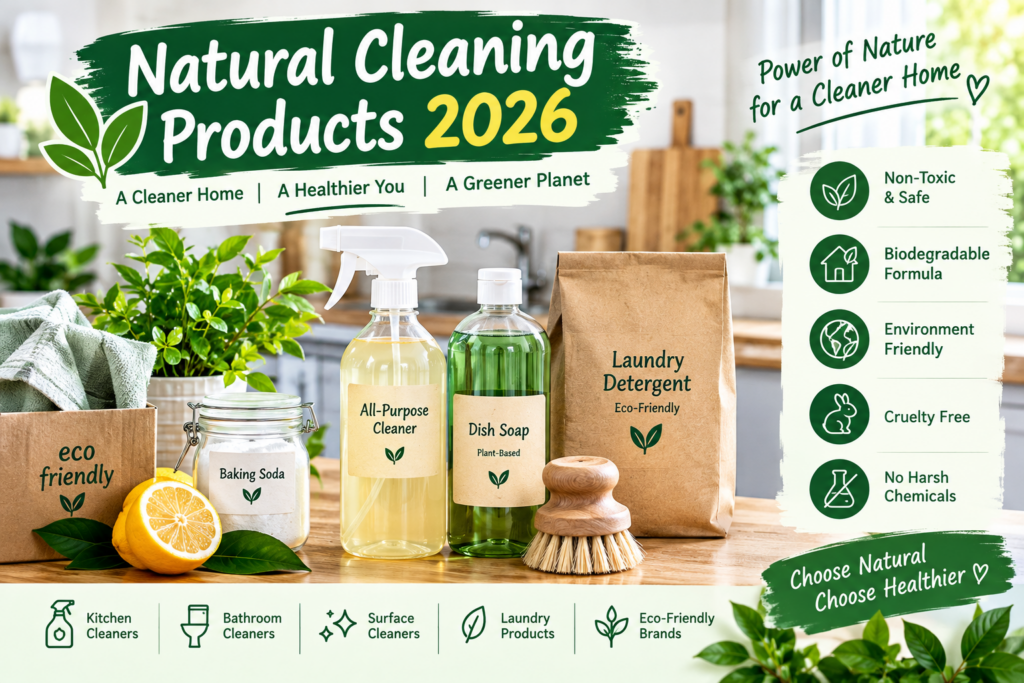
The Shift Toward Non-Toxic Home Care in 2026
The natural cleaning aisle has changed considerably. Products are now marketed as plant-based, biodegradable, fragrance-free, non-toxic, or environmentally friendly. Those labels can be useful—but they should not automatically be treated as proof that a product is safer.
For U.S. shoppers, one practical starting point is the EPA Safer Choice program. EPA evaluates ingredients against specific human-health and environmental criteria, and products carrying the Safer Choice label must meet the program’s requirements.
That distinction matters. “Natural” is not a regulated shortcut for “safe,” and a product does not become a better choice simply because its bottle uses green colors or pictures of leaves.
Why Traditional Cleaners Deserve a Closer Look
Conventional household cleaners can contain a wide range of ingredients designed for specific jobs, including surfactants, solvents, preservatives, fragrances, and disinfecting agents. Some are perfectly appropriate when used as directed, while others may be worth avoiding or limiting depending on the product and your household’s needs.
There is also a growing need to look beyond marketing language. The FTC’s Green Guides explain that environmental claims should be truthful and supported by competent and reliable evidence. Even claims such as “non-toxic” and “eco-friendly” should not be taken at face value without considering what they actually mean.
That is why this guide takes a practical approach. Instead of simply calling a cleaner “green” or “natural,” we’ll look at ingredients, certifications, cleaning performance, fragrance, packaging, and value. We’ll also consider what matters specifically to U.S. consumers when choosing safer cleaning products for kitchens, bathrooms, laundry rooms, and everyday household use.
The result is a more useful way to shop: less hype, more evidence, and products that can actually handle the messes of real American homes.
Why Switch to Natural Cleaning Products?
Switching to Natural Cleaning Products 2026 is less about throwing away every conventional cleaner in your home and more about making smarter choices. For many U.S. households, that can mean choosing products with fewer unnecessary fragrances, avoiding overly harsh formulas for routine cleaning, improving ventilation, and checking whether a product has credible safety information behind its claims.
The important part is knowing what “natural” actually means. A bottle labeled plant-based, green, or natural is not automatically safer. The American Lung Association notes that even products marketed as “green” or “natural” can contain ingredients that irritate the eyes, throat, or respiratory system.
Protecting Indoor Air Quality & Reducing Chemical Off-Gassing
Indoor air is one of the biggest reasons to rethink the products used around your home. Some cleaning products release volatile organic compounds (VOCs) into indoor air during use and, in some cases, while they are stored. EPA notes that concentrations of many VOCs can be higher indoors than outdoors.
This does not mean every conventional cleaner is dangerous or that every natural cleaner is VOC-free. In fact, EPA warns that “low VOC” or “no VOC” labeling alone does not necessarily guarantee a safer product for indoor air.
A practical approach is simple: choose products with clear ingredient and safety information, avoid unnecessary fragrance when possible, follow the label, and keep rooms ventilated while cleaning. EPA specifically recommends ventilation and suggests looking for products carrying the Safer Choice label when choosing household cleaners.
Family, Infant, and Pet Safety
Homes with babies, toddlers, pets, or people who are sensitive to fragrances need a little extra care. Young children spend a lot of time close to floors and other surfaces, while pets may come into contact with recently cleaned areas through their paws or mouths.
That does not mean every cleaning chemical needs to be eliminated. The smarter goal is to reduce unnecessary exposure and use the right product for the job.
For everyday cleaning, mild soap and water may be enough for many surfaces. When a stronger product is necessary, follow its directions carefully and keep cleaning products stored away from children and pets. EPA also recommends keeping household chemical products away from children and using ventilation when products may release VOCs.
For shoppers who want an additional layer of confidence, EPA’s Safer Choice program is particularly useful. Its certified products are evaluated against human-health and environmental criteria, and EPA maintains a searchable database of certified products.
Surface Protection: Enzymes vs. Harsh Corrosives
Not every cleaning job requires the strongest chemical available.
Different ingredients work in different ways. Enzyme-based cleaners, for example, can be formulated to break down specific types of organic messes such as food residue, grease, or pet-related stains. They can be useful when targeted cleaning is more appropriate than using an aggressive general-purpose formula.
Harsh acidic or alkaline cleaners have their place, too, particularly for difficult buildup or specialized cleaning. But stronger does not always mean better for everyday use. Certain formulations can damage sensitive finishes, irritate skin and eyes, or require additional protective measures.
The better choice depends on the surface, type of dirt, concentration, contact time, and manufacturer’s instructions. This is one reason a well-formulated cleaner with a credible safety profile can be a better everyday option than simply reaching for the strongest product on the shelf.
And there is one U.S. safety rule that should never be ignored: never mix household cleaning products unless the label specifically tells you to do so. CDC warns that mixing bleach with other cleaners, particularly ammonia-containing products, can release dangerous vapors.
The Bottom Line:
The best reason to switch to natural or safer cleaning products is not the word “natural” on the label. It is the opportunity to make more informed choices.
Look beyond the packaging. Check ingredients, consider fragrance and ventilation, match the cleaner to the surface, and look for credible programs such as EPA Safer Choice when appropriate. For American families, that approach is more useful than assuming a green label automatically means a safer product.
Comparison: Best Natural & Non-Toxic Cleaning Brands (2026)
Choosing among Natural Cleaning Products 2026 can get confusing quickly. One brand may focus on plant-derived ingredients, another on fragrance-free formulas, while a third may stand out mainly because it uses refillable or plastic-reducing packaging.
So instead of treating every “green” label as equal, this comparison looks at the things U.S. shoppers can actually check: certifications, ingredient transparency, packaging, everyday cleaning use, and approximate price level.
One certification deserves particular attention. The EPA Safer Choice program evaluates product ingredients against human-health and environmental criteria and also requires certified products to meet performance requirements. That makes it a more useful comparison point than simply looking for words such as “natural” or “green” on the front of a bottle.
Best Natural & Non-Toxic Cleaning Brands at a Glance
| Brand | Best For | Key Certifications / Programs | Typical Price Level* | Eco-Impact Focus |
|---|---|---|---|---|
| ECOS | Everyday household cleaning | EPA Safer Choice on many products; Leaping Bunny | $–$$ | Plant-derived formulas, concentrated/refill-oriented options, packaging improvements |
| Seventh Generation | Mainstream natural cleaning | EPA Safer Choice on selected products | $–$$ | Plant-based formulations, recycled-content packaging on selected products |
| Blueland | Plastic reduction & refills | EPA Safer Choice on selected products; USDA BioPreferred on selected products; Cradle to Cradle on selected products; Leaping Bunny | $$ | Reusable bottles and tablet-based refills |
| Branch Basics | Minimal-ingredient cleaning | Brand ingredient transparency; certification varies by product | $$ | Concentrated formulas and reusable bottles |
| Sensitive Home | Fragrance-sensitive households | EPA Safer Choice | $$ | Products formulated with sensitive users in mind |
| Green Works | Affordable mainstream alternative | EPA Safer Choice on selected products | $–$$ | Plant-based positioning and Safer Choice-certified formulas |
*Price levels are broad shopping guidance rather than fixed 2026 prices. Formulas, package sizes, retailers, subscriptions, and sales can change the final cost.
1. ECOS — Best Overall for Everyday Cleaning
ECOS is one of the strongest options for shoppers who want a wide selection without moving entirely into specialty cleaning products.
The company currently reports more than 120 EPA Safer Choice-certified products, covering categories such as laundry, dishwashing, and household cleaning. EPA has also recognized ECOS as a Safer Choice Partner of the Year.
Why it stands out:
You get a broad product range, relatively easy availability, and a large number of formulas that have gone through the EPA Safer Choice process.
Best for: Families who want one brand for several rooms and cleaning jobs.
2. Seventh Generation — Best Mainstream Choice
Seventh Generation is a familiar option for U.S. shoppers who want natural-leaning household products without shopping exclusively through specialty websites.
The brand has been a Safer Choice partner since 2009, and EPA has recognized its work developing Safer Choice-certified products.
The practical advantage is availability. You can often find Seventh Generation products through major U.S. retailers, making it easier to compare prices instead of paying a premium simply because a product is considered “eco.”
Best for: Shoppers who want a recognizable brand with a long history in the natural-cleaning category.
3. Blueland — Best for Reducing Single-Use Plastic
Blueland takes a different approach. Instead of shipping a new bottle of liquid cleaner every time, many of its products use tablets or concentrated formats that are mixed with water at home.
EPA recognized Blueland as a 2024 Safer Choice Partner of the Year, noting that the company had achieved Safer Choice certification for almost every tablet in its product line at that time.
Blueland also lists certifications including EPA Safer Choice, USDA BioPreferred, Cradle to Cradle, and Leaping Bunny, although the certification can differ by individual product.
Best for: U.S. households trying to reduce the number of disposable cleaning bottles they purchase.
4. Branch Basics — Best for a Minimalist Cleaning Routine
Branch Basics appeals to shoppers who prefer a simplified cleaning setup rather than a different spray for every surface.
Its concentrated approach can reduce the number of individual bottles needed around the home. However, shoppers should still evaluate the exact product and its ingredient information rather than assuming that “non-toxic” or “natural” automatically means risk-free.
Best for: People who want a simple cleaning system with fewer products.
5. Sensitive Home — Best for Sensitive Households
Sensitive Home is worth considering when fragrance and irritation are major concerns. EPA has recognized the company as a Safer Choice Formulator-Product Manufacturer, noting that its dish, laundry, and surface cleaners were designed with sensitive users in mind.
That makes the brand particularly interesting for households that want to pay closer attention to fragrance and formulation rather than simply choosing whatever product has the greenest packaging.
Best for: Shoppers prioritizing sensitive-use formulations.
6. Green Works — Best Budget-Friendly Mainstream Option
Green Works sits closer to the conventional supermarket-cleaner aisle while offering products positioned around plant-based cleaning.
Its connection with EPA’s Safer Choice program also makes it worth considering for shoppers who want a mainstream option but still want to look for independently defined ingredient and environmental criteria. EPA has previously recognized the Green Works line in its Safer Choice partner program.
Best for: Budget-conscious shoppers who want an easier transition from conventional cleaners.
How We Compare “Eco-Impact”
“Eco-friendly” is one of the easiest words for a cleaning brand to put on a package—and one of the hardest claims for shoppers to evaluate.
The FTC Green Guides caution against broad, unqualified environmental claims because consumers may interpret them as meaning that a product has wide-ranging environmental benefits. Environmental claims should be specific and supported by appropriate evidence.
For that reason, this comparison considers practical indicators such as:
- EPA Safer Choice certification
- Ingredient transparency
- Concentrated or refill formats
- Reusable packaging
- Recycled-content claims when clearly specified
- Third-party certifications where relevant
- Company sustainability information
- Availability for U.S. consumers
- Overall value rather than packaging appearance alone
A Quick Buying Rule for U.S. Shoppers
If you’re standing in a U.S. store comparing two cleaners, don’t automatically choose the bottle with the biggest “natural” or “green” message.
Instead, turn the bottle around.
Check the ingredients. Look for meaningful certifications. Read the directions. Consider fragrance. Then compare the price per ounce or per usable dose.
And remember: an EPA Safer Choice label is not an EPA endorsement of a brand. It indicates that the certified product meets the program’s applicable criteria. Individual products—not entire brands—should be checked when certification matters to your purchase.
That small change in shopping behavior can make Natural Cleaning Products 2026 much easier to navigate. You don’t need the most expensive cleaner or the product with the most impressive-looking package. You need a formula that fits your household, performs well for the job, and has claims you can actually verify.
Top Natural Cleaning Choices for Every Household Need
There is no single “best” cleaner for every American home. A busy household may want a strong appliance cleaner, while someone living in a small apartment may care more about saving storage space and reducing plastic bottles. Families with fragrance sensitivities may have a completely different priority.
That is why our Natural Cleaning Products 2026 picks focus on the job each product is designed to handle—not just the words printed on the front of the package.
Best Heavy-Duty & Appliance Care: Eco Safeway
Best for: Equipment, appliances, commercial-style cleaning jobs, and households that need more specialized cleaning power.
Eco Safeway is an interesting choice for shoppers looking beyond ordinary kitchen and bathroom sprays. Its product range includes specialized cleaners for applications such as ice machines, washing machines, condenser coils, drains, marine equipment, and other heavy-duty jobs. The company states that its products carry an HMIS 0-0-0 rating, meaning the products are rated at zero for health, flammability, and physical hazards under that HMIS classification.
That said, an HMIS rating should not be treated as the same thing as EPA Safer Choice certification. The two systems serve different purposes. For a U.S. shopper, it is still smart to check the individual product label, SDS, intended use, and manufacturer instructions before using a heavy-duty cleaner around food-contact surfaces or sensitive materials.
Why we like it: The range goes beyond basic surface sprays and addresses cleaning jobs where a specialized formula can make more sense.
Best fit: Appliance maintenance, equipment care, marine applications, and tougher cleaning tasks.
Best All-in-One Multi-Surface Concentrate: Branch Basics
Best for: Households that want fewer bottles and one concentrated product for multiple routine cleaning jobs.
Branch Basics takes a minimalist approach. Its Concentrate is diluted with water for use in different cleaning applications, which can help reduce the number of ready-to-use bottles taking up space under the sink.
The current ingredient list for the Concentrate includes water, decyl glucoside, coco-glucoside, chamomile flower extract, sodium citrate, sodium bicarbonate, and sodium gluconate.
That ingredient transparency is useful because shoppers can look beyond broad terms such as “clean” or “green” and see what is actually in the formula.
Why we like it: A simple concentrate can make a practical difference in a home where several specialized sprays would otherwise be needed.
Best fit: Kitchens, bathrooms, counters, and everyday household cleaning.
U.S. shopping tip: Always dilute and use the product according to the manufacturer’s instructions. “One cleaner for many surfaces” does not mean it is automatically appropriate for every finish, stone, appliance, or material.
Best Plastic-Free Refill System: Blueland
Best for: U.S. shoppers who want to reduce disposable cleaning bottles and switch to a refill-based system.
Blueland has built its cleaning system around reusable containers and concentrated tablets or powders. Instead of repeatedly purchasing a new bottle filled mostly with water, customers can keep the container and purchase refills. The company says its cleaning refills are packaged in compostable paper and that its tablets and powders are manufactured in the United States.
Blueland also has several product-specific certifications and programs, including EPA Safer Choice, USDA BioPreferred, Cradle to Cradle, and Leaping Bunny. However, certification can vary by product, so shoppers should check the specific formula rather than assuming the entire catalog carries every certification.
The EPA’s own Safer Choice database is a useful way for U.S. shoppers to verify whether a particular product is currently certified.
Why we like it: The refill format tackles a very visible household waste problem—empty cleaning bottles.
Best fit: Apartments, small homes, sustainability-focused families, and shoppers trying to reduce single-use plastic.
Best Fragrance-Free Choice for Sensitive Households: ATTITUDE
Best for: Shoppers who specifically want fragrance-free household cleaning options.
ATTITUDE offers a dedicated range of fragrance-free household products, including unscented laundry detergent, dish soap, all-purpose cleaner, bathroom cleaner, and other cleaning products. Its current U.S. site lists an unscented all-purpose cleaner at $6.95 for 27.1 fl. oz. and an unscented dish soap at $5.95 for 23.7 fl. oz.
For people who are sensitive to fragrances, this is an important distinction. “Natural fragrance” is still fragrance. Choosing an unscented product can be a more straightforward way to avoid added fragrance than relying on vague marketing language.
ATTITUDE also states that its Nature + Technology household collection is EWG Verified, vegan, and cruelty-free.
Why we like it: The brand gives shoppers a clear fragrance-free option rather than making them hunt through a large product range.
Best fit: Fragrance-sensitive households, families looking for unscented laundry or dish products, and shoppers who prefer naturally derived formulations.
Important: “Hypoallergenic” and “fragrance-free” are not interchangeable terms, and neither means a product cannot cause irritation or an allergic reaction. If someone in your household has a diagnosed allergy or significant skin condition, check the complete ingredient list and follow advice from their healthcare professional.
Which One Should You Choose?
| Household Need | Our Pick | Main Reason |
|---|---|---|
| Heavy-duty or appliance cleaning | Eco Safeway | Specialized cleaning applications and HMIS 0-0-0-rated products |
| One concentrate for everyday cleaning | Branch Basics | Simple concentrated formula and multi-use approach |
| Reduce disposable cleaning bottles | Blueland | Reusable containers with tablet/refill system |
| Fragrance-free household cleaning | ATTITUDE | Dedicated unscented cleaning range |
| Verify environmental/safety criteria | EPA Safer Choice database | Product-level certification lookup |
A Smarter Way to Shop in 2026
The easiest mistake is choosing a cleaner because the package looks natural.
Instead, ask three questions:
What job does it need to do?
A daily countertop spray and a heavy-duty appliance cleaner are not interchangeable.
What is actually in the formula?
Look for ingredient transparency rather than relying only on phrases such as “green,” “natural,” or “non-toxic.”
Can the claim be verified?
For U.S. consumers, programs such as EPA Safer Choice provide a more meaningful reference point than packaging alone. EPA maintains a searchable database of products that meet its Safer Choice Standard.
That approach makes choosing Natural Cleaning Products 2026 much less complicated. You do not need to find one perfect brand for your entire home. In many cases, the better strategy is to choose the right product for the right job—and verify the claims before paying for the “green” label.
How to Spot Greenwashing: What the Labels Don’t Tell You
A green bottle, a leaf-shaped logo, and the words “natural” or “non-toxic” can make a cleaning product look like the obvious choice. But packaging is not the same thing as evidence.
For shoppers comparing Natural Cleaning Products 2026, the smarter approach is to look past the front label. What ingredients are actually disclosed? Which claims can be verified? Is there an independent certification, or is the “green” message simply part of the branding?
Greenwashing does not always mean a company is deliberately lying. Sometimes a claim is simply so broad that it gives shoppers a much bigger impression than the evidence supports. The FTC’s Green Guides specifically address this problem and caution businesses about broad, unqualified environmental claims such as “green” or “eco-friendly.”
Ingredient Red Flags: Fragrances, MIT/BIT, and Phthalates
The word “fragrance” deserves a closer look.
Fragrance can refer to a mixture of ingredients rather than one clearly identified substance. That does not automatically make a product unsafe, but it can make ingredient transparency harder for consumers. EPA’s Safer Choice program has specific criteria for fragrance ingredients, and products carrying its additional Fragrance-Free designation must meet EPA’s requirements for having no fragrance materials.
For households trying to minimize unnecessary fragrance, choosing an explicitly fragrance-free product can therefore be more meaningful than simply choosing one marketed as “natural.”
What about MIT and BIT?
Methylisothiazolinone (MIT) and benzisothiazolinone (BIT) are preservatives used in some water-based products to help control microbial growth.
Their presence should not automatically be interpreted as proof that a cleaner is dangerous. Preservatives serve a real function. However, consumers who are concerned about skin sensitization may want to identify these ingredients on the label and consider fragrance-free or preservative alternatives where appropriate.
EPA’s Safer Choice program specifically evaluates ingredients for concerns including sensitization and other human-health and environmental endpoints.
And what about phthalates?
Phthalates are a broad family of chemicals with different properties and uses. Consumers often encounter them in discussions about fragrance because some fragrance formulations can involve chemicals that are not individually obvious from a simple “fragrance” listing.
The practical takeaway is not to panic when you see a chemical-sounding ingredient. Instead, look for ingredient transparency and credible certification. A product that explains what is in the formula gives you much more useful information than a bottle that simply says “clean” or “chemical-free.”
Understanding U.S. Regulations: FTC Green Guides & EPA Standards
This is where U.S. shoppers have an important advantage: there are government programs and rules that can help separate specific claims from marketing language.
FTC Green Guides
The Federal Trade Commission (FTC) uses the Green Guides to explain how environmental marketing claims should be presented. The guidance focuses on whether consumers are likely to interpret a claim in a misleading way and whether the advertiser has appropriate evidence to support it.
That matters when you see phrases such as:
- “Eco-friendly”
- “Green”
- “Non-toxic”
- “Biodegradable”
- “Plant-based”
- “Chemical-free”
- “Better for the environment”
For example, “plant-based” tells you something about the source of certain ingredients, but it does not automatically tell you that the finished product is safer, more effective, or environmentally superior in every respect.
The same caution applies to “non-toxic.” The FTC notes that marketers making a non-toxic claim should have evidence showing that the product is safe for both people and the environment.
EPA Safer Choice
For household cleaners, EPA Safer Choice is one of the most useful U.S. programs to know.
EPA evaluates ingredients against human-health and environmental criteria and also has product-level requirements covering areas such as performance, packaging, and ingredient disclosure.
Importantly, Safer Choice is not the same thing as saying a product contains no chemicals. Cleaning products need chemicals to work. Instead, the program evaluates the chemicals used and looks for safer options within their functional classes.
EPA also maintains a searchable database where consumers can check whether a specific product meets the Safer Choice Standard.
That’s a much better shopping habit than trusting a green-colored package.
Crucial Third-Party Certifications to Look For
Government programs are not the only useful signals. Some independent organizations have their own standards and certification systems.
But remember: one certification does not prove that a product is perfect in every environmental or health category. Each program has a different purpose.
EWG Verified®
EWG Verified is a consumer-facing certification that evaluates eligible products against the Environmental Working Group’s own criteria. For cleaning products, EWG says its verification process considers ingredient safety, transparency, and other requirements under its program.
What it can tell you: The product has gone through EWG’s verification process.
What it cannot tell you: That the product is automatically the “safest” cleaner for every person or household.
Use the certification as one data point, not the entire buying decision.
MADE SAFE®
MADE SAFE is another independent certification that shoppers may encounter when researching non-toxic and environmentally conscious products.
Its approach focuses on screening products and ingredients against its own prohibited and restricted substance criteria.
For a consumer, the useful question is simple: What does this particular certification actually evaluate? Reading the standard behind a logo is more informative than assuming every green seal means the same thing.
B Corp
A B Corp certification is different from a product-level cleaning certification.
B Corp certification evaluates a company’s broader social and environmental performance, governance, workers, community impact, and other business practices. It should therefore be viewed as a company-level signal, not proof that every individual cleaner made by that company has been independently assessed for chemical safety.
That distinction is easy to miss.
A cleaning company can have strong corporate sustainability practices while a particular product may still contain ingredients that some shoppers prefer to avoid. Conversely, a product can meet a strong ingredient standard even if its manufacturer is not B Corp certified.
Greenwashing Checklist for U.S. Shoppers
Before buying a “natural” or “non-toxic” cleaner, take 30 seconds to check:
| What to Check | What to Ask |
|---|---|
| Ingredient list | Are the ingredients clearly disclosed? |
| Fragrance | Is it scented, fragrance-free, or simply marketed as “fresh”? |
| Preservatives | Does the formula contain MIT, BIT, or other preservatives you want to understand? |
| EPA Safer Choice | Can you verify the specific product in EPA’s database? |
| Environmental claims | Does the brand explain exactly what “eco-friendly” means? |
| Packaging claims | Is recycled or recyclable content clearly specified? |
| Third-party seals | Who issued the certification, and what does it actually cover? |
| Performance | Does the cleaner work for the surface and job you need it for? |
| Safety directions | Are warnings, usage instructions, and storage information clearly provided? |
The Bottom Line
The best defense against greenwashing is not memorizing every chemical name. It’s learning to question vague claims and look for evidence.
When evaluating Natural Cleaning Products 2026, don’t stop at “natural,” “green,” or “non-toxic” on the front of the bottle. Check the ingredients, investigate the certification, verify EPA claims when applicable, and look for specific environmental statements rather than broad promises.
A trustworthy cleaning product does not need to sound perfect.
It needs to tell you enough that you can make an informed decision.
Hands-On Performance Testing & Real Results
A cleaner can have a beautiful ingredient list and still disappoint when you actually use it. Nobody wants to spray a kitchen counter three times just to remove a greasy fingerprint.
That is why evaluating Natural Cleaning Products 2026 should go beyond ingredient claims. For everyday U.S. households, cleaning performance matters just as much as sustainability. A product needs to remove the type of mess it promises to tackle, work on the intended surface, and provide enough cleaning power to justify its price.
One important distinction: not every household cleaner is a disinfectant. A product marketed for general cleaning should not automatically be assumed to kill bacteria or viruses. If a product makes antimicrobial or disinfecting claims, check its EPA registration and follow the label directions.
Grease, Mineral Scale, and Bacteria Removal Compared
Different messes require different cleaning approaches. Comparing every cleaner with one “toughness” score would therefore be misleading.
Grease and Food Residue
Kitchen grease is generally where stronger surfactant-based cleaners have an advantage. A good everyday degreaser should loosen oily residue without requiring excessive scrubbing.
For routine kitchen cleaning, compare products based on:
- How quickly the formula breaks down visible grease
- How much product is needed
- Whether it leaves a sticky film
- Whether repeated applications are necessary
- Whether it is approved or recommended for the specific surface
A cleaner that requires half the product but twice the scrubbing is not necessarily the better value.
Mineral Scale and Hard-Water Deposits
Calcium and mineral deposits are a different challenge. If you’ve ever cleaned a showerhead or faucet in a hard-water area, you’ve probably noticed that an ordinary all-purpose spray may not be enough.
Acidic cleaners are commonly used for mineral deposits because acids can react with certain mineral buildup. But stronger is not automatically better. Some natural stone surfaces, metals, finishes, and sealants can be damaged by acidic products.
Always check the manufacturer’s surface instructions before using a descaling product.
This is particularly important in U.S. homes where the same bathroom may contain glass, ceramic tile, stainless steel, natural stone, and different types of fixtures.
Bacteria and Disinfection
This is the category where consumers need to be especially careful with marketing language.
Cleaning and disinfecting are not the same thing.
Cleaning removes dirt and some germs from surfaces. Disinfection uses a product designed and labeled to kill specified microorganisms under defined conditions.
In the United States, antimicrobial pesticides—including many disinfectant products—are regulated by the EPA. EPA’s List N provides information on disinfectants that meet its criteria for use against SARS-CoV-2, the virus that causes COVID-19. (epa.gov)
So if a product claims to disinfect, don’t judge it simply by the words “natural” or “non-toxic.” Check the EPA registration number and product label and use the product exactly as directed.
For ordinary dirt and routine household messes, you may not need a disinfectant every time. CDC guidance emphasizes cleaning regularly and using disinfection when appropriate, particularly when someone is sick or when there is a higher risk of spreading germs. (cdc.gov)
Cost-Per-Use Breakdown: Are Eco-Cleaners Actually More Expensive?
The price on the shelf doesn’t tell the whole story.
A $7 bottle can be cheaper than a $15 concentrate if you use a lot more of the first product. On the other hand, a premium concentrate isn’t automatically a bargain simply because it makes several bottles of diluted cleaner.
For a fair comparison, calculate cost per usable ounce or cost per prepared bottle.
Simple Cost-Per-Use Formula
Cost per use = Product price ÷ estimated number of uses
For concentrates:
Cost per prepared bottle = Product price ÷ number of bottles the concentrate makes
For example, imagine:
| Cleaner | Purchase Price | Approx. Uses | Estimated Cost per Use |
|---|---|---|---|
| Conventional spray | $6.00 | 40 | $0.15 |
| Natural ready-to-use spray | $8.00 | 45 | $0.18 |
| Concentrate | $14.00 | 100 | $0.14 |
| Tablet refill system | $12.00 | 50 | $0.24 |
These figures are illustrative, not current product prices. Actual costs depend on bottle size, dilution instructions, retailer, subscriptions, and how heavily you use the cleaner.
The interesting part is that the most expensive bottle is not always the most expensive option per use.
What About Refills?
Refill systems can change the calculation even further.
With a reusable bottle, you’re primarily paying for the cleaning formula rather than repeatedly buying another spray bottle. But shipping costs, refill frequency, subscription discounts, and the initial cost of the reusable container should all be included when comparing systems.
For U.S. shoppers, a useful calculation is:
First-year cost = bottle/setup cost + refills + shipping − applicable discounts
That gives you a more realistic picture than comparing two shelf prices.
What We Would Look for in a Real-World Test
If you want to personally compare two Natural Cleaning Products 2026 options at home, keep the test simple and repeatable.
Use the same:
- Surface material
- Amount of mess
- Amount of cleaner
- Dwell/contact time
- Number of wipes or scrubbing passes
- Cleaning cloth or sponge
- Water temperature
- Room conditions
Then record four things:
1. Cleaning power — Did it remove the mess?
2. Effort — How much scrubbing was required?
3. Residue — Did the surface feel or look clean afterward?
4. Cost — How much product did you actually use?
For disinfectants, don’t create your own “bacteria-killing test” at home. Instead, verify the product’s EPA registration and follow its approved label directions. That provides a much more reliable basis for comparing antimicrobial claims.
The Real-World Verdict
The best eco-conscious cleaner isn’t necessarily the one with the most impressive sustainability language or the highest price.
A genuinely useful product should clean effectively, suit the surface, provide clear directions, and offer a reasonable cost per use.
For American households, that is the comparison that matters. A $10 cleaner that lasts three months may be a better purchase than a $5 bottle that disappears in a few weeks. And a refill system can make financial sense when the formula is concentrated enough to reduce both product volume and packaging.
In other words, don’t ask only:
“Is this cleaner natural?”
Ask:
“Does it work for my mess, is it appropriate for my surface, can I verify its claims, and what does each cleaning session actually cost?”
That is a much more useful way to judge today’s natural cleaning products.
Frequently Asked Questions
Is Mrs. Meyer’s actually non-toxic?
Not necessarily in the absolute sense implied by the phrase “non-toxic.” Mrs. Meyer’s Clean Day markets many products around plant-derived ingredients and a more natural cleaning experience, but “natural” and “non-toxic” are not interchangeable terms.
The better question is whether a specific product has ingredients or certifications that match your preferences. For U.S. shoppers, check the individual ingredient list and look for credible third-party or government-backed standards rather than relying only on front-label language.
It is also worth remembering that EPA Safer Choice certification is product-specific. Consumers can search EPA’s current database to verify whether a particular cleaner is certified.
Bottom line: Mrs. Meyer’s may be a reasonable option for some households, but I would not describe the entire brand as automatically “non-toxic.”
What is the best all-purpose cleaner in 2026?
There isn’t one universal winner because the “best” cleaner depends on what you care about most—cleaning power, fragrance, ingredients, price, sensitive-skin considerations, or environmental impact.
For shoppers prioritizing a combination of everyday performance and independently defined ingredient criteria, EPA Safer Choice is a useful starting point. EPA maintains a searchable database of certified cleaning products, including all-purpose cleaners.
For Natural Cleaning Products 2026, I would compare:
- EPA Safer Choice status
- Fragrance-free options
- Ingredient transparency
- Cleaning performance
- Price per use
- Packaging and refill options
- Whether the product is appropriate for your particular surface
A “best” cleaner that damages your countertop or requires five applications isn’t really the best choice for your home.
How do you clean your house without toxic chemicals?
You don’t need to eliminate every chemical to clean your home effectively. In fact, “chemical-free” is not a realistic description—water itself is a chemical, and cleaning products work because of chemicals.
A more practical approach is to reduce unnecessary exposure and choose products with clearer safety information.
For everyday cleaning:
- Start with soap, water, and mechanical cleaning when they are sufficient.
- Use the mildest appropriate cleaner for the surface.
- Consider fragrance-free products if you prefer to minimize fragrance exposure.
- Ventilate rooms while cleaning.
- Follow the product label rather than assuming more product means better cleaning.
- Store cleaners away from children and pets.
- Never mix cleaning products unless the label specifically instructs you to do so.
For products marketed as safer alternatives, EPA Safer Choice can help U.S. consumers identify cleaners that meet defined ingredient, product, performance, and environmental criteria.
What cleaning products are toxin-free?
There is no simple list of household cleaners that can honestly be labeled completely “toxin-free” in every circumstance.
The term “toxin-free” is often used as marketing shorthand, but toxicity depends on the substance, concentration, route of exposure, and circumstances of use. A product can contain ingredients that are considered safer for their intended function without being literally free of every substance capable of causing harm at some exposure level.
For U.S. shoppers, a more useful strategy is to look for:
- EPA Safer Choice certification
- EPA’s Fragrance-Free designation when avoiding fragrance matters
- Clear ingredient disclosure
- Appropriate safety directions
- Specific, substantiated environmental claims
- Reputable third-party certifications where relevant
EPA explains that Safer Choice evaluates ingredients within their functional classes and considers human-health and environmental concerns rather than simply banning the word “chemical.”
In other words: don’t shop for a magical “toxin-free” bottle. Shop for a cleaner with evidence behind its safety and environmental claims.
What is the most non-toxic cleaning product?
There isn’t a scientifically meaningful single product that can be called “the most non-toxic cleaning product.”
For many routine household tasks, the simplest effective option may be enough. For example, cleaning a lightly soiled surface with water and an appropriate mild cleaner does not require the strongest chemical available.
If you want a packaged product, EPA Safer Choice is one of the strongest U.S.-specific starting points because its program evaluates ingredients as well as product-level factors and performance. EPA says Safer Choice-certified products must meet its applicable criteria while still performing effectively.
For people specifically trying to avoid fragrance, EPA’s Safer Choice Fragrance-Free designation is particularly useful. EPA distinguishes “fragrance-free” from “unscented”: an unscented product may still contain ingredients used to mask odors, whereas the Safer Choice fragrance-free designation is verified against EPA’s criteria.
So rather than asking, “What is the most non-toxic cleaner?” a better question is:
“What is the safest effective cleaner for this particular job and surface?”
What is the lawsuit against Mrs. Meyer’s?
There have been legal disputes involving Mrs. Meyer’s products over the years, so it is important not to combine different cases into one claim.
One documented California case dates back to 2009, when David Steinman filed a lawsuit against The Caldrea Company involving Mrs. Meyer’s Clean Day Liquid Dish Soap. California’s Attorney General database records the matter as a failure-to-warn case concerning alleged exposure to 1,4-dioxane, with the complaint filed in San Francisco Superior Court in September 2009.
The issue involved an important technical distinction: 1,4-dioxane is not intentionally added as a cleaning ingredient in the ordinary sense; it can occur as a manufacturing byproduct associated with certain ethoxylated ingredients. The existence of a lawsuit or allegation does not, by itself, establish that a product is unsafe or that every product from the brand has the same issue.
There are also more recent online discussions and legal-claim reports involving the brand’s “natural” or plant-based marketing. Because litigation can change and individual claims may be dismissed, settled, amended, or remain unresolved, readers should check the actual court record before treating a lawsuit allegation as a proven fact.
The practical takeaway for shoppers: a lawsuit should prompt you to investigate the specific allegation—not automatically conclude that every Mrs. Meyer’s product is unsafe.
Final Verdict & Key Takeaways
After looking at ingredients, certifications, cleaning performance, refill systems, and real-world value, one thing becomes clear: there is no single “perfect” cleaner for every American household.
The best Natural Cleaning Products 2026 are the ones that balance effective cleaning, sensible ingredients, clear labeling, appropriate safety information, and realistic environmental claims.
You do not need to replace every bottle under your kitchen sink overnight. A better approach is to make changes where they actually matter.
Our Final Take
For everyday household cleaning, look for products that clearly explain what they contain and how they should be used. If independent verification matters to you, the EPA Safer Choice program is one of the most useful U.S. resources for checking qualifying cleaning products. EPA evaluates ingredients against human-health and environmental criteria and requires certified products to meet applicable performance standards. (epa.gov)
For shoppers concerned about fragrance, an explicitly fragrance-free product can be a more meaningful choice than a cleaner simply described as “fresh,” “natural,” or “green.”
For sustainability, don’t judge a product by the color of its bottle. Look at the details: refill systems, concentrated formulas, reusable packaging, recycled content, and specific environmental claims.
And if a brand makes a broad claim such as “eco-friendly” or “non-toxic,” ask what evidence supports it. The FTC’s Green Guides are designed to help businesses understand how environmental marketing claims should be substantiated and presented to consumers. (ftc.gov)
The 6 Things We Would Prioritize
1. Choose the right cleaner for the job.
A gentle multi-surface spray is not a substitute for a specialized descaler, degreaser, or disinfectant.
2. Read the ingredients—not just the front label.
“Plant-based,” “natural,” and “clean” can tell you something, but they don’t tell the whole story.
3. Verify important certifications.
For U.S. household cleaners, EPA Safer Choice is especially relevant. Third-party programs such as EWG Verified or MADE SAFE can provide additional information, but each certification has its own scope and criteria.
4. Don’t confuse cleaning with disinfecting.
A cleaner removes dirt and debris. A disinfectant is specifically designed and labeled to kill certain microorganisms under defined conditions. If you need disinfection, check the product’s EPA registration and follow the label.
5. Calculate the cost per use.
A $15 concentrate may actually cost less per cleaning than a $7 ready-to-use spray if it produces substantially more usable product. Compare the amount you actually use—not just the sticker price.
6. Be skeptical of perfect-sounding claims.
“100% non-toxic,” “chemical-free,” and “completely eco-friendly” should make you look for more information, not reach for your wallet faster.
Best Choice by Household Priority
| Your Priority | What to Look For |
|---|---|
| Everyday cleaning | Effective multi-surface formula |
| Fragrance concerns | Clearly labeled fragrance-free option |
| Ingredient transparency | Full or detailed ingredient disclosure |
| Environmental considerations | Specific, substantiated sustainability claims |
| Independent verification | EPA Safer Choice or relevant third-party certification |
| Plastic reduction | Concentrates, tablets, or refill systems |
| Heavy-duty cleaning | Product specifically designed for the task |
| Disinfection | EPA-registered disinfectant with appropriate label directions |
| Best value | Cost per use rather than bottle price |
That is a much more realistic approach to creating a safer and more environmentally conscious cleaning routine.
Final Verdict
The biggest lesson from Natural Cleaning Products 2026 is that smarter cleaning is not about finding a magical “chemical-free” product. It’s about understanding what you’re buying and why.
For U.S. consumers, start with the basics: read the label, check the ingredients, verify meaningful certifications, follow safety directions, and compare cost per use. When environmental claims influence your purchase, look for specific information rather than vague promises.
A good cleaning product should earn its place in your home through performance and transparency—not clever packaging.
And you don’t have to make the switch all at once. Start with one product you use frequently, compare a few alternatives, and see what actually works in your home.
That’s the kind of change that is easier to afford, easier to maintain, and far more useful than chasing the “greenest” bottle on the shelf.
Explore More Eco-Friendly Living Guides
If you enjoyed this guide on non-toxic home care, check out our top-rated sustainable lifestyle articles to complete your eco-friendly journey:
🌿 10 Best Eco-Conscious Clothing Brands in 2026 — Discover ethical fashion brands that prioritize sustainable fabrics and fair trade practices.
👗 Sustainable Fashion 2026: The Ultimate Guide to Eco-Friendly Style — Learn how to build a timeless capsule wardrobe without compromising on ethics or quality.
10 best Eco-Conscious Clothing Brands In 2026
Sustainable Fashion 2026