
10 Best Eco-Friendly Cleaning Products 2026
Cleaning your home does not have to mean choosing between a spotless kitchen and a lower-impact lifestyle. In 2026, U.S. shoppers have more options than ever for eco-friendly cleaning products that combine everyday cleaning performance with refillable packaging, concentrated formulas, plant-based ingredients, and more transparent product standards.
But there is a catch: “green,” “natural,” and “eco-friendly” do not automatically mean a product is safer or more sustainable. A good-looking label can tell you very little about what is actually inside the bottle or what happens to the packaging after you finish using it.
That is why this guide takes a more practical approach to the 10 Best Eco-Friendly Cleaning Products 2026. Instead of judging products only by marketing language, we look at factors that matter to American households: cleaning performance, ingredients, packaging, refill options, certifications, fragrance choices, price, and how easy the product is to use in a normal U.S. home.
For shoppers who want an extra layer of reassurance, the EPA’s Safer Choice program is one useful place to start. EPA evaluates ingredients against health and environmental criteria rather than simply accepting a company’s “green” claim. The USDA’s BioPreferred program is another relevant U.S. standard for certain products because it verifies the biobased content of certified products, including cleaning products.
So, whether you are replacing a conventional all-purpose spray, looking for a low-waste laundry option, or simply trying to reduce the number of plastic bottles under your sink, the goal is straightforward: find cleaning products that work well without relying on vague sustainability promises.
Why Switch to Eco-Friendly Cleaning Products?
For many American families, cleaning products are used several times a week—or several times a day. That makes the choices under your kitchen sink more important than they might seem.
Switching to thoughtfully formulated cleaning products can help you reduce unnecessary packaging, choose products with clearer ingredient information, and avoid paying extra for sustainability claims that are difficult to verify.
There is also a practical reason to make the switch: many newer cleaning brands have moved beyond the traditional spray-bottle model. Concentrates, tablets, reusable bottles, refill pouches, and powdered formulas can reduce the amount of water and packaging shipped with every purchase.
Still, less plastic does not automatically make a product better, and plant-based does not automatically mean harmless. The smarter approach is to look at the whole product—from formulation and performance to packaging and disposal.
The FTC’s Green Guides specifically caution marketers against broad, unqualified environmental claims because consumers may interpret “eco-friendly” as meaning a product has wide-ranging environmental benefits.
That is an important distinction for shoppers, too.
Health & Environmental Benefits of Non-Toxic Cleaning
The phrase “non-toxic” is widely used in the cleaning aisle, but it deserves a closer look. Under FTC guidance, companies making a non-toxic claim should have competent and reliable scientific evidence showing that the product is safe for people and the environment.
For consumers, a better strategy is to look beyond a single front-label claim.
Consider:
- Ingredient transparency: Can you find meaningful information about the formula?
- EPA recognition: Does the product carry an applicable EPA Safer Choice or related designation?
- Fragrance: Is there a fragrance-free option if you prefer to avoid added fragrance?
- Packaging: Can the bottle be reused, refilled, or recycled through a realistic local program?
- Concentration: Are you shipping mostly water, or buying a concentrated formula?
- Performance: Does it actually clean well enough that you do not need to use twice as much?
- Specific claims: Does the brand explain exactly what makes the product lower-impact rather than simply calling it “green”?
EPA’s Safer Choice program also has a specific fragrance-free designation for qualifying products, which can be useful for shoppers who prefer products without fragrance materials.
The bigger picture is simple: the best eco-friendly cleaning product is not necessarily the one with the greenest packaging or the longest list of plant-based ingredients. It is the product that balances effective cleaning, ingredient transparency, responsible packaging, and realistic environmental benefits.
That is the standard we use throughout this 2026 guide.
Quick Buyer’s Guide: What to Look For
Before adding any product from our 10 Best Eco-Friendly Cleaning Products 2026 list to your cart, take a minute to look past the green packaging and words like “natural,” “clean,” or “plant-based.”
A genuinely better cleaning product should make sense on more than one level: what is in the formula, how well it cleans, how it is packaged, what claims can be verified, and whether the product fits your household’s needs.
For U.S. shoppers, third-party certifications and specific environmental claims can be more useful than a simple green label. The FTC’s Green Guides caution businesses against broad, unqualified environmental claims that could mislead consumers. That is one reason we recommend looking for specific, verifiable claims instead of assuming that every product marketed as “eco-friendly” has the same environmental benefits.
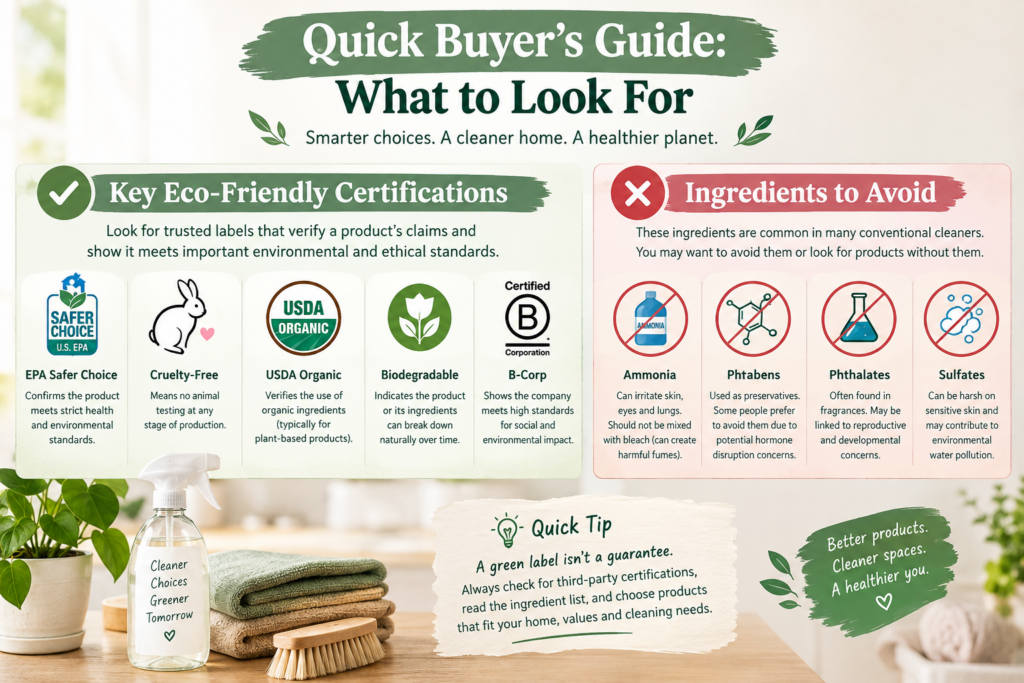
Key Eco-Friendly Certifications and Standards
Not every badge on a cleaning bottle means the same thing. Some address ingredients, some address animal testing, some address a company’s overall business practices, and others focus on environmental attributes.
Here are the labels worth understanding before you buy:
| Certification or Label | What It Tells You | What It Does Not Guarantee |
|---|---|---|
| EPA Safer Choice | EPA has reviewed the product’s ingredients against specific human-health and environmental criteria | It does not mean the product has zero environmental impact |
| EPA Safer Choice Fragrance-Free | The qualifying product contains no fragrance ingredients under EPA’s standard | It is not a guarantee that every user will have the same experience |
| USDA Certified Biobased Product | Verifies the percentage of renewable biobased ingredients through the USDA BioPreferred program | It does not automatically mean the entire product or package is sustainable |
| Leaping Bunny | Helps consumers identify companies that meet a cruelty-free standard | Cruelty-free does not necessarily mean vegan or environmentally friendly |
| B Corp Certification | Evaluates a company’s broader social and environmental performance | It is a company-level certification, not a certification that a particular cleaner is non-toxic |
| Biodegradable claim | May describe how a particular ingredient or material breaks down under stated conditions | “Biodegradable” by itself does not tell you how quickly or where breakdown occurs |
For cleaning products, EPA Safer Choice deserves particular attention because the program evaluates ingredients using health and environmental criteria. If a product carries the appropriate Safer Choice label, shoppers have more concrete information than they would from a generic “green” claim alone.
USDA BioPreferred can also be useful when you want to know whether a product contains verified renewable agricultural, forestry, or other biobased ingredients.
And remember: certification is not the same as marketing. If a brand displays a sustainability badge, check what organization issued it and what exactly was evaluated.
What About “Cruelty-Free” and “Vegan”?
These terms are often grouped together, but they are not interchangeable.
Cruelty-free generally relates to animal testing, while vegan refers to the absence of animal-derived ingredients or materials. A product can meet one description without meeting the other.
For shoppers who prioritize animal welfare, look for a recognizable third-party standard rather than relying only on a bunny symbol or a brand’s own statement.
That distinction matters because the phrase “cruelty-free” says little about packaging waste, ingredient sourcing, biodegradability, or overall environmental impact.
Be Careful With “Biodegradable”
“Biodegradable” sounds straightforward, but the details matter.
A cleaning ingredient may break down under particular environmental conditions without meaning that the entire product—including its bottle, cap, label, and other components—will disappear quickly after disposal.
When a brand makes a biodegradability claim, look for information about what material is biodegradable and under what conditions.
This is a good example of why specific claims are more useful than broad sustainability language.
Ingredients to Think Twice About
There is no universal list of “bad” cleaning ingredients. Whether an ingredient is appropriate depends on its concentration, formulation, exposure, intended use, and the product’s overall safety profile.
So rather than treating every chemical-sounding ingredient as dangerous, focus on the ingredients and claims that are particularly relevant to your household priorities.
Ammonia
Ammonia is a powerful cleaning ingredient and can be found in some household cleaners, particularly products designed for glass and hard surfaces.
The bigger issue is safe handling. Never mix ammonia-containing cleaners with bleach. Dangerous gases can form.
If you prefer a simpler cleaning routine, you may choose an alternative product that does not require ammonia. Always read the product label and follow its directions.
Parabens
Parabens are preservatives used in some personal-care and other formulations. They are not a defining ingredient of modern household cleaning products, and their presence or absence should not be treated as the only measure of whether a cleaner is environmentally responsible.
If avoiding parabens is important to you, check the ingredient information rather than assuming a product is “paraben-free” because its packaging looks natural.
Phthalates
Phthalates can be associated with fragrance formulations and other product components. Consumers who want to minimize exposure to certain fragrance-related ingredients may prefer fragrance-free products or brands that provide clearer fragrance disclosure.
Again, the useful question is not simply “Does this product contain chemicals?” Everything in a cleaning formula is made of chemicals. The better question is: What ingredients are present, why are they there, and what evidence supports the product’s safety and environmental claims?
Sulfates
Sulfates are surfactants that help products lift oils and dirt. Their presence does not automatically make a cleaning product unsafe or environmentally harmful.
Some shoppers nevertheless prefer sulfate-free formulas based on personal preferences or concerns about irritation. If that is your priority, check the full ingredient information rather than relying solely on front-label marketing.
A Better Rule for Choosing Cleaning Products
Instead of trying to find a bottle with the longest list of “free-from” claims, use this simple checklist:
1. Check the actual ingredients.
Do not rely only on words such as natural, clean, green, or plant-powered.
2. Look for meaningful third-party standards.
EPA Safer Choice and USDA BioPreferred can provide more useful information than an unexplained sustainability badge.
3. Examine the packaging.
A concentrated cleaner, refill system, tablet, or reusable bottle may reduce packaging compared with repeatedly buying conventional ready-to-use bottles—but compare the actual packaging system rather than assuming.
4. Consider fragrance.
If you prefer to avoid added fragrance, look for a clearly identified fragrance-free option.
5. Check the company’s environmental claims.
Specific claims with supporting information are more meaningful than vague statements such as “100% green.”
6. Make sure it actually works.
An eco-friendly cleaner that requires three times as much product to clean the same surface is not necessarily the better choice.
Our Take
For Best Eco-Friendly Cleaning Products 2026, we would not choose a product simply because it has a recycled-looking bottle, a leaf on the label, or the word “natural” in large letters.
The better choice is usually the one where the cleaning performance, formula, packaging, and sustainability claims all hold up when you look a little closer.
That is also a more realistic approach for U.S. families. You do not need to replace every cleaner in your home overnight. Start with the products you use most often—such as an all-purpose spray, dish soap, laundry detergent, or bathroom cleaner—and compare the alternatives carefully.
10 Best Eco-Friendly Cleaning Products in 2026
There is no single “greenest” cleaner for every American household. A busy family may care most about an affordable product available at Target or Walmart, while a zero-waste shopper may prefer a refill tablet that eliminates another plastic bottle.
That is why this list looks beyond the word eco-friendly on the label. We considered cleaning format, ingredient transparency, refill or packaging systems, relevant third-party certifications, everyday practicality, and the specific job each product is designed to handle.
We also give extra weight to products with meaningful U.S. standards or independently verifiable claims. For example, EPA maintains a searchable database of products that meet its Safer Choice Standard, including all-purpose cleaners, laundry products, floor cleaners, toilet bowl cleaners, dish soaps, and window cleaners.
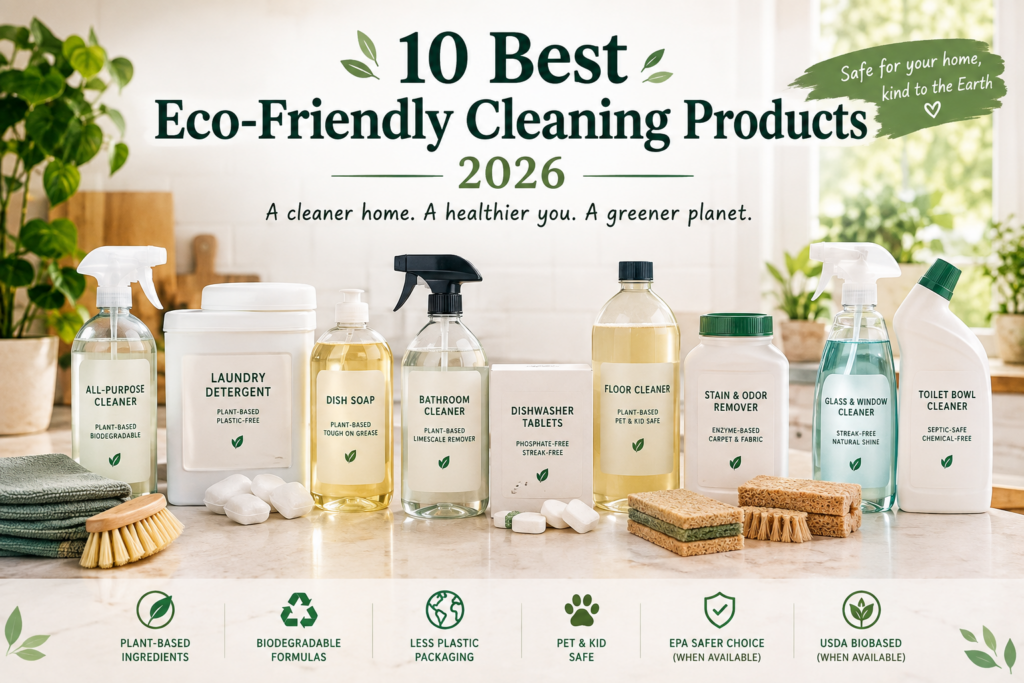
Quick Picks: Best Eco-Friendly Cleaning Products 2026
| Category | Our Pick | Best For | Standout Feature |
|---|---|---|---|
| Best All-Purpose Cleaner | Branch Basics Concentrate | Whole-home cleaning | One concentrated formula with multiple uses |
| Best Eco-Friendly Laundry Detergent | Blueland Laundry Tablets | Plastic-conscious laundry routines | Lightweight tablet format and reusable system |
| Best Plant-Based Dish Soap | Seventh Generation Dish Liquid | Everyday dishes | Widely available and established safer-chemistry credentials |
| Best Bathroom & Tile Cleaner | Blueland Bathroom Cleaner | Soap scum and everyday bathroom cleaning | Refillable tablet system |
| Best Eco Dishwasher Tablets | Blueland Dishwasher Tablets | Automatic dishwashers | Tablet format with reduced packaging |
| Best Natural Floor Cleaner | Bona | Hard-surface floors | Strong floor-care specialization |
| Best Stain & Odor Remover | Branch Basics Concentrate | Fabric and everyday household messes | Versatile concentrated formula |
| Best Biodegradable Sponge & Scrubber | Full Circle Home | Kitchen cleaning | Reusable and lower-waste cleaning tools |
| Best Glass & Window Cleaner | Seventh Generation Glass & Surface Cleaner | Mirrors and windows | Straightforward everyday glass cleaning |
| Best Toilet Bowl Cleaner | Blueland Toilet Cleaner Tablets | Routine toilet cleaning | Refillable tablet approach |
Our editorial note: “Best” here means best suited to the category based on the product’s format, available certifications or company claims, sustainability approach, usability, and intended job. It does not mean every product is completely impact-free or suitable for every household.
1. Best All-Purpose Cleaner: Branch Basics Concentrate
Best for: Households that want one versatile cleaner instead of several bottles
Why we like it: Concentrated format, simple routine, and multiple household applications
If you are trying to simplify the cabinet under your kitchen sink, Branch Basics Concentrate is one of the more interesting options to consider.
Instead of buying a separate bottle for every surface, the concentrate can be diluted for different household cleaning jobs. That makes the system especially appealing to shoppers who want to reduce the number of ready-to-use bottles they purchase.
The bigger advantage is the format. You are buying a concentrated product and adding water at home rather than repeatedly shipping a bottle that is already mostly water.
Good fit for: Minimalists, refill shoppers, and households replacing multiple conventional cleaners.
Keep in mind: Concentrates require measuring and mixing. If you want something you can spray immediately, a ready-to-use cleaner may be more convenient.
Our take: For someone starting a lower-waste cleaning routine, versatility can matter more than having the “greenest” label on the shelf.
2. Best Eco-Friendly Laundry Detergent: Blueland Laundry Tablets
Best for: U.S. households trying to reduce bulky detergent packaging
Why we like it: Compact tablet format and reusable packaging system
Laundry detergent is an easy category to overlook when reducing household waste. Traditional liquid detergent can mean large plastic containers, significant shipping weight, and a lot of water being transported from the manufacturer to your home.
Blueland Laundry Tablets take a different approach: the detergent comes in a concentrated dry format that is designed to be used with a reusable system.
Blueland has also received recognition from EPA Safer Choice for its certified product line, including laundry tablets. EPA specifically highlighted the company’s efforts to reduce plastic through plastic-free products and reusable bottles.
Good fit for: Apartment dwellers, families looking to reduce detergent-bottle waste, and shoppers who prefer pre-measured doses.
Keep in mind: Tablet detergents are not automatically better for every stain or water condition. Your washer, load size, water hardness, and stain level still matter.
Our take: The strongest argument here is not simply “green ingredients.” It is the combination of a concentrated format and a packaging system designed for repeated use.
3. Best Plant-Based Dish Soap: Seventh Generation Dish Liquid
Best for: Everyday kitchen use and easy U.S. availability
Why we like it: Established brand, plant-based positioning, and strong presence in mainstream U.S. retail
Dish soap has to do one thing particularly well: cut grease without making you work twice as hard.
Seventh Generation remains a practical option for shoppers who want a more environmentally conscious mainstream product without ordering a specialty cleaner online.
The company has been an EPA Safer Choice partner since 2009, and EPA has recognized its work around safer chemical ingredients and Safer Choice-certified products.
Good fit for: Families who want an easier switch from conventional dish soap.
Keep in mind: “Plant-based” does not mean the entire product is impact-free. Look at the exact formula and packaging rather than relying on the front label alone.
Our take: Availability matters. An eco-conscious product that you can consistently buy locally can be more useful than a niche alternative that is difficult to replace.
4. Best Non-Toxic Bathroom & Tile Cleaner: Blueland Bathroom Cleaner
Best for: Routine bathroom maintenance with less single-use packaging
Why we like it: Refillable tablet concept and a purpose-built bathroom formula
Bathrooms create a particular cleaning challenge: soap residue, toothpaste, water spots, and mineral buildup can accumulate quickly.
Blueland Bathroom Cleaner is designed around the company’s reusable bottle and tablet approach. The format makes sense for households that already use refillable cleaners and want to extend that system into the bathroom.
Blueland’s Safer Choice credentials are also worth noting. EPA has recognized the company for its Safer Choice-certified products and plastic-reduction efforts.
Good fit for: Regular shower, sink, counter, and bathroom-surface cleaning.
Keep in mind: Routine cleaning is different from heavy-duty mineral buildup. For stubborn limescale, you may need a specialized product designed for that specific problem.
Our take: This is a good example of where sustainability is built into the format, not just the ingredient story.
5. Best Eco Dishwasher Tablets: Blueland Dishwasher Tablets
Best for: Households using an automatic dishwasher
Why we like it: Pre-measured tablet format and reduced packaging approach
Dishwasher detergent is another category where concentrated formats can make practical sense.
Blueland Dishwasher Tablets eliminate the need to repeatedly purchase large liquid or gel containers and fit naturally into the brand’s refill-oriented system.
EPA has specifically listed dishwasher tablets among the Blueland products that have achieved Safer Choice certification.
Good fit for: Families who run their dishwasher frequently and want to reduce detergent packaging.
Keep in mind: Dishwasher performance depends heavily on your machine, water hardness, loading pattern, and wash cycle. No detergent can compensate for an overloaded dishwasher.
Our take: For eco-conscious shoppers, this is one of the more straightforward categories in which a compact product format can make everyday sense.
6. Best Natural Floor Cleaner: Bona
Best for: Households that want a cleaner from a floor-care specialist
Why we like it: Bona focuses specifically on floor maintenance rather than trying to be everything for every surface
Floor cleaning is one area where using the wrong product can be more frustrating than helpful. Hardwood, laminate, tile, stone, and other flooring materials do not all respond the same way.
Bona is a useful option for shoppers who want a dedicated floor-care brand rather than using one all-purpose spray everywhere.
EPA has recognized Bona as a Safer Choice Formulator-Product Manufacturer and noted its Safer Choice-certified product portfolio.
Good fit for: Homes with finished hard floors where surface compatibility matters.
Keep in mind: Always check the cleaner’s label against your specific flooring manufacturer’s care instructions.
Our take: “Natural” is not the only measure that matters here. A cleaner that is appropriate for your floor and used correctly can prevent the need for unnecessary replacement or repair.
7. Best Natural Stain & Odor Remover: Branch Basics Concentrate
Best for: Everyday household spots and odor-related cleaning
Why we like it: One concentrate can serve multiple cleaning purposes
Stain removal is where many “gentle” cleaners are put to the real test.
Branch Basics Concentrate is worth considering for households that prefer a multipurpose system instead of maintaining a separate bottle for every cleaning problem.
The benefit is convenience: rather than buying a specialized cleaner for every minor spill, you can use an appropriately diluted formula for the task.
Good fit for: Everyday household messes, fabric-related cleaning, and shoppers who prefer a minimalist cleaning cabinet.
Keep in mind: Always spot-test fabrics and follow the care label. A general-purpose cleaner is not automatically suitable for delicate textiles, upholstery, or specialty materials.
Our take: For everyday stains, versatility can be more useful than collecting a dozen specialty products.
8. Best Biodegradable Kitchen Sponge & Scrubbers: Full Circle Home
Best for: Replacing disposable plastic-heavy kitchen cleaning tools
Why we like it: Focus on reusable and lower-waste cleaning accessories
Not every eco-friendly cleaning upgrade comes in a bottle.
Sponges, scrubbers, brushes, and dish-cleaning tools are replaced regularly in many kitchens, so this category deserves attention when building a lower-waste cleaning routine.
Full Circle Home offers kitchen cleaning tools built around reusable and lower-waste materials.
Good fit for: Shoppers trying to reduce disposable cleaning accessories.
Keep in mind: Do not assume that “compostable” means you can simply put an item in your backyard compost bin. Compostability depends on the specific material and the disposal system available to you.
The FTC says marketers making compostable claims need evidence that the relevant materials can break down safely and in a timely manner under the stated conditions.
Our take: For cleaning tools, durability can be just as important as the material. A product that lasts substantially longer may prevent more waste than a supposedly greener item that needs frequent replacement.
9. Best Eco-Friendly Glass & Window Cleaner: Seventh Generation Glass & Surface Cleaner
Best for: Mirrors, windows, and everyday glass surfaces
Why we like it: Easy category-specific use and mainstream U.S. availability
Glass cleaners are deceptively simple. You want enough cleaning power to remove fingerprints, dust, and everyday residue without leaving a cloudy film behind.
Seventh Generation Glass & Surface Cleaner is a practical option for shoppers who want a recognizable eco-conscious brand without moving into a complicated concentrate system.
The brand’s long-standing participation in EPA’s Safer Choice program is another useful signal for U.S. shoppers evaluating cleaning products.
Good fit for: Mirrors, windows, and routine household glass cleaning.
Keep in mind: A microfiber cloth and the right amount of product can make as much difference to the final finish as the cleaner itself.
Our take: Sometimes the more sustainable choice is simply using less product and getting the same result.
10. Best Natural Toilet Bowl Cleaner: Blueland Toilet Cleaner Tablets
Best for: Routine toilet cleaning with a refill-style system
Why we like it: Compact tablet format and less dependence on traditional single-use bottles
Toilet cleaners are a category where shoppers often want a strong product but do not necessarily want another bulky plastic bottle under the bathroom sink.
Blueland Toilet Cleaner Tablets follow the company’s broader refill-tablet model.
EPA’s Safer Choice program includes toilet bowl cleaners among its recognized household product categories, and Blueland has been recognized by EPA for Safer Choice-certified products across its line.
Good fit for: Routine toilet maintenance and households already using refillable cleaning systems.
Keep in mind: Do not confuse a routine toilet cleaner with an EPA-registered disinfectant. A product should not be assumed to kill specific pathogens simply because it cleans a surface.
Our take: For everyday maintenance, a compact refill system can be a sensible alternative to repeatedly buying conventional bottles.
Which of These Eco-Friendly Cleaning Products Is Right for You?
You do not need to replace every cleaner in your home at once.
Choose Branch Basics if you want one versatile concentrate that can simplify your cleaning cabinet.
Choose Blueland if reducing single-use packaging and using refill tablets are your biggest priorities.
Choose Seventh Generation if you want an eco-conscious option that is easier to find through mainstream U.S. retailers.
Choose Bona if your main concern is proper care of hard floors.
Choose Full Circle Home if you are focusing on reusable or lower-waste cleaning tools rather than only changing liquid cleaners.
And before buying any product marketed as “eco-friendly,” take one final look at the claim. The FTC warns that broad, unqualified environmental claims can create a misleading impression of overall environmental benefit. A specific claim—such as a verified certification, a clearly described recycled-content percentage, or a defined refill system—is much more useful to a shopper.
Bottom Line:
The best eco-friendly cleaning routine is rarely about finding one magical bottle.
It is about making a series of practical swaps that fit your home: buy concentrates when they make sense, reuse bottles, choose verified standards where available, avoid vague greenwashing claims, and pick products that actually clean well enough that you do not need to use more.
That is the approach behind our 10 Best Eco-Friendly Cleaning Products in 2026 picks—and it is a much more useful way to shop than simply choosing the package with the biggest green leaf on the front.
Comparison Table: Price, Rating & Best Use Case
Choosing among the 10 Best Eco-Friendly Cleaning Products 2026 is easier when you can compare the basics in one place. But price alone does not tell the whole story.
A $6 cleaner that needs to be replaced frequently may not be a better value than a concentrated formula that costs more upfront. Likewise, a refill tablet may have a higher starting price than a conventional spray but can reduce the number of plastic bottles you purchase over time.
The table below focuses on the factors that matter most to U.S. shoppers: typical price range, our editorial score, primary use case, product format, and the sustainability feature worth paying attention to.
At-a-Glance Comparison
| Product | Typical U.S. Price* | Editorial Rating | Best Use Case | Format | Sustainability Highlight |
|---|---|---|---|---|---|
| Branch Basics Concentrate | ~$25–$55 | 4.7/5 | Whole-home cleaning | Concentrate | Reusable bottle + concentrated formula |
| Blueland Laundry Tablets | ~$15–$30 | 4.6/5 | Everyday laundry | Tablets | Plastic-conscious refill system |
| Seventh Generation Dish Liquid | ~$4–$8 | 4.5/5 | Dishes & kitchen cleanup | Liquid | Plant-based positioning + established U.S. brand |
| Blueland Bathroom Cleaner | ~$15–$20 starter / refill packs vary | 4.6/5 | Bathroom surfaces | Tablets | Reusable bottle + refills |
| Blueland Dishwasher Tablets | ~$15–$30 | 4.6/5 | Automatic dishwashers | Tablets | Concentrated, low-packaging format |
| Bona Floor Cleaner | ~$7–$15 | 4.5/5 | Hard floors | Liquid / spray | Safer Choice-certified options |
| Branch Basics Concentrate | ~$25–$55 | 4.6/5 | Stains & household odors | Concentrate | Multi-use formula |
| Full Circle Home | ~$5–$20 | 4.5/5 | Kitchen sponges & scrubbers | Reusable tools | Lower-waste cleaning accessories |
| Seventh Generation Glass & Surface Cleaner | ~$4–$8 | 4.4/5 | Windows & mirrors | Spray | Safer Choice-oriented product line |
| Blueland Toilet Cleaner Tablets | ~$15–$25 | 4.5/5 | Routine toilet cleaning | Tablets | Refill-based packaging approach |
*Prices are typical U.S. retail ranges, not guaranteed current prices. Promotions, subscription discounts, pack sizes, retailer, and region can change the final price.
How We Rated Them
Our editorial rating is not meant to replace verified customer reviews. It is a category-based score designed to help readers compare products on more than marketing appeal.
We consider:
- Cleaning practicality — 30%: Does the product make sense for its intended job?
- Ingredients & transparency — 20%: How clearly does the brand communicate what is in the formula?
- Packaging & waste reduction — 20%: Does the format offer a meaningful packaging advantage?
- Certifications & evidence — 15%: Are relevant third-party standards or verifiable claims available?
- Value & convenience — 15%: Is the product reasonably practical for an average U.S. household?
This approach matters because there is no single government definition that makes a household cleaner universally “eco-friendly.” The FTC specifically warns marketers against broad, unqualified environmental claims and recommends that environmental benefits be specific and substantiated.
Best Choice by Household Need
Want one cleaner for multiple jobs?
→ Branch Basics Concentrate
Trying to cut down on laundry detergent bottles?
→ Blueland Laundry Tablets
Want an easy-to-find everyday dish soap?
→ Seventh Generation Dish Liquid
Prefer refillable bathroom cleaning?
→ Blueland Bathroom Cleaner
Use a dishwasher regularly?
→ Blueland Dishwasher Tablets
Mostly concerned about your floors?
→ Bona Floor Cleaner
Want fewer specialized bottles under the sink?
→ Branch Basics Concentrate
Trying to replace disposable kitchen scrubbers?
→ Full Circle Home
Need an everyday glass cleaner?
→ Seventh Generation Glass & Surface Cleaner
Want a compact toilet-cleaning format?
→ Blueland Toilet Cleaner Tablets
What U.S. Shoppers Should Check Before Buying
A comparison table can narrow your choices, but it should not be the final step.
For products sold in the United States, one useful verification tool is the EPA’s Safer Choice product database. EPA maintains a searchable list of products that meet its Safer Choice Standard, including household cleaning categories, and the database can also identify products that meet its fragrance-free criteria.
That does not mean every product without a Safer Choice label is a bad product. It simply gives shoppers an additional, independently administered standard to consider.
The same principle applies to claims such as “biodegradable,” “recyclable,” “compostable,” and “non-toxic.” The FTC explains that these claims can have specific substantiation requirements and that consumers should look at what the claim actually covers. For example, a recyclable package may not be recyclable through the program available in your particular community.
Our Bottom Line:
If you are shopping for the Best Eco-Friendly Cleaning Products 2026, do not automatically choose the product with the lowest price or the most impressive green packaging.
Instead, ask three simple questions:
Does it clean well?
Can I verify its important claims?
Does its packaging or formula offer a practical improvement over what I already use?
That three-question test is often more useful than a long list of “green” promises—and it helps U.S. shoppers make a cleaner choice without turning sustainability into a guessing game.
DIY vs. Store-Bought Eco Cleaners
Not every eco-friendly cleaning choice needs to come from a store.
For some everyday jobs, a simple combination of white vinegar, baking soda, water, or mild dish soap can do the trick. For others—especially laundry, dishwasher cleaning, disinfecting, heavy grease, or stubborn bathroom buildup—a properly formulated commercial cleaner can be the more practical choice.
That is why, when comparing the 10 Best Eco-Friendly Cleaning Products 2026, we would not automatically rank homemade cleaners above store-bought products. The better question is: Which option does the job effectively, with the least unnecessary product, packaging, and hassle?
The U.S. EPA makes a similar distinction. Homemade cleaners can be useful for some household tasks, but commercially formulated products are generally designed and tested for more consistent performance.
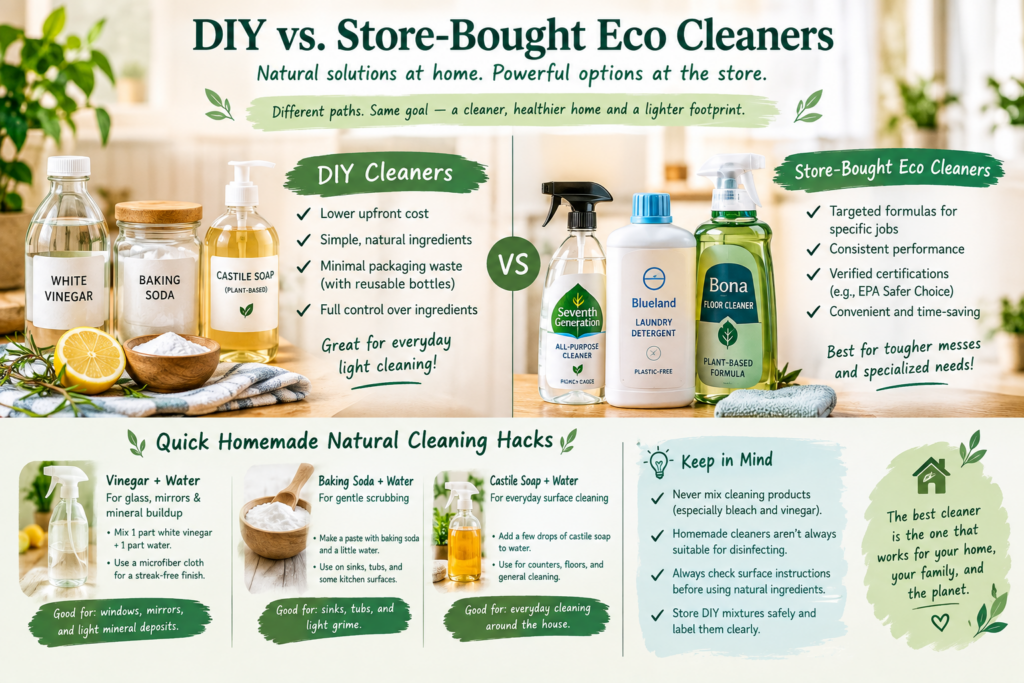
DIY vs. Store-Bought: Which Is Better?
| Factor | DIY Cleaner | Store-Bought Eco Cleaner |
|---|---|---|
| Upfront cost | Usually low | Usually higher |
| Packaging waste | Can be very low with reusable bottles | Depends on bottle/refill system |
| Ingredient control | High | Depends on brand transparency |
| Convenience | Requires mixing | Usually ready to use |
| Cleaning performance | Good for some basic jobs | Often more specialized |
| Disinfection | Usually not appropriate to assume | Use an EPA-registered product when disinfection is needed |
| Shelf life | Depends on the mixture | Formulated and labeled by manufacturer |
| Best for | Simple everyday cleaning | Specialized or demanding cleaning tasks |
Quick Homemade Natural Cleaning Hacks
You do not need a complicated recipe book to try a few basic DIY cleaning methods.
The following options are best viewed as simple household cleaning hacks, not universal replacements for commercial cleaners.
1. Vinegar + Water for Glass and Everyday Mineral Residue
White vinegar is useful because its acidity can help loosen mineral deposits and some everyday buildup.
For a basic glass-cleaning solution, dilute white vinegar with water and use a clean microfiber cloth.
Good for:
- Windows
- Mirrors
- Some glass surfaces
- Light mineral buildup
Important: Vinegar is acidic, so do not assume it is safe for every surface. Avoid using it on surfaces that manufacturers specifically say should not be exposed to acidic cleaners.
And never mix vinegar with bleach or other incompatible cleaning products. The EPA advises consumers not to mix household cleaning products because dangerous vapors can result.
2. Baking Soda + Water for Gentle Scrubbing
Baking soda is one of the simplest ingredients to keep around for light-duty household cleaning.
Make a loose paste with baking soda and a small amount of water, then use it for appropriate surfaces where gentle abrasion is useful.
Good for:
- Sink cleaning
- Some bathroom surfaces
- Light grime
- Toilet-bowl scrubbing
The important word here is gentle. Baking soda is mildly abrasive, so test it on an inconspicuous area before using it on a delicate or easily scratched surface.
3. Mild Dish Soap + Water for Everyday Surface Cleaning
Sometimes the simplest option wins.
A small amount of mild dish soap diluted in water can work for everyday dirt and grease on surfaces where soap-and-water cleaning is appropriate.
The CDC notes that in most household situations, cleaning with soap and water can remove dirt and most germs from surfaces. Disinfection is a separate step and is generally more important when someone is sick or when there is a specific reason to reduce pathogens.
That distinction is easy to overlook.
Cleaning removes dirt and impurities. Disinfecting is intended to kill remaining germs.
A homemade vinegar spray should not automatically be treated as a disinfectant.
4. Vinegar for Some Hard-Water Deposits
If you live in an area with hard water, you may notice white mineral deposits around faucets, shower fixtures, or other compatible surfaces.
A diluted vinegar solution can help loosen some mineral buildup.
Apply it only to surfaces that can safely tolerate an acidic cleaner, allow appropriate contact time, and rinse when the surface manufacturer’s instructions call for it.
For expensive fixtures, natural stone, or unfamiliar materials, check the manufacturer’s care instructions first.
DIY Cleaning Safety: The Rule You Should Never Ignore
There is one homemade-cleaner rule worth putting in bold:
Never mix cleaning products unless the label specifically says the combination is safe.
That includes DIY mixtures.
Do not mix vinegar with bleach. Do not mix bleach with ammonia. Do not combine homemade mixtures with commercial cleaners simply because both products appear mild.
The EPA and CDC both warn that mixing cleaning products can create dangerous vapors.
Also:
- Label any homemade mixture you store.
- Keep mixtures away from children and pets.
- Use adequate ventilation.
- Never store cleaning mixtures in food or beverage containers.
- Follow the manufacturer’s instructions for the surface you are cleaning.
The EPA specifically recommends making only the amount needed when preparing homemade alternatives and using clean, reusable containers that are properly labeled.
When Store-Bought Eco Cleaners Make More Sense
DIY cleaning has its place. But there is a reason many households still prefer professionally formulated products.
A commercial cleaner may be the better option when you need:
Consistent performance.
Formulated products can combine surfactants, solvents, enzymes, or other ingredients for a specific cleaning task.
A specialized formula.
Dishwasher detergents, laundry detergents, floor cleaners, and certain bathroom products are designed around different cleaning conditions.
Verified standards.
Some U.S. products carry certifications such as EPA Safer Choice, giving shoppers an additional way to evaluate ingredient and environmental criteria.
Disinfection.
If you actually need to disinfect a surface, do not assume a vinegar or baking-soda mixture will do the job. The CDC recommends using an EPA-registered disinfectant or an appropriately prepared bleach solution when disinfection is necessary.
Convenience.
Not everyone wants to measure ingredients before cleaning the bathroom after a long workday. Sometimes the refillable spray bottle already sitting under the sink is simply the better option.
DIY or Store-Bought? Our Take
For most U.S. households, the smartest approach is probably a mix of both.
Use simple DIY methods for straightforward jobs where they make sense. Keep a few well-formulated commercial products for tasks that need specialized performance.
That approach also prevents a common mistake in sustainable cleaning: assuming that homemade automatically means environmentally better.
A DIY cleaner may reduce packaging, but if it works poorly and you need to repeat the job several times, the practical advantage becomes smaller. On the other hand, a concentrated store-bought cleaner with a reusable bottle or refill system can reduce packaging while saving time.
The EPA’s Safer Choice program also makes an important point here: “homemade” does not automatically equal “green,” and some common household ingredients can have hazards when used incorrectly.
The Simple Rule for Eco-Friendly Cleaning
Think of your cleaning routine this way:
DIY for simple jobs.
Specialized products for specialized jobs.
Verified claims over green marketing.
Less waste without sacrificing cleaning performance.
That is ultimately the philosophy behind our 10 Best Eco-Friendly Cleaning Products 2026 picks. The goal is not to make every cleaning bottle in your home disappear. It is to help you choose products—and simple alternatives—that work well, make sense for your household, and avoid unnecessary waste.
U.S. safety reminder: If a product is marketed as a disinfectant, follow its EPA registration and label directions rather than relying on a homemade “natural” recipe. The EPA notes that antimicrobial cleaning products are pesticides and generally carry an EPA registration number on the label.
Frequently Asked Questions (FAQs)
What is the best eco-friendly cleaning brand?
There is no single best eco-friendly cleaning brand for every U.S. household. Blueland, Branch Basics, Seventh Generation, and Bona are worth considering because they approach sustainability in different ways, including concentrated formulas, refill systems, ingredient transparency, and recognized safer-product standards.
For shoppers who want a stronger U.S. verification signal, look for products carrying the EPA Safer Choice label. EPA evaluates every chemical ingredient in a certified product against human-health and environmental criteria and also considers product performance and packaging.
Quick answer: If certification is your priority, start with EPA Safer Choice-certified products rather than choosing a brand simply because its packaging says “natural” or “green.”
What are the top ten eco-friendly products?
The top ten picks in this guide cover different cleaning jobs rather than treating one product as a universal solution:
- Branch Basics Concentrate — Best for versatile whole-home cleaning
- Blueland Laundry Tablets — Best for lower-packaging laundry care
- Seventh Generation Dish Liquid — Best for everyday dishwashing
- Blueland Bathroom Cleaner — Best for routine bathroom cleaning
- Blueland Dishwasher Tablets — Best for automatic dishwashers
- Bona Floor Cleaner — Best for hard-floor care
- Branch Basics Concentrate — Best for versatile stain and household cleaning
- Full Circle Home — Best for reusable kitchen cleaning tools
- Seventh Generation Glass & Surface Cleaner — Best for windows and mirrors
- Blueland Toilet Cleaner Tablets — Best for routine toilet cleaning
The right choice depends on what you actually need to clean. A concentrated all-purpose cleaner may be more useful for a small apartment, while a family with frequent laundry and dishwasher loads may get more value from refillable laundry and dishwasher products.
What are the best non-toxic cleaning products in 2026?
Rather than looking for a cleaner that claims to be completely “non-toxic,” U.S. shoppers should look for specific, verifiable safety and environmental information.
One of the strongest places to start is the EPA’s Safer Choice program. EPA says certified products must meet stringent ingredient criteria, and every chemical ingredient is reviewed regardless of its percentage in the formula. Certified products must also meet performance requirements.
For 2026, shoppers can also compare:
- EPA Safer Choice certification
- Fragrance-free options when desired
- Full ingredient disclosure
- Clear manufacturer safety information
- Refillable or reduced-packaging formats
- Specific rather than vague environmental claims
Also remember that “plant-based,” “natural,” and “non-toxic” are not interchangeable terms. A plant-derived ingredient does not automatically make an entire formula safer, and the absence of one controversial ingredient does not prove that a product is universally safe.
Quick answer: The best option is usually a well-formulated product with transparent ingredients, credible certification where available, and a clear use case—not simply the product with the most “natural” language on its label.
Is Mrs. Meyer’s actually non-toxic?
It is better not to describe Mrs. Meyer’s Clean Day as universally “non-toxic.” The brand itself says its products are made without several ingredients, including ammonia, chlorine, parabens, phthalates, formaldehyde, artificial colorants, phosphates, and petroleum distillates. It also says its products use plant-derived and other ingredients and are cruelty-free.
However, individual Mrs. Meyer’s products can contain other ingredients that some shoppers may want to evaluate for themselves. For example, the brand’s current multi-surface cleaner ingredient lists include fragrance, methylisothiazolinone, and benzisothiazolinone.
So the fairest answer is:
Mrs. Meyer’s is a mainstream cleaning brand with plant-derived ingredients and several “free-from” claims, but “non-toxic” is too broad a label to apply automatically to every product in the range.
If fragrance or specific preservatives are a concern for you, check the ingredient list of the exact product and scent before buying.
Are eco-friendly cleaning products actually better for the environment?
Sometimes—but not automatically.
A refill tablet can reduce packaging compared with repeatedly buying ready-to-use bottles. A concentrated formula can reduce the amount of water transported with each purchase. A durable reusable scrubber may create less waste than repeatedly replacing disposable tools.
But “eco-friendly” is not a guarantee of a lower overall environmental footprint.
The EPA recommends looking for credible standards and ecolabels when evaluating greener cleaning products, including Safer Choice for products with safer chemical ingredients and Design for the Environment (DfE) for qualifying antimicrobial products such as disinfectants and sanitizers.
The practical rule is simple: look at the whole product—formula, packaging, performance, durability, and disposal—not just the front label.
Is EPA Safer Choice the same as “non-toxic”?
No.
EPA Safer Choice is not a blanket “non-toxic” claim. It is a specific U.S. EPA program with defined ingredient, product, performance, packaging, and environmental criteria.
EPA says every chemical ingredient in a Safer Choice-certified product is evaluated, and the finished product must meet the program’s requirements before it can carry the label.
That makes the label much more meaningful than an unexplained “green” or “natural” badge.
Are natural cleaning products safe for pets and children?
Not automatically.
Natural ingredients can still cause irritation or other problems when they are swallowed, inhaled, splashed into the eyes, or used incorrectly. Store cleaning products and homemade mixtures where children and pets cannot reach them, and always follow the product label.
If a product carries the EPA Safer Choice label, EPA says the program evaluates ingredients for human-health and environmental criteria, including concerns such as carcinogenicity, reproductive/developmental toxicity, and aquatic toxicity.
For households with young children or pets, proper storage and correct use matter just as much as the marketing claim on the bottle.
What should I look for when buying eco-friendly cleaning products in the U.S.?
Start with five things:
1. Look for credible certification.
EPA Safer Choice is one of the most useful U.S. standards for household cleaning products.
2. Read the ingredient information.
Do not rely only on phrases such as “natural,” “green,” or “plant-powered.”
3. Check the packaging system.
Refills, concentrates, tablets, and reusable bottles can reduce packaging, but compare the complete system.
4. Question broad environmental claims.
Specific claims are more useful than vague statements about being “good for the planet.”
5. Choose a product that actually works.
A cleaner that requires excessive product or repeated applications may not deliver the practical benefit you expected.
That is ultimately the thinking behind our 10 Best Eco-Friendly Cleaning Products 2026 selection: better information first, greener marketing second.
Final Verdict & Conclusion
Choosing the 10 Best Eco-Friendly Cleaning Products is not really about finding a bottle with a green label. For U.S. households, the better approach is to look at the full picture: how well a product cleans, what is in the formula, how transparent the brand is, how much packaging it uses, and whether its environmental claims can actually be supported.
After comparing these factors, there is no single cleaner that is perfect for every home. Branch Basics stands out for shoppers who want one concentrated formula for multiple cleaning jobs. Blueland makes the most sense for people trying to cut down on single-use plastic through refillable and tablet-based products. Seventh Generation remains a practical option for everyday household cleaning, particularly when easy availability and familiar product formats matter. For floors, Bona is a useful choice when surface-specific performance is the priority.
One important point is worth keeping in mind: “natural,” “green,” “non-toxic,” and “eco-friendly” are not interchangeable terms. The FTC’s Green Guides caution businesses against broad environmental claims that cannot be properly substantiated. For shoppers, that means a sustainability claim should be treated as a starting point—not proof that a product is automatically safer or better for the environment.
For stronger evidence, look for recognized standards such as EPA Safer Choice when evaluating cleaning formulas. EPA reviews ingredients in certified products against human-health and environmental criteria, while the USDA BioPreferred program can help shoppers identify products with verified biobased content. These labels answer different questions, so one certification should not be treated as proof of every environmental or health claim.
Our Final Take
If your goal is to make your cleaning routine more sustainable in 2026, you do not need to replace every product in your home at once.
Start with the products you use most often. Choose concentrated formulas or refill systems where they make practical sense, avoid unnecessary packaging, check ingredient information, and pay attention to whether a brand clearly explains its environmental claims. If fragrance is a concern, consider fragrance-free options rather than assuming that every plant-based or “natural” scent is automatically better.
And remember that eco-friendly cleaning is also about how you use a product. Using the correct amount, reusing durable spray bottles, washing reusable cleaning cloths, and buying only what your household actually needs can make a meaningful difference over time.
For U.S. consumers, the smartest choice is therefore not simply the product with the most impressive sustainability language. It is the cleaner that offers a reasonable balance of cleaning performance, ingredient transparency, packaging, credible standards, price, and everyday practicality.
That is ultimately what makes these Best Eco-Friendly Cleaning Products 2026 worth considering: they give American households practical ways to reduce unnecessary waste and make more informed cleaning choices—without turning sustainability into an all-or-nothing lifestyle.
Bottom line: Buy based on evidence, not just the word “green.” Check the label, understand the certification, consider the packaging, and choose the product that genuinely fits your home and cleaning needs.
For readers who want to verify product claims or learn more about safer and more sustainable cleaning practices, these U.S.-based resources are worth bookmarking:
Explore More Eco-Friendly Living Guides
If you enjoyed this guide on non-toxic home care, check out our top-rated sustainable lifestyle articles to complete your eco-friendly journey:
 10 Best Eco-Conscious Clothing Brands in 2026 — Discover ethical fashion brands that prioritize sustainable fabrics and fair trade practices.
- Sustainable Fashion 2026: The Ultimate Guide to Eco-Friendly Style — Learn how to build a timeless capsule wardrobe without compromising on ethics or quality.
Natural Cleaning Products 2026 —Best Safe Choices for Your Home


external resources.
- EPA Safer Choice – Learn About the Safer Choice Label
Learn how the U.S. Environmental Protection Agency evaluates ingredients and products that qualify for the Safer Choice label.
EPA Safer Choice – Learn About the Safer Choice Label - EPA Safer Choice – Certified Product Database
Search the EPA’s database to find certified cleaning products and check whether a specific product carries the Safer Choice label.
EPA Safer Choice – Certified Products - FTC Green Guides – Environmental Marketing Claims
The Federal Trade Commission explains how environmental claims such as “eco-friendly,” “green,” “non-toxic,” “recyclable,” and “biodegradable” should be supported and communicated.
FTC Green Guides – Environmental Marketing Claims - USDA BioPreferred Program
The USDA BioPreferred Program helps consumers identify products made with verified biobased ingredients, including products in the cleaning category.
USDA BioPreferred – Find Certified Products - CDC – When and How to Clean and Disinfect Your Home
The Centers for Disease Control and Prevention provides practical guidance on when cleaning is enough, when disinfection may be appropriate, and how to use cleaning products safely.
CDC – When and How to Clean and Disinfect Your Home - B Lab – B Corp Certification
B Corp certification evaluates a company’s broader social and environmental performance. It should not be confused with a product-specific safety or non-toxicity certification.
B Lab – B Corp Certification
Why These Resources Matter:
These sources give readers a way to look beyond marketing language and verify important claims for themselves. For U.S. shoppers comparing the Best Eco-Friendly Cleaning Products 2026, checking certifications, ingredient information, environmental claims, and proper cleaning guidance is more useful than relying on a “green” label alone.