
10 Best Plastic Free Laundry Detergents in US: A Practical Buyer’s Guide for 2026
The average American household does somewhere between 300 and 400 loads of laundry a year. That’s a jug of detergent every four to six weeks, give or take, and almost none of those jugs get a second life. They’re heavy, they’re bulky, and the vast majority of them are made from HDPE plastic that municipal recycling programs accept in theory and landfill in practice.
Switching to a plastic-free detergent is one of the few sustainability swaps that doesn’t cost you anything. In some cases it saves money. It takes up less shelf space. And it eliminates the single most annoying object in your laundry room.
But there’s a wrinkle, and it’s the reason most roundups on this topic are useless: a lot of products marketed as plastic-free still contain plastic. Not in the box — in the formula. We’ll get into that, because it’s the one thing that should actually change what you buy.
Below are ten options genuinely worth your money, organized by who they’re for, what they cost per load, and where they fall short.
Quick Answer: The Best Plastic Free Laundry Detergents in US
| # | Product | Format | Approx. Cost/Load | Best For | Formula PVA-Free? |
|---|---|---|---|---|---|
| 1 | Meliora Laundry Powder | Powder, cardboard canister | $0.20–$0.30 | Best overall | Yes |
| 2 | Molly’s Suds Original Powder | Powder, cardboard box | $0.15–$0.25 | Sensitive skin, large families | Yes |
| 3 | Blueland Laundry Tablets | Tablet, paper refill pouch | $0.25–$0.35 | Renters, apartments | Yes |
| 4 | Dirty Labs Bio Enzyme Liquid | Liquid, aluminum bottle | $0.30–$0.40 | Stains, athletic wear | Yes |
| 5 | Nellie’s Laundry Soda | Powder, steel tin | $0.15–$0.25 | Budget bulk buying | Yes |
| 6 | Tru Earth Eco-Strips | Sheet, cardboard | $0.20–$0.30 | Travel, dorms, RVs | Check label |
| 7 | Earth Breeze Eco Sheets | Sheet, cardboard | $0.20–$0.30 | Fragrance-free households | Check label |
| 8 | Tide Evo Fiber Tiles | Tile, cardboard | $0.30–$0.40 | Maximum stain removal | Check label |
| 9 | Arm & Hammer Power Sheets | Sheet, cardboard | $0.15–$0.25 | Grocery store availability | Check label |
| 10 | Tangie Laundry Bar | Bar, paper wrap | $0.10–$0.20 | Lowest cost per load | Yes |
Prices reflect approximate US retail in 2026 and shift with subscription discounts, bulk sizing, and retailer promotions. Cost per load is the only number worth comparing — package price tells you nothing.
The 30-Second Decision Framework
If you read nothing else, read this. Three questions, and you’re done.
Question 1: What’s your water like?
If you have hard water — and if you live in Arizona, Nevada, Utah, Texas, Florida, or most of the Midwest, you probably do — soap-based powders can underperform. The minerals in hard water react with soap and leave a dull film on fabric. You have two options: run warmer cycles (90°F or above instead of cold), or add washing soda or an oxygen booster. Or skip the issue entirely and buy a liquid or tablet with a true detergent formula.
Question 2: Do you care about plastic in the formula, or just the packaging?
This is the fork in the road. If packaging is your concern, any option on this list works. If you want zero synthetic polymer anywhere in the product, you need to buy powder in cardboard, a bar, or soap nuts. Powder detergents in cardboard boxes, pure soap nuts, and homemade washing-soda blends contain no polyvinyl alcohol. The products most likely to contain PVA are laundry sheets, strips, and pods, because the dissolvable film and binders are usually made from PVA or PVOH. The Zero Waste List
Question 3: How much storage do you have?
Families with a dedicated laundry room should buy powder in bulk — the cost per load drops significantly and a 250-load tin lasts most of a year. Apartment dwellers, renters, and anyone using a shared basement machine should buy tablets or sheets, which fit in a drawer and travel well.
Answer those three and the list below narrows to two or three products.
The PVA Problem Most Articles Skip
Here’s the thing nobody puts on the front of the box.
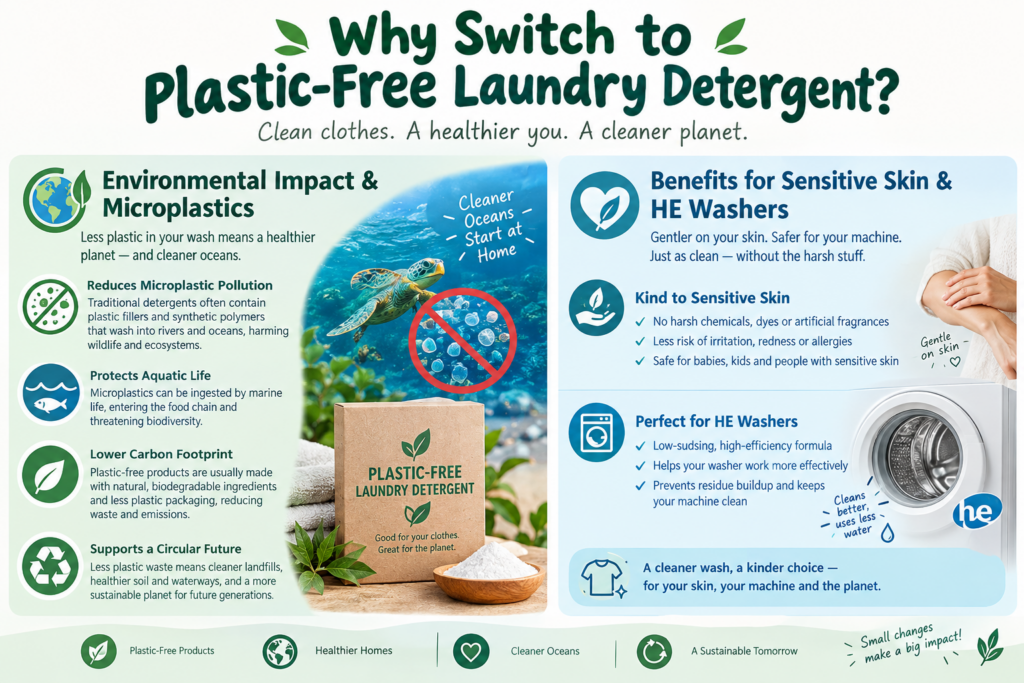
The “plastic-free” claim usually refers to packaging — no plastic jugs, just cardboard or paper boxes that are recyclable. That’s a real win compared to a single-use HDPE bottle. But it skips half the question. The other half is what’s in the formula. Many laundry products use synthetic polymers as binders, thickeners, or dissolvable films. Polyvinyl alcohol — PVA, also written PVOH — is the most common, used in detergent pods and laundry sheets to hold the formula in solid form until it hits water. Thriving Sustainably
So a laundry sheet in a cardboard envelope may have eliminated the jug while keeping a synthetic polymer in the product itself.
Is that actually bad? Honestly, the science is unsettled. PVA is water-soluble and does biodegrade under the right wastewater treatment conditions. How completely it breaks down in real-world municipal treatment plants — which vary enormously across the US — is an open research question, and credible scientists land on different sides of it. Some peer-reviewed work suggests a meaningful fraction passes through untreated. Industry-funded studies suggest otherwise. Nobody should tell you this is settled.
What is settled: if you’d rather not roll the dice, the workaround is trivial. Scan the ingredient list for polyvinyl alcohol, PVA, or PVOH. Be skeptical of any dissolvable sheet, strip, or pod, because the format almost always relies on PVA film. Watch the marketing too — “dissolves completely” often describes PVA dissolving into your water, not disappearing. When in doubt, switch formats: a cardboard-boxed powder sidesteps the question entirely. The Zero Waste List
Also worth knowing: PVA is a film and binder, not a cleaning agent. It exists to hold a sheet or pod together, not to clean your clothes. You lose nothing in performance by avoiding it. The Zero Waste List
How to Read a Label Without Getting Played
“Plastic-free” has no federal definition. Neither does “non-toxic,” “eco-friendly,” or “clean.” No agency certifies those words. You are trusting a marketing department.
Certifications are different. Here’s what carries weight in the US:
EPA Safer Choice. The Environmental Protection Agency reviews every intentionally added ingredient in a product against its safer-chemical criteria. This is the strongest single signal on an American detergent label. Important caveat: it addresses ingredient safety, not packaging, and not carbon footprint.
USDA Certified Biobased Product. Verifies a minimum percentage of renewable biological content and prints that percentage on the label. Useful, narrow.
B Corp Certification. This is company-level, not product-level. It tells you about governance, worker treatment, and supply chain accountability. It tells you nothing about what’s in the box.
National Eczema Association Seal of Acceptance. Relevant if skin sensitivity is driving the purchase. Earth Breeze’s fragrance-free sheets, for example, carry this seal and are dermatologist approved. walmart
FTC Green Guides. Not a certification — the rulebook. The Federal Trade Commission’s Green Guides hold that unqualified environmental claims are deceptive unless the marketer can substantiate them. A claim like “biodegradable” needs to specify under what conditions and in what timeframe. If a brand won’t tell you, treat the claim as decoration.
One practical test that beats all of the above: does the brand publish a complete ingredient list? Not “plant-derived surfactants.” The actual ingredients. Companies with nothing to hide tend not to hide anything.
The 10 Best Plastic Free Laundry Detergents in US
1. Meliora Laundry Powder — Best Overall
Meliora is a simple, fully-disclosed powder — soap, washing soda, and a touch of essential oil, or fragrance-free if you prefer — packed in a recyclable cardboard canister with zero plastic film, pods, or PVA. The Zero Waste List
What earns it the top spot isn’t a proprietary formula. It’s the opposite: there is no proprietary formula. Meliora lists every ingredient, explains what each one does, and doesn’t hide behind vague terms. The company is a certified B Corp and manufactures in Chicago, which shortens the shipping distance for most of the country.
The honest downside: it’s soap-based rather than detergent-based, so hard-water households will want to add washing soda or an oxygen booster for whites. Cold-water-only washers may notice slight residue on dark fabrics. Neither is a dealbreaker, but both are real.
Buy it if: You want the cleanest possible ingredient list and you’re willing to add a booster occasionally.
2. Molly’s Suds Original Powder — Best for Sensitive Skin and Big Families
Molly’s Suds started from a different angle than most brands on this list. The Original laundry powder was formulated to be a genuinely natural detergent, free of harsh chemicals and complicated synthetic compounds, rather than primarily as a plastic-reduction play. The Laundry Guru
Five ingredients. Cardboard packaging. It’s widely available at Target, Whole Foods, and Amazon, which matters more than people admit — a swap you can make during a normal grocery run is a swap that lasts.
The large 120-load and 240-load boxes bring cost per load down to roughly what you’d pay for store-brand liquid, which is the number that convinces skeptical households. Fragrance-free and lightly scented versions both exist, and the unscented is genuinely unscented rather than “masked.”
Buy it if: Someone in the house reacts to fragrance, or you’re washing for four-plus people and need bulk economics.
3. Blueland Laundry Tablets — Best for Renters and Small Spaces
Blueland’s model is simple: buy a tin once, buy paper refill pouches forever. One tablet per load, no measuring, no scoop, nothing to spill in a shared basement laundry room.
The tin is roughly the size of a large coffee mug. If you’re working with a stacked washer-dryer in a closet — which describes a huge share of American renters — this is the format that fits. Blueland is a certified B Corp and publishes full ingredient disclosure.
For tough loads, pair it with a booster. Blueland’s Oxi Laundry Booster ships as a refillable powder in a paper pouch rather than a PVA pod, so you get extra cleaning power without reintroducing dissolvable film. The Zero Waste List
The cost per load runs higher than bulk powder. You’re paying for convenience and form factor, and that’s a legitimate thing to pay for.
Buy it if: You live in an apartment, share a laundry room, or just hate measuring.
4. Dirty Labs Bio Enzyme Liquid — Best for Stains and Athletic Wear
If you’ve tried a plastic-free powder and hated it, this is your off-ramp.
Dirty Labs makes a highly concentrated enzyme-based liquid sold in an aluminum bottle. Aluminum matters here: it’s infinitely recyclable and it actually gets recycled at high rates in US curbside programs, which you cannot honestly say about most plastic. The bottle is small — the formula is concentrated enough that a single bottle covers 80 loads.
Performance is the selling point. Enzyme formulas break down protein, starch, and oil stains in cold water in a way soap-based powders simply don’t. Grass stains, blood, sweat-soaked gym clothes, baby spit-up — this handles them.
It’s the most expensive option on this list per load. For a household that runs a lot of athletic wear or has young kids, it’s worth it. For someone washing office clothes and bedsheets, it’s overkill.
Buy it if: Stain removal is your priority and you wash in cold water.
5. Nellie’s Laundry Soda — Best Budget Bulk Buy
A washing soda and coconut-derived soap blend in a reusable steel tin. Nellie’s has been around longer than most of the current crop of plastic-free brands, and the 250-load tin is among the cheapest true plastic-free options per load available in the US.
The formula is basic in the best sense. Two active ingredients doing what they’ve done for a century. It works in HE and standard machines, and the tin is genuinely reusable — people keep them for decades.
Minor irony worth flagging: the included scoop is plastic. It’s reusable and lasts forever, so judge it however you like, but purists should know.
Buy it if: You want the lowest per-load cost without hand-grating a bar, and you have somewhere to store a large tin.
6. Tru Earth Eco-Strips — Best for Travel, Dorms, and RVs
Tru Earth’s eco-strips use no plastic jug, and their light weight and small size need far less space than traditional liquid or powder detergents. Cherry Picks
That compactness is the whole pitch. A 32-load envelope weighs a few ounces and fits in a backpack pocket. For college students hauling laundry across campus, RV travelers watching every pound, or anyone using a laundromat, nothing else comes close on convenience.
Tru Earth is also one of the more widely distributed strip brands in North America, so restocking is easy.
Verify the current ingredient list for PVA before you commit if that’s a priority for you — formulations change, and the strip format is exactly the one most likely to rely on dissolvable film.
Buy it if: Portability is the deciding factor.
7. Earth Breeze Eco Sheets — Best Fragrance-Free Sheet
Earth Breeze sheets wash up to 28 regular loads per pack with no mess, no measuring, and no wasted detergent, dissolve quickly in hot or cold cycles, and are safe for sensitive skin — they’ve been awarded the National Eczema Association Seal of Acceptance and are dermatologist approved. They come in plastic-free cardboard packaging and work in all machines, including HE washers. walmartGreen Hive
The practical advantage over smaller direct-to-consumer brands: you can buy these at Walmart and Amazon without a subscription. No recurring charge to cancel, no shipment showing up when you already have four boxes.
The fragrance-free version is the one to get. The scented version is fine but faint, which disappoints people expecting a “fresh laundry” smell.
Buy it if: You need fragrance-free and want it available at a big-box store.
8. Tide Evo Fiber Tiles — Best Cleaning Power
Consumer Reports named Tide Evo Free & Gentle Detergent Fiber Tiles one of the two best laundry detergent sheets of 2026. Tide Evo earned the highest overall score among the 14 detergent sheets Consumer Reports tested, removing stains including blood, grass, and dirt effectively. House DigestMSN
That’s a meaningful result, because independent testing of this category is thin. Most “best of” lists — including plenty that outrank this one — are built on marketing copy and affiliate relationships. Consumer Reports buys products at retail and tests them blind.
What you’re getting is P&G’s stain chemistry in a cardboard box instead of a jug. The tiles are small, dense, and dissolve reliably. Cost per load is higher than the budget picks, and the formula is a mainstream one rather than a minimalist ingredient list — so if “clean ingredients” is your primary concern, this isn’t your pick.
Buy it if: You have kids, pets, or a job that produces real stains, and performance beats ingredient purism for you.
9. Arm & Hammer Power Sheets — Best Grocery Store Option
The other top performer in Consumer Reports’ 2026 sheet testing, alongside Tide Evo. House Digest
The case for Arm & Hammer is availability and price. You can pick these up at Target, Kroger, Walmart, or your regional grocery chain during a normal shopping trip. No subscription, no shipping wait, no mental overhead. And the per-load cost is competitive with conventional liquid detergent — sometimes lower on promotion.
Environmental swaps stick when they’re frictionless. A perfect detergent you have to reorder online every eight weeks loses to a good one sitting on the shelf you already walk past.
Buy it if: You want to make the switch this week without changing how you shop.
10. Tangie Laundry Bar — Lowest Cost Per Load
A concentrated solid bar you grate or shave into the drum. Paper wrap, no box, nothing to recycle because there’s essentially nothing to throw away.
This is the most hands-on option here, and that’s the trade. You need a grater and about fifteen seconds per load. In exchange, a single bar runs a small household for months at a cost per load that nothing else on this list touches.
Bars are also the format least likely to contain anything synthetic, since there’s no film, no binder, and no need for anti-caking agents.
Buy it if: You’re optimizing for cost and minimal waste, and a few extra seconds per load doesn’t bother you.
Format Comparison: Which One Fits Your Life
| Format | Pros | Cons | Best Household |
|---|---|---|---|
| Powder (cardboard) | Cheapest in bulk, no PVA, long shelf life | Can leave residue in cold/hard water, bulky storage | Families with laundry rooms |
| Tablets | No measuring, compact, PVA-free options exist | Higher cost per load | Renters, apartments |
| Sheets/Strips | Lightest, most portable, no mess | Usually contain PVA, higher cost | Travel, dorms, laundromats |
| Liquid (aluminum) | Best cold-water performance, enzyme stain removal | Most expensive, heavier to ship | Athletic wear, kids, pets |
| Bars | Lowest cost, zero packaging waste | Requires grating, slowest | Small households, minimalists |
What Switching Actually Costs
Let’s do the math, because vague claims about saving money are how these articles lose credibility.
A typical American household runs 8 to 10 loads a week — call it 400 a year. At $0.25 per load, that’s about $100 annually, or $8 to $9 a month. Conventional mid-tier liquid detergent runs roughly $0.20 to $0.30 per load. Premium pods run $0.30 to $0.45.
So: plastic-free lands squarely in the same range. Bulk powder undercuts most liquids. Sheets and tablets sit alongside premium pods.
The one adjustment is upfront cost. You’re buying 60 to 250 loads at once instead of 32, so budget $20 to $40 for the first purchase and expect it to last two to four months. That sticker shock is the main reason people bounce off the switch. Push through it — the per-load math works.
Two add-ons that pay for themselves:
- Wool dryer balls ($10–$15, last for years) replace dryer sheets completely and cut drying time by roughly 10 to 20 percent. Dryer sheets are another frequently overlooked source of synthetic materials in the laundry routine. The Zero Waste List
- An oxygen booster in a paper pouch handles whites and set-in stains, so you don’t need to keep a second detergent around.
Five Mistakes That Make People Give Up
Using too much. Concentrated formats need less than your instinct says. Excess detergent doesn’t clean better — it leaves residue that traps odor and makes towels less absorbent. If your clothes smell stale after washing, you’re probably overdosing.
Ignoring water hardness. This is the single most common reason people abandon plastic-free powder and go back to jugs. Test your water or check your utility’s annual report. If it’s hard, add washing soda or switch to a liquid.
Washing everything in cold. Cold water saves energy, and for most loads it’s fine. But soap-based powders dissolve better at 90°F and above. Run towels and bedding warm.
Assuming “recyclable” means recycled. Cardboard almost always gets recycled in US curbside programs. Flexible film pouches almost never do, even when labeled recyclable. Check what your municipality actually accepts.
Trusting unregulated claims. “Non-toxic,” “natural,” and “eco-friendly” mean whatever the brand wants. EPA Safer Choice and a published ingredient list mean something.
Frequently Asked Questions
Do plastic-free detergents work in HE washers?
Almost all of them, yes. Well-formulated sheets dissolve within seconds in hot or cold water, making them suitable for all machines including HE washers. Powders and tablets are HE-safe too. Just confirm on the label, and use the correct dispenser or drop directly in the drum as directed. Green Hive
Is PVA really plastic?
It’s a synthetic, water-soluble polymer. Whether that counts as “plastic” in a meaningful environmental sense is genuinely debated. What’s not debated is that it’s a petroleum-derived synthetic material that your detergent doesn’t strictly need.
Will these clean as well as Tide?
Some will, some won’t. Tide Evo scored highest of 14 sheets in Consumer Reports’ 2026 testing — and it’s a plastic-free-packaged product. Enzyme liquids like Dirty Labs compete directly on stain removal. Simple soap-based powders clean everyday soil well but need a booster for tough stains. Match the product to the job. MSN
Are they safe for septic systems?
Most are, and many brands state it explicitly. Look for phosphate-free formulas without optical brighteners. Simple powders and bars are generally the safest bet for septic.
The Bottom Line
If you want one recommendation and no further reading: buy a cardboard canister of powder — Meliora or Molly’s Suds — plus a set of wool dryer balls. That combination eliminates the jug, the dryer sheets, and the PVA question in a single purchase, costs roughly what you’re spending now, and works in any American washing machine.
If convenience outranks everything else, buy Tide Evo or Arm & Hammer Power Sheets at your regular store and don’t overthink it. Both tested at the top of their category, both come in cardboard, both are available on a normal Tuesday.
A swap you’ll actually keep beats a perfect one you’ll quit in six weeks. Start with whichever of those two paths sounds less like a chore, and adjust from there.
Explore More Eco-Friendly Living Guides
If you enjoyed this guide on non-toxic home care, check out our top-rated sustainable lifestyle articles to complete your eco-friendly journey:
 10 Best Eco-Conscious Clothing Brands in 2026 — Discover ethical fashion brands that prioritize sustainable fabrics and fair trade practices.
- Sustainable Fashion 2026: The Ultimate Guide to Eco-Friendly Style — Learn how to build a timeless capsule wardrobe without compromising on ethics or quality.
Natural Cleaning Products 2026 —Best Safe Choices for Your Home