

A clean home does not always need a strong chemical smell. In many Indian households, cleaning is part of the everyday routine—from wiping kitchen platforms after cooking to removing bathroom stains, cleaning floors during the monsoon, and dealing with dust and grime that quickly builds up in busy cities. But as more people become conscious of indoor air quality, plastic waste and the ingredients used around children and pets, natural and eco-friendly cleaning products are becoming a practical alternative.
The idea is not to replace every cleaner in your home overnight. A better approach is to understand what you are buying, check the ingredient and usage information, and choose products that balance cleaning performance, safety, packaging and environmental claims.
That is where this guide to the Top 10 Natural Cleaning Products comes in. Instead of treating every product labelled “green”, “natural” or “plant-based” as automatically sustainable, we will look at what actually matters for Indian consumers—including ingredients, certifications, packaging, cleaning needs, price in ₹ and suitability for typical Indian homes.
Why Switch to Natural Cleaning Products in Indian Homes?
For many Indian families, cleaning needs are quite different from a typical one-product-fits-all approach. Kitchens may have stubborn masala and oil stains, bathrooms can develop hard-water marks, and homes in dusty or humid areas may need frequent floor cleaning.
Natural cleaning does not necessarily mean using only ingredients from the kitchen. It can include plant-based, biodegradable or responsibly formulated commercial cleaners, as well as simple household ingredients such as baking soda, vinegar, neem and reetha where they are appropriate for the job.
A few everyday changes can make a meaningful difference:
- Check the ingredient list: Do not rely only on words such as “natural”, “green” or “eco-friendly” on the front label.
- Choose concentrated products where practical: Less water and smaller packaging can sometimes mean less material to transport and store.
- Look at packaging: Refillable bottles, recycled plastic and minimal packaging can be useful sustainability indicators.
- Match the cleaner to the surface: A natural product is not automatically suitable for marble, granite, wood, stainless steel or delicate finishes.
- Avoid unnecessary disinfecting: Routine cleaning and disinfection are not always the same thing. Use a disinfectant when the situation actually calls for one and follow the product label.
- Consider the whole product: Ingredients, manufacturing, packaging, transport and disposal all contribute to its environmental footprint.
There is also a growing reason for Indian shoppers to look more carefully at environmental claims. Under India’s Guidelines for Prevention and Regulation of Greenwashing or Misleading Environmental Claims, 2024, environmental claims are expected to be truthful, clear and supported by verifiable information.
So, a bottle saying “100% green” is not enough by itself. Look for specific information that explains why the product is considered environmentally preferable.
Toxic Chemicals in Conventional Cleaners vs. Plant-Based Alternatives
It is tempting to divide cleaning products into two simple groups—“chemical cleaners” and “natural cleaners”. In reality, that distinction is misleading.
Everything is made of chemicals, including vinegar, baking soda and plant-derived ingredients. Likewise, a plant-based ingredient is not automatically harmless or suitable for every surface. The more useful question is: What is in the product, how concentrated is it, how should it be used, and what evidence supports its environmental or safety claims?
Conventional cleaners may contain strong ingredients designed to remove grease, disinfect surfaces, dissolve mineral deposits or provide a long-lasting fragrance. These can be useful when used correctly, but incorrect mixing or excessive use can create unnecessary risks.
For example, never mix bleach-based cleaners with acids such as vinegar or with ammonia-containing products, because dangerous gases can be produced. Natural ingredients should also be used sensibly rather than assuming that “natural” means risk-free.
Plant-based and naturally derived formulations can offer another option for everyday cleaning. Ingredients such as citrus-derived solvents, plant-based surfactants, soap-based ingredients and other biodegradable components are increasingly found in eco-conscious formulations. However, their actual environmental performance depends on the complete formulation and manufacturing process—not simply on whether one ingredient comes from a plant.
For Indian consumers, certifications and verifiable claims can therefore be more useful than attractive packaging language. India’s Ecomark framework is specifically intended to help consumers identify products with environmental attributes while considering relevant quality requirements. BIS also notes that while certification is generally voluntary, certain products can be subject to compulsory Indian Standards through government-issued Quality Control Orders.
What Should Indian Shoppers Look For?
Before adding an eco-friendly cleaner to your cart, ask five simple questions:
- What exactly is the product designed to clean?
- Are the ingredients and usage directions clearly disclosed?
- Does the brand provide evidence for its environmental claims?
- Can the packaging be reused, refilled or recycled through available systems?
- Is the product genuinely practical for my home’s cleaning needs?
This approach is especially useful in India, where online marketplaces can offer hundreds of products using terms such as natural, organic, chemical-free, non-toxic and eco-friendly. These terms can mean very different things, so the label deserves a closer look.
The goal of this guide is simple: help Indian households make cleaner, more informed choices without paying extra merely for a “green” label.
In the sections ahead, we compare the 10 Best Eco-Friendly Cleaning Products for Indian Homes in 2026, looking at what each type of product is best for, what to check before buying, and where traditional options such as neem, reetha, baking soda and vinegar can still make sense.
Top 10 Natural Cleaning Products for Indian Homes
Choosing a natural or eco-friendly cleaner in India is no longer just about finding a bottle with a green label. Indian homes have very different cleaning needs — from dusty floors and hard-water marks to oily kitchen surfaces, bathroom stains, children’s clothes and pet messes.
For this list, the focus is on practical cleaning performance, ingredient transparency, plant-derived or naturally inspired formulations, packaging options, Indian availability and suitability for everyday household use.
The phrase Top 10 Natural Cleaning Products for Indian Homes covers a mix of ready-to-use products and traditional alternatives. Not every option will suit every household, and “natural” does not automatically mean safer or more sustainable. Always follow the manufacturer’s instructions and check the label before use.
Our approach: We have prioritized products and cleaning methods that are relevant to Indian households, while avoiding unsupported “chemical-free” or “100% safe” claims. Prices can vary by seller, pack size and offers.
1. Best Overall Eco-Friendly Cleaner: Herbal Strategi All-Purpose & Herbal Cleaners
Best for: Everyday household cleaning, kitchen surfaces and general home maintenance
Indian-home advantage: Herbal formulations and products designed specifically for Indian household cleaning needs
Herbal Strategi is one of the more recognisable Indian names in the natural home-cleaning category. Its range includes floor cleaners, bathroom cleaners, glass cleaners, dishwashing products and other household formulations.
The brand currently describes its cleaners as using herbal actives and extracts, and its bathroom cleaner lists ingredients including soap nut extract, citrus oil and coconut-derived ingredients. The brand also identifies its products as cruelty-free and vegan through PETA certification.
What makes the range interesting for Indian households is its focus on familiar ingredients such as soap nut (reetha) and citrus oils rather than relying solely on conventional cleaning chemistry.
Why we like it: A practical option if you want to gradually replace several conventional cleaners with more plant-focused alternatives.
Watch out: “Herbal” does not mean you can mix it with another cleaner. The manufacturer’s instructions specifically warn against mixing its bathroom cleaner with acids or other cleaners.
2. Best Natural Floor Cleaner for Marble & Tiles: Nimyle Herbal Floor Cleaner
Best for: Marble, granite, ceramic and other commonly used Indian flooring
Key ingredient: Neem
Typical Indian price: Around ₹85–₹175 depending on pack size and seller
Nimyle is a familiar choice for Indian households looking for a neem-based floor cleaner. Its manufacturer describes the Herbal and Lemongrass variants as having neem-based natural antimicrobial action and being suitable for surfaces including ceramic, marble, granite and mosaic.
The product is particularly relevant for homes where floors are mopped frequently. Current Indian retail listings show different pack sizes, including 500 ml and larger bottles, making it relatively easy to compare the cost per litre.
Why we like it: Neem has a long history in Indian household hygiene, and Nimyle brings that familiar ingredient into a ready-to-use floor-cleaning format.
Best for: Homes that want a mainstream, affordable neem-based floor cleaner rather than a premium niche product.
Tip: Always follow the dilution instructions printed on your particular bottle.
3. Best Pet & Child-Friendly Floor Cleaner: Koparo Clean Natural Floor Cleaner
Best for: Homes with children and pets
Key ingredients: Coconut-derived surfactants and other plant-based ingredients
Koparo takes a more modern approach to natural home care. According to the brand, its cleaning range uses coconut-derived surfactants and plant-based ingredients, and its products are tested by third-party laboratories using ISO 17025-accredited standards.
The company also states that its formulations are made without added ammonia, chlorine, phosphates, parabens, silicon, EDTA, triclosan and artificial colours.
That ingredient transparency is useful for shoppers who want to look beyond the word “natural” on the front of a bottle.
Why we like it: Koparo gives consumers more information about what goes into its formulations and how the products are tested.
Important: “Pet-friendly” or “child-friendly” does not mean a child or pet should ingest the product. Keep every household cleaner out of reach and follow the label directions.
4. Best Natural Bathroom & Tile Cleaner: Rustic Art Neem Lemongrass Multipurpose Cleaner
Best for: Bathrooms, basins, toilets and stubborn household grime
Key feature: Concentrated formulation
Rustic Art’s Neem Lemongrass Multipurpose Cleaner is an interesting option for shoppers who prefer concentrated products. The current 1,100 g product is listed at ₹890, although prices and availability can change.
The brand says only a small quantity is needed for bathroom and toilet cleaning and that the product can be diluted substantially for certain cleaning tasks. It also highlights reduced water use during rinsing.
Why we like it: A concentrated product can be useful when you want to reduce the number of bottles stored at home and potentially reduce packaging per use.
Best for: Buyers who are comfortable measuring and diluting a concentrated cleaner rather than using a ready-to-spray product.
Tip: Test any cleaner on an inconspicuous area first, particularly when using it on painted surfaces, natural stone or delicate finishes.
5. Best Plant-Based Laundry Detergent: BornGood Plant-Based Laundry Liquid
Best for: Everyday machine and hand laundry
Key ingredients: Citrus-derived extracts, vegetable-derived glycerine and plant-derived surfactant ingredients
BornGood’s concentrated laundry detergent is designed around plant-based ingredients and is sold in bottles and refill formats. Its current product information lists citric extracts from citrus fruits, a palm-derived surfactant and vegetable-oil-derived glycerine among its key ingredients.
The brand currently lists a 1-litre bottle as suitable for up to 100 loads, depending on usage, and also offers refill options.
For Indian consumers, concentrated laundry products can be particularly useful when storage space is limited or when you want to reduce the frequency of buying bulky detergent bottles.
Why we like it: Plant-derived formulation plus refill/concentrated options makes it worth considering for a lower-waste laundry routine.
Current price reference: The brand lists an MRP of ₹749 for the 1-litre bottle, although offers can change.
6. Best Natural Dishwashing Option: BornGood Plant-Based Dishwash Gel
Best for: Everyday dishes, plates, utensils and kitchen cleaning
Key ingredients: Citrus-derived citric acid, coconut extracts and vegetable-oil-derived glycerine
One change I would make to the original list is the product selection here. Rather than relying on Seventh Generation Dishwashing Liquid, which is not as straightforward a recommendation for an India-focused article, an India-available plant-based option such as BornGood gives readers a more practical choice.
BornGood’s current dishwash gel lists citric acid from citrus fruits, natural coconut extracts and vegetable-oil-derived glycerine among its key ingredients. It is available in different pack and refill formats.
Why we like it: The formulation is clearly described, and the product is available through an India-focused brand.
Indian kitchen tip: For oily kadais and pressure cookers, allow the cleaner a little contact time rather than simply increasing the amount of liquid. You can often get better results without wasting product.
7. Best Eco-Friendly Laundry Option for Baby & Family Clothes: Easy Mommy Life / Little Laundry
Best for: Baby clothes and frequent family laundry
Baby and children’s clothes often need frequent washing, which makes detergent choice especially important for parents who prefer simpler formulations and lower-fragrance options.
However, this is one category where shoppers should be careful with marketing language. “Baby-safe”, “natural” and “chemical-free” are not interchangeable terms. Before buying, check the complete label, fragrance information, washing instructions and any testing or certification claims provided by the manufacturer.
For an India-focused article, this category is useful because many parents search for phrases such as:
- “best natural detergent for baby clothes in India”
- “chemical-free baby laundry detergent”
- “eco-friendly detergent for newborn clothes”
- “plant-based detergent for sensitive skin”
Why it belongs on this list: Baby laundry is a genuine Indian consumer search intent, but the safest editorial approach is to evaluate the actual ingredients and manufacturer information rather than promising that any detergent is universally “safe”.
8. Best Traditional Indian Multi-Surface Cleaner: Bio-Enzyme Cleaner
Best for: Kitchen surfaces, odour control and everyday multi-surface cleaning
Traditional inspiration: Fruit peels, fermentation and citrus
Bio-enzyme cleaners have become increasingly popular among Indian eco-conscious households. Some formulations are produced through fermentation using ingredients such as citrus peels, fruit or vegetable matter, sugar and water.
There are now commercial Indian bio-enzyme cleaners as well. For example, Indian brands currently sell citrus bio-enzyme and multi-surface formulations, including products made using locally sourced ingredients.
You can also make a simple fermented cleaner at home, but DIY recipes require patience and proper storage. Homemade fermentation should not automatically be described as a disinfectant, and it should not replace a tested disinfectant where disinfection is genuinely required.
Why we like it: It connects a traditional low-waste idea with modern eco-conscious cleaning.
Best for: People who enjoy DIY cleaning and want to make use of kitchen fruit waste.
9. Best Natural Glass & Window Cleaner: Lemon & White Vinegar-Based Spray
Best for: Glass windows, mirrors and light surface marks
Low-cost ingredients: White vinegar + water
For basic glass cleaning, you do not necessarily need a specialised “green” spray.
A simple diluted white-vinegar solution can help remove fingerprints, light mineral deposits and everyday marks from suitable glass surfaces. Adding lemon can provide a fresh scent, although the acidity of vinegar is doing much of the cleaning work.
A simple starting formula is:
1 part white vinegar + 1 part water
Spray lightly onto glass and wipe with a clean microfibre cloth.
Important: Vinegar is acidic, so do not assume it is suitable for every surface. Avoid using acidic solutions on sensitive natural stone such as marble, limestone or some stone finishes.
Why we like it: It is inexpensive, easy to prepare and reduces the need to buy another single-purpose plastic bottle.
10. Best Natural Odour-Control Option: Neem & Plant-Based Cleaners
Best for: Everyday odour management and general household cleaning
Neem has a long association with Indian household hygiene. Modern commercial cleaners use neem extracts in different ways, while some households continue to use traditional neem-based practices.
For general cleaning, a neem-based household product can be a useful option if you prefer plant-derived ingredients and a familiar Indian ingredient profile.
But there is an important distinction between cleaning, deodorising and disinfecting.
A product should not be called a disinfectant simply because it contains neem, essential oils or another plant extract. If you specifically need disinfection, look for a product with an appropriate tested claim and follow its label directions.
Why we like it: Neem makes this category particularly relevant to Indian households and connects traditional practices with modern home-care products.
Quick Comparison: Which Natural Cleaner Should You Choose?
| Cleaning need | Recommended option | Best suited for |
|---|---|---|
| Everyday home cleaning | Herbal Strategi | General household use |
| Floor cleaning | Nimyle Herbal | Marble, granite, tiles and regular mopping |
| Homes with children/pets | Koparo | Plant-based household cleaning |
| Bathroom cleaning | Rustic Art | Concentrated bathroom and multi-surface cleaning |
| Laundry | BornGood | Regular family laundry |
| Dishwashing | BornGood Dishwash Gel | Kitchen and utensils |
| Baby/family laundry | Baby-focused laundry products | Frequent washing |
| DIY multi-surface cleaning | Bio-enzyme cleaner | Eco-conscious households |
| Glass & mirrors | Diluted white vinegar | Windows and mirrors |
| Odour-focused cleaning | Neem-based cleaners | General household odour control |
What Makes a Cleaning Product Truly Eco-Friendly in India?
The word eco-friendly should not be your only buying criterion.
When comparing natural cleaning products in India, look at the complete picture:
- Ingredients: Are they clearly disclosed?
- Packaging: Is there a refill, recycled-plastic or lower-packaging option?
- Concentration: Will a small amount clean a large area?
- Testing: Does the manufacturer provide credible testing information?
- Certifications: Is a claimed certification actually relevant to the product?
- Environmental claims: Can the brand explain and substantiate them?
- Indian standards: Does the product meet applicable Indian requirements?
- Price per use: Is the “eco” option actually economical after dilution?
- Surface compatibility: Is it suitable for marble, granite, tiles, wood or other surfaces in your home?
India’s Ecomark Rules, 2024 provide an important framework for environmental labelling. The rules link Ecomark eligibility with relevant Indian Standards/BIS conformity or Quality Control Order requirements and environmental criteria.
That is why a smart Indian shopper should look beyond a green bottle, a leaf logo or the word “natural”.
Our Take
There is no single cleaner that is perfect for every Indian home.
For everyday floor cleaning, Nimyle is a practical mainstream choice. For shoppers who want more detailed ingredient information and plant-based formulations, Koparo is worth considering. BornGood stands out for concentrated laundry and dishwashing options, while Herbal Strategi offers a broader herbal home-cleaning range.
The bigger lesson is simple: buy less, use the right amount, choose refills where practical, and do not confuse “natural” with automatically “safe” or “sustainable”.
That is a much more realistic approach to building an eco-conscious cleaning routine in an Indian home in 2026.
Traditional Indian Ingredients for Natural Cleaning
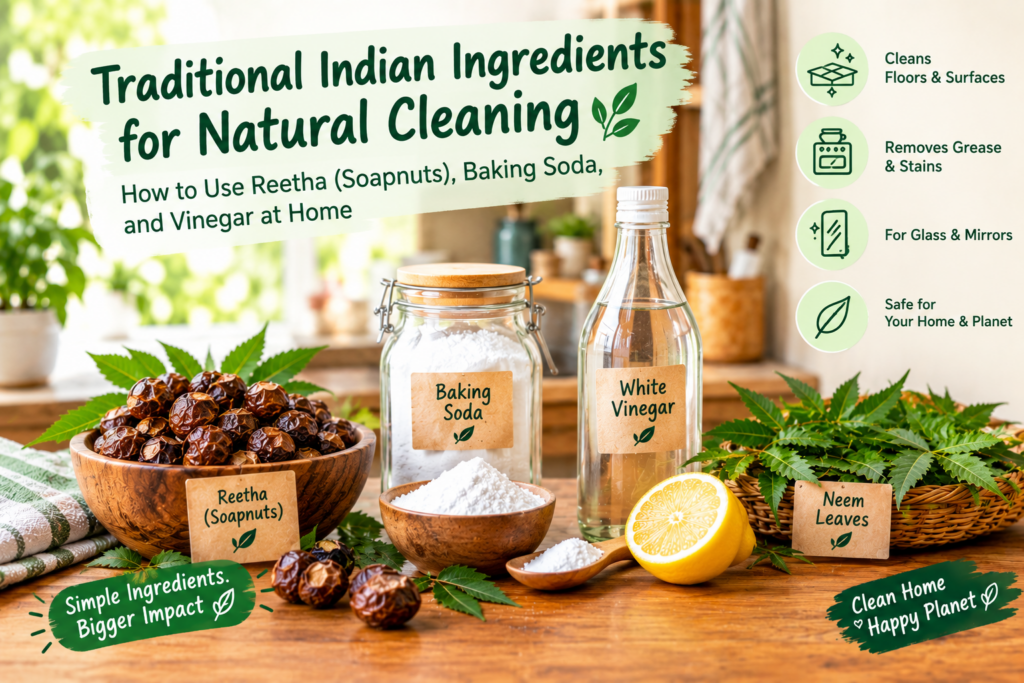
Before spending money on another bottle of “green” cleaner, look around your kitchen. Indian households have used simple ingredients such as reetha (soapnuts), baking soda, vinegar and neem for generations in different forms of cleaning and household care.
Today, these ingredients fit naturally into the growing interest in eco-friendly cleaning products in India. They can be inexpensive, easy to find and useful for specific cleaning jobs. But there is an important difference between a traditional cleaning ingredient and a professionally formulated cleaner: not every natural ingredient is suitable for every surface, and natural does not automatically mean harmless or disinfecting.
For households exploring the 10 Best Eco-Friendly Cleaning Products, these traditional options can work alongside commercial plant-based cleaners rather than necessarily replacing them.
Why Traditional Ingredients Still Make Sense in Indian Homes
There is a practical reason these ingredients remain popular.
Indian homes often deal with cooking oil, masala stains, dust, hard-water marks, bathroom scale and frequent floor cleaning. A few basic ingredients can handle some everyday tasks without requiring a separate product for every surface.
They also fit well with a low-waste cleaning routine:
- Buy only what you actually need.
- Reuse suitable spray bottles.
- Measure concentrates instead of over-pouring them.
- Use microfibre cloths that can be washed and reused.
- Avoid buying a separate cleaner for every small cleaning task.
- Choose commercial products with refill options where available.
The goal is not to make every cleaning product at home. It is to use the simplest effective method for the job.
1. Reetha (Soapnuts): The Traditional Indian Natural Cleaner
Best for: Gentle washing and DIY cleaning experiments
Also known as: Soapnut, aritha, ritha, Indian soapberry
Reetha has a special place in traditional Indian household practices. The fruit contains saponins, naturally occurring compounds that can produce a mild soapy solution when extracted in water.
This makes reetha interesting for people looking for a traditional alternative to conventional cleaning products.
How to Make a Simple Reetha Cleaning Solution
You can start with:
- 8–10 dried reetha
- 1 litre of water
- A clean saucepan
- A fine strainer
- A clean bottle
Method:
- Break or lightly crush the reetha.
- Add them to approximately 1 litre of water.
- Simmer for around 15–20 minutes.
- Allow the liquid to cool completely.
- Strain out the fruit pieces.
- Store the liquid in a clean, labelled bottle.
- Refrigerate it if you are making a small batch for household use.
Because this is a homemade water-based preparation without commercial preservatives, make small batches and discard it if you notice an unusual smell, mould or visible changes.
Where Can You Use Reetha?
A mild reetha solution can be experimented with for certain washable household items and gentle cleaning tasks.
However, do not assume it is a universal surface cleaner. Test it on a small hidden area first, especially on painted surfaces, polished finishes, natural stone or delicate materials.
Indian household tip: Reetha is particularly interesting if you already use it traditionally for hair care and want to explore other low-waste household uses.
2. Baking Soda: A Simple Kitchen-Cabinet Cleaning Staple
Best for: Odour control, light scrubbing and greasy household messes
Baking soda, or sodium bicarbonate, is one of the easiest household ingredients to find in India.
It is mildly alkaline and can provide gentle abrasive action when used as a paste. That makes it useful for certain everyday cleaning jobs.
How to Use Baking Soda for Cleaning
For a simple cleaning paste:
Mix:
- 2–3 tablespoons baking soda
- A small amount of water
Add water gradually until you get a spreadable paste.
You can use the paste for suitable surfaces where light scrubbing is appropriate.
For odour control, a small amount of dry baking soda can also be placed in an appropriate open container in areas such as a refrigerator.
Baking Soda Works Well For:
- Light grime
- Some kitchen odours
- Sink cleaning
- Stubborn marks on suitable surfaces
- Cleaning the inside of certain household appliances
But there is a catch.
Do not use baking soda as a universal scrub.
Its abrasive nature can potentially dull delicate finishes. Be cautious with polished stone, sensitive coatings, glass and surfaces where scratching is a concern.
Baking Soda + Vinegar: Should You Mix Them?
This is one of the most common DIY cleaning questions.
The dramatic fizz looks impressive, but mixing baking soda and vinegar mainly creates an acid-base reaction. Once they react, much of their individual cleaning action is neutralised.
So, for routine cleaning, using them separately is often more practical than mixing them together.
3. White Vinegar: Useful for Certain Household Cleaning Jobs
Best for: Glass, mirrors and some mineral deposits
Main property: Acidity
White vinegar contains acetic acid and can be useful for certain cleaning tasks, particularly where mineral deposits or residue are involved.
A simple glass-cleaning solution can be made by mixing:
1 part white vinegar + 1 part water
Put the solution in a labelled spray bottle, apply a small amount to suitable glass and wipe with a clean microfibre cloth.
Where Vinegar Can Help
Depending on the surface, diluted vinegar may be useful for:
- Glass windows
- Mirrors
- Some water marks
- Certain mineral residues
- General household wipe-downs
But vinegar is not a universal cleaner.
Do Not Use Vinegar on Every Surface
Avoid using acidic vinegar solutions on sensitive natural stones such as:
- Marble
- Limestone
- Travertine
- Some polished stone surfaces
Acids can damage or etch these materials.
This is particularly important in India because marble and other natural stones are widely used in kitchens, bathrooms, floors and countertops.
Simple rule: If you are unsure about a surface, check the manufacturer’s care instructions first.
Reetha vs Baking Soda vs Vinegar: Which One Should You Choose?
| Ingredient | Best use | Main advantage | Main caution |
|---|---|---|---|
| Reetha | Mild DIY cleaning | Traditional, saponin-rich ingredient | Homemade liquid has limited shelf life |
| Baking soda | Odour control & gentle scrubbing | Cheap and widely available | Can be abrasive |
| White vinegar | Glass & some mineral deposits | Acidic cleaning action | Can damage natural stone |
| Neem | Traditional household cleaning | Familiar Indian botanical | Do not assume it is a disinfectant |
| Bio-enzyme | Multi-purpose DIY cleaning | Uses fermentation-based approach | Quality varies greatly between DIY batches |
This is why there is no single “best” natural ingredient. The right choice depends on what you are cleaning and what material the surface is made from.
4. Neem: An Indian Traditional Cleaning Ingredient
Neem is another familiar Indian ingredient associated with traditional household hygiene.
Neem leaves, extracts and neem-based products are used in a variety of household and personal-care applications. Commercial floor cleaners also use neem as a marketing and formulation ingredient.
However, one distinction matters:
Neem-containing does not automatically mean disinfectant.
If you need actual disinfection, particularly after illness or in situations where microbial control is important, use a product that is specifically formulated, tested and labelled for that purpose.
For ordinary cleaning, a neem-based household cleaner can be one option among many.
5. Bio-Enzyme Cleaners: A Modern Take on Traditional Low-Waste Cleaning
Bio-enzyme cleaners have become increasingly popular among Indian eco-conscious households.
They are generally associated with fermentation-based preparations made from ingredients such as fruit peels, water and a sugar source. Citrus peel preparations are particularly popular in DIY recipes.
The appeal is obvious: instead of immediately throwing away certain kitchen scraps, households can experiment with turning them into a fermented cleaning liquid.
But DIY bio-enzyme cleaning needs realistic expectations.
It should not automatically be called a disinfectant, and a homemade batch should not be treated as equivalent to a laboratory-tested commercial cleaning formulation.
For everyday light cleaning and odour-related tasks, it can be an interesting low-waste option.
How to Use Natural Cleaning Ingredients Safely
Natural ingredients are simple, but that does not mean you can use them without precautions.
1. Never Mix Different Cleaners Randomly
This is the most important rule.
Do not experiment by combining vinegar, bleach, toilet cleaner, ammonia-containing products or other commercial cleaners. Some combinations can release dangerous gases or create unwanted chemical reactions.
2. Test First
Before applying a homemade solution to a new surface:
Test → wait → inspect → then clean the larger area.
This is especially important for marble, granite, wood, painted surfaces and polished finishes.
3. Label Homemade Solutions
A spray bottle containing a homemade liquid should not look like a drinking-water bottle.
Write clearly:
“Cleaning Solution – Do Not Drink”
Also record the date it was prepared.
4. Keep Homemade Cleaners Away From Children and Pets
“Natural” does not mean edible.
Reetha, vinegar, essential oils and other concentrated household ingredients should still be stored responsibly.
5. Do Not Use Food-Grade Claims as Cleaning Claims
FSSAI regulates food safety and food-related products; it does not mean that a household cleaner is automatically approved simply because one of its ingredients is food-grade.
Similarly, an AYUSH certification is not a general eco-certification for household cleaning products. Consumers should always check what a particular certification actually covers.
What Indian Standards Mean for Cleaning Products
When buying commercial cleaners, look beyond the words “natural” and “eco-friendly”.
The Bureau of Indian Standards (BIS) maintains Indian Standards for different household cleaning products. For example, BIS lists IS 4955:2020 for Household Laundry Detergent Powders, while IS 7983:1994 covers liquid toilet cleaners.
BIS also explains that its certification system is generally voluntary unless the government makes compliance mandatory through a Quality Control Order or another regulatory requirement.
For consumers, the practical takeaway is simple:
Do not assume that every product with a BIS reference, “herbal” label or eco-friendly claim has the same level of certification. Check exactly what standard, licence or claim applies to the product.
India’s Ecomark Rules, 2024 are also relevant to environmental labelling. The framework is intended to identify products with environmental attributes while considering applicable quality requirements.
This matters because environmental marketing should be specific rather than vague. India’s 2024 Greenwashing Guidelines address misleading environmental claims, including vague, exaggerated or unsubstantiated claims.
Traditional Ingredients vs. Commercial Eco-Friendly Cleaners
You do not have to choose one side.
A practical Indian cleaning routine can combine both.
For example:
Monday: Use a plant-based floor cleaner for routine mopping.
Tuesday: Use diluted vinegar for suitable glass surfaces.
Wednesday: Use baking soda for an appropriate sink-cleaning task.
Weekend: Prepare a small reetha or bio-enzyme batch if you enjoy DIY cleaning.
The idea is not to turn your kitchen into a laboratory.
It is to use less, waste less and choose the right cleaner for the right job.
That is also a more sensible way to think about the 10 Best Eco-Friendly Cleaning Products in 2026. A sustainable cleaning routine is not necessarily about buying ten “green” bottles. Sometimes the most eco-conscious choice is using an ingredient you already have, using the correct quantity and keeping the product in service for longer.
Quick Takeaway for Indian Households
If you are just starting:
- Choose reetha for traditional DIY experimentation.
- Choose baking soda for odour control and suitable light scrubbing.
- Choose white vinegar for glass and appropriate acidic-cleaning jobs.
- Choose neem-based products when you prefer an Indian botanical ingredient.
- Choose bio-enzyme cleaners if you enjoy low-waste DIY methods.
- Choose a tested commercial cleaner when you need consistent performance or a specific cleaning function.
The best natural cleaning routine is not the one with the most ingredients. It is the one that works for your home, your surfaces and your cleaning habits without creating unnecessary waste or safety risks.
How to Choose the Right Eco-Friendly Cleaning Product
Choosing an eco-friendly cleaner is not simply about picking a bottle with a green label or words such as “natural”, “herbal” or “plant-based”. Indian households deal with very different cleaning needs—from oily kitchen platforms and masala stains to bathroom limescale, hard-water marks, dust and monsoon dampness. The right product should therefore balance cleaning performance, ingredient transparency, household safety and environmental claims.
When comparing the 10 Best Eco-Friendly Cleaning Products, look beyond attractive packaging. Read the ingredient list, check what the manufacturer actually claims, and look for credible certifications or test information where applicable.
1. Ingredients to Avoid—or at Least Question
There is no single list of ingredients that makes a cleaning product automatically “bad”. Concentration, formulation, intended use and exposure all matter. However, certain ingredients may be worth checking if your priority is a gentler or more environmentally conscious cleaning routine.
Parabens
Parabens are preservatives more commonly associated with personal-care and cosmetic products than with everyday household cleaners.
If a cleaning brand markets itself as a minimalist, plant-based or naturally formulated product, check whether it clearly discloses its preservative system rather than relying only on front-label claims.
Better buying habit: Don’t reject a product simply because you cannot recognise every ingredient. Instead, look for a transparent ingredient list and clear manufacturer information.
Sulphates and Strong Surfactants
Terms such as SLS (sodium lauryl sulphate) and SLES (sodium laureth sulphate) can appear in cleaning formulations because surfactants help lift grease and dirt.
Their presence alone does not prove that a cleaner is unsafe or non-eco-friendly. For environmentally conscious shoppers, the more useful questions are:
- What type of surfactant is being used?
- Is the formulation readily biodegradable?
- Does the brand disclose its ingredients?
- Is the product excessively fragranced?
- Does the manufacturer provide environmental or safety testing information?
For Indian homes, this matters particularly when a product is used frequently on kitchen surfaces, floors or laundry.
Ammonia and Chlorine-Based Cleaners
Ammonia and chlorine compounds have legitimate cleaning and disinfection applications, so they should not simply be labelled “toxic” without context.
The important point is safe handling and correct product use.
Never mix household cleaners unless the label specifically instructs you to do so. In particular, mixing chlorine-containing products with acidic cleaners can release hazardous gases.
For everyday eco-conscious cleaning, many households can choose a milder product for routine dirt and grease instead of automatically reaching for a strong chemical cleaner.
Simple rule: Use the least aggressive product that can reasonably do the job.
2. Don’t Confuse “Natural” With “Eco-Friendly”
This is one of the easiest mistakes to make while shopping online.
A product containing neem, lemon, vinegar, reetha or essential oils may sound natural, but that alone does not establish that the complete formulation is environmentally preferable.
Likewise, a synthetic ingredient is not automatically harmful simply because it has a chemical-sounding name.
A better approach is to check four things:
| What to Check | Why It Matters |
|---|---|
| Ingredient transparency | Helps you understand what you are actually buying |
| Cleaning performance | A cleaner that does not work may encourage excessive product use |
| Packaging | Refill packs and concentrated formulas can reduce packaging in some cases |
| Environmental claims | Claims should be specific and supported rather than vague |
This is especially relevant in India, where terms such as “eco-friendly”, “green”, “natural” and “sustainable” can influence purchasing decisions.
3. Look for Credible Certifications and Test Information
A certification can be useful, but not every badge means the same thing.
Ecomark India
For Indian shoppers, Ecomark is one of the most relevant environmental labels to understand. The Ecomark framework is linked with Indian standards and environmental criteria, rather than simply allowing a brand to put a “green” symbol on its packaging.
So, if a product claims an Indian environmental certification, check what certification it actually holds and whether the claim can be verified.
BIS Standards
The Bureau of Indian Standards (BIS) maintains Indian Standards covering several household cleaning categories.
For example, IS 4955:2020 covers household laundry detergent powders, while IS 7983:1994 covers liquid toilet cleaners. BIS’s current “Know Your Standard” portal also allows consumers to search standards by product name or IS number.
However, don’t make the mistake of assuming that “BIS standard exists” = every eco-friendly cleaner automatically has BIS certification. Standards and certification requirements vary by product category, and some BIS certifications are voluntary unless made compulsory through applicable government requirements.
Cruelty-Free and Vegan Labels
These labels answer different questions:
- Cruelty-free: generally relates to animal testing policies.
- Vegan: generally relates to whether animal-derived ingredients are used.
- Eco-friendly: relates to environmental characteristics and should be supported by specific evidence.
- B Corp: evaluates a company’s broader social and environmental performance; it is not a product-specific cleaning certification.
Therefore, a product can be vegan without being especially sustainable, or cruelty-free without being an environmentally superior cleaner.
Read the badge for what it actually certifies—not what you hope it means.
4. What About Pet-Safety Badges?
Indian pet parents often search for terms such as:
- “pet-safe floor cleaner”
- “non-toxic floor cleaner for dogs”
- “best natural floor cleaner for cats”
- “pet-friendly cleaning products in India”
These are useful search terms, but “pet-safe” is not a universal certification category that automatically proves a product is harmless to every animal.
A responsible brand should provide clear usage instructions and, ideally, explain its formulation or safety testing.
Even with a plant-based cleaner, don’t allow pets to lick wet floors or freshly cleaned surfaces unless the manufacturer specifically says the product can be used that way. Essential oils also deserve extra caution around animals because some concentrated oils can be unsuitable for certain pets.
A Better Pet-Safety Checklist
Before buying a cleaner for a home with dogs or cats, check:
- Full ingredient disclosure
- Clear dilution instructions
- Whether the product is intended for floors or surfaces your pet contacts
- Warnings about ingestion or direct contact
- Manufacturer’s safety information
- Independent testing, if claimed
- Whether the “pet-safe” statement is backed by anything more than marketing language
This is a more reliable approach than choosing a product solely because it has a paw-print icon on the bottle.
5. Don’t Ignore the Label Just Because the Product Looks “Green”
A common shopping mistake is to focus on the front of the package and ignore the back.
Before buying, turn the bottle around and check:
Ingredients → Directions → Dilution → Precautions → Manufacturer → Batch/details → Certification claims
This takes less than a minute and can tell you far more than a large “100% Natural” or “Eco” statement on the front.
For example, a concentrated cleaner may require only a small quantity per bucket. Another product may need substantially more for the same job. Comparing cost per actual use, rather than simply the ₹ price printed on the bottle, gives a fairer picture.
6. Indian Household Buying Checklist
For most Indian homes, this quick checklist is more useful than choosing a cleaner because it is trending on social media.
Before you buy, ask:
- Does it clearly list the ingredients?
- Is it suitable for my surface—marble, granite, ceramic, glass, wood or laminate?
- Does it require dilution?
- Does the manufacturer provide clear usage instructions?
- Are environmental claims specific and believable?
- Is there a relevant certification or independent testing claim?
- Can I buy a refill instead of another plastic bottle?
- Is the product concentrated enough to reduce unnecessary packaging and transport?
- Does it suit my family’s actual cleaning needs?
- Is it safe to use around children and pets according to the label?
One more practical point: natural does not mean suitable for every surface. Vinegar, for example, should not be used casually on acid-sensitive natural stones such as marble and limestone. Similarly, abrasive powders can dull delicate finishes.
7. A Simple Way to Compare Eco-Friendly Cleaners
If two products look equally “green”, use this five-point test:
Ingredients + Performance + Safety Information + Certification/Testing + Packaging
The winner does not necessarily need to have the most badges.
A straightforward product with a transparent ingredient list, useful instructions, sensible packaging and verifiable claims can be a better choice than an expensive cleaner covered in vague green marketing.
This is also where Best Eco-Friendly Cleaning Products 2026 searches can become confusing. “Best” should depend on the job: a floor cleaner that works well on ceramic tiles may not be the right option for marble, glass or laundry.
8. What Indian Consumers Should Know About Greenwashing
Be particularly careful with broad statements such as:
- “100% eco-friendly”
- “completely chemical-free”
- “zero chemicals”
- “non-toxic”
- “completely safe”
- “100% biodegradable”
A cleaning product cannot realistically be described as “chemical-free”—water itself is a chemical substance, and cleaning products work because they contain functional ingredients.
More importantly, India’s Guidelines for Prevention and Regulation of Greenwashing or Misleading Environmental Claims, 2024, issued under the consumer-protection framework, are intended to address vague, misleading or unsubstantiated environmental claims.
That makes ingredient transparency and evidence more important than ever for Indian shoppers.
A good eco-friendly product should be able to explain its environmental claim, not just print it in green lettering.
Quick Buying Verdict
If you are choosing between several natural or eco-friendly cleaners, don’t ask only:
“Which one has the greenest packaging?”
Ask:
“Which product gives me the cleaning performance I need, with transparent ingredients, responsible environmental claims, appropriate safety information and less unnecessary packaging?”
That is a much more practical way to select products for an Indian household.
For readers comparing the 10 Best Eco-Friendly Cleaning Products, the safest approach is to match the product to the cleaning task first—floor, bathroom, laundry, kitchen or glass—and then compare ingredients, certifications, packaging and price per use.
Natural is a useful starting point. Transparency is what builds trust.
Frequently Asked Questions (FAQs)
What is the best natural household cleaning product?
There is no single natural cleaning product that is best for every Indian home. For everyday cleaning, ingredients such as baking soda, white vinegar, reetha (soapnuts), neem-based cleaners and bio-enzyme solutions can be useful when used for the right surface and cleaning job.
For example, baking soda works well for light scrubbing and odour control, while diluted white vinegar can help with some mineral deposits and glass cleaning. Reetha contains natural saponins and can be used to prepare a mild homemade cleaning solution.
If you prefer a ready-to-use option, look for a product with a clearly disclosed ingredient list, proper usage instructions and specific environmental claims rather than choosing a cleaner only because its label says “natural” or “green”.
For readers comparing the 10 Best Eco-Friendly Cleaning Products, the best choice ultimately depends on whether you need a floor cleaner, dishwash liquid, laundry detergent, bathroom cleaner or multi-surface cleaner.
Important: Natural does not mean suitable for every surface. Avoid using acidic cleaners such as vinegar on marble, limestone and other acid-sensitive natural stones.
How to clean an Indian home?
Cleaning an Indian home is easier when you follow a simple routine instead of using a different strong chemical cleaner for every room.
Start with dry cleaning—dust furniture, fans, windows and corners before mopping. Then clean the kitchen, bathroom and frequently touched surfaces according to their specific requirements.
A practical routine is:
- Dust and sweep first to remove loose dirt.
- Clean the kitchen with a suitable degreasing or surface cleaner, especially around the hob and countertops.
- Clean bathrooms regularly to prevent soap residue and mineral deposits from building up.
- Mop floors with a suitable diluted floor cleaner.
- Clean glass and mirrors separately to avoid streaks.
- Wash reusable cleaning cloths and mop heads regularly.
- Ventilate the home, particularly during and after cleaning.
- During India’s monsoon season, pay extra attention to damp corners, bathrooms and areas with poor ventilation.
Traditional options such as neem, reetha, baking soda and vinegar can complement a modern cleaning routine, but they should not be treated as universal disinfectants.
For homes with children or pets, follow the product’s label directions and keep concentrated cleaning products out of reach.
What are the top 10 cleaning products for home?
The ideal top 10 depends on the type of cleaning you do, but a practical Indian household cleaning kit can include:
| Cleaning Product | Best Use |
|---|---|
| All-purpose cleaner | Everyday surfaces |
| Floor cleaner | Tiles, granite or suitable flooring |
| Bathroom cleaner | Soap residue and bathroom dirt |
| Dishwashing liquid/gel | Plates, utensils and kitchenware |
| Laundry detergent | Clothes and household fabrics |
| Glass cleaner | Windows and mirrors |
| Baking soda | Light scrubbing and odour control |
| White vinegar | Glass and selected mineral deposits |
| Reetha solution | Traditional natural cleaning |
| Bio-enzyme cleaner | Selected organic dirt and odour-related cleaning |
When building an eco-conscious cleaning kit, you do not necessarily need ten separate bottles. A concentrated multi-surface cleaner, reusable cloths and a few simple ingredients can cover many everyday jobs.
The 10 Best Eco-Friendly Cleaning Products should therefore be judged by actual cleaning performance, ingredient transparency, packaging, safety information and credible environmental claims, rather than by the number of “green” words printed on the label.
Also check whether the product is appropriate for your particular surface. A cleaner suitable for ceramic tiles may not be appropriate for polished marble or unfinished wood.
What are some non-toxic cleaning products available in India?
Indian consumers can find a growing range of plant-based, mineral-based and traditionally inspired cleaning products. However, the term “non-toxic” should not be accepted as proof of safety by itself. Look for a transparent ingredient list, clear directions, warnings and evidence supporting specific safety or environmental claims.
Common options available in India include:
- Baking soda – useful for light scrubbing and odour control.
- White vinegar – useful for glass and certain mineral deposits, but unsuitable for acid-sensitive stone.
- Reetha (soapnuts) – a traditional source of natural saponins that can be used in homemade cleaning solutions.
- Neem-based cleaners – inspired by a long-standing Indian household ingredient.
- Plant-based floor and surface cleaners – available from several Indian brands.
- Plant-based laundry detergents – an option for consumers looking to reduce reliance on conventional formulations.
- Bio-enzyme cleaners – fermentation-based cleaners commonly made from fruit or vegetable waste and used for selected household cleaning tasks.
Before purchasing, check the label, ingredients, intended surface, dilution instructions and manufacturer information. Claims such as “100% chemical-free”, “completely safe” or “zero chemicals” should be treated cautiously because every formulated cleaning product contains chemicals, including water.
For environmental claims, Indian consumers can also look for relevant BIS standards, Ecomark-related information and substantiated certification claims where applicable. BIS standards apply to specific product categories, while Ecomark is an environmental labelling framework rather than a generic badge that every natural cleaner automatically qualifies for.
It is also worth remembering that FSSAI and AYUSH are not general certifications for household cleaning products. Their relevance depends on the product category and the specific claim being made.
Explore More Eco-Friendly Living Guides
If you enjoyed this guide on non-toxic home care, check out our top-rated sustainable lifestyle articles to complete your eco-friendly journey:
 10 Best Eco-Conscious Clothing Brands in 2026 — Discover ethical fashion brands that prioritize sustainable fabrics and fair trade practices.
- Sustainable Fashion 2026: The Ultimate Guide to Eco-Friendly Style — Learn how to build a timeless capsule wardrobe without compromising on ethics or quality.
Natural Cleaning Products 2026 —Best Safe Choices for Your Home