
15 Best Eco-Friendly Products in 2026
Eco-friendly shopping is changing in the U.S. In 2026, people are not just looking for products labeled “green” or “sustainable”—they want products that are actually useful, durable, and capable of reducing waste in everyday life. Whether it is replacing single-use plastics, choosing reusable household items, or finding more responsible personal-care products, small changes can add up over time.
That is the idea behind this guide to the 15 Best Eco-Friendly Products in 2026. We have focused on practical products that make sense for everyday American consumers, rather than simply choosing items because they have an environmental-sounding label.
The Shift Toward Real Sustainability in 2026
The meaning of sustainable shopping is becoming more practical. Instead of asking only, “Is this product eco-friendly?”, shoppers are starting to ask better questions: Will it last? Can I reuse it? Is the material responsibly sourced? Does it reduce unnecessary packaging? And is the environmental claim actually supported by useful information?
That shift is important because sustainability is not always about buying something new. Sometimes, the better choice is a durable product that can be used repeatedly for years instead of a cheaper disposable alternative that needs constant replacement.
For U.S. shoppers, this also means looking beyond marketing claims. Products such as sunscreen, for example, have additional regulatory considerations because sunscreens marketed in the United States are regulated by the FDA as over-the-counter drugs. Similarly, shoppers visiting Hawaii should check sunscreen ingredients rather than relying solely on the phrase “reef-safe,” as Hawaii restricts the sale and distribution of sunscreens containing oxybenzone or octinoxate without a prescription.
How We Selected & Tested These Products (Methodology)
To make this list useful rather than just another collection of “green” products, we considered several practical factors. We looked at materials, durability, reusability, packaging, waste reduction, everyday performance, transparency, and overall value.
Products were given more attention when they offered a clear practical benefit—for example, replacing disposable items, using recycled or responsibly sourced materials, reducing packaging, or helping households use fewer resources over time.
We also considered the needs of American consumers, including products that are realistic for homes, offices, travel, and everyday routines across the U.S.
For products involving health or personal care, we treated environmental marketing claims separately from safety and regulatory information. In other words, a product being marketed as “eco-friendly” does not automatically mean it is FDA-approved, medically superior, or appropriate for every situation.
The goal of this list is simple: help you find sustainable products that you can actually use and keep using—not products that only look environmentally friendly on the package.
Top 15 Eco-Friendly Products at a Glance (Quick Comparison Table)
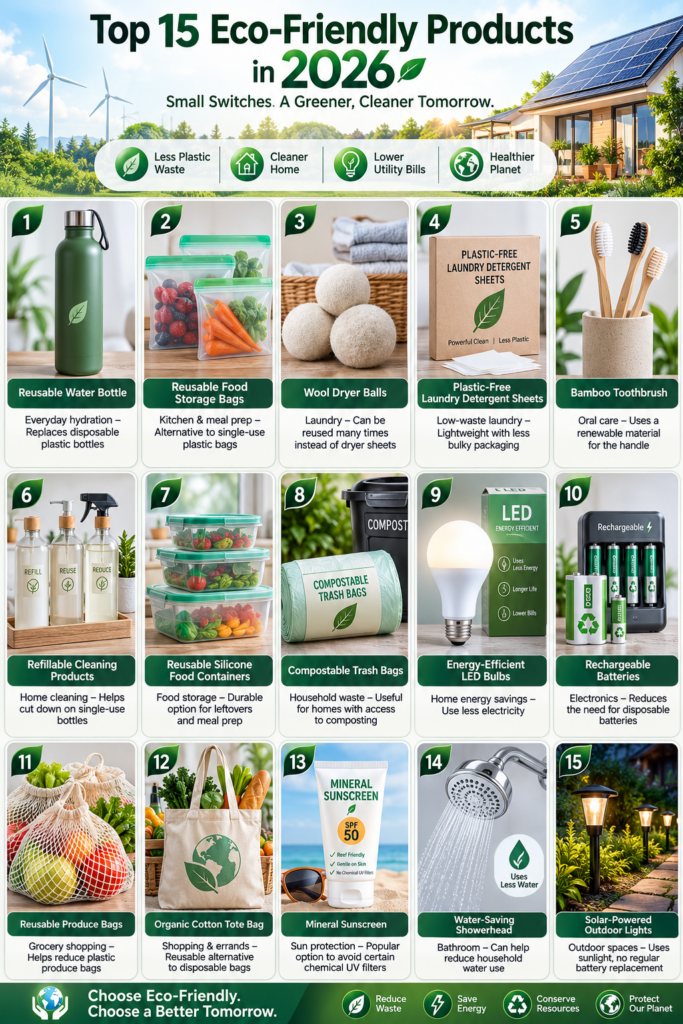
Before getting into the details, here is a quick look at the 15 Best Eco-Friendly Products in 2026. These picks cover common needs around the American home, from reducing single-use waste to making everyday shopping and personal care a little more sustainable.
| # | Eco-Friendly Product | Best For | Why It Stands Out |
|---|---|---|---|
| 1 | Reusable Water Bottle | Everyday hydration | Replaces disposable plastic bottles and is easy to carry |
| 2 | Reusable Food Storage Bags | Kitchen & meal prep | A practical alternative to single-use plastic bags |
| 3 | Wool Dryer Balls | Laundry | Can be reused many times instead of disposable dryer sheets |
| 4 | Plastic-Free Laundry Detergent Sheets | Low-waste laundry | Lightweight format with less bulky packaging |
| 5 | Bamboo Toothbrush | Oral care | Uses a renewable material for the handle |
| 6 | Refillable Cleaning Products | Home cleaning | Helps cut down on repeated single-use bottles |
| 7 | Reusable Silicone Food Containers | Food storage | Durable option for storing leftovers and meal prep |
| 8 | Compostable Trash Bags | Household waste | Useful for households that already have access to suitable composting |
| 9 | Energy-Efficient LED Bulbs | Home energy savings | Use less electricity than traditional incandescent bulbs |
| 10 | Rechargeable Batteries | Electronics | Reduces the need for repeatedly buying disposable batteries |
| 11 | Reusable Produce Bags | Grocery shopping | Helps reduce the use of thin plastic produce bags |
| 12 | Organic Cotton Tote Bag | Shopping & errands | A reusable alternative to disposable shopping bags |
| 13 | Mineral Sunscreen | Sun protection | A popular option for shoppers looking to avoid certain chemical UV filters |
| 14 | Water-Saving Showerhead | Bathroom | Can help reduce household water use |
| 15 | Solar-Powered Outdoor Lights | Outdoor spaces | Uses sunlight to power lights without regular battery replacement |
A Quick Note for U.S. Shoppers
“Eco-friendly” does not automatically mean that a product is better in every situation. Durability, how often you will actually use the item, its packaging, and what happens at the end of its useful life all matter.
Sunscreen deserves a little extra attention. In the U.S., sunscreen products are regulated by the FDA as over-the-counter drugs, so environmental marketing should not be confused with FDA approval or an assurance that a product is environmentally safe. If you are shopping specifically for Hawaii, check the active ingredients and local requirements rather than relying only on a “reef-safe” label. Hawaii restricts the sale and distribution of sunscreens containing oxybenzone or octinoxate without a prescription.
The table above is meant as a starting point. The detailed sections that follow explain what makes each product a more sustainable choice, where it makes sense, and what to watch for before buying.
Best Zero-Waste Kitchen & Household Essentials
If you are trying to create a lower-waste home in the U.S., the kitchen and laundry room are good places to start. These are areas where disposable products can quietly add up—plastic food bags, paper towels, bulky detergent containers, and everyday trash.
The good news is that going zero-waste does not have to mean changing everything at once. A few well-chosen products can replace items you regularly throw away, while still fitting into a normal American household routine.
As part of our 15 Best Eco-Friendly Products in 2026, these four household essentials stand out because they focus on a simple idea: use less, reuse more, and avoid unnecessary waste where practical.
1. Reusable Silicone Food Storage Bags (Single-Use Plastic Alternative)
Reusable silicone bags are one of those swaps that can make sense almost immediately. Instead of reaching for a disposable plastic storage bag every time you pack lunch, store leftovers, or freeze food, you can wash and reuse a durable silicone version.
For U.S. households that use food-storage bags regularly, the biggest advantage is convenience. A good silicone bag can handle everyday kitchen tasks, and many are designed for freezer or dishwasher use.
But not every reusable bag is equally durable. Look for food-contact materials clearly identified by the manufacturer, sturdy seals, and a design that is easy to clean. If the bag is difficult to wash or dry, it may end up sitting unused—which defeats the purpose of the swap.
Best for: Lunches, leftovers, meal prep and freezer storage.
What to check before buying: Material information, temperature limits, leak resistance and cleaning instructions.
2. Dehydrated Laundry Detergent Sheets (Zero Jug Waste)
Traditional liquid laundry detergent often comes in large plastic containers that take up space in the laundry room. Detergent sheets offer a different approach: a lightweight, pre-measured sheet that dissolves in the wash.
For apartment dwellers, frequent travelers, and households trying to reduce bulky packaging, the format can be surprisingly convenient. There is no heavy jug to carry home, and the compact packaging can also make storage easier.
Still, “zero-waste” should not be taken literally. Packaging, ingredients, shipping materials, and how a product performs in your particular washer all matter. Before switching, check whether the detergent is suitable for your machine and whether the manufacturer provides clear ingredient and usage information.
Best for: People who want a lightweight, low-packaging laundry option.
What to check before buying: Ingredient transparency, packaging materials, cleaning performance and compatibility with your washer.
3. BPI-Certified Compostable Trash Bags
Compostable trash bags can be useful—but this is one category where reading the label really matters.
A bag described as “compostable” is not necessarily suitable for every composting setup. BPI certification can give shoppers a more meaningful reference point because BPI is a well-known North American certification program for compostable products.
For U.S. consumers, the most important question is not simply, “Is this bag compostable?” It is “Does my local composting program accept it?” Some municipal and commercial composting facilities have specific rules about certified compostable bags.
If your local program does not accept them, putting these bags in the compost bin may simply create contamination. Check your city, county, or waste hauler’s accepted-materials list before purchasing a large pack.
Best for: Households with access to a composting program that accepts certified compostable bags.
What to check before buying: BPI certification, local composting rules, bag strength and required composting conditions.
4. Swedish Cellulose Dishcloths (Paper Towel Replacement)
If your household goes through paper towels quickly, Swedish cellulose dishcloths are worth considering. They are thin, absorbent cloths designed for everyday kitchen cleanup and can replace many small paper-towel jobs.
They are particularly handy for wiping counters, cleaning up spills, or drying surfaces. After use, many can be washed and reused, giving them a longer working life than a disposable paper towel.
The key is to treat them as a reusable cleaning tool rather than expecting one cloth to last forever. Replace it when it becomes worn or difficult to clean properly, and follow the manufacturer’s washing instructions.
Best for: Kitchen counters, spills and everyday surface cleaning.
What to check before buying: Cellulose/cotton composition, washing instructions, absorbency and durability.
Which Zero-Waste Swap Makes the Biggest Difference?
There is no single “best” zero-waste product for every household. It depends on what you already use and throw away most often.
If you regularly use disposable food-storage bags, start with reusable silicone bags. If laundry detergent jugs are your biggest packaging concern, detergent sheets may be a more convenient switch. For households with access to an appropriate composting service, BPI-certified compostable bags can be worth considering. And if paper towels disappear from your kitchen every week, Swedish cellulose dishcloths are an easy everyday alternative.
The most sustainable product is often the one you will actually use repeatedly. A reusable item sitting unused in a drawer does not reduce much waste; a simple product that becomes part of your normal routine can.
Smart Buying Tip for U.S. Consumers.
Don’t rely on words such as “natural,” “green,” “earth-friendly,” or “zero-waste” alone. Look for specific information about materials, certifications, packaging, durability and disposal.
For compostable products especially, certification is only part of the picture. Your local waste system matters too. Before buying, check whether your city or composting provider accepts the product.
That practical approach is what we use throughout the 15 Best Eco-Friendly Products in 2026—looking beyond the label and asking whether a product can genuinely reduce waste in everyday life.
Best Sustainable Personal Care & Clean Beauty
Personal care is another area where a few small changes can cut down on packaging and everyday waste. Think about how many shampoo bottles, toothpaste tubes, deodorant containers, and floss boxes one person can go through in a year. Switching all of them at once is not necessary. Even one or two practical swaps can make a noticeable difference over time.
As part of our 15 Best Eco-Friendly Products in 2026, these personal-care options were selected with a U.S. shopper in mind. The focus is not simply on whether a product looks “natural” on the label, but on packaging, ingredients, reusability, convenience, and whether the product makes sense as part of a normal daily routine.
1.Waterless Shampoo & Conditioner Bars
Shampoo and conditioner bars are a simple alternative to traditional bottled hair-care products. Because the product is concentrated and does not need a conventional plastic bottle, it can reduce packaging and take up less space in a bathroom or travel bag.
They are especially convenient for people who travel frequently or want to simplify their shower routine. However, hair type matters. A bar that works beautifully for oily hair may not feel the same on dry, curly, or color-treated hair.
When shopping, look for clear ingredient information and choose a formula suited to your hair rather than buying solely because it is marketed as “zero waste.”
Best for: Travelers and shoppers looking to reduce plastic bathroom packaging.
What to check: Hair type, ingredients, packaging, fragrance preferences, and how the bar should be stored between uses.
2.Zero-Waste Hydroxyapatite Toothpaste Tablets
Toothpaste tablets are an interesting option for people trying to reduce traditional toothpaste-tube waste. Instead of squeezing toothpaste from a plastic tube, you chew or dissolve a tablet according to the manufacturer’s directions and then brush with the resulting paste.
Hydroxyapatite is a calcium-phosphate mineral that has attracted attention in oral-care products, particularly among consumers looking for fluoride-free alternatives. But shoppers should not assume that every hydroxyapatite tablet provides the same level of cavity protection.
If cavity prevention is your priority, check the product’s labeling and consider advice from a dental professional. “Natural” or “fluoride-free” does not automatically mean better for your teeth.
Best for: Adults interested in low-packaging oral-care alternatives.
What to check: Active ingredients, dental claims, packaging, flavor, and whether the product has appropriate regulatory or professional support for the claims it makes.
3.Refillable Natural Deodorants (Aluminum & Plastic-Free)
Refillable deodorants can reduce the number of containers thrown away after each product is finished. Instead of replacing the entire package, you keep the outer case and replace the deodorant refill.
For shoppers who prefer aluminum-free or plastic-reduced personal-care products, this format can be appealing. Still, “natural deodorant” is a broad marketing term, and formulas can behave very differently from one another.
If you are switching from an antiperspirant to a deodorant, remember that they are not the same thing. Deodorant generally targets odor, while antiperspirant products are designed to reduce sweating.
Best for: Consumers who want refillable packaging and aluminum-free deodorant options.
What to check: Refill availability, ingredients, skin sensitivity, scent, and whether you want deodorant or antiperspirant protection.
4.US FDA-Regulated Non-Nano Zinc Oxide Mineral Sunscreen
Sunscreen requires more careful shopping than most products on this list. In the United States, sunscreen is regulated by the FDA as an over-the-counter (OTC) drug, so shoppers should look for the required Drug Facts information and pay attention to the active ingredients and SPF claims.
Zinc oxide is an FDA-recognized sunscreen active ingredient, and mineral sunscreens can be an option for consumers who prefer zinc oxide-based UV protection. The term “non-nano,” however, should not be treated as an FDA approval or environmental certification by itself.
Hawaii adds another consideration. Under Hawaii state law, the sale and distribution of sunscreens containing oxybenzone or octinoxate are restricted without a prescription. That is why travelers should check the actual active-ingredient list rather than relying only on front-label terms such as “reef-safe.”
It is also important to keep the terminology accurate: “reef-safe” is not a universal FDA certification. Environmental impact depends on the ingredients, formulation, local rules, and how sunscreen enters marine environments.
Best for: U.S. shoppers looking for zinc oxide mineral sun protection, particularly those traveling to Hawaii.
What to check: FDA-required Drug Facts labeling, SPF, active ingredients, broad-spectrum labeling, water-resistance claims, and Hawaii’s current requirements if you are traveling there.
5.Biodegradable Bamboo Dental Floss with Refillable Glass Vial
Traditional dental floss usually comes in a plastic dispenser that is eventually discarded. A refillable glass-vial system takes a different approach: keep the container and replace only the floss.
Bamboo-based or other plant-derived floss options can appeal to people trying to reduce plastic in their bathroom routine. But “biodegradable” does not necessarily mean that the entire product can go into a backyard compost bin. The floss coating, packaging, and local waste conditions all matter.
The best option is one that you will actually use consistently. There is little environmental benefit to buying an attractive zero-waste floss that feels uncomfortable and ends up unused.
Best for: People looking to reduce plastic from their daily oral-care routine.
What to check: Floss material, coating, refill availability, packaging, comfort, and disposal instructions.
Which Sustainable Personal-Care Swap Should You Try First?
You do not need to replace your entire bathroom cabinet to make your routine more sustainable.
If plastic bottles are your biggest concern, shampoo and conditioner bars are an easy place to start. If toothpaste packaging bothers you, toothpaste tablets may be worth exploring. For bathroom packaging, a refillable deodorant or refillable floss vial can reduce the amount of packaging you purchase repeatedly.
Sunscreen is different. Here, performance and regulatory information should come before environmental marketing. Choose a sunscreen that provides the protection you need, read the Drug Facts label, and check local requirements when traveling—especially in places such as Hawaii.
The broader lesson behind the 15 Best Eco-Friendly Products in 2026 is simple: sustainability works best when it fits your real routine. The smartest purchase is not necessarily the product with the most impressive green label; it is the one that performs well, lasts or refills when appropriate, and helps you avoid unnecessary waste without creating a new problem somewhere else.
Best Eco-Tech & Smart Home Energy Savers
Technology can make a home more convenient, but it can also create another problem: more devices, chargers, cables, and electronic waste. For many U.S. households, the smarter approach is not simply buying more gadgets. It is choosing technology that helps you understand energy use, reduce unnecessary consumption, or replace products that are frequently thrown away.
That is why these picks are included in our 15 Best Eco-Friendly Products in 2026. We are looking beyond flashy features and focusing on whether a product offers a practical benefit for an everyday American home.
1. Smart Eco-Plugs with Real-Time Energy Monitoring
A smart plug with energy monitoring can answer a surprisingly useful question: Where is my electricity actually going?
Instead of guessing how much a gaming setup, home office, TV, aquarium, or older appliance costs to run, an energy-monitoring smart plug can show electricity use through an app or connected system. That information can help you identify devices that consume more power than expected and make better decisions about when to switch them off.
For U.S. shoppers, look for a model that provides clear power or energy readings, supports your preferred smart-home platform, and has sensible security and privacy features. ENERGY STAR’s Smart Home Energy Management Systems criteria specifically include plug-load monitoring/control devices capable of reporting power or energy consumption.
One important reality check: a smart plug does not automatically reduce your electricity bill. The savings come from what you do with the information—turning off unnecessary loads, creating schedules, or changing habits.
Best for: Home offices, entertainment setups, appliances and households curious about electricity usage.
What to check: Energy monitoring accuracy, app features, electrical rating, smart-home compatibility, privacy and standby power.
2. Portable Solar Power Banks & Off-Grid Chargers
Portable solar chargers can be useful when you are camping, hiking, traveling, or simply want an emergency charging option during a power outage. Instead of relying entirely on a wall outlet, these devices can use sunlight to recharge a built-in battery or compatible device.
But expectations matter. A small solar panel is not going to replace a rooftop solar system or rapidly charge every device in every weather condition. Charging speed depends on panel size, sunlight, battery capacity, temperature, and how the product is being used.
For American consumers, a good portable solar charger should therefore be judged by real-world usefulness rather than the word “solar” on the package. Check the battery capacity, output ports, charging specifications, weather resistance and warranty before buying.
The U.S. Department of Energy notes that solar performance can vary with factors such as system size, orientation and available sunlight—an important reminder that solar output is highly dependent on conditions.
Best for: Camping, road trips, emergency preparedness and off-grid charging.
What to check: Battery capacity, solar-panel size, USB/USB-C output, durability, weather resistance and charging time.
3. Plant-Based / Compostable Smartphone Cases
Smartphone cases are easy to overlook when discussing sustainable technology. Millions of people replace them as phones change, cases wear out, or designs simply go out of style.
Plant-based or compostable cases can be an interesting alternative for consumers trying to reduce conventional plastic use. However, the word “compostable” needs context. A case may require commercial composting conditions and may not break down properly in a backyard compost pile or regular landfill environment.
Before buying, check exactly what the manufacturer means by compostable or plant-based. Look for information about the material, certifications, durability and disposal instructions.
There is another practical consideration: durability. If a case protects your phone for several years, replacing it less often may be more meaningful than buying a supposedly greener case every few months.
Best for: Smartphone owners who want to reduce conventional plastic in everyday accessories.
What to check: Material composition, durability, phone protection, certification claims and end-of-life instructions.
A Smarter Way to Choose Eco-Tech:
The best eco-tech purchase is not necessarily the gadget with the longest feature list. Ask a simpler question first: Will this product help me use less energy, waste fewer materials, or keep something useful in service for longer?
For energy-conscious U.S. households, products that provide useful consumption data can be especially valuable. ENERGY STAR’s smart-home guidance emphasizes scheduling, energy-use information and automated controls as ways connected devices can help households manage energy.
And don’t forget the hidden side of electronics. A product that saves a small amount of electricity but has a very short lifespan may not be a great sustainability choice. Look at the complete picture—energy use, durability, repairability, battery life, packaging and eventual disposal.
That practical approach is what makes these products worthy of consideration in the 15 Best Eco-Friendly Products in 2026, rather than simply calling every connected gadget “green.”
Best Reusable Everyday Lifestyle Gear
Some of the easiest sustainable changes are the ones you barely have to think about. A reusable tumbler that replaces disposable cups, grocery bags that stay in your car, or outdoor lights that recharge during the day can become part of your routine without requiring a major lifestyle change.
For this part of our 15 Best Eco-Friendly Products in 2026, we focused on everyday gear that makes sense for American consumers. The goal is not to buy more things simply because they are marketed as sustainable. It is to choose products that are durable, useful, and likely to replace something you would otherwise keep buying or throwing away.
1. Insulated Vacuum-Sealed Stainless Steel Tumblers
A good stainless steel tumbler is one of those products that can earn its place in your daily routine pretty quickly. Fill it with coffee on the way to work, keep water cold during a summer road trip, or take it to the gym instead of grabbing another disposable bottle or cup.
Vacuum insulation helps maintain the temperature of the drink, while stainless steel provides a durable alternative to many disposable drink containers.
For U.S. shoppers, the practical details matter more than a trendy logo. Look for a comfortable lid, a size that fits your car’s cup holder, a leak-resistant design, and construction that can handle regular use.
The biggest sustainability benefit comes from using the tumbler repeatedly. Buying one and replacing it every few months because the lid breaks is not exactly a win.
Best for: Commuting, work, travel, workouts and everyday hydration.
What to check: Stainless-steel grade, insulation performance, lid design, dishwasher compatibility and durability.
2. Certified Organic Cotton Produce & Grocery Bags
Reusable cotton produce and grocery bags can help reduce dependence on disposable shopping bags, especially for shoppers who already carry reusable bags to the supermarket or farmers market.
For consumers specifically looking for organic cotton, certification is worth paying attention to. USDA organic rules distinguish between certified organic finished textiles and products that only contain particular organic fibers. Textiles meeting the Global Organic Textile Standard (GOTS) can also be sold as organic in the U.S. under the applicable requirements.
That means shoppers should not assume that every bag described as “organic cotton” carries the same certification or standard. Check the product description and certification information before buying.
There is also a simple real-world rule: remember the bags. Keeping a few in your car, near the front door, or with your grocery cart makes it much easier to use them consistently.
Best for: Grocery shopping, farmers markets and reducing disposable shopping bags.
What to check: Organic certification, cotton composition, stitching, handle strength, washability and bag capacity.
3. Solar-Powered Outdoor LED Pathway Lights
Solar-powered pathway lights are a straightforward way to add outdoor lighting without running electrical wiring to every small garden or walkway light. During the day, their solar panels collect energy and store it in an internal battery; after dark, the lights use that stored energy.
They can work particularly well for garden paths, walkways, patios and other areas where you want gentle nighttime lighting rather than high-powered illumination.
But solar lighting is not completely maintenance-free. Performance depends on sunlight, panel placement, battery condition and weather. A light placed under heavy shade may not stay illuminated as long as one receiving several hours of direct sunlight.
For that reason, don’t judge a solar light only by its advertised brightness or runtime. Look at the battery type, LED efficiency, weather resistance, solar-panel placement and replacement-part availability.
Best for: Garden paths, walkways, patios and outdoor accent lighting.
What to check: Solar-panel size, battery capacity, LED brightness, weather resistance, operating time and warranty.
What Makes These Everyday Products a Better Sustainable Choice?
The common thread between these three products is repeat use.
A stainless steel tumbler can replace hundreds of disposable drink containers over its useful life. Reusable grocery bags can become part of your weekly shopping routine. Solar pathway lights can provide outdoor illumination without needing a conventional wired connection for each small light.
But sustainable shopping is not just about the product itself. The FTC advises consumers and marketers to look carefully at environmental claims and the specific attributes behind them rather than relying on broad terms such as “eco-friendly” or “green.”
So, when comparing products, ask a few simple questions:
- Will I use this regularly?
- Is it durable enough to last?
- What material is it actually made from?
- Can I repair, wash, refill or reuse it?
- Does the sustainability claim have meaningful supporting information?
- What happens when the product reaches the end of its useful life?
Those questions are more useful than simply choosing the product with the biggest “eco-friendly” label.
And that is the bigger idea behind the 15 Best Eco-Friendly Products in 2026: sustainable living does not have to be complicated. Sometimes the best change is simply replacing a disposable habit with something durable enough to become part of your everyday life.
How to Choose Genuine Eco-Friendly Products in 2026
Walking into a U.S. store or browsing Amazon for sustainable products can be surprisingly confusing. One package says “eco-friendly,” another says “natural,” and a third displays a certification logo—but those labels do not all mean the same thing.
When choosing products from our 15 Best Eco-Friendly Products in 2026, a useful starting point is to look past the front of the package. Check what the claim actually means, who verified it, what material or process it covers, and whether the company provides enough information to support the statement.
For American shoppers, third-party certifications can be helpful because they provide a specific standard to look for. But even a certification does not mean a product has zero environmental impact. Every product has a footprint; the goal is to understand what you are actually buying.
Essential U.S. Certifications to Look For
Not every certification applies to every product. A cotton bag, skincare product, household cleaner, and business brand may use completely different standards. Here are some labels worth understanding before you buy.
USDA Organic: Particularly relevant to agricultural products and certain organic textile claims. USDA organic labels are subject to specific requirements, and organic products generally need review by a USDA-accredited certifying agent. For textiles, the USDA explains that finished products meeting its organic requirements may carry the USDA organic seal, while GOTS-compliant textiles may also be sold as organic in the U.S. under applicable rules.
B Corp: B Corp certification focuses on a company’s social, environmental, and governance practices rather than certifying that an individual product is environmentally friendly. B Lab’s standards cover areas such as governance, workers, community, environment, and customers. That makes it useful when you want to understand the broader practices of a company—not just one product’s packaging.
Leaping Bunny: This certification is especially relevant when shopping for cosmetics, personal-care products, and household products where cruelty-free purchasing is important. Remember that “cruelty-free” addresses animal testing; it does not automatically tell you whether a product is recyclable, biodegradable, low-carbon, or otherwise sustainable.
Climate Neutral / Climate-Related Certifications: Carbon and climate claims deserve extra scrutiny. Look for information explaining what emissions were measured, what reduction actions were taken, and whether offsets or other mechanisms were used. A vague “carbon neutral” statement without supporting details tells you very little about a product’s actual environmental footprint.
The important takeaway is simple: a certification should tell you something specific. Don’t assume one logo proves that a product is sustainable in every possible way.
Avoiding Greenwashing: FTC Green Guides Compliance Checklist
Greenwashing often happens when a product creates the impression that it is broadly better for the environment without clearly explaining why.
The FTC’s Green Guides advise marketers against broad, unqualified environmental claims such as “green” or “eco-friendly” because such claims can be difficult to substantiate. Environmental claims should be specific, clear, and supported by competent and reliable evidence.
For U.S. shoppers, this gives you a useful checklist:
- Look for a specific claim: “Made with 70% recycled plastic” tells you more than simply “eco-friendly.”
- Check what the claim applies to: Is it the product, packaging, or only one component?
- Verify recycled-content claims: Find out whether the recycled material is actually in the product or only in the packaging.
- Be careful with “biodegradable”: Ask where and under what conditions the product is expected to break down.
- Question “compostable”: Check whether it requires a commercial composting facility or can actually break down in home composting conditions.
- Don’t treat a certification logo as a blanket guarantee: Check what organization issued it and what environmental attribute was evaluated.
- Look for evidence behind “non-toxic” claims: The FTC says such claims need appropriate substantiation regarding safety for people and the environment.
- Watch for vague carbon claims: Look for an explanation of the emissions accounting and any offsets involved.
- Consider the trade-offs: A product can have one environmental advantage while creating another environmental cost.
- Check local recycling or composting access: “Recyclable” does not necessarily mean your local facility accepts the item.
What About “Reef-Safe” Sunscreen?
Sunscreen is a good example of why shoppers should separate environmental marketing from regulatory claims.
In the U.S., sunscreen products are regulated by the FDA as OTC drugs. So an environmental phrase such as “reef-safe” should not be interpreted as an FDA certification or guarantee of environmental safety.
For Hawaii, ingredient-level checking is particularly important. Hawaii law restricts the sale and distribution of sunscreen containing oxybenzone or octinoxate without a prescription. Therefore, if you are buying sunscreen for a Hawaii vacation, check the active ingredients rather than relying only on a “reef-safe” badge.
This is also why we treat sunscreen differently from ordinary household products in the 15 Best Eco-Friendly Products in 2026. UV protection, FDA labeling, ingredients, and local requirements should come first; environmental considerations should be evaluated separately.
The Simple Rule: Look for Evidence, Not Just Green Packaging
You don’t need to become an environmental scientist to shop more responsibly.
Before buying, ask three basic questions:
What exactly is the environmental benefit?
Who verifies or supports the claim?
Can I realistically reuse, recycle, compost, refill, or keep this product for a long time?
If a brand answers those questions clearly, that is a much stronger signal than a package covered in leaves and green colors.
For U.S. consumers, this evidence-first approach is one of the easiest ways to avoid greenwashing and make smarter purchases. It also keeps the focus where it belongs: on what the product actually does, not just what the marketing says it does.
How Much Do You Actually Save?
Buying an eco-friendly product can sometimes cost more upfront, so it is fair to ask the obvious question: Will I actually save money in the long run?
The answer depends on what you are replacing, how often you use it, and how long the new product lasts. A reusable water bottle, for example, may reduce the number of bottled drinks you buy, while rechargeable batteries can make sense for households that regularly go through disposable ones. On the other hand, a more expensive “green” product is not automatically a money-saving product.
That is an important distinction when looking at the 15 Best Eco-Friendly Products in 2026. The goal is not to claim that every sustainable product will lower your monthly expenses. Some deliver direct savings, some reduce replacement costs, and others are primarily about reducing waste or resource use.
Where the Biggest Savings Can Come From?
For most U.S. households, the easiest savings to understand are products that replace something you purchase repeatedly.
| Product Type | Potential Money-Saving Benefit | What Determines Your Savings |
|---|---|---|
| Reusable water bottle | Fewer disposable bottles or drinks | How often you buy bottled beverages |
| Reusable food bags | Fewer disposable storage bags | Frequency of meal prep and food storage |
| Laundry detergent sheets | Potentially lower packaging and storage costs | Price per load and washing frequency |
| Reusable dishcloths | Fewer paper towels | How many paper towels your household uses |
| Rechargeable batteries | Fewer disposable battery purchases | Number of batteries used each year |
| Smart energy-monitoring plug | Can help identify unnecessary electricity use | Device usage and local electricity rate |
| LED lighting | Lower electricity use than older lighting technologies | Wattage, hours of use and utility rate |
| Solar outdoor lights | No routine electricity cost for each light | Sun exposure, battery life and replacement needs |
| Refillable personal-care products | Fewer complete packages to purchase | Refill price and product lifespan |
| Stainless steel tumbler | Fewer disposable cups or bottles | How frequently you use it |
Don’t Confuse “Eco-Friendly” With “Cheaper”
This is where sustainable shopping gets a little more interesting.
A reusable product can have a higher purchase price but become cheaper over time because you use it hundreds of times. Another product may reduce plastic waste but cost roughly the same as its conventional alternative. And some eco-friendly options may actually cost more simply because of their materials, manufacturing process, certification, or smaller production scale.
So instead of asking only “What’s the cheapest option?”, consider the cost per use.
For example, if a reusable item costs $20 and you use it 200 times, its basic purchase cost works out to about 10 cents per use—before considering cleaning, maintenance, or eventual replacement. A disposable product may look cheaper at checkout but become more expensive when purchased repeatedly.
Smart Plugs Can Help You Find Hidden Energy Costs
Energy-saving technology is another category where the financial benefit depends heavily on how you use it.
A smart plug with energy monitoring does not magically reduce your electricity bill. Its value is that it can show how much power a connected device is using and help you identify equipment that is running unnecessarily.
ENERGY STAR’s smart-home guidance highlights energy monitoring, scheduling, alerts and automated controls as tools that can help households manage energy consumption.
For a U.S. homeowner or renter, that can be useful for identifying devices such as entertainment systems, home-office equipment or appliances that remain powered when they are not needed.
Your actual savings will depend on the device, usage pattern and local electricity rate. So it is better to measure your own consumption than rely on a generic “save $X per year” promise.
Reusable Products Usually Need One Simple Habit
There is a catch with almost every reusable product: you have to actually reuse it.
A $25 reusable grocery bag system does not save much if you forget the bags in your garage every week. A reusable tumbler has little financial advantage if you keep buying disposable drinks anyway.
The same applies to reusable food-storage bags, cloths, rechargeable batteries and refillable personal-care products.
The environmental and financial benefits become more meaningful when the product becomes part of your normal routine.
A Simple Way to Calculate Your Own Savings
You don’t need a complicated spreadsheet.
Use this basic calculation:
Annual cost of the old product − annual cost of the new product = potential annual savings
Then consider the initial purchase price and expected lifespan.
For example:
Disposable products: $8 × 12 purchases = $96 per year
Reusable alternative: $25 initial purchase + occasional maintenance/replacement
The exact numbers will vary, but this gives you a much more realistic comparison than relying on a manufacturer’s headline claim.
For energy products, use:
Energy used × your electricity rate = estimated electricity cost
Your utility bill is the best source for the rate you actually pay because electricity prices vary considerably by location, plan and usage.
What About the Environmental “Savings”?
Not every benefit shows up on your bank statement.
Using a reusable product can reduce the number of disposable items you purchase. Choosing a durable product can mean fewer replacements. An energy-monitoring device can help you understand where electricity is going. A solar-powered outdoor light can avoid routine grid electricity use for that particular light.
These are useful benefits, but they should not be exaggerated.
The FTC’s Green Guides caution against broad, unqualified environmental claims and recommend that environmental benefits be specific and supported by evidence.
That is why a trustworthy product comparison should distinguish between money saved, waste avoided, energy used, and other environmental benefits instead of treating them as the same thing.
Bottom Line: Buy for Long-Term Value, Not Just the Green Label
The best eco-friendly purchase is not necessarily the most expensive or the one with the most impressive sustainability claims.
For American consumers, a better strategy is to look at cost per use, expected lifespan, replacement frequency, energy consumption, maintenance, and disposal. If a product lasts for years and replaces something you regularly buy, it has a much stronger case.
And sometimes the smartest sustainable choice is the simplest one: use what you already own for longer.
That is the real financial lesson behind the 15 Best Eco-Friendly Products in 2026. Sustainable shopping works best when the product saves resources and makes practical sense for your household budget.
Frequently Asked Questions (FAQs)
1.Do eco-friendly products really save money in the long run?
They can, but it depends on the product and how often you use it. Reusable bags, stainless steel tumblers, rechargeable batteries, refillable personal-care products, and reusable cleaning cloths can reduce the need to repeatedly buy disposable alternatives. Energy-monitoring products may also help identify unnecessary electricity use.
However, an eco-friendly label does not automatically mean a product is cheaper. Before buying, compare the upfront price, cost per use, expected lifespan, maintenance, and replacement cost. A durable product that you use for years can offer better value than a cheaper item that needs frequent replacement.
2.What is the difference between biodegradable and compostable items?
Biodegradable generally means a material can break down naturally through biological processes, but the speed and conditions can vary significantly. A product labeled biodegradable may not break down quickly in a landfill, where sunlight, air, and moisture can be limited.
Compostable means the material is intended to break down into usable compost under appropriate composting conditions. But “compostable” does not necessarily mean that you can put the item in your backyard compost bin. Some products require commercial or industrial composting facilities.
For U.S. shoppers, it is worth checking the manufacturer’s disposal instructions and your local waste program before purchasing. The FTC specifically cautions that biodegradable and compostable environmental claims should be supported and clearly qualified when special conditions are required.
3.How can I verify if a product is truly reef-safe in the US?
There is no single universal U.S. government certification that makes a sunscreen officially “reef-safe.” Treat the phrase as an environmental marketing claim rather than proof of FDA approval.
For sunscreen, start with the Drug Facts label and check the active ingredients. Sunscreens are regulated by the FDA as OTC products, and FDA labeling requirements include information such as active ingredients, SPF and broad-spectrum claims.
If you’re traveling to Hawaii, check the ingredients particularly carefully. Hawaii restricts the sale and distribution of sunscreen containing oxybenzone or octinoxate without a prescription. So rather than trusting a “reef-safe” badge alone, verify the actual ingredients and check current local requirements.
In short, when evaluating the 15 Best Eco-Friendly Products in 2026, “reef-safe” should never be treated as a substitute for checking FDA labeling, sunscreen ingredients, or Hawaii-specific rules.
Final Verdict & Key Takeaways.
Choosing from the 15 Best Eco-Friendly Products in 2026 does not mean buying the product with the biggest “green” label. The better approach is to choose products that solve a real everyday need, last long, reduce waste, or use fewer resources over time.
For most U.S. households, the best starting point is simple: replace frequently used disposable products with durable, reusable alternatives. Reusable food storage bags, stainless steel tumblers, refillable personal-care products, Swedish dishcloths, and reusable grocery bags can make a noticeable difference because they are used repeatedly.
For energy-conscious households, smart energy-monitoring plugs and solar-powered products can also be useful. However, technology only creates savings when it changes how you use energy. ENERGY STAR notes that smart-home systems can help consumers schedule devices, monitor consumption, and automate energy-saving actions.
Key Takeaways for U.S. Shoppers:
- Look beyond the word “eco-friendly.” A product should explain what makes it environmentally preferable rather than relying only on vague green marketing claims. The FTC advises against broad, unqualified environmental claims because they can be difficult to substantiate.
- Prioritize durability. A reusable product is more useful when you will actually use it for years instead of replacing it frequently.
- Check certifications carefully. Look for certifications that match the specific claim, such as organic, energy-efficiency, compostability, or cruelty-free credentials.
- Consider your local infrastructure. A product labeled recyclable or compostable may not have convenient recycling or composting options in your community.
- Compare cost per use, not just the purchase price. A slightly more expensive product can be the better value if it lasts significantly longer.
- For sunscreen, check the details. U.S. sunscreen is regulated as an OTC drug, so consumers should look for proper Drug Facts labeling and review the active ingredients rather than relying solely on terms such as “reef-safe.”
- Choose what fits your lifestyle. The most sustainable product is often the one you will consistently use, maintain, refill, wash, or recharge.
Our Bottom Line:
There is no single “greenest” product for everyone. A reusable kitchen item may be the smartest choice for one household, while an energy-monitoring device or solar charger may provide more value for another.
The goal is not to make your lifestyle perfect overnight. Start with products you use regularly, replace unnecessary disposables, avoid unsupported environmental claims, and choose quality over short-term convenience.
That makes the 15 Best Eco-Friendly Products in 2026 less about buying more—and more about buying better.
Recommended External Resources
If you want to verify an eco-friendly product before buying it, these official U.S. resources are useful starting points:
- FTC Green Guides – Learn how environmental claims such as “recyclable,” “compostable,” “biodegradable,” and “eco-friendly” should be supported and qualified. FTC Green Guides
- FTC Consumer Advice: Eco-Friendly Claims – Helpful for understanding what common green marketing terms actually mean and what consumers should check before buying. FTC Consumer Advice
- USDA Organic Standards – Check official requirements for products marketed as organic in the United States, including applicable labeling categories. USDA Organic Labeling
- ENERGY STAR – Useful for checking energy-efficiency information and learning about smart-home energy management systems. ENERGY STAR Smart Home Energy Management
Quick Tip
Before purchasing, don’t rely on a green label alone. Check who issued the certification, what exactly it covers, whether the claim applies to the entire product or only one component, and whether the environmental benefit is relevant to your local disposal or recycling options. FTC guidance specifically emphasizes that environmental claims should be truthful and properly substantiated.
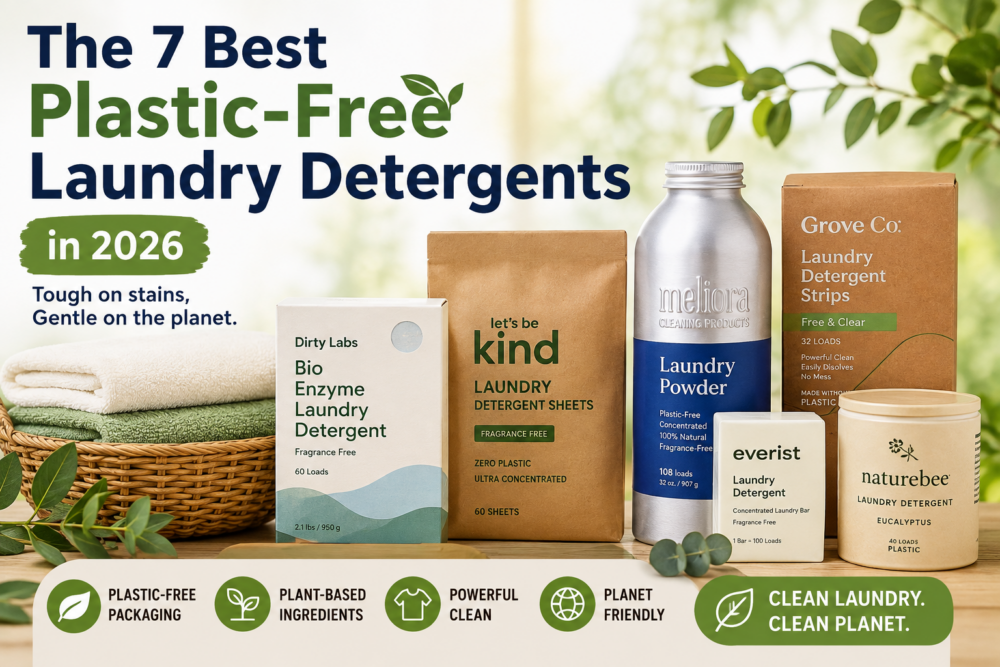
7 Best Plastic-Free Laundry Detergents in 2026