


Best Solar Panels for Home in India 2026: Introduction
Choosing the best solar panels for home in India 2026 is not only about finding the highest-wattage panel. Indian homeowners should also consider efficiency, performance in high temperatures, roof space, warranty, durability, installation quality, and price.
With rooftop solar growing across India and schemes such as PM Surya Ghar: Muft Bijli Yojana supporting residential installations, solar power is becoming a practical option for many households.
In this guide, we’ll compare popular solar panel technologies such as TOPCon, HJT, and Mono PERC, explain their key advantages, and help you understand which option may be suitable for your home, electricity usage, and budget.
Quick answer: For a typical Indian home in 2026, look for a reputable manufacturer, a suitable N-type TOPCon module, strong product and performance warranties, good local service and—where applicable—an exact model that meets the relevant MNRE/ALMM requirements.
Table of Contents
- Best Solar Panels for Home in India 2026 – Quick Overview
- Top Solar Panel Brands in India 2026
- Best Solar Panels in India 2026 – Comparison
- Best Solar Panel Technology for Home in India
- TOPCon vs Mono PERC vs HJT Solar Panels
- Best High-Efficiency Solar Panels for Home
- Best 550W Solar Panels in India 2026
- Best Solar Panels for 1kW, 2kW, 3kW and 5kW Systems
- How Many Solar Panels Do You Need for Your Home?
- Solar Panel Price in India 2026
- Best Solar Panels for Hot Weather in India
- Best Solar Panels for Small Roofs
- Solar Panel Efficiency, Warranty and Lifespan
- ALMM Approved Solar Panels in India 2026
- DCR Solar Panels in India
- PM Surya Ghar Subsidy and Solar Panels
- Best Solar Panels for Rooftop Solar
- How to Choose the Best Solar Panel for Your Home
- Solar Panel Buying Checklist
- Common Mistakes to Avoid
- Final Verdict
- FAQs
Best Solar Panels for Home in India 2026 – Quick Overview
There is no single solar panel that is perfect for every Indian household.
Choosing the best solar panels for home in India 2026 depends on more than just panel wattage. Your roof size, daily electricity use, local weather, budget, and installation quality all matter.
For most Indian homes, TOPCon solar panels are a strong all-round choice because they offer high efficiency and good performance when roof space is limited. However, that does not mean they are the right option for everyone.
Quick Guide:
| Your Requirement | Recommended Option |
|---|---|
| Best for most Indian homes | TOPCon panels |
| Best panel for a small roof | High-efficiency TOPCon or HJT |
| Best for budget buyers | Quality Mono PERC panels |
| Best high-efficiency panel | HJT or premium TOPCon |
A practical point many buyers overlook is the installer and product warranty. A good panel can still deliver disappointing results if the system is poorly designed or installed.
Before making a purchase, check the panel’s efficiency, temperature coefficient, degradation warranty, product warranty, manufacturer reputation, and applicable MNRE/ALMM requirements.
The right panel is not always the most expensive one. It is the one that gives your home a sensible balance of performance, reliability, available roof space, and long-term value.
Top 10 Best Solar Panel Brands in India 2026.
Choosing from the top 10 best solar panel brands in India 2026 can feel confusing because every company highlights different efficiency ratings, warranties, and technologies. For a homeowner, the better question is: Which brand offers the right balance of performance, reliability, service, and price for my roof?
Some established names in the Indian solar market include Waaree Energies, Vikram Solar, Tata Power Solar, Adani Solar, RenewSys, and Jakson Solar. Other brands may also be worth considering depending on the panel model, availability, installer support, and your location.
For example, a homeowner with limited roof space may prefer a high-efficiency TOPCon or HJT panel, while someone working with a tighter budget may focus more on a reliable and reasonably priced module. Warranty terms and after-sales support should also be checked rather than choosing purely on brand popularity.
Quick Tip for Homeowners.
Before buying, compare:
- Panel efficiency and technology
- Product and performance warranty
- Temperature performance
- Degradation rate
- MNRE/ALMM eligibility, where applicable
- Local installer and after-sales support
The best solar panel brand is ultimately the one that fits your electricity needs, roof conditions, budget, and long-term expectations.
Best Solar Panels Comparison Table.
When comparing the best solar panels for home in India 2026, looking at the brand name alone is not enough. A panel that works well on one roof may not be the most practical choice for another home. Efficiency, technology, warranty, temperature performance, and price all deserve attention.
The table below gives a simple starting point for comparing popular solar panel options available in the Indian market. Exact specifications can vary by model, so it is always worth checking the manufacturer’s current datasheet before purchasing.
| Solar Panel Technology | Efficiency | Best For | Main Advantage | Price Level |
|---|---|---|---|---|
| TOPCon | High | Most homes | Good efficiency and modern technology | Medium–High |
| HJT | Very High | Small roofs | Excellent efficiency and temperature performance | High |
| Mono PERC | Moderate–High | Budget buyers | Proven and widely available | Low–Medium |
| Bifacial TOPCon | High | Suitable open roofs | Can generate additional power from reflected light | Medium–High |
| Bifacial HJT | Very High | Premium systems | High efficiency and strong performance | High |
What Should You Choose?
For many homeowners, TOPCon offers a practical balance between efficiency and cost. If roof space is very limited, a high-efficiency HJT panel may make more sense. Budget-conscious buyers can still consider good-quality Mono PERC panels.
Before making the final decision, compare the actual panel model, warranty, degradation rate, installer reputation, and applicable MNRE/ALMM requirements.
Which Solar Panel Technology Is Best in 2026?
There is no single solar panel technology that is perfect for every Indian home. When looking at the best solar panels for home in India 2026, the right choice depends on your roof area, electricity consumption, local climate, and budget.
TOPCon – Best All-Round Choice:
For many homeowners, TOPCon is a practical option. It offers high efficiency and is particularly useful when roof space is limited. It also provides a good balance between modern technology and overall system cost.
HJT – Best for High Efficiency:
HJT (Heterojunction Technology) is worth considering when maximum efficiency is the priority. It can perform well in hot conditions, making it attractive for parts of India with high temperatures. The downside is that premium HJT modules can cost more.
Mono PERC – Best for Budget Buyers:
Mono PERC remains a familiar and widely available option. If your roof has enough space and keeping the initial cost under control is important, a quality Mono PERC panel can still be a sensible choice.
Our Practical Take:
For most homes, TOPCon is the strongest all-round option in 2026. HJT makes more sense for premium, space-constrained installations, while Mono PERC can suit budget-focused buyers. Always compare the specific model’s datasheet, warranty, degradation rate, and installer support before buying.
TOPCon vs Mono PERC vs HJT – Which Is Better?
When choosing the best solar panels for home in India 2026, three technologies often come up: TOPCon, Mono PERC, and HJT. Each has its own strengths, and the best choice depends on your roof space, budget, climate, and electricity needs.
TOPCon: is a strong all-round option for many Indian homes. It offers high efficiency and is a good fit when roof space is limited. For homeowners looking for newer technology without moving too far into the premium price range, TOPCon is worth considering.
Mono PERC: is the more budget-friendly choice. It is a proven technology and can make sense when you have enough roof space and want to keep the initial investment lower.
HJT: focuses on high efficiency and strong performance, particularly in warmer conditions. It can be attractive for premium residential systems, although the upfront cost may be higher.
Quick Verdict:
- Best overall: TOPCon
- Best for budget: Mono PERC
- Best for high efficiency: HJT
- Best for limited roof space: TOPCon or HJT
Before buying, compare the specific panel model, warranty, degradation rate, temperature coefficient, and installer support rather than choosing only by technology name.
Best Solar Panel Efficiency for Indian Homes.
When people search for the best solar panels for home in India 2026, efficiency is usually one of the first numbers they check. And it matters—but it should not be the only deciding factor.
For a typical Indian home, a panel with high efficiency can be especially useful when roof space is limited. More electricity can be generated from the same available area. Technologies such as TOPCon and HJT are popular choices for homeowners looking for higher-efficiency modules, while Mono PERC can still be practical where roof space and budget are less restrictive.
What Efficiency Should You Look For?
Modern residential panels commonly fall into the roughly 20%–24% efficiency range, depending on the specific model and technology. However, always check the manufacturer’s current datasheet rather than relying on a generic technology figure.
A useful way to think about it is simple:
Small roof + higher electricity demand → prioritize efficiency.
Large roof + tighter budget → price and overall system value may matter more.
Also check the panel’s temperature coefficient, degradation rate, product warranty, and real installation conditions. India has many hot and sunny regions, so how a panel performs at higher temperatures can be just as important as its headline efficiency.
In short, the most efficient panel is not automatically the best purchase. The goal is to find the right balance between efficiency, cost, reliability, roof space, and long-term performance.
Best Solar Panel Wattage for Home.
Choosing the right panel wattage is just as important as choosing the right brand. When comparing the best solar panels for home in India 2026, many homeowners focus on the highest-wattage panel available. In practice, the right wattage depends on your electricity consumption, roof size, and the capacity of the complete solar system.
For most residential installations, 550W–600W panels are becoming an attractive option because higher-wattage modules can produce more power from each panel. This can be useful when roof space is limited. However, a lower-wattage panel may still be perfectly suitable if you have enough roof area.
What Wattage Do You Need?
A simple example:
- 2 kW system: around 4–5 panels of 550W
- 3 kW system: around 5–6 panels of 550W
- 5 kW system: around 9–10 panels of 550W
These are approximate figures. The actual number depends on the panel’s rated output and the final system design.
Don’t choose panels by wattage alone. Check efficiency, dimensions, warranty, temperature performance, inverter compatibility, and installation quality. For an Indian home, a slightly higher-wattage panel can be a smart choice when every square metre of roof space matters.
How Many Solar Panels Do You Need for Your Home?
One of the first questions homeowners ask after deciding to install rooftop solar is simple: how many solar panels will my home actually need? There is no single number for every house. Your monthly electricity use, available roof space, panel wattage, sunlight, and desired system capacity all make a difference.
For someone comparing the best solar panels for home in India 2026, it helps to start with your electricity consumption rather than the panel brand.
A Simple Example.
If you choose 550W panels, an approximate setup could look like this:
- 2 kW system: about 4 panels
- 3 kW system: about 5–6 panels
- 5 kW system: about 9–10 panels
- 6 kW system: about 10–11 panels
These numbers are only a starting point. A professional installer should calculate the final system size after checking your electricity bills, roof orientation, shading, available area, and local solar conditions.
For Indian homes, don’t forget the practical side. A roof may look large, but water tanks, walls, trees, and shade can reduce the usable area.
The best approach: check your recent electricity bills, estimate your daytime usage, and then choose the panel wattage and system size that fit your actual needs—not simply the largest system you can install.
Solar Panel Price in India 2026
The solar panel price in India 2026 can vary quite a bit depending on the panel technology, system size, inverter, installation work, and the brand you choose. So, there is no single price that fits every home.
For a residential rooftop system, the overall cost is more useful to consider than the panel price alone. For example, current 2026 market estimates from SolarSquare put starting prices for complete systems at around ₹2.10–₹2.47 lakh for 3 kW and ₹3.10–₹3.83 lakh for 5 kW, before applicable subsidy, depending on the variant and location.
What Changes the Final Price?
- Panel technology: TOPCon and HJT can cost more than older technologies.
- System capacity: A 5 kW system naturally costs more than a 3 kW system.
- Inverter and mounting structure: These are important parts of the total installation.
- Roof and installation conditions: Height, structure, wiring, and local requirements can affect the quote.
- Government subsidy: Eligible residential consumers may receive support under the PM Surya Ghar scheme.
One practical tip: don’t choose a solar system simply because the initial quote looks cheap. Compare the panel warranty, inverter quality, installation standards, after-sales service, and expected generation before making the final decision.
Best Solar Panels for Different Budgets.
Buying the best solar panels for home in India 2026 does not always mean choosing the most expensive technology. A sensible choice should match your electricity needs, roof space, and how much you are comfortable spending upfront.
Budget-Friendly Buyers:
If keeping the initial cost low is your priority, a good-quality Mono PERC panel can still be worth considering. It is a familiar technology and can work well when you have sufficient roof space.
Mid-Range Budget:
For homeowners looking for a better balance between efficiency and price, TOPCon is an attractive option in 2026. It can provide higher efficiency without necessarily moving into the most expensive premium segment.
Premium Budget:
If your roof space is limited and you want maximum efficiency, HJT panels are worth a closer look. They can offer excellent performance, but the higher upfront cost needs to make sense for your home.
Quick Recommendation.
| Budget | Suitable Choice | Best For |
|---|---|---|
| Low | Mono PERC | Cost-conscious homes |
| Medium | TOPCon | Most homeowners |
| High | HJT / Premium TOPCon | Limited roof space |
Remember, the cheapest quote is not automatically the best deal. Check the panel warranty, degradation rate, inverter, installer experience, after-sales service, and applicable MNRE/ALMM requirements before signing the deal.
For most Indian households, TOPCon offers a practical middle ground between cost and performance.
Solar Panel Warranty and Lifespan: What to Check.
When comparing the best solar panels for home in India 2026, warranty is one detail that is easy to overlook. A panel may look attractive on paper, but what matters over the years is how well it performs and what protection you get if something goes wrong.
Most modern solar panels are designed to operate for 25 years or more, although actual performance depends on the product, installation, weather conditions, and maintenance. Instead of looking only at the word “25-year warranty,” check what that warranty actually covers.
Key Things to Check:
- Product warranty: Covers manufacturing defects and certain component failures.
- Performance warranty: Sets out how much power the panel should retain over time.
- Annual degradation: A lower degradation rate generally means better long-term output.
- Warranty terms: Check exclusions, claim procedures, and who provides the support.
- Manufacturer reputation: A strong warranty is more useful when the company has reliable customer service.
For Indian homes, also consider heat, dust, humidity, and monsoon conditions when selecting panels. Good installation matters just as much as the panel itself.
A practical approach is to compare the complete warranty document—not just the headline number. A reliable panel with transparent warranty terms can be a better long-term investment than a cheaper panel with unclear support.
How to Check ALMM-Approved Solar Panels?
If you are planning a rooftop solar installation in India, checking whether the panel is ALMM-approved can save you from an unnecessary headache later. ALMM stands for the Approved List of Models and Manufacturers, maintained by the Ministry of New and Renewable Energy (MNRE).
For homeowners researching the best solar panels for home in India 2026, ALMM status is particularly important when the project involves government-supported schemes or applicable requirements.
How to Check ALMM Status?
- Visit the official MNRE website.
- Open the latest ALMM list published by MNRE.
- Search for the manufacturer’s name.
- Check the exact module model and technology, not just the brand name.
- Match the details with the panel’s datasheet, label, and quotation from your installer.
This last step is easy to miss. A company may have several models, and approval for one model does not automatically mean every panel sold by that manufacturer is included.
A Practical Buying Tip:
Ask your installer to provide the exact model number before making the payment. Then verify it against the latest official MNRE list yourself.
ALMM status can change as MNRE updates its list, so avoid relying on an old screenshot or a seller’s claim alone. For the most reliable information, always check the latest official MNRE publication before finalizing your solar system.
DCR Solar Panels: What Homeowners Should Know?
If you are comparing the best solar panels for home in India 2026, you may come across the term DCR solar panels. DCR means Domestic Content Requirement, which relates to the use of domestically manufactured solar cells and modules under certain government-supported solar programmes.
For homeowners, this matters because not every solar panel automatically qualifies for every subsidy or scheme. If you are planning to install rooftop solar under the PM Surya Ghar: Muft Bijli Yojana, it is important to confirm the current eligibility requirements with your installer and official government sources.
What Should You Check?
Before placing an order, ask the installer:
- Is the exact panel model DCR-compliant?
- Is the manufacturer eligible under the applicable requirements?
- Does the quotation clearly mention DCR modules?
- Is the panel included in the relevant MNRE/ALMM requirements, where applicable?
- Will the installation qualify for the intended government benefit?
One common mistake is assuming that a well-known Indian brand automatically means every module it sells is DCR-compliant. The exact model and applicable scheme rules matter.
For peace of mind, keep the invoice, module details, warranty documents, and installation records safely. Rules can also change, so verify the latest requirements before purchasing rather than relying only on an older quotation or seller’s claim.
PM Surya Ghar Subsidy and Solar Panels in 2026.
If you are planning to install rooftop solar in 2026, the PM Surya Ghar subsidy can significantly reduce the upfront cost for eligible residential consumers. The scheme is designed to encourage households to generate their own electricity through rooftop solar. MNRE says eligible residential consumers can receive Central Financial Assistance (CFA) after installation and verification through the applicable process.
For homeowners researching the best solar panels for home in India 2026, subsidy eligibility should be considered before choosing a panel or installer. The applicable guidelines provide CFA for the first 2 kW and additional support for the next 1 kW, with no additional central assistance beyond 3 kW under the cited structure.
What Should Homeowners Check?
- Choose an eligible residential rooftop system.
- Use an applicable empanelled vendor.
- Check current MNRE requirements before installation.
- Keep invoices, panel details, and installation documents.
- Confirm the subsidy process with your DISCOM or official portal.
One practical point: don’t choose a solar panel only because a seller promises a subsidy. Verify the latest scheme rules yourself, because government guidelines and eligible models can change. For 2026 installations, checking the current MNRE information before paying an advance is a smart step.
Best Solar Panels for India’s Hot and Dusty Climate.
India’s heat and dust can make solar panel selection a little different from simply choosing the panel with the highest efficiency. For homeowners looking for the best solar panels for home in India 2026, temperature performance, durability, and resistance to real-world conditions deserve equal attention.
In hot regions such as Rajasthan, Gujarat, Maharashtra, and parts of Delhi-NCR, panel temperature can rise well above the surrounding air temperature. A lower temperature coefficient can help reduce the loss in power output as the module gets hotter. NREL data shows that HJT generally has a lower power temperature coefficient than TOPCon and PERC, although actual performance depends on the specific module.
What Should You Look For?
- TOPCon: A strong all-round option for many Indian homes.
- HJT: Worth considering where high heat performance is a priority.
- Mono PERC: Can still make sense for budget-focused installations.
- Good cleaning access: Important in dusty locations because soiling can reduce solar generation.
One practical point is often missed: the best panel on paper may not be the best panel for your roof. Check the temperature coefficient, warranty, degradation rate, dust conditions, installation quality, and local service support before making the final choice.
Best Solar Panel for Small Roof Space.
When roof space is limited, every square metre matters. That is why homeowners searching for the best solar panels for home in India 2026 should pay close attention to panel efficiency and physical size, rather than simply choosing the cheapest module.
For a small rooftop, high-efficiency TOPCon or HJT panels can be a practical choice. They can produce more power from a given roof area, which is useful when the available space is restricted. Current 2026 market guidance also highlights TOPCon and HJT for space-constrained residential installations.
What Should You Look For?
- High efficiency: More power from limited roof area.
- Higher wattage: Fewer panels may be needed for the same system size.
- Good temperature performance: Important for India’s hot summers.
- Low degradation: Helps maintain output over the long term.
- Suitable dimensions: Check the actual panel size before ordering.
Our Practical Take:
For most small Indian rooftops, TOPCon is a strong all-round option because it balances efficiency and cost. HJT can make sense when maximum efficiency and heat performance are more important than the initial price.
Don’t forget to check shading, water tanks, parapet walls, panel spacing, and maintenance access. A panel may look excellent on paper, but the roof layout ultimately decides how much solar capacity you can install.
Important Features to Check Before Buying Solar Panels.
Buying solar panels is a long-term decision, so looking only at the price or wattage can be a mistake. If you are comparing the best solar panels for home in India 2026, check the technical details as carefully as the brand name.
Key Features to Compare:
- Panel efficiency: Higher efficiency can be useful when your roof space is limited.
- Wattage: Check the panel’s rated output and how many modules you will need for your system.
- Temperature coefficient: Important in India’s hot climate because panel output changes as temperature rises.
- Degradation rate: A lower degradation rate can help maintain better generation over the years.
- Product and performance warranty: Read what each warranty actually covers rather than relying only on the headline number.
- Panel technology: Compare TOPCon, HJT, and Mono PERC based on your roof, budget, and expected performance.
- Build quality: Check certifications, module construction, and protection against moisture and environmental conditions.
- Manufacturer and installer support: Good after-sales service can make a real difference if a problem appears later.
One practical tip: always check the exact model number and datasheet. Two panels from the same brand can have noticeably different specifications.
For Indian homeowners, the smartest purchase is usually not the panel with the highest advertised efficiency, but the one that offers a sensible balance of performance, reliability, warranty, price, and local support.
Common Mistakes to Avoid When Buying Solar Panels.
Buying solar panels is a long-term investment, and a small mistake at the beginning can affect your system for years. While researching the best solar panels for home in India 2026, don’t make your decision based only on a low price or an impressive wattage number.
Mistakes Homeowners Should Avoid.
1. Choosing only by price: The cheapest quotation may not include the same panel quality, inverter, structure, or installation standards.
2. Ignoring roof conditions: Shade from trees, water tanks, nearby buildings, and parapet walls can reduce actual solar generation.
3. Focusing only on efficiency: A higher-efficiency panel is useful, but it may not offer the best value for every roof or budget.
4. Not checking the warranty: Read both product and performance warranties. Understand who handles the claim if something goes wrong.
5. Buying without checking the exact model: Don’t assume every panel from a particular brand has identical specifications or eligibility.
6. Overlooking the installer: Even a good panel can perform poorly if the system is badly designed or installed.
7. Forgetting future electricity needs: If your household consumption is likely to increase, discuss the right system capacity before installation.
Final Tip:
Before paying an advance, compare panel specifications, inverter, warranty, installation quality, expected generation, and after-sales service. A little research now can prevent expensive surprises later.
How to Choose the Best Solar Panel for Your Home?
Choosing the best solar panels for home in India 2026 becomes much easier when you start with your own electricity needs instead of a brand name. A panel that works well for one house may not be the right fit for another.
1. Check Your Electricity Usage.
Look at your recent electricity bills and understand how much power your home uses each month. This gives you a better starting point for deciding the required solar system size.
2. Measure Your Usable Roof Space.
Don’t count the entire roof area. Water tanks, shade, walls, and maintenance pathways can reduce the space available for panels.
3. Compare Panel Technology.
TOPCon is a strong all-round option, while HJT can be attractive when high efficiency and hot-weather performance are priorities. Mono PERC may suit homeowners who want to control the initial cost.
4. Check More Than Efficiency.
Look at the temperature coefficient, degradation rate, warranty, panel dimensions, and rated wattage. These details tell you more about long-term suitability than efficiency alone.
5. Don’t Ignore the Installer.
A quality panel needs proper system design and installation. Ask about the inverter, mounting structure, wiring, earthing, after-sales service, and applicable MNRE requirements.
Final Thought:
The best choice is the panel that fits your roof, electricity consumption, climate, budget, and long-term expectations—not simply the one with the highest specifications.
Solar Panel Buying Checklist for Indian Homeowners.
Buying rooftop solar is a decision you will live with for many years. So, if you are looking for the best solar panels for home in India 2026, it helps to have a simple checklist before you compare quotes.
Before You Buy, Check These Points:
- Check your electricity bills – Understand your average monthly consumption before deciding system size.
- Measure usable roof space – Consider shade, water tanks, walls, and maintenance access.
- Compare panel technology – Look at TOPCon, HJT, and Mono PERC based on your needs.
- Check panel efficiency and wattage – Higher efficiency can be useful for smaller roofs.
- Review the temperature coefficient – Important for India’s hot summer conditions.
- Check degradation and warranty – Read both product and performance warranty terms.
- Verify the exact model – Don’t rely only on the manufacturer’s name.
- Check applicable MNRE/ALMM requirements – Especially if your installation involves a government-supported programme.
- Compare the inverter – It is just as important as the solar panels for overall system performance.
- Research the installer – Ask about installation quality, earthing, wiring, monitoring, and after-sales service.
- Get a complete written quotation – Make sure panels, inverter, structure, installation, taxes, and other charges are clearly mentioned.
A good buying decision is not about finding the cheapest solar panel. It is about choosing a reliable complete system that suits your home, budget, roof, and long-term electricity needs.
Best Solar Panels for Home in India 2026 – Final Verdict
Choosing the best solar panels for home in India 2026 is less about finding one “perfect” brand and more about finding the right match for your home. Your electricity usage, roof space, local climate, budget, and installer all play a role.
For most Indian homeowners, TOPCon stands out as a practical all-round choice. It offers good efficiency and is particularly useful when roof space is limited. If maximum efficiency and hot-weather performance are the priority, HJT is worth considering, although the upfront cost can be higher.
Mono PERC still has a place for budget-conscious buyers, especially when there is enough roof space and keeping the initial investment under control matters.
Our Quick Verdict:
- Best overall: TOPCon
- Best for small roofs: TOPCon or HJT
- Best for premium efficiency: HJT
- Best for budget buyers: Quality Mono PERC
- Best value: Depends on the complete system, not just the panel
Before making the final purchase, compare the exact panel model, efficiency, temperature coefficient, degradation rate, warranty, inverter, installation quality, after-sales support, and applicable MNRE/ALMM requirements.
The smartest choice is not necessarily the most expensive panel. For an Indian home, it is the one that can deliver reliable generation for years while fitting your roof, electricity needs, and budget.
FAQs About Solar Panels for Home in India
1. Which solar panel is best for a home in India in 2026?
For many Indian homes, TOPCon is a strong all-round option because it offers good efficiency and modern performance. However, the right panel depends on your roof, budget, and electricity usage.
2. Is TOPCon better than Mono PERC?
TOPCon generally offers higher efficiency and can be a better choice when roof space is limited. Mono PERC can still make sense for budget-focused homeowners with enough available roof area.
3. Are HJT solar panels worth buying in India?
HJT can be worth considering if high efficiency and performance in hot conditions are priorities. The higher upfront price should, however, be compared with the expected long-term benefit.
4. How many solar panels does a home need?
It depends on your electricity consumption and panel wattage. A 3 kW system using 550W panels, for example, would require roughly 5–6 panels.
5. How long do solar panels last?
Good-quality solar panels are generally designed for 25 years or more, although output gradually decreases over time.
6. Should I check ALMM and DCR requirements?
Yes, where applicable. Before buying, verify the exact panel model, manufacturer, and current MNRE requirements, particularly if you are applying for a government-supported rooftop solar programme.
7. Is a higher-efficiency panel always better?
Not necessarily. The best solar panels for home in India 2026 should balance efficiency, price, roof space, warranty, reliability, and installation quality.

5 Renewable Energy Trends to Follow Into 2026
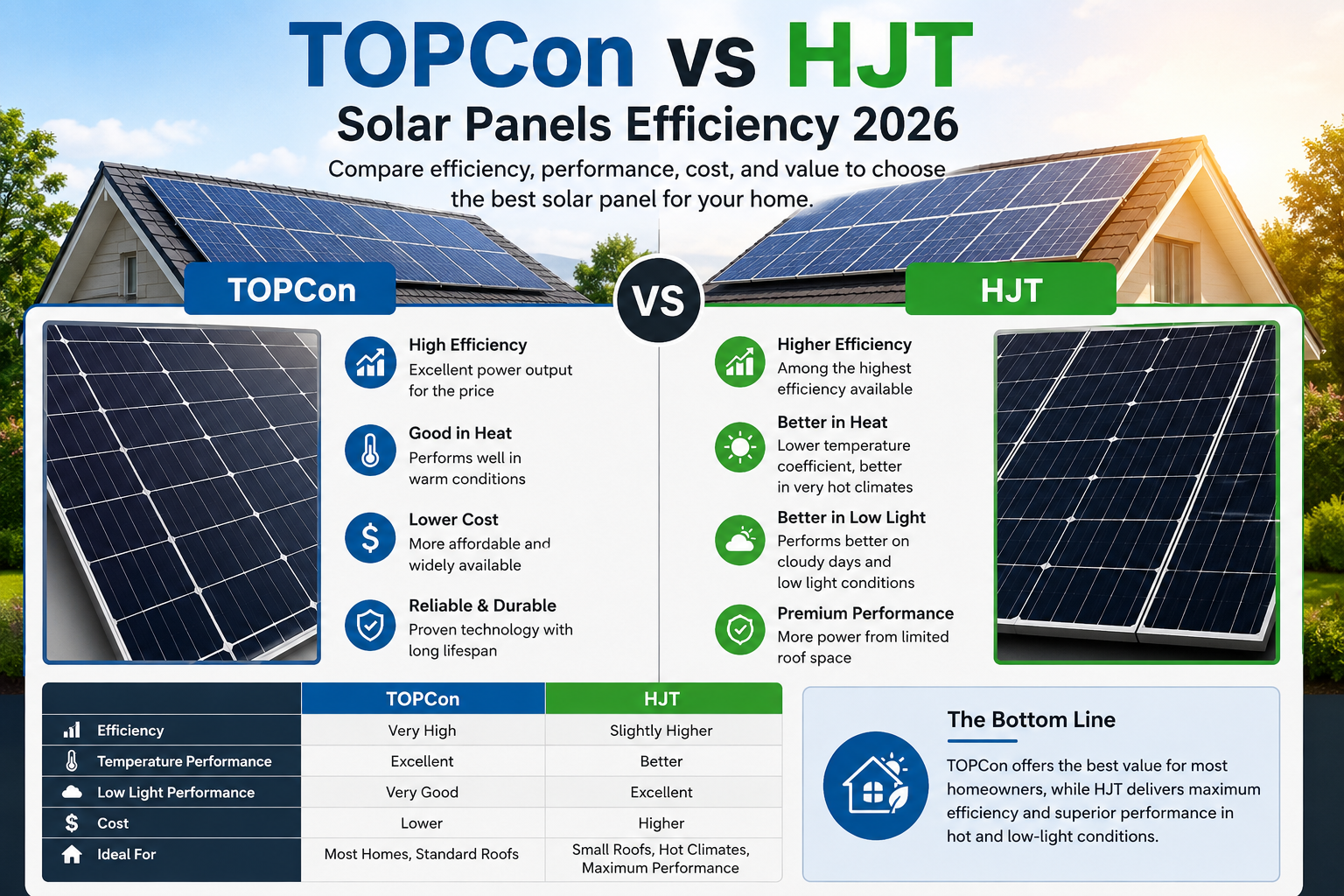
TOPCon vs HJT Solar Panels Efficiency 2026
Recommended External Resources
- MNRE – Ministry of New and Renewable Energy
MNRE Official Website — - PM Surya Ghar – Rooftop Solar Programme
MNRE Grid Connected Rooftop Solar Programme — - MNRE – ALMM Approved Solar Panels
MNRE ALMM – Approved Models & Manufacturers — - Latest ALMM List – August 2026
Updated ALMM List-I – 03 August 2026 — Latest approved solar PV module list. - Bureau of Indian Standards (BIS) – Solar PV Standards
BIS Solar PV Standards —