
Table of Contents
ToggleNEOM Renewable Energy Grid Infrastructure 2026: Future of Clean Energy
Publication date: August 18, 2026
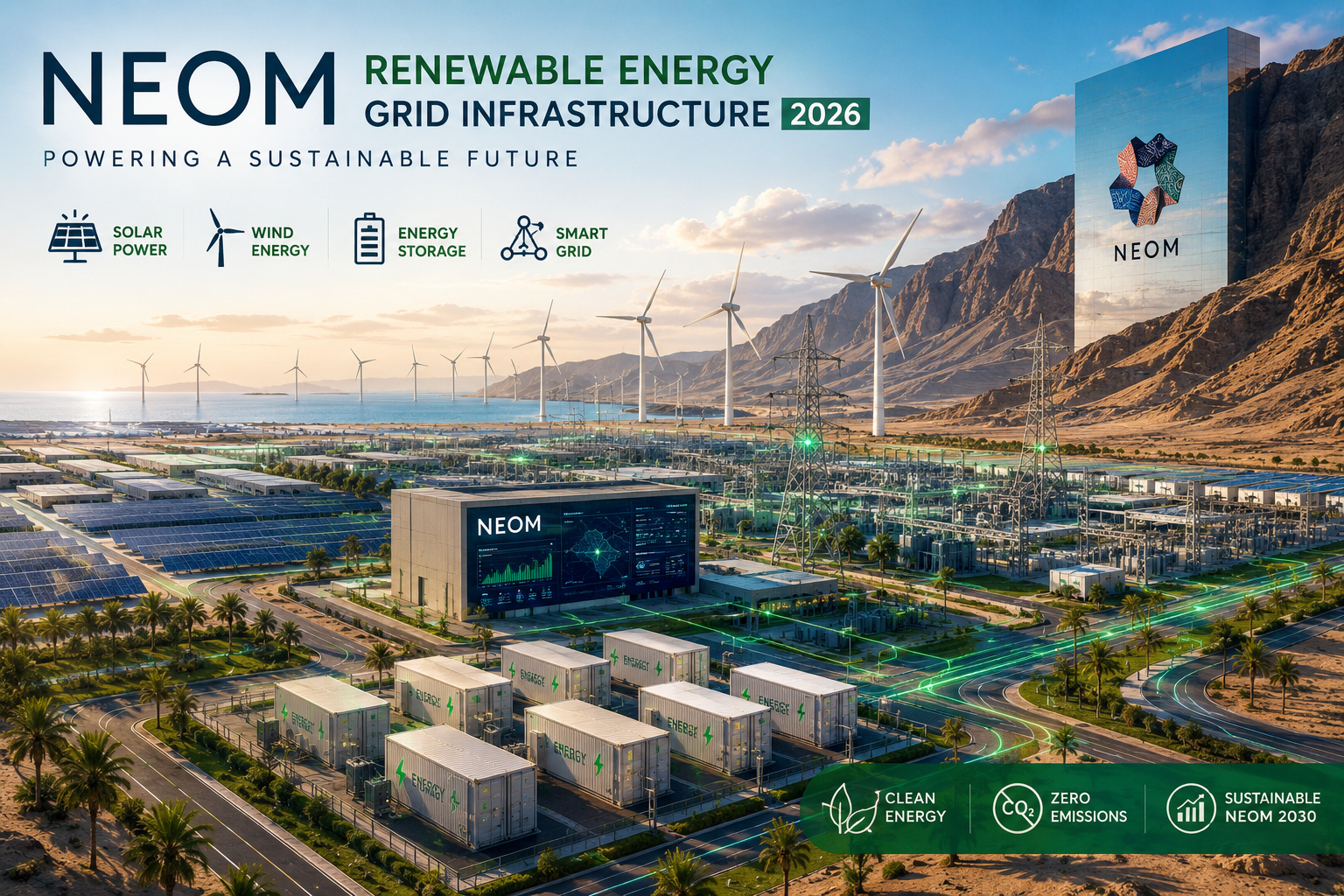
NEOM, a futuristic development in northwestern Saudi Arabia, is being built around an ambitious clean-energy vision. In 2026, its energy infrastructure goes beyond simply generating electricity from solar and wind. The project is also focusing on smart grids, high-voltage transmission, energy storage, digital energy management, and green hydrogen to create a more connected and flexible renewable energy system.
The NEOM renewable energy grid infrastructure 2026 is particularly important because it is designed to connect large-scale renewable generation with the growing energy needs of NEOM’s cities and industries. Solar and wind projects can provide clean electricity, while advanced grid infrastructure and energy storage can help manage fluctuations in renewable power.
This article explores how NEOM renewable energy grid infrastructure 2026 is being developed, the role of solar and wind energy, how smart grid and transmission technologies support the system, and why NEOM could become an important example of large-scale renewable energy infrastructure in Saudi Arabia.
Table of Contents:
- What Is NEOM Renewable Energy Grid Infrastructure 2026?
- What Is NEOM and Where Is It Located?
- Why NEOM Needs Renewable Energy
- How NEOM’s Renewable Energy Grid Works
- Solar and Wind Power in NEOM
- NEOM Smart Grid Infrastructure
- Energy Storage and Battery Systems
- The Role of ENOWA in NEOM’s Energy Network
- NEOM Green Hydrogen and Renewable Energy
- Key Benefits of NEOM’s Renewable Energy Grid
- Challenges of Building NEOM’s Energy Infrastructure
- NEOM Renewable Energy Projects in 2026
- How NEOM Supports Saudi Arabia’s Clean Energy Goals
- Future of NEOM Renewable Energy After 2026
- Frequently Asked Questions
- Conclusion
What Is NEOM Renewable Energy Grid Infrastructure 2026?
NEOM renewable energy grid infrastructure 2026 refers to the network being developed to connect renewable electricity generation with homes, businesses, industries, and large projects across NEOM in northwestern Saudi Arabia. Instead of relying mainly on conventional power generation, NEOM is being designed around a cleaner energy system that can integrate sources such as solar and wind power with advanced transmission and grid technologies.
What makes the NEOM approach interesting is the scale of the project. Renewable electricity needs to be generated, moved across different areas, balanced when supply changes, and delivered reliably to consumers. That requires more than adding new solar or wind capacity. The grid itself needs to be flexible, digitally managed, and capable of handling changing electricity demand.
In practical terms, NEOM renewable energy grid infrastructure 2026 can be viewed as an important link between renewable energy generation and NEOM’s planned urban and industrial development. Technologies such as smart-grid systems, high-voltage transmission, energy storage, and digital monitoring can help make renewable electricity more dependable.
The wider goal is closely connected with Saudi Arabia’s clean-energy ambitions and NEOM’s plan to develop a low-carbon economy. For readers trying to understand the project, the key point is simple: NEOM is not just building renewable energy projects; it is also developing the infrastructure needed to use and distribute that electricity at a very large scale.
What Is NEOM and Where Is It Located?
NEOM is a large-scale development project in northwestern Saudi Arabia, along the Red Sea near the Gulf of Aqaba. The project is part of Saudi Arabia’s wider Vision 2030 strategy and aims to create new urban, industrial, tourism, and technology-focused destinations in the region.
NEOM is not a single city. It is a broader development area made up of several planned projects and regions, including THE LINE, Oxagon, Trojena, and Sindalah. Each has a different purpose, but they are connected by NEOM’s wider focus on technology, sustainability, and new infrastructure.
Its location is particularly important for renewable energy. The region has strong solar resources and suitable conditions for wind power, while its position on the Red Sea also gives it strategic access to regional trade routes. These factors support NEOM’s ambition to develop a large-scale clean-energy system.
For NEOM renewable energy grid infrastructure 2026, the location matters because renewable electricity generated in different parts of the region needs reliable infrastructure to reach developing communities and industrial facilities. This makes transmission networks, smart-grid technologies, energy storage, and efficient electricity management important parts of NEOM’s long-term energy plans.
In simple terms: NEOM is a major development zone in northwestern Saudi Arabia where new cities, industries, tourism destinations, and renewable-energy infrastructure are being planned together rather than developed separately.
Why NEOM Needs Renewable Energy
NEOM is being planned as a large, technology-driven development, so its electricity needs are expected to be very different from those of a typical city. New communities, industries, transport systems, data-driven services, tourism projects, and large infrastructure will all require a reliable supply of power. Meeting that demand sustainably is one of the reasons renewable energy is central to NEOM’s plans.
There is also a practical reason. Saudi Arabia has abundant solar resources, and parts of the NEOM region also have good potential for wind power. Using these resources can help reduce dependence on fossil-fuel-based electricity while supporting the project’s wider clean-energy goals.
But producing renewable electricity is only one part of the challenge. Solar generation changes with daylight and weather, while wind generation naturally varies. NEOM therefore needs an energy system that can generate, store, manage, and distribute electricity efficiently. This is where NEOM renewable energy grid infrastructure 2026 becomes important.
A well-connected grid can help move electricity from renewable generation sites to areas where it is needed. Energy storage can provide additional flexibility when renewable production falls, while smart-grid technologies can help monitor electricity flows and respond to changing demand.
There is another important consideration: scale. NEOM is not being developed as a small standalone renewable-energy project. Its planned cities and industries require infrastructure capable of supporting substantial electricity demand over time. Building the grid alongside renewable generation gives the project an opportunity to design the energy system around cleaner sources from the beginning.
In simple terms: NEOM needs renewable energy because its long-term development requires a large, reliable, and lower-carbon electricity system. Renewable generation, storage, and modern grid infrastructure have to work together—not as separate pieces, but as one connected energy network.
How NEOM’s Renewable Energy Grid Works.
At its core, NEOM renewable energy grid infrastructure 2026 is designed to connect clean electricity generation with the places that will need that power. The idea sounds simple, but operating a large renewable-based energy system requires several parts to work together smoothly.
1. Renewable Energy Generation:
The system starts with renewable power, particularly solar and wind energy. NEOM’s location in northwestern Saudi Arabia gives it strong potential for solar generation, while wind resources can provide another source of clean electricity.
Rather than depending on one energy source, combining different renewable technologies can help create a more balanced supply.
2. High-Voltage Transmission:
Once electricity is generated, it needs to reach cities, industrial facilities, and other developments across the NEOM region. This is where transmission infrastructure becomes important.
High-voltage networks can move large amounts of electricity over longer distances with lower transmission losses. For a development spread across a large geographic area, that connection is essential.
3. Smart Grid Management:
Renewable electricity is not always available at the same level. Solar output changes throughout the day, while wind generation can rise and fall with weather conditions.
A smart grid can monitor electricity production, demand, and network conditions in real time. This helps operators respond when supply or demand changes instead of treating the grid as a fixed system.
4. Energy Storage and Flexibility:
Storage can play an important supporting role. When renewable generation is higher than immediate demand, stored electricity can potentially be used later when production decreases.
This becomes especially useful for solar power. Electricity generated during strong daylight hours may need to support demand at other times.
5. Digital Control and Monitoring:
A modern renewable grid also depends heavily on digital technology. Sensors, monitoring systems, automated controls, and data analysis can help operators understand how electricity is moving through the network.
For a project as ambitious as NEOM, this digital layer matters because the grid will need to respond to changing demand as new communities and industries become operational.
The Simple Picture.
You can think of the system as a chain:
Solar & Wind → Transmission Network → Smart Grid → Storage & Energy Management → Homes, Businesses & Industry
The important point is that NEOM renewable energy grid infrastructure 2026 is not simply about building more renewable power plants. The real challenge is connecting generation, transmission, storage, and digital management into a dependable electricity system.
That integrated approach is what could make NEOM’s renewable-energy model particularly interesting to watch as the project develops.
Solar and Wind Power in NEOM.
Solar and wind power are expected to be important building blocks of NEOM’s clean-energy strategy. The region’s geography gives it a natural advantage for renewable generation, particularly because of its strong solar resources and suitable areas for wind development. For a project being planned at NEOM’s scale, having more than one renewable source can also provide greater flexibility in how electricity is produced.
Solar Power:
Solar energy is a natural fit for northwestern Saudi Arabia. The region receives strong sunlight for much of the year, making large-scale solar generation an important part of NEOM’s renewable-energy plans.
Solar power can produce significant amounts of electricity during daylight hours, when generation is at its strongest. However, output falls in the evening and can also change with weather conditions. This is why solar generation needs to work alongside energy storage and grid management rather than operating on its own.
Wind Power:
Wind energy provides another renewable source for NEOM. Unlike solar power, wind generation does not depend on daylight, which can make it a useful complement to solar generation when local wind conditions are favourable.
The combination is particularly interesting from a grid-planning perspective. Solar production generally peaks during the day, while wind generation can follow a different pattern. Using both sources can therefore help diversify renewable electricity supply.
How Solar and Wind Fit Into NEOM’s Grid.
The real challenge is not simply generating clean electricity. NEOM also needs to move that electricity to where it is required and maintain a reliable supply as demand changes.
This is where NEOM renewable energy grid infrastructure 2026 becomes important. Renewable generation can be connected through transmission networks, while smart-grid technologies, energy storage, and digital monitoring can help manage variations in supply and demand.
A simplified view looks like this:
Solar + Wind → Grid Connection → Transmission → Storage & Grid Management → Energy Users
This integrated approach matters because renewable power works differently from conventional generation. The grid has to adapt to changing weather, generation levels, and electricity demand.
Why the Combination Matters?
For NEOM, combining solar and wind is not just about producing more renewable electricity. It is about building an energy system that can support future cities, industries, transport, and other large developments while keeping carbon emissions lower.
The key takeaway is simple:solar provides a strong daytime renewable resource, wind adds another source of generation, and the grid infrastructure connects both to the wider energy system. Together, these technologies form an important part of NEOM’s broader clean-energy vision.
NEOM Smart Grid Infrastructure.
NEOM’s renewable-energy system needs more than solar panels and wind turbines. It also needs a smart grid that can monitor electricity generation, demand, and power flows in real time.
For NEOM renewable energy grid infrastructure 2026, smart-grid technology can help balance variable renewable power. Solar generation changes with daylight, while wind output depends on weather conditions. Digital monitoring, automated controls, smart meters, and energy-management systems can help the grid respond to these changes more efficiently.
Why the Smart Grid Matters?
A smart grid can help NEOM:
- Monitor renewable electricity in real time
- Balance changing power supply and demand
- Coordinate energy storage with renewable generation
- Improve grid visibility and reliability
- Support growing electricity demand from future cities and industries
In simple terms, the smart grid acts as the digital layer of NEOM’s energy network, helping connect renewable generation, storage, transmission, and electricity users into one coordinated system.

Energy Storage and Battery Systems.
Renewable energy does not always arrive when electricity demand is highest. Solar power, for example, is strongest during daylight hours, while electricity use can remain high after the sun goes down. This makes energy storage and battery systems an important part of a renewable-based power network such as NEOM.
For NEOM renewable energy grid infrastructure 2026, battery storage can help bridge the gap between when renewable electricity is generated and when it is needed. Excess electricity produced during periods of strong solar or wind generation can potentially be stored and used later, helping the grid manage changing supply conditions.
Why Battery Storage Matters for NEOM?
Battery systems can support the renewable grid in several practical ways:
- Store surplus electricity: Extra renewable power can be stored instead of being immediately unused.
- Support evening demand: Stored energy can help when solar generation decreases after sunset.
- Balance the grid: Batteries can respond quickly when electricity supply or demand changes.
- Improve renewable integration: Storage can make it easier to use variable solar and wind generation.
- Provide additional flexibility: Batteries can support grid operations during short periods of changing conditions.
For a large development like NEOM, storage becomes particularly relevant as renewable generation and electricity demand grow together. Future communities, industrial facilities, transport systems, and other infrastructure may have different patterns of electricity use, so the grid needs ways to respond to those changes.
However, batteries are not a replacement for transmission infrastructure or renewable generation. They work as one part of a larger system that includes power generation, transmission, smart-grid controls, and energy management.
In simple terms: battery storage gives NEOM’s renewable energy system more flexibility. Solar and wind generate the power, while batteries can help make that power available at the right time. This connection is an important part of building a more reliable NEOM renewable energy grid infrastructure 2026.
The Role of ENOWA in NEOM’s Energy Network.
ENOWA is the energy and water company within NEOM, and it has a central role in developing the project’s future energy system. Rather than focusing only on electricity generation, ENOWA’s work covers areas such as renewable energy, grid infrastructure, energy storage, and green hydrogen.
For NEOM renewable energy grid infrastructure 2026, ENOWA is particularly important because the electricity network needs to connect renewable generation with the communities and industries being developed across NEOM. That requires careful planning of generation, transmission, distribution, and energy management.
What Does ENOWA Do?
ENOWA’s energy-related activities include several key areas:
- Renewable energy: Supporting the development and integration of clean electricity sources such as solar and wind.
- Grid infrastructure: Developing the electricity network needed to deliver power across NEOM.
- Energy storage: Exploring storage solutions that can help manage variable renewable generation.
- Green hydrogen: Supporting NEOM’s wider clean-energy ecosystem, including renewable-powered hydrogen production.
- Digital energy management: Using advanced technologies to improve how the energy system is monitored and managed.
One of the interesting aspects of ENOWA’s role is that these areas are being developed as parts of a connected energy ecosystem. A solar or wind project is only useful at scale if the electricity can be transported, managed, and delivered reliably to the end user.
This is why ENOWA matters when looking at NEOM renewable energy grid infrastructure 2026. Its role connects the physical infrastructure—such as renewable generation and electricity networks—with the digital and operational systems needed to manage them.
For NEOM, the bigger objective is to build an energy system capable of supporting future cities, industries, and other developments while increasing the use of renewable power.
In short: ENOWA is one of the key organizations shaping how NEOM generates, manages, and delivers energy as the development moves forward.
NEOM Green Hydrogen and Renewable Energy.
Green hydrogen is an important part of NEOM’s wider clean-energy strategy. The basic idea is straightforward: use renewable electricity to produce hydrogen through electrolysis, without relying on fossil fuels as the energy source. This creates a connection between renewable power generation and an energy carrier that can be used in sectors where direct electrification may be difficult.
NEOM’s green hydrogen plans are being developed through the NEOM Green Hydrogen Company (NGHC), a joint venture involving ACWA Power, Air Products, and NEOM. The project is being developed at Oxagon and is designed around renewable electricity generated from solar and wind resources.
How Green Hydrogen Connects With the Grid.
The relationship between hydrogen and NEOM renewable energy grid infrastructure 2026 is worth understanding. Renewable electricity can be used directly by homes, businesses, and industries, but some electricity can also support electrolysis for hydrogen production.
This creates another potential use for renewable generation. When the energy system produces large amounts of renewable electricity, hydrogen production can provide additional demand for that clean power.
The wider system can be viewed simply:
Solar & Wind → Renewable Electricity → Grid + Electrolysis → Green Hydrogen
Green hydrogen can then be used for applications such as industrial processes, transport, and other energy-intensive activities, depending on the project’s future development and market demand.
Why It Matters for NEOM?
Green hydrogen adds another layer to NEOM’s renewable-energy ecosystem. The project is not only looking at how to generate clean electricity but also how that electricity can support industries and energy-intensive activities.
At the same time, hydrogen production requires substantial renewable electricity, so reliable generation and grid infrastructure remain important. This is where NEOM renewable energy grid infrastructure 2026 connects with the broader hydrogen strategy.
In simple terms: renewable energy provides the electricity, the grid helps manage and deliver that power, and electrolysis can turn part of the renewable electricity into green hydrogen for uses beyond conventional power consumption.
Key Benefits of NEOM’s Renewable Energy Grid?
A renewable-energy grid can offer NEOM more than just cleaner electricity. Because the project is being developed on a large scale, its energy network needs to support future communities, industries, transport, and other infrastructure while dealing with the natural ups and downs of solar and wind generation.
For NEOM renewable energy grid infrastructure 2026, some of the main potential benefits include:
1. Greater Use of Renewable Power.
Connecting solar and wind projects through a coordinated grid can make it easier to use locally generated renewable electricity. This supports NEOM’s wider ambition to build a lower-carbon energy system.
2. Better Energy Flexibility.
Renewable generation changes throughout the day and with weather conditions. A modern grid combined with energy storage can help manage these fluctuations and make better use of available clean electricity.
3. Improved Grid Management.
Smart-grid technologies can provide real-time information about electricity generation, demand, and network conditions. This can help operators make faster and more informed decisions when conditions change.
4. Support for Future Development.
NEOM is planned to include residential areas, industrial facilities, tourism destinations, and advanced infrastructure. A flexible energy network can provide the foundation needed as electricity demand grows.
5. Support for Green Hydrogen.
Renewable electricity can also be used for green hydrogen production. This creates another potential use for clean power and connects the electricity network with NEOM’s broader hydrogen ambitions.
6. Lower Dependence on Fossil Fuels.
Greater use of renewable electricity can reduce the need for conventional fossil-fuel-based power generation, supporting Saudi Arabia’s broader clean-energy transition.
Overall, the value of NEOM renewable energy grid infrastructure 2026 is not limited to producing clean electricity. Its bigger advantage is the ability to connect renewable generation, storage, smart-grid technology, and energy-intensive industries into one coordinated system.
For NEOM, that integrated approach could be just as important as the renewable energy projects themselves.
Challenges of Building NEOM’s Energy Infrastructure
Building a renewable-energy network at NEOM’s scale is a major engineering and planning challenge. Generating clean electricity is only the starting point. That electricity also has to be transmitted, stored, balanced, and delivered reliably as new communities and industries come online.
One of the biggest challenges for NEOM renewable energy grid infrastructure 2026 is managing the variable nature of renewable power. Solar generation changes with daylight and weather, while wind output can fluctuate. A dependable system therefore needs sufficient storage, flexible grid management, and accurate forecasting.
Key Challenges
1. Large-Scale Transmission
NEOM covers a vast area, so connecting renewable generation with future cities and industrial facilities requires substantial transmission infrastructure. Building and maintaining those networks can be complex and expensive.
2. Energy Storage
Batteries and other storage technologies can help balance renewable electricity, but large-scale storage requires significant investment, suitable technology, and careful system planning.
3. Growing Electricity Demand
NEOM is being developed in stages. As residential areas, tourism projects, industries, and other facilities become operational, electricity demand will change. The grid needs enough capacity to grow without compromising reliability.
4. Harsh Environmental Conditions
High temperatures, dust, and challenging desert conditions can affect energy infrastructure and increase maintenance requirements. Equipment needs to be designed and operated with the local environment in mind.
5. Grid Coordination
Solar, wind, storage, hydrogen production, transmission networks, and electricity users all need to work together. Managing such a complex system requires strong digital controls and experienced grid operations.
6. Cost and Long-Term Investment
A modern renewable grid involves major upfront investment. The challenge is not only building the infrastructure but also ensuring that it remains economically and technically viable as NEOM develops.
Ultimately, the success of NEOM renewable energy grid infrastructure 2026 will depend on how well these challenges are managed. The ambition is substantial, but so is the complexity of creating a reliable renewable-energy system at this scale.
NEOM Renewable Energy Projects in 2026
By 2026, NEOM’s renewable-energy development is moving beyond the idea of simply building solar and wind capacity. The wider energy system also includes transmission, storage, smart-grid technology, and green hydrogen, making the projects closely connected rather than isolated investments.
One of the most important developments is the NEOM Green Hydrogen Project at Oxagon. It is designed to use renewable electricity from solar and wind resources to produce green hydrogen through electrolysis. The project is being developed by the NEOM Green Hydrogen Company, a joint venture involving NEOM, ACWA Power, and Air Products.
Solar and wind generation are also central to NEOM’s wider energy strategy. These renewable sources need supporting infrastructure to move and manage electricity efficiently across the development area.
This is where NEOM renewable energy grid infrastructure 2026 becomes particularly important. Transmission networks, energy storage, and digital grid management can help connect renewable generation with future communities and industrial facilities.
The interesting part is how these projects fit together. Renewable generation supplies clean power, the grid distributes and manages it, storage provides flexibility, and green hydrogen creates another major use for renewable electricity.
Together, these developments are shaping NEOM’s ambition to build a large-scale, integrated clean-energy ecosystem in northwestern Saudi Arabia.
How NEOM Supports Saudi Arabia’s Clean Energy Goals
NEOM is closely connected with Saudi Arabia’s broader effort to diversify its economy and increase the role of cleaner energy. The project provides a large-scale setting for developing renewable power, modern electricity networks, energy storage, and green hydrogen technologies.
Saudi Arabia has significant solar resources, and renewable energy can help the country reduce its reliance on conventional power generation over time. NEOM’s location in the northwest also provides an opportunity to combine solar and wind resources with new energy infrastructure.
The NEOM renewable energy grid infrastructure 2026 is an important part of this wider picture. A modern grid can help connect renewable generation with growing electricity demand while smart-grid technologies and storage can provide additional flexibility.
NEOM also has ambitions beyond electricity. Its green hydrogen development at Oxagon is designed to use renewable power for hydrogen production, creating another potential pathway for clean energy in industry and transport.
From a broader perspective, NEOM can serve as a real-world testing ground for integrating several clean-energy technologies at scale. Its experience could provide useful lessons about renewable generation, grid management, storage, and hydrogen production.
In that sense, NEOM is not just a development project. It is also part of Saudi Arabia’s longer-term transition toward a more diversified and lower-carbon energy system.
Future of NEOM Renewable Energy After 2026
The development of NEOM’s renewable-energy system is unlikely to stop at 2026. As more parts of the project become operational, electricity demand will change, and the energy network will need to expand alongside new cities, industries, transport systems, and other infrastructure.
The foundation created through NEOM renewable energy grid infrastructure 2026 could support further investment in renewable generation, transmission, energy storage, and smart-grid technologies. Solar and wind power are expected to remain important, while improvements in battery storage and digital energy management could make it easier to handle changing renewable output.
Green hydrogen is another area worth watching. If production expands, it could create additional demand for renewable electricity and strengthen the connection between NEOM’s power network and its industrial ambitions.
There is also a practical side to the story. A large renewable-energy system needs continuous maintenance, upgrades, and careful planning as demand grows. The technologies used today may not be the same ones that dominate a decade from now.
For that reason, the future of NEOM’s energy system will depend not only on how much renewable capacity is built, but on how effectively generation, storage, transmission, digital controls, and energy demand are integrated.
The bigger opportunity is to create an energy network that can evolve with NEOM rather than needing to be rebuilt every time the development expands.
Frequently Asked Questions About NEOM Renewable Energy Grid Infrastructure 2026.
1. What is NEOM renewable energy grid infrastructure 2026?
NEOM renewable energy grid infrastructure 2026 refers to the developing network of renewable power generation, transmission, smart-grid systems, energy storage, and related energy infrastructure supporting NEOM in northwestern Saudi Arabia.
2. What renewable energy sources does NEOM use?
NEOM’s clean-energy plans focus mainly on solar and wind power. These resources can provide renewable electricity for planned communities, industries, and other developments across the region.
3. Why does NEOM need a smart grid?
Solar and wind power can change depending on daylight and weather. A smart grid can monitor electricity generation and demand, helping operators manage these changes and coordinate renewable generation with storage and other grid resources.
4. Does NEOM use battery energy storage?
Energy storage is an important part of NEOM’s renewable-energy strategy. Battery systems can help store surplus renewable electricity and provide additional flexibility when generation or demand changes.
5. What role does ENOWA play in NEOM’s energy system?
ENOWA is NEOM’s energy and water company. It is involved in developing the energy ecosystem, including renewable power, grid infrastructure, storage, and other clean-energy solutions.
6. Is green hydrogen part of NEOM’s renewable-energy plans?
Yes. NEOM is developing a large green hydrogen project at Oxagon through the NEOM Green Hydrogen Company. Renewable electricity from solar and wind is used to support hydrogen production through electrolysis.
7. What are the biggest challenges for NEOM’s renewable grid?
Key challenges include managing variable renewable generation, building large transmission networks, integrating energy storage, handling harsh environmental conditions, and matching infrastructure development with future electricity demand.
8. Why is NEOM important for Saudi Arabia’s clean-energy transition?
NEOM provides a large-scale environment for combining renewable energy, smart grids, storage, and green hydrogen. Its development could provide practical experience in integrating these technologies into a broader clean-energy system.
9. What could happen to NEOM’s renewable energy system after 2026?
After 2026, the system is expected to evolve as NEOM’s cities and industries develop. Future expansion could involve additional renewable generation, grid upgrades, storage capacity, and greater integration of digital energy-management technologies.
10. Is NEOM aiming to run entirely on renewable energy?
NEOM has set an ambitious vision for a clean-energy system based heavily on renewable sources. However, the exact operational mix and how the system performs as different parts of NEOM become active will depend on project development and future energy requirements.
Conclusion:
NEOM’s renewable-energy vision is about much more than building solar farms and wind projects. The bigger challenge is creating an energy network that can generate, move, store, and manage clean electricity reliably as the development grows.
The NEOM renewable energy grid infrastructure 2026 provides an important foundation for this approach. Smart-grid technology, transmission networks, energy storage, and renewable generation all need to work together rather than operate as separate systems. Green hydrogen adds another layer, creating a potential use for renewable electricity beyond the conventional power grid.
What makes NEOM particularly interesting is the scale of its ambition. The project is attempting to develop cities and industries alongside a modern energy system from the ground up. That creates opportunities, but it also brings real engineering, cost, and operational challenges.
Ultimately, NEOM’s success will depend not simply on how much renewable energy it produces, but on how effectively it can turn that energy into a reliable system that supports real people, businesses, and industries over the long term.
5 Renewable Energy Trends to Follow Into 2026
TOPCon vs HJT Solar Panels Efficiency 2026
Recommended External Resources
- NEOM – Energy — NEOM ka renewable energy, smart grid aur energy infrastructure overview.
- ENOWA – Energy & Water — ENOWA ka 100% renewable-energy system aur smart energy network.
- ENOWA – Energy Sectors — Solar, wind, substations, transmission lines aur digital energy platform ki details.
- ENOWA – Investment Timeline — 2026 ke planned 6.5 GW solar aur 1.6 GW wind projects ki information.
- ACWA Power – NEOM Green Hydrogen Project — 4 GW renewable power, solar, wind, storage aur hydrogen infrastructure ki details.
- NEOM – About NEOM — NEOM ki location, sustainability vision aur renewable-energy grid ka background.