

Solar Panels for Home Cost in 2026: USA, UK & Europe Price Guide
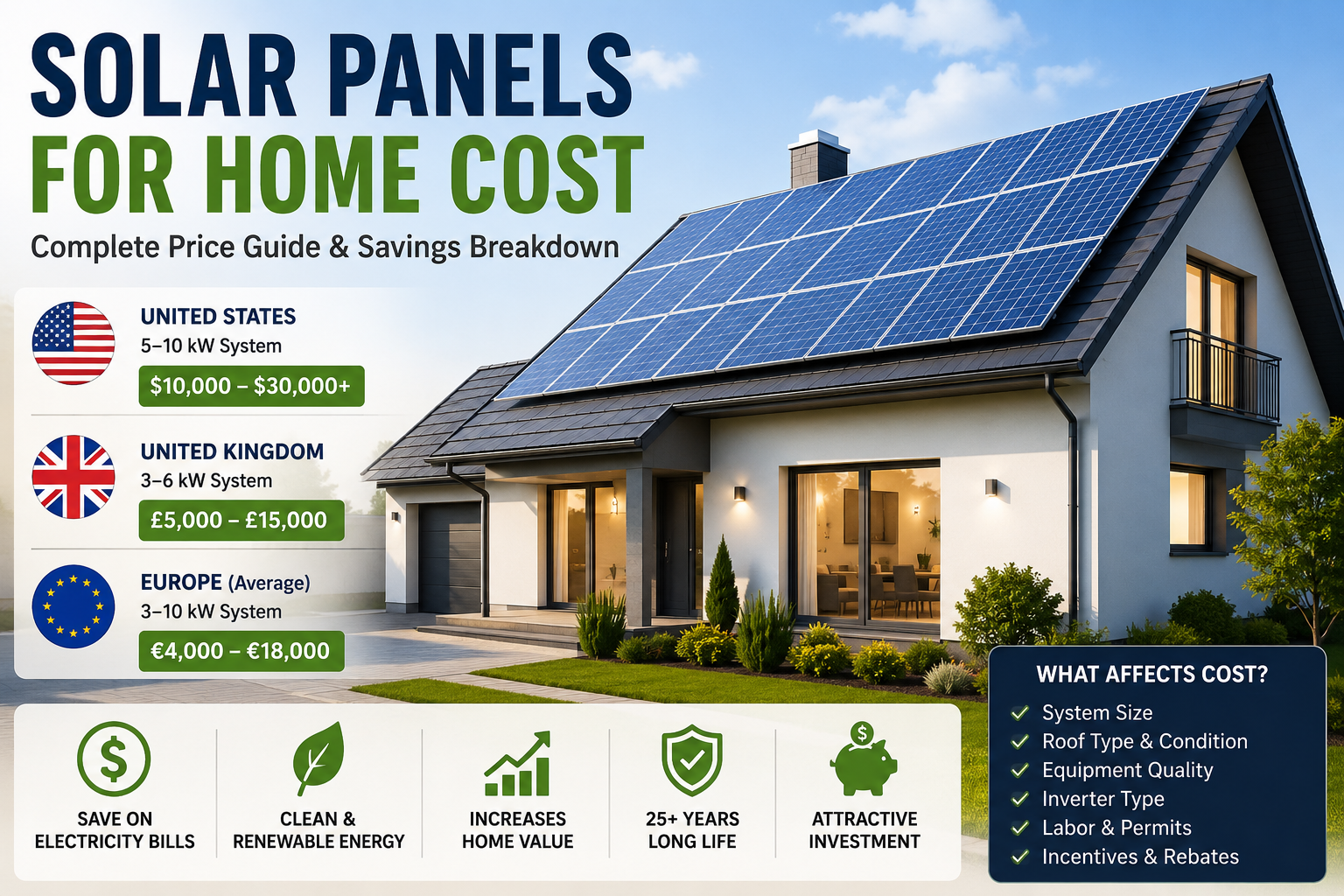
If you are researching solar panels for home cost, the short answer is this: a typical residential solar system in 2026 usually costs about $10,000–$30,000+ in the United States before incentives, £5,000–£15,000 in the United Kingdom, and roughly €4,000–€18,000 across many European countries, depending on system size, roof type, equipment quality, labor rates, and local incentives.
The most important factor is not the panel price alone—it is the total installed cost, often called the solar panel installation cost for home. That includes panels, inverter, mounting hardware, wiring, permits, labor, and grid connection.
Quick Answer: Typical Home Solar Costs (2026)
| Region | Common Home System Size | Typical Installed Cost* |
|---|---|---|
| United States | 5–10 kW | $10,000–$30,000+ |
| United Kingdom | 3–6 kW | £5,000–£15,000 |
| Netherlands | 3–6 kW | €4,000–€10,000 |
| Germany | 5–10 kW | €7,000–€18,000 |
| Other EU countries | 3–10 kW | €4,000–€18,000 |
Typical market ranges for residential systems; actual quotes vary by roof, equipment, installer, and incentives.
For many households, the payback period is often measured in years rather than decades, especially where electricity prices are high and net metering or export payments are available.
The average solar panels for home cost in the United States is usually higher than in many European countries.
In the UK, solar panels for home cost depends largely on system size and roof complexity.
Understanding solar panels for home cost helps homeowners avoid unrealistic low-price offers.
Why Homeowners Search for “Solar Panels for Home Cost”
Most people asking this question want to know:
- How much will a complete home solar system cost?
- What size system do I need?
- What affects the price most?
- Will I save money on electricity bills?
- What incentives are available in my country?
- Is adding a battery worth the extra cost?
This guide answers those questions with a practical, region-by-region breakdown.
What Is Included in the Solar Panel Installation Cost for Home?
When comparing quotes, make sure you are comparing installed systems, not just panel prices.
A complete residential solar installation usually includes:
- Solar panels
- Inverter (string or microinverters)
- Mounting rails and roof attachments
- DC and AC wiring
- Electrical protection devices
- Monitoring system
- Labor
- Permits and inspections
- Grid connection paperwork
A quote that looks unusually cheap may exclude permits, electrical upgrades, or monitoring equipment.
Solar Panels for Home Cost by System Size
System size is measured in kilowatts (kW). Larger systems produce more electricity but cost more upfront.
United States (before incentives):
| System Size | Typical Cost Range |
|---|---|
| 3 kW | $7,000–$12,000 |
| 5 kW | $10,000–$18,000 |
| 7 kW | $14,000–$24,000 |
| 10 kW | $20,000–$35,000+ |
A 5–7 kW system is common for many detached homes.
United Kingdom:
| System Size | Typical Cost Range |
|---|---|
| 3 kW | £5,000–£7,500 |
| 4 kW | £6,000–£9,000 |
| 6 kW | £8,500–£15,000 |
A 4 kW system is one of the most common residential installations in the UK.
Netherlands:
| System Size | Typical Cost Range |
|---|---|
| 3 kW | €4,000–€6,000 |
| 5 kW | €5,500–€8,500 |
| 6 kW | €6,500–€10,000 |
Dutch homes often use relatively compact systems because roof space is limited.
How Much Do Solar Panels Themselves Cost?
Panels are only part of the total budget.
| Panel Type | Typical Relative Price |
|---|---|
| Standard monocrystalline | Lower |
| High-efficiency monocrystalline | Medium |
| Premium high-efficiency panels | Higher |
In many modern residential projects, panels represent roughly one-third to one-half of the total installed cost, with the rest covering inverter, mounting, electrical work, labor, and permitting.
What Affects Solar Panels for Home Cost the Most?
The final solar panels for home cost can vary by thousands of dollars even between homes that look similar. Installers calculate the price based on technical, structural, and local market factors. Understanding these factors helps homeowners estimate solar panels for home cost more accurately and compare installation quotes with confidence.
1. System Size:
System size is usually the biggest factor affecting solar panels for home cost. A larger system needs more panels, mounting hardware, wiring, and installation time, so the total price increases.
- 3 kW system: lower upfront cost, suitable for small homes.
- 5–7 kW system: common for many family homes.
- 10 kW+ system: higher total cost but often lower cost per watt.
Larger systems can reduce the average solar panels for home cost per watt because fixed expenses such as permits and design work are spread across more solar capacity.
2. Roof Type:
Roof material has a direct impact on solar panels for home cost because each roof type requires a different installation method.
- Asphalt shingle roofs: usually the easiest and least expensive to install solar on.
- Tile roofs: often require more labor and careful handling of tiles.
- Metal roofs: can be cost-effective depending on the attachment method.
- Flat roofs: may need tilted mounting frames or ballast systems, which add material and engineering costs.
Complex roof shapes with dormers, skylights, or multiple roof sections can also increase solar panels for home cost.
3. Roof Condition:
Roof condition is another important factor in solar panels for home cost. If the roof is near the end of its life, replacing it before solar installation is usually cheaper than removing and reinstalling the panels later. Many installers recommend addressing major roof repairs before proceeding with a solar project.
4. Roof Orientation and Shading:
Orientation and shading affect system performance and can influence solar panels for home cost through equipment selection.
- South-facing roofs in the northern hemisphere usually produce the most electricity.
- East- and west-facing roofs may need additional panel capacity.
- Trees, chimneys, and nearby buildings can create shading.
Shaded roofs often benefit from microinverters or power optimizers, which can increase upfront solar panels for home cost but improve energy production.
5. Inverter Choice:
The inverter converts solar electricity into usable household electricity, and the choice affects overall solar panels for home cost.
String Inverter:
- Lower upfront cost
- Simpler design
- Best for roofs with little shading
Microinverters:
- Higher upfront cost
- Panel-level monitoring
- Better performance on shaded roofs
- Easier future expansion
Many homeowners choose microinverters when maximizing production is more important than minimizing solar panels for home cost.
6. Equipment Quality:
Higher-efficiency panels and premium brands usually increase solar panels for home cost, but they may offer:
- Better efficiency,
- Longer warranties,
- Better low-light performance,
- Slower long-term degradation.
A low price is not always the best value if equipment quality is significantly lower.
7. Local Labor Costs:
Labor is a major component of solar panels for home cost. Installation labor is often much more expensive in high-cost U.S. states and some Western European countries than in other regions. Local wage levels, licensing requirements, and installer demand all influence the final price.
8. Permits and Grid Connection:
Administrative expenses can noticeably affect solar panels for home cost. These may include building permits, electrical permits, utility interconnection applications, inspections, and meter upgrades. Permit and utility fees vary widely between cities and countries.
9. Electrical Upgrades:
Older homes sometimes require electrical upgrades before solar can be installed safely. A new electrical panel, additional breakers, grounding improvements, or wiring upgrades can add several hundred to several thousand dollars to solar panels for home cost.
10. Battery Storage:
Adding a home battery is one of the largest optional increases in solar panels for home cost. Battery systems require extra equipment, safety components, and installation labor. Batteries are usually purchased for backup power or higher self-consumption rather than for increasing solar production.
11. Site Access and Scaffolding
Difficult roof access can increase solar panels for home cost. Multi-story homes, steep roofs, narrow access routes, or the need for extensive scaffolding often require additional labor and equipment.
Quick Summary:
The factors that usually have the greatest impact on solar panels for home cost are:
| Factor | Impact on Solar Panels for Home Cost |
|---|---|
| System size | Very High |
| Roof type and complexity | High |
| Battery storage | High |
| Local labor costs | High |
| Inverter choice | Medium–High |
| Roof condition | Medium |
| Permits and grid connection | Medium |
| Electrical upgrades | Medium |
| Equipment quality | Medium |
| Site access and scaffolding | Low–Medium |
When comparing installer quotes, focus on the total installed price, expected annual production, warranty coverage, and included equipment rather than choosing the lowest headline price. A slightly higher solar panels for home cost can sometimes deliver better long-term savings if the system produces more electricity and includes stronger warranties.
Solar Panels for Home Cost With Battery Storage
A battery stores excess solar energy for evening use or backup power.
| Region | Typical Additional Battery Cost |
|---|---|
| United States | $5,000–$15,000+ |
| United Kingdom | £2,500–£10,000+ |
| Europe | €3,000–€12,000+ |
Batteries usually improve self-consumption rather than solar production. Whether they are financially attractive depends on electricity prices, export compensation, and backup-power needs.
Adding battery storage can significantly increase solar panels for home cost.
Example: Estimated Total Cost.
Example Home in the United States:
- Annual electricity use: 8,000–10,000 kWh
- Recommended system: ~6 kW
- Installed cost: ~$12,000–$20,000 before incentives
- With battery: ~$18,000–$35,000+
Example Home in the UK:
- Annual electricity use: 3,500–4,500 kWh
- Recommended system: ~4 kW
- Installed cost: ~£6,000–£9,000
- With battery: ~£9,000–£17,000+
Example Home in the Netherlands:
- Annual electricity use: 3,000–5,000 kWh
- Recommended system: ~4–5 kW
- Installed cost: ~€5,000–€8,500
- With battery: ~€8,000–€16,000+
These are illustrative planning examples, not fixed market prices.
Cost Per Watt: A Better Way to Compare Quotes?
Installers often quote a price per watt.
Formula:
Total installed price ÷ system size (watts) = cost per watt
Example:
- System price: $15,000
- System size: 6,000 W
- Cost per watt = $2.50/W
Comparing cost per watt helps identify unusually expensive or unusually cheap proposals.
Are Solar Panels Cheaper in Europe Than in the USA?
In many cases, yes—especially in countries with mature solar markets and streamlined permitting. However, the comparison is not always straightforward because:
- VAT rules differ
- Incentives differ
- Labor costs differ
- Equipment specifications differ
- Grid connection requirements differ
The Netherlands and Germany often have competitive residential solar pricing relative to many U.S. markets.
What Incentives Can Reduce Solar Panel Installation Cost for Home?
Government incentives, tax benefits, export payments, and financing programs can significantly reduce the solar panel installation cost for home. The exact savings depend on your country, state, region, utility company, and the year you install the system. Because energy policies change regularly, homeowners should always verify current rules before signing a contract.
A useful way to think about incentives is that they can reduce cost in three different ways:
- Lower the upfront installation price
- Reduce taxes owed
- Provide ongoing payments for exported electricity
United States:
The United States offers one of the most widely used residential solar tax incentives. Eligible homeowners may claim a federal residential clean energy tax credit on qualifying solar installation expenses, which can substantially reduce the effective solar panel installation cost for home.
Additional support may be available through:
- State tax credits
- Property tax exemptions
- Sales tax exemptions
- Utility rebates
- Net metering programs
- Performance-based incentives
The value of these programs varies significantly by state. Some states provide substantial additional savings, while others offer little or no extra support.
Example: If a homeowner installs a qualifying solar system and receives a federal tax credit, the effective out-of-pocket cost may be lower than the original contract price. The actual savings depend on eligibility, tax situation, and current federal rules.
Check before buying: U.S. Department of Energy, IRS, state energy office, and local utility websites.
United Kingdom:
The UK no longer offers a nationwide residential solar installation grant for most homeowners, but solar can still reduce household energy costs through export payments.
Under approved export arrangements, homeowners may receive payments for surplus electricity sent to the grid. The value depends on:
- The energy supplier
- The export tariff offered
- The amount of electricity exported
- Metering arrangements
UK homeowners may also benefit from lower electricity bills by using more of their solar energy during the day.
When evaluating solar panel installation cost for home in the UK, compare both:
- Estimated bill savings
- Estimated export income
Together, these determine the overall financial return.
Netherlands:
The Netherlands has historically been one of Europe’s strongest residential solar markets. Incentives and tax rules have changed over time, so current national guidance should always be checked.
Potential financial benefits may include:
- Favorable VAT treatment for certain residential solar installations
- Compensation for exported electricity
- Savings from offsetting household electricity consumption
Future policy changes related to export compensation can affect long-term savings, so Dutch homeowners should review the latest government and utility information when calculating solar panel installation cost for home and expected payback.
Germany:
Germany has a mature residential solar market with established support mechanisms. Homeowners may benefit from:
- Feed-in tariffs or export payments
- Favorable financing options
- Regional or municipal energy programs
- Support for battery storage in some areas
German incentives are designed primarily to encourage renewable electricity generation rather than simply reducing upfront installation cost.
Other European Union Countries:
Many EU countries offer some combination of:
- Investment grants
- Tax deductions
- Feed-in tariffs
- Export payments
- Low-interest energy-efficiency loans
- Regional renewable energy programs
Because each country has its own energy policy, the same solar system may have a very different financial outcome in Spain, Italy, France, Belgium, or another EU member state.
How Incentives Affect Real Solar Costs?
The table below shows how incentives can change the effective homeowner cost.
| Item | Example Before Incentive | Example After Incentive |
|---|---|---|
| Installed system price | $18,000 | $18,000 |
| Federal/state incentive | — | -$4,000 |
| Net homeowner cost | $18,000 | $14,000 |
Illustrative example only; not a guaranteed savings amount.
The key point is that incentives usually reduce the effective cost paid by the homeowner, not necessarily the installer’s contract price.
Net Metering and Export Payments:
Many homeowners focus only on installation incentives, but export compensation can be equally important.
- Net metering: exported electricity offsets electricity imported from the grid.
- Export payment: exported electricity is paid at a specified rate.
Higher export compensation can improve payback and reduce the long-term effective solar panel installation cost for home.
Battery Incentives:
Some regions offer additional support for battery storage. These programs may reduce the cost of adding a battery, but eligibility rules are often stricter than for solar panels alone.
Check whether incentives apply to:
- Solar-only systems
- Solar-plus-storage systems
- Backup power systems
- New construction projects
Important Questions to Ask Installers:
Before accepting a quote, ask:
- Which incentives are included in this estimate?
- Are the incentives guaranteed or estimated?
- Who applies for the incentive—the installer or the homeowner?
- What documents are required?
- When will the incentive be received?
- What happens if the policy changes before installation is completed?
Common Mistakes to Avoid:
- Assuming all incentives are automatic.
- Comparing quotes that include different incentives.
- Ignoring export income assumptions.
- Using outdated tax-credit percentages.
- Forgetting to check local utility rules.
Key Takeaway:
Incentives can substantially reduce solar panel installation cost for home, but the savings vary widely by country and region. Homeowners in the USA should review federal, state, and utility programs; those in the UK should compare export tariffs; and buyers in the Netherlands, Germany, and other EU countries should check current national and regional solar policies before making a purchase decision.
Always confirm current incentive rules before signing a contract.
How Long Does It Take for Solar Panels to Pay for Themselves?
Payback depends on:
- Installed cost
- Electricity price
- Solar production
- Self-consumption rate
- Export payment rate
- Financing costs
General estimate:
| Region | Common Payback Range |
|---|---|
| United States | ~6–15 years |
| United Kingdom | ~8–15 years |
| Netherlands | ~5–12 years |
| Germany | ~7–15 years |
These are broad estimates, not guarantees.
How Much Can Solar Reduce Electricity Bills?
A properly sized system may offset a significant portion of annual electricity consumption, but most grid-connected homes still purchase some electricity from the grid at night, during winter, or during extended cloudy periods.
The highest savings usually occur when:
- daytime electricity use is high,
- electricity prices are high,
- and exported electricity receives reasonable compensation.
What Size Solar System Do You Need?
A simple starting point is annual electricity use.
| Annual Use | Approximate System Size |
|---|---|
| 3,000 kWh | 2.5–3.5 kW |
| 5,000 kWh | 4–6 kW |
| 8,000 kWh | 6–9 kW |
| 12,000 kWh | 9–13 kW |
Actual sizing should account for roof orientation, shading, climate, and future electric vehicle or heat-pump plans.
Hidden Costs Many Buyers Miss:
Ask installers whether the quote includes:
- Main electrical panel upgrades
- Roof repairs
- Scaffolding
- Monitoring subscription fees
- Bird protection or critter guards
- Permit fees
- Utility interconnection fees
- Extended warranties
A transparent quote should clearly list all included and excluded items.
Solar Panels for Home Cost: New Build vs Existing Home
The solar panels for home cost can be different for a newly constructed house and an existing home. In many cases, installing solar during construction is simpler and may reduce labor and electrical work. Existing homes can still be excellent candidates for solar, but additional upgrades may increase the overall project cost.
New Build Home.
Installing solar panels during construction is often easier because the roof, electrical system, and utility connections are planned from the beginning.
Why New Builds Can Be More Cost-Effective:
- Electrical wiring can be designed specifically for solar.
- Roof mounting locations can be planned in advance.
- Scaffolding and site access are often already available.
- The electrical panel is usually new and properly sized.
- Utility approvals can be coordinated with the construction schedule.
These factors can help reduce labor time and keep the solar panels for home cost lower than a similar retrofit installation.
Additional Advantages:
- Better roof orientation can be selected during design.
- Future battery storage can be planned in advance.
- Electric vehicle charging and heat-pump integration can be included from the start.
- Monitoring equipment can be installed neatly within the home’s electrical layout.
For homeowners building a new house, asking for a solar-ready design can make future expansion easier and more affordable.
Existing Home.
Adding solar panels to an existing home is usually more complex, and this can increase the total installation cost.
Common Additional Costs:
- Running new electrical conduit through finished walls or ceilings.
- Upgrading an older electrical panel.
- Reinforcing roof sections if needed.
- Repairing roof materials around mounting points.
- Removing existing rooftop equipment.
- Installing additional safety devices to meet current electrical codes.
Older homes may require more inspection and preparation work before solar installation can begin.
Roof Age Matters:
A key question for any existing home is how old the roof is. If the roof is expected to need replacement within the next few years, many installers recommend replacing it before installing solar panels. Removing and reinstalling a solar system later can add significant labor costs.
Typical Cost Comparison.
| Home Type | Installation Complexity | Relative Cost |
|---|---|---|
| New build | Low | Lower |
| Existing home with modern electrical system | Medium | Moderate |
| Existing home with old roof and electrical upgrades | High | Higher |
This comparison shows relative differences only; actual costs vary by country, roof type, and installer.
Energy Planning Difference:
A new build allows homeowners to size the solar system for future energy needs such as:
- Electric vehicles,
- Heat pumps,
- Home batteries,
- Induction cooking,
- Smart home energy systems.
In an existing home, the system is often designed around current electricity use, which may limit future expansion unless extra roof space and electrical capacity are available.
Which Option Offers Better Long-Term Value?
- New build: usually lower upfront installation cost and easier future expansion.
- Existing home: can still provide excellent savings when the roof is in good condition and electrical upgrades are minimal.
The best financial outcome depends on electricity prices, solar production, and how much of the solar energy is used within the home.
Key Takeaway:
If you are building a new house, installing solar during construction is often the most efficient and cost-effective approach. If you own an existing home, check the roof condition and electrical panel first, as these are two of the biggest factors that can increase the overall solar panels for home cost.
How Roof Orientation Affects Value
Roof orientation has a major impact on how much electricity a solar system produces over its lifetime. While orientation does not usually change equipment prices directly, it affects energy generation, annual savings, and the overall value of the investment. A roof that receives more sunlight can generate more electricity from the same number of panels, which improves the long-term return on the solar panels for home cost.
Best Orientation in the Northern Hemisphere
For homes in the USA, UK, Netherlands, Germany, and most of Europe, a south-facing roof generally receives the most sunlight throughout the year and often delivers the highest annual energy production.
Typical Value Ranking
| Roof Orientation | Expected Annual Production | Relative Value |
|---|---|---|
| South | Highest | Excellent |
| Southwest / Southeast | Very High | Very Good |
| West / East | Moderate to High | Good |
| Northeast / Northwest | Lower | Fair |
| North | Lowest | Lowest |
These are general trends; actual performance depends on roof angle, local climate, and shading.
South-Facing Roofs:
South-facing roofs usually offer the strongest financial return because they receive sunlight for the longest period during the day. Homeowners often need fewer panels to achieve a target energy output, which can improve savings relative to the solar panels for home cost.
East-Facing Roofs:
East-facing systems produce more electricity in the morning. They can work well for households that use more electricity early in the day, such as homes with morning appliance use or home offices.
West-Facing Roofs:
West-facing systems generate more electricity in the afternoon and early evening. This can be valuable in regions where electricity prices are higher later in the day because more solar energy is available when household demand is often highest.
North-Facing Roofs:
North-facing roofs in the northern hemisphere usually receive the least direct sunlight. Solar may still be possible, but production is typically lower and the payback period may be longer.
Roof Tilt Also Matters:
Orientation works together with roof angle.
- 20°–40° tilt: often performs well in many temperate climates.
- Very shallow roofs: may produce less winter energy.
- Very steep roofs: may reduce summer production.
Installers usually model local sunlight conditions to estimate annual output.
The Hidden Cost of Poor Orientation.
A less favorable orientation may require additional panel capacity to achieve the same annual electricity production. More panels can increase total system price even if the roof itself is suitable for solar.
Shading Can Matter More Than Orientation.
A slightly east- or west-facing roof with little shading may outperform a south-facing roof that is heavily shaded by trees, chimneys, or nearby buildings. Installers often perform a shading analysis before finalizing system design.
Example:
Suppose two homes install similar solar systems:
- Home A: South-facing roof with minimal shading.
- Home B: East-facing roof with partial afternoon shading.
Home A will usually produce more electricity each year, leading to higher bill savings and a stronger return on the initial investment.
When Orientation Still Provides Good Value:
Solar can remain financially attractive on east- and west-facing roofs when:
- Electricity prices are high,
- Most solar energy is used within the home,
- Roof space is adequate,
- Shading is limited,
- And installation costs are reasonable.
Many successful residential solar projects in Europe are installed on east-west roof layouts.
Questions to Ask Your Installer?
- What is my roof orientation?
- What annual production is expected?
- How much shading affects the roof?
- Would a different panel layout improve performance?
- What is the estimated payback period for this orientation?
Key Takeaway:
Roof orientation influences energy production more than installation price. In the northern hemisphere, south-facing roofs usually provide the highest value, while east- and west-facing roofs can still deliver strong savings when shading is limited. Understanding roof orientation helps homeowners evaluate the true long-term value of their solar panels for home cost rather than focusing only on the upfront price.
Questions to Ask Before Signing a Contract?
- What is the total installed price?
- What system size (kW) is being proposed?
- What annual production is estimated?
- What assumptions were used for shading?
- Which panels and inverter are included?
- What warranties are provided?
- Who handles permits and utility paperwork?
- What happens if roof repairs are needed?
- Is monitoring included for the life of the system?
- What incentives were assumed in the quote?
USA vs UK vs Netherlands: Practical Comparison.
| Factor | USA | UK | Netherlands |
|---|---|---|---|
| Typical home system | 5–10 kW | 3–6 kW | 3–6 kW |
| Upfront cost | Highest | Medium | Often lower |
| Roof space | Often larger | Moderate | Often smaller |
| Electricity prices | Varies by state | Relatively high | Relatively high |
| Financial attractiveness | Good in many states | Good for many homes | Often strong |
The best value is not necessarily the cheapest installation; it is the system that produces the most useful electricity at the lowest lifetime cost.
Future Cost Trends (2026 and Beyond).
Solar Panels for Home Cost Long-term solar costs have generally declined over the past decades, but short-term prices can rise or fall due to:
- trade policies,
- supply-chain conditions,
- currency movements,
- labor shortages,
- and changes in incentive programs.
For homeowners deciding in 2026, waiting for lower prices is not always beneficial if electricity prices remain high, because delayed savings can offset future equipment price reductions.
Frequently Asked Questions.
1.What is the average solar panels for home cost in 2026?
A typical residential system often falls around $10,000–$30,000+ in the USA, £5,000–£15,000 in the UK, and €4,000–€18,000 in Europe, depending on size and location.
2.What is included in solar panel installation cost for home?
Panels, inverter, mounting hardware, wiring, labor, permits, inspections, monitoring, and grid connection are usually included.
3.How much does a 5 kW solar system cost?
Roughly $10,000–$18,000 in the USA, £6,000–£9,000 in the UK, and €5,500–€8,500 in the Netherlands before incentives.
4.Is a battery worth adding?
It can be worthwhile where electricity prices are high, export payments are low, or backup power is important, but it increases upfront cost substantially.
5.How long do solar panels last?
Many residential panels carry performance warranties of 20–25 years and often continue producing electricity beyond that period.
6.Can solar eliminate my electricity bill completely?
Some homes can achieve near-net-zero annual consumption, but most grid-connected homes still have some utility charges and occasional electricity purchases.
7.Do solar panels increase home value?
Research in some markets suggests solar may increase home value, but the effect varies by country, local market conditions, system ownership, and buyer preferences.
8.Should I get multiple quotes?
Yes. Obtaining at least three detailed quotes is one of the best ways to compare price, equipment quality, warranty coverage, and production estimates.
Final Verdict:
For most homeowners, the key question is not simply “How much do solar panels cost?” but “How much useful electricity will they produce over 25 years?”
- In the United States, expect roughly $10,000–$30,000+ for a typical residential installation before incentives.
- In the United Kingdom, expect about £5,000–£15,000.
- In the Netherlands and much of Europe, expect roughly €4,000–€18,000 depending on system size and local conditions.
The smartest buying strategy is to compare cost per watt, expected annual production, warranty coverage, and total lifetime savings, not just the headline price. A slightly more expensive system that produces more energy and carries stronger warranties can often deliver better long-term value than the cheapest quote available.
About the Author:
I am not a professional expert in sustainable technology, renewable energy, climate science, or environmental policy. I regularly read information from trusted public sources such as government websites, research organizations, educational institutions, newspapers, technical reports, and other publicly available resources. The purpose of these articles is to collect practical information in simple language and present it in a way that helps readers understand sustainability-related topics more easily and make informed decisions in everyday life.
Publication & Update Note
This article is written for Solar Panels for Home Cost 2026 homeowners in the USA, UK, Netherlands, and Europe. Solar pricing, incentives, VAT rules, export tariffs, and tax credits change regularly. Always verify current local policies and obtain written installer quotes before making a purchase decision.
Further Reading: For official guidance on solar incentives, system sizing, and energy savings, visit the U.S. Department of Energy, NREL, Ofgem, the European Commission, and the IEA using the links above.
Which Home Battery is Best in 2026?

best solar panels for home 2026
Recommended External Sources (Solar Panels for Home Cost)
- U.S. Department of Energy (DOE)
- National Renewable Energy Laboratory (NREL)
- ENERGY STAR
- UK government energy guidance
- Ofgem
- European Commission energy pages
- International Renewable Energy Agency (IRENA)