
Types of Renewable Energy: A Complete Guide to Clean Energy Sources
Renewable energy has moved from being a niche topic to an important part of the global energy system. Homes are adding solar panels, countries are building wind farms, utilities are expanding hydropower and battery storage, and businesses are looking for cleaner ways to produce and use electricity.
But what exactly are the types of renewable energy, and how are they different?
In simple terms, renewable energy comes from natural resources that are replenished over time. The main sources include sunlight, wind, moving water, heat from the Earth, and organic materials. Unlike coal, oil, and natural gas, renewable resources are not depleted in the same way when they are used.
Today, renewable energy includes much more than solar panels and wind turbines. Different technologies work better in different climates and locations, and each has its own advantages, limitations, costs, and environmental considerations.
This guide explains the major types of renewable energy, how they work, where they are used, their benefits and challenges, and what their role could look like in the coming years.
Quick Answer
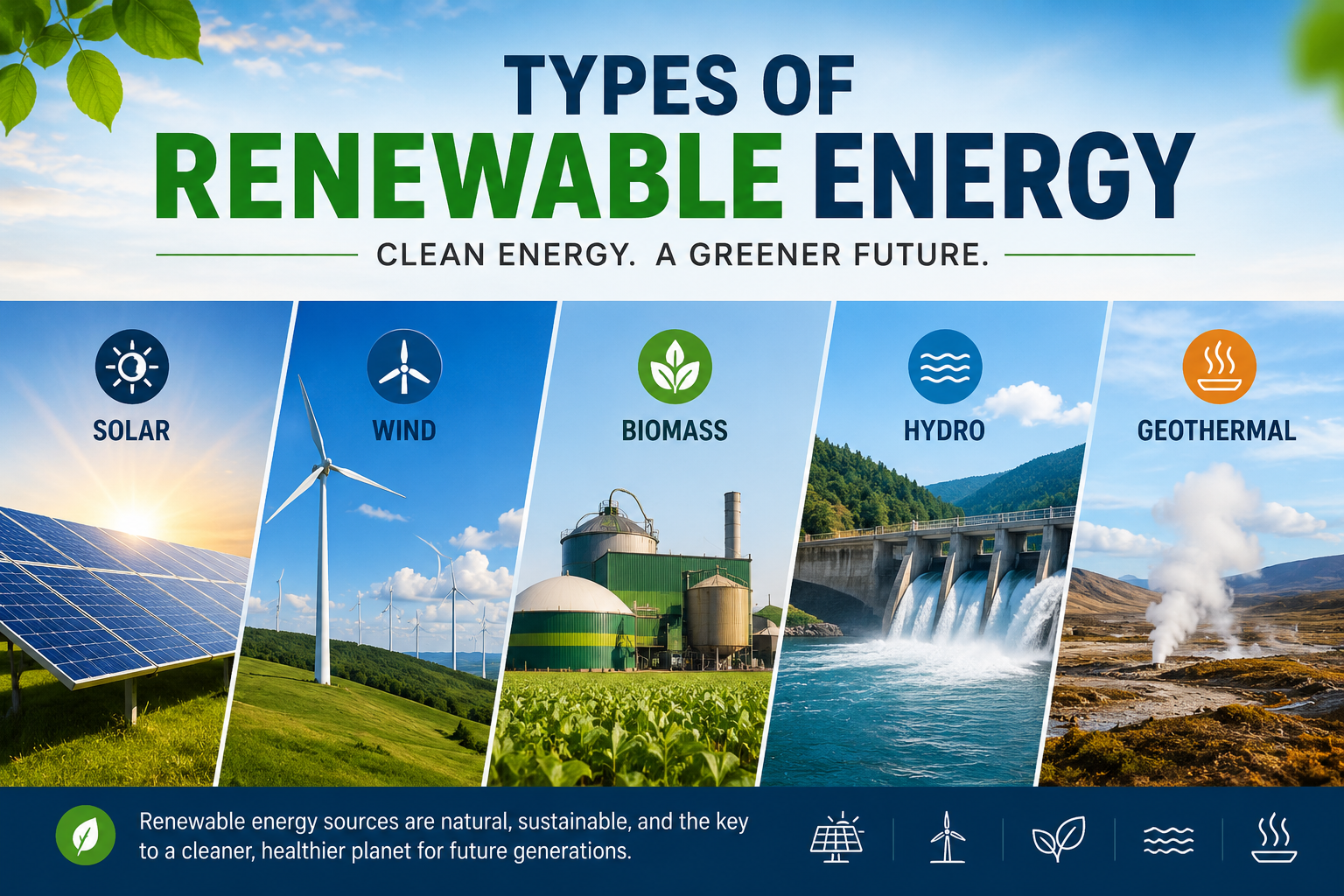
The main types of renewable energy are:
- Solar energy
- Wind energy
- Hydropower
- Geothermal energy
- Biomass energy
- Tidal and wave energy
Solar and wind are currently driving much of the growth in new renewable electricity capacity. Hydropower remains an important source of renewable electricity, while geothermal, biomass, and marine energy have more specific uses and resource requirements.
The International Energy Agency reported that renewable electricity generation accounted for 34% of global electricity generation in 2025. Solar PV and wind together accounted for 17%.
Table of Contents
- What Is Renewable Energy?
- Renewable Energy vs. Clean Energy
- Why Is Renewable Energy Important?
- Types of Renewable Energy
- How Does Renewable Energy Work?
- Renewable Energy vs. Fossil Fuels
- Comparison of Renewable Energy Sources
- Advantages of Renewable Energy
- Challenges and Limitations
- Which Renewable Energy Source Is Most Efficient?
- Which Renewable Energy Is Best for Homes?
- Renewable Energy and Climate Change
- Renewable Energy and Energy Storage
- Renewable Energy in India
- Renewable Energy in the USA
- Renewable Energy in the UK and Europe
- Future Trends in Renewable Energy
- How to Choose Renewable Energy for Your Home
- Frequently Asked Questions
- Conclusion
What Is Renewable Energy?
Renewable energy is energy produced from natural resources that are continuously replenished. Sunlight arrives every day, wind is created by differences in atmospheric pressure and temperature, rivers and rainfall support hydropower, and heat remains stored beneath the Earth’s surface. Organic materials can also be replenished when they are produced and managed sustainably.
These resources can be converted into electricity, heat, or fuels. The main types of renewable energy include solar, wind, hydropower, geothermal, biomass, and marine energy such as tidal and wave power. Each source uses a different natural process and has its own advantages, limitations, and practical applications.
For example, solar panels convert sunlight into electricity. Wind turbines convert the movement of air into electricity. A hydroelectric plant uses moving water to turn turbines, while geothermal systems can use underground heat for electricity or heating.
The important point is that “renewable” describes the source of the energy. It does not automatically mean that every project has zero environmental impact.
A large hydropower project, for example, can affect rivers and ecosystems. Biomass can have different environmental impacts depending on what material is used and how it is produced. Solar and wind projects also require land, materials, manufacturing, transport, and infrastructure.
That is why evaluating the different types of renewable energy requires looking at the entire system rather than simply labeling a technology as “green.” The environmental impact, resource availability, energy output, and local conditions all matter when deciding which renewable energy source is most suitable.
Renewable Energy vs. Clean Energy
The terms renewable energy and clean energy are often used as if they mean exactly the same thing, but they are slightly different.
Renewable energy refers to energy from naturally replenished resources.
Clean energy is a broader term generally used for energy sources and technologies that produce little or no greenhouse gas emissions during operation.
Solar, wind, hydropower, and geothermal energy can be described as both renewable and low-emission energy sources.
Nuclear energy is different. It produces very low operational carbon emissions, but it is not generally classified as renewable because it relies on finite uranium resources.
Biomass also needs more careful consideration. It is renewable when its biological resources are replenished sustainably, but its environmental performance depends on the source material, land use, transportation, processing, and how the fuel is converted into energy.
Understanding this distinction helps avoid a common mistake: assuming that every source described as “clean” is renewable or that every renewable project has the same environmental impact.
Why Is Renewable Energy Important?
The growing interest in renewable energy is linked to several environmental, economic, and energy-security goals.
Reducing dependence on fossil fuels:
Coal, oil, and natural gas remain major sources of energy, but they are finite resources. Burning them also produces greenhouse gases and air pollutants.
Renewable sources can replace some fossil fuel use, particularly in electricity generation and increasingly in heating and transport.
Improving energy security:
Countries that depend heavily on imported fossil fuels can use domestic renewable resources to diversify their energy supply.
Sunlight, wind, water, geothermal heat, and organic resources are available in different combinations across almost every region.
Supporting cleaner electricity:
Electricity generation is one of the major areas where renewable technologies can reduce dependence on fossil fuels.
The IEA reported that global renewable electricity generation reached 34% of total electricity generation in 2025.
Creating economic opportunities:
Renewable energy supports jobs and businesses in areas such as manufacturing, engineering, construction, installation, maintenance, grid development, and energy services.
Costs have also become an important part of the story. IRENA’s 2026 report found that renewable energy remained highly competitive for new electricity generation in 2025, although costs varied significantly by technology and location.
Types of Renewable Energy.
This is the most important section of the article because different renewable sources work in very different ways.
Solar Energy:
Solar energy uses radiation from the Sun to produce electricity or heat.
Solar photovoltaic panels are the most familiar example. They contain semiconductor materials that generate an electrical current when sunlight reaches them.
There are also solar thermal technologies that use sunlight to produce heat. Concentrated solar power systems use mirrors to concentrate sunlight and can generate high-temperature heat for electricity production.
Where is solar energy used?
Solar energy can be used almost anywhere with a suitable solar resource.
Common applications include:
- Rooftop solar panels
- Large solar farms
- Solar water heaters
- Solar-powered pumps
- Off-grid electricity systems
- Solar-powered lighting
- Commercial and industrial systems
One major advantage of solar is its scalability. A small system can serve a single home, while large projects can supply electricity to the grid.
Solar also works well with battery storage. During sunny periods, a solar system can produce electricity that is used immediately or stored for later.
Benefits of solar energy:
Solar energy has no fuel cost during operation and produces no direct emissions while generating electricity. It can also be installed close to where electricity is consumed, reducing the need for some long-distance transmission.
Limitations of solar energy:
The main limitation is that sunlight is not available at the same level throughout the day. Solar output falls at night and can also decrease because of clouds, shading, dust, or seasonal changes.
This is why solar is often combined with batteries, flexible electricity generation, demand management, or a wider electricity grid.
Solar PV is currently the largest driver of new renewable capacity worldwide. The IEA reported that solar PV accounted for more than three-quarters of new renewable capacity additions in 2025.
Wind Energy:
Wind energy converts the movement of air into electricity.
A wind turbine uses blades to capture part of the kinetic energy in moving air. The rotating blades drive a generator, producing electricity.
Wind projects are generally divided into two categories.
Onshore wind:
Onshore turbines are installed on land. They are common in areas with strong and consistent wind resources.
Offshore wind:
Offshore turbines are installed in oceans or other large bodies of water. Offshore locations can provide strong wind resources, although construction, maintenance, and grid connection can be more challenging.
Benefits of wind energy:
Wind power can produce large amounts of electricity without burning fuel during operation. Land around turbines can sometimes continue to be used for agriculture or other purposes.
Limitations of wind energy:
Wind speeds change over time, so electricity production is variable. Projects can also raise concerns about landscape, noise, birds, bats, and local communities.
Good planning and environmental assessment are therefore important.
Wind remains one of the two major technologies driving global renewable capacity growth, alongside solar PV. The IEA reported around 160 GW of new wind capacity in 2025.
Hydropower:
Hydropower generates electricity using moving or falling water.
It is one of the oldest large-scale renewable electricity technologies and remains important in many countries.
A conventional hydropower plant typically uses a dam or reservoir to control water flow. Water passes through turbines, causing them to rotate and generate electricity.
Other systems use the natural flow of a river without a large reservoir.
Pumped-storage hydropower:
Pumped storage is particularly important because it can act as a form of large-scale energy storage.
Water is pumped to a higher reservoir when electricity is available. Later, it can flow back down through turbines to generate electricity.
Benefits of hydropower:
Hydropower can provide reliable electricity and, in suitable locations, respond quickly to changes in electricity demand.
Limitations of hydropower:
Large projects can change river flows, affect fish and wildlife, alter ecosystems, and sometimes require communities to relocate.
Drought can also reduce electricity production when reservoirs and rivers have insufficient water.
The U.S. Department of Energy describes hydropower as one of the oldest and largest sources of renewable energy and notes that facilities range from very large dams to small run-of-river systems.
Geothermal Energy:
Geothermal energy uses heat stored beneath the Earth’s surface.
In areas with suitable geological conditions, underground heat can be used directly for heating or to produce electricity.
Geothermal power plants may use hot water or steam from underground reservoirs to drive turbines.
Where is geothermal energy useful?
Geothermal resources are particularly important in areas with strong underground heat, including volcanic and tectonically active regions.
Countries such as Iceland, Indonesia, Kenya, New Zealand, and parts of the United States have significant geothermal resources.
Benefits of geothermal energy:
One major advantage is that geothermal power can provide relatively steady output because it does not depend on sunlight or wind conditions.
Geothermal heating can also be highly useful where underground heat resources are accessible.
Limitations:
The biggest limitation is location.
Not every region has commercially useful geothermal resources. Drilling can also be expensive and technically challenging.
The IEA expects geothermal capacity additions to grow in the coming years, with new projects concentrated in countries with suitable resources and developing technologies.
Biomass Energy:
Biomass energy comes from organic material.
Examples include:
- Agricultural residues
- Forestry residues
- Wood products and waste
- Animal waste
- Food waste
- Organic municipal waste
Biomass can be burned to produce heat or electricity. Organic waste can also be processed to produce biogas, while some biological materials can be converted into liquid biofuels.
Biogas:
Biogas is produced when organic material breaks down in an oxygen-free environment. It can be used for heating, electricity generation, or, after appropriate upgrading, as a renewable gas fuel.
Benefits of biomass:
Biomass can turn organic waste into something useful. It can also provide energy when required rather than only when the sun is shining or the wind is blowing.
Limitations:
Biomass is not automatically sustainable.
The environmental impact depends heavily on where the material comes from and how it is managed. Using waste residues can be very different from growing dedicated energy crops on land that could otherwise support food production or natural ecosystems.
For that reason, sustainable sourcing is essential.
Tidal and Wave Energy.
Tidal and wave technologies use energy from the ocean.
Tidal energy:
Tidal systems use the movement of ocean water caused by tides.
Tidal power has one important advantage over wind and solar: tidal cycles are highly predictable.
Wave energy:
Wave energy devices capture energy from the movement of waves at the ocean surface.
Benefits:
- Predictable tidal cycles
- Large potential resource in suitable coastal areas
- No fuel combustion during electricity generation
Limitations:
Marine energy is still less mature than solar, wind, and hydropower.
Equipment must operate in difficult marine environments, and installation, maintenance, grid connection, and environmental assessment can be challenging.
For now, tidal and wave energy remain relatively small parts of the global renewable energy system.
How Does Renewable Energy Work?
Although the technologies differ, most renewable electricity systems follow a basic process.
Natural resource → Energy conversion → Electricity or heat → Home, business, industry, or grid
For example:
A solar panel captures sunlight and produces electricity.
A wind turbine captures moving air and turns a generator.
A hydropower plant uses moving water to rotate turbines.
A geothermal plant uses underground heat to produce electricity.
A biomass plant converts organic material into heat and electricity.
The technology changes, but the basic idea is similar: take energy that already exists in a natural process and convert it into a useful form.
Renewable Energy vs. Fossil Fuels
| Feature | Renewable Energy | Fossil Fuels |
|---|---|---|
| Main sources | Sun, wind, water, Earth heat, organic materials | Coal, oil, natural gas |
| Resource availability | Naturally replenished | Finite |
| Fuel combustion | Not required for solar and wind | Central to conventional use |
| Operational emissions | Generally low for electricity generation | Generally higher |
| Price exposure | Less dependent on fuel purchases | Strongly affected by fuel prices |
| Environmental impacts | Vary by technology and project | Significant impacts from extraction and combustion |
| Energy storage needs | Important for some variable sources | Usually less dependent on storage at the generation stage |
This does not mean renewable energy has no environmental impact. Manufacturing equipment, building transmission lines, mining materials, using land, and disposing of old equipment all have environmental considerations.
The important difference is that renewable technologies can produce energy without continuously extracting and burning fossil fuels.
Comparison of Renewable Energy Sources
| Energy Source | Main Resource | Best Known For | Main Challenge |
|---|---|---|---|
| Solar | Sunlight | Scalability | Variable output |
| Wind | Moving air | Large-scale electricity | Variable output and siting |
| Hydropower | Flowing water | Reliable generation and storage | Ecosystem and water impacts |
| Geothermal | Underground heat | Steady output | Location and drilling |
| Biomass | Organic material | Waste and fuel flexibility | Sustainable sourcing |
| Tidal and Wave | Ocean movement | Marine energy potential | Cost and technology maturity |
There is no single renewable technology that is best everywhere.
A sunny region may benefit strongly from solar power. A windy coastal region may have better conditions for wind. A mountainous area with suitable rivers may have hydropower potential. Agricultural regions may have opportunities for biogas or biomass.
The best energy mix depends on local resources, demand, infrastructure, environmental conditions, and economics.
Advantages of Renewable Energy.
Lower greenhouse gas emissions:
Many renewable technologies produce substantially lower lifecycle greenhouse gas emissions than fossil-fuel-based electricity, although exact emissions vary by technology and project.
Reduced air pollution:
Solar and wind electricity generation does not involve burning fuel during operation, which helps avoid many combustion-related air pollutants.
Energy security:
Using domestic renewable resources can reduce dependence on imported fuels.
Flexible scale:
Solar, for example, can range from a small rooftop system to a large utility-scale project.
Long-term resource availability:
Sunlight, wind, flowing water, and geothermal heat are naturally replenished.
Economic opportunities:
The renewable energy sector supports manufacturing, construction, installation, engineering, maintenance, and research.
Challenges and Limitations.
Renewable energy is not a perfect solution, and understanding its limitations is important.
Variable electricity production:
Solar and wind production changes with weather and time.
Energy storage:
Batteries, pumped storage, thermal storage, and other technologies can help match electricity supply with demand.
Grid infrastructure:
A larger renewable electricity system may require new transmission lines, distribution upgrades, flexible generation, and better grid management.
Land use:
Large projects require land or marine space and must be planned carefully.
Materials and manufacturing:
Solar panels, batteries, turbines, and other technologies require minerals and manufactured components.
Environmental impacts:
Every energy technology has some environmental footprint. Renewable projects therefore still require appropriate environmental planning and regulation.
Which Renewable Energy Source Is Most Efficient?
There is no single answer because “efficiency” can mean different things.
You might be asking how efficiently a technology converts its available energy into electricity. You might instead mean how much electricity a project produces over the year, how much land it requires, or how much it costs.
For example, hydropower can provide highly controllable electricity where suitable water resources exist. Solar panels can be installed almost anywhere with sufficient sunlight. Wind turbines can produce large amounts of electricity in strong wind regions. Geothermal plants can provide steady generation where underground heat is accessible.
Therefore, the most useful question is not simply, “Which renewable energy is the most efficient?”
A better question is:
Which renewable technology works best for the location, resource, and energy need?
Which Renewable Energy Is Best for Homes?
For many homeowners, solar energy is the most practical renewable electricity technology.
A rooftop solar system can generate electricity directly at the property where it is consumed.
However, solar is not automatically suitable for every home.
Before installing a system, homeowners should consider:
- Roof orientation
- Roof condition
- Shading
- Local sunlight
- Electricity consumption
- Local electricity prices
- Available roof space
- Battery requirements
- Local regulations
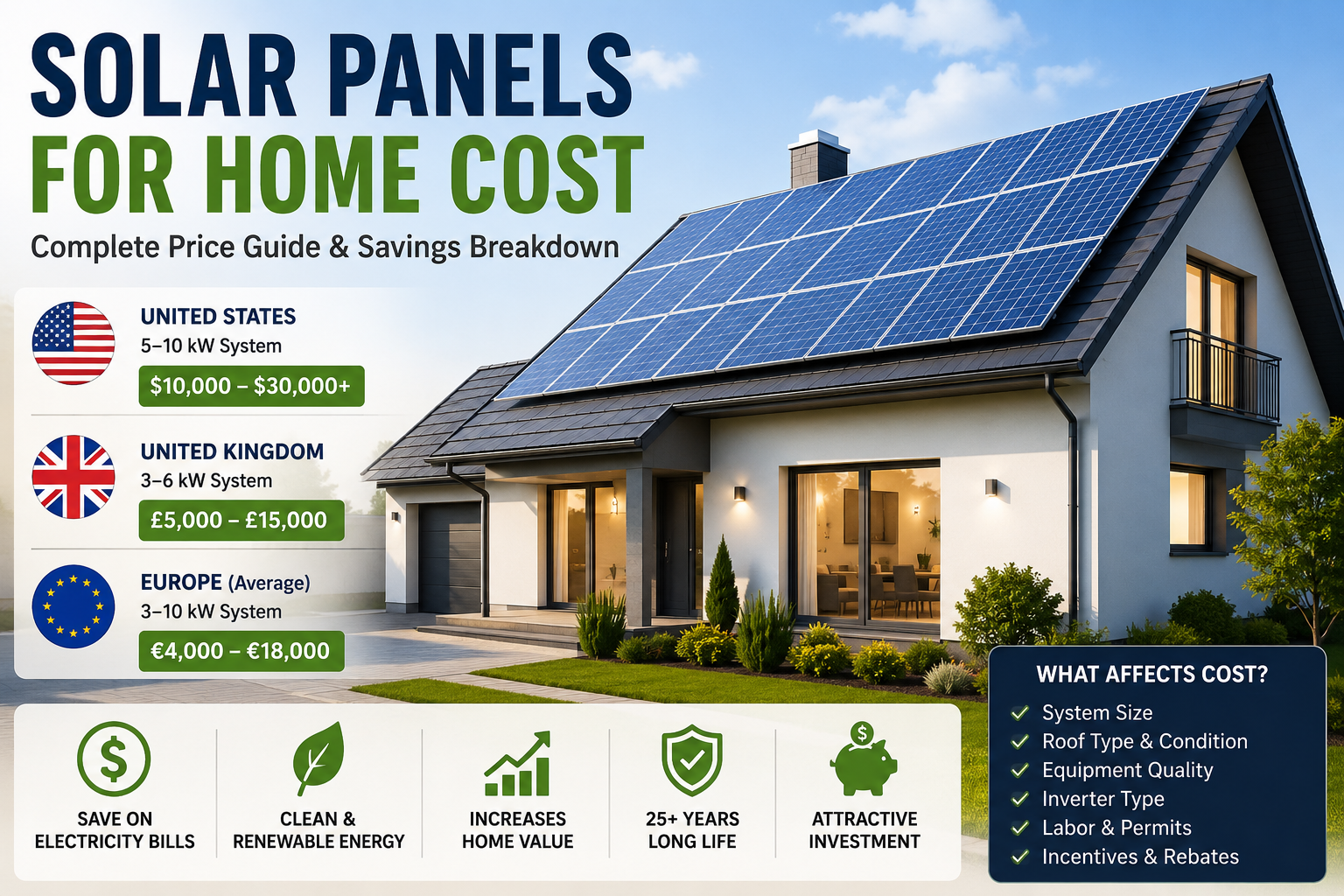
- Installation and maintenance costs
In some locations, a heat pump powered by renewable electricity may also play an important role in reducing fossil fuel use for heating.
The right solution depends on the building and local energy system rather than simply choosing the most popular technology.
Renewable Energy and Climate Change
Climate change is one of the main reasons renewable energy has received increasing attention.
When coal, oil, and natural gas are burned, they release carbon dioxide and other pollutants.
Renewable electricity technologies such as solar and wind do not require fossil fuel combustion during electricity generation.
This makes renewable energy an important part of strategies designed to reduce energy-related greenhouse gas emissions.
However, renewable energy is only one part of climate action.
types of renewable energy important areas include:
- Energy efficiency
- Electrification
- Cleaner transport
- Better buildings
- Industrial decarbonization
- Low-carbon fuels
- Energy storage
- Grid modernization
The strongest results come from combining these approaches rather than treating renewable energy as a standalone solution.
Renewable Energy and Energy Storage.
Energy storage is becoming increasingly important as solar and wind grow.
Solar power is strongest during daylight hours, while electricity demand may remain high after sunset. Wind output can also change depending on weather conditions.
Storage can help move electricity from one period to another.
Battery storage:
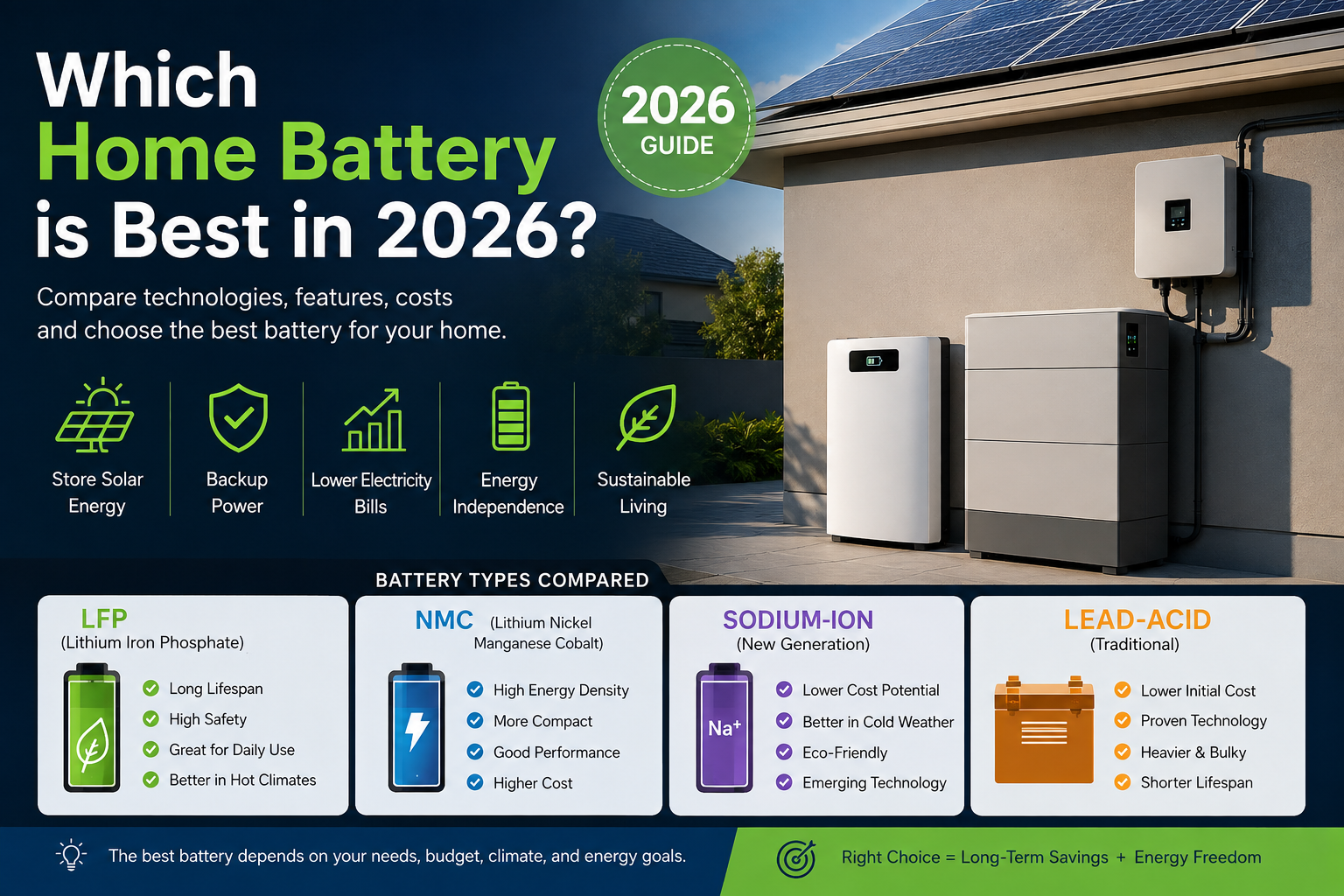
Lithium-ion batteries are widely used today, while other battery technologies are also being developed.
Pumped-storage hydropower:
Water is moved uphill when electricity is available and released through turbines when electricity is needed.
Thermal storage:
Some systems store energy as heat for later use.
Storage does not create energy by itself. Instead, it helps manage when energy is available.
This makes storage particularly useful for integrating variable renewable electricity into modern grids.
Renewable Energy in India:
India has become an important market for renewable energy, particularly solar power.
types of renewable energy India has strong solar resources across many regions, while states such as Tamil Nadu, Gujarat, Karnataka, Maharashtra, and Rajasthan have also developed significant renewable projects.
According to India’s Ministry of New and Renewable Energy, cumulative solar capacity reached about 162.15 GW and wind capacity about 57.44 GW by 30 June 2026. The same official data reported total renewable capacity of about 288.59 GW when large hydropower is included.
India’s renewable energy mix includes:
- Solar power
- Wind power
- Large hydropower
- Small hydropower
- Biomass
- Waste-to-energy
Rooftop solar is also becoming increasingly relevant for households and businesses.
For India, the combination of solar growth, electricity storage, transmission improvements, and energy efficiency will be important as electricity demand continues to grow.
The Ministry of New and Renewable Energy also publishes renewable energy statistics covering solar, wind, hydro, and bio-power at national and state levels.
Renewable Energy in the USA:
The United States has a diverse types of renewable energy resource base.
The U.S. Department of Energy identifies solar, wind, geothermal, biomass, marine energy, and hydropower as important renewable resources across different parts of the country.
Different regions have different strengths.
Texas and the central plains have strong wind resources. The Southwest has excellent solar resources. The Pacific Northwest has major hydropower resources, while geothermal resources are particularly important in parts of the western United States.
The U.S. renewable energy market also includes rapidly growing battery storage and distributed energy systems.
Because the country is geographically large, its renewable energy strategy is not based on one technology. Resource availability varies significantly between states and regions.
Renewable Energy in the UK and Europe:
The UK and many European countries have invested heavily in types of renewable energy .
Offshore wind is particularly important in the UK and North Sea region because of strong wind resources and suitable coastal conditions.
Other parts of Europe have different strengths.
Southern Europe has strong solar resources. Norway and several Alpine countries have major hydropower resources. Iceland makes extensive use of geothermal energy and hydropower.
European energy systems are also increasingly connecting renewable electricity with batteries, electric vehicles, heat pumps, and other flexible technologies.
This regional diversity shows why the types of renewable energy used in one country may look very different from those used in another.
Future Trends in types of renewable energy ?
The renewable energy sector is continuing to change rapidly.
The IEA expects global renewable power capacity to increase by around 4,600 GW between 2025 and 2030, with solar PV accounting for almost 80% of that expansion in its current forecast.
Several trends are worth watching.
More solar and wind:
Solar PV is expected to remain the largest contributor to new renewable capacity growth.
Better energy storage:
As variable renewable generation increases, storage will become more important for balancing electricity supply and demand.
Smarter electricity grids:
Digital technologies can help grids manage solar panels, batteries, electric vehicles, flexible demand, and distributed generation.
Green hydrogen:
Renewable electricity can be used to produce hydrogen through electrolysis. Green hydrogen could become useful in industries where direct electrification is difficult.
More distributed energy:
Instead of relying only on large power plants, future energy systems may include millions of smaller systems such as rooftop solar, batteries, electric vehicles, and smart appliances.
Improved geothermal technology:
New drilling and geothermal technologies could expand the number of locations where geothermal resources can be developed.
The future is therefore unlikely to depend on one renewable source. A combination of technologies will be more practical.
How to Choose Renewable Energy for Your Home
Choosing the right types of renewable energy for your home depends on your location, energy needs, budget, and available resources. For many homes, solar energy is a practical choice, while geothermal heating or small-scale wind systems may work better in suitable locations. Check sunlight, roof space, energy use, local rules, and installation costs before making a decision.
Step 1: Understand your electricity use.
Look at your electricity bills and identify how much energy your home uses throughout the year.
Step 2: Check your property.
For solar, examine roof condition, orientation, shading, and available space.
Step 3: Check local renewable resources.
Solar potential, wind conditions, available water resources, and local climate all matter.
Step 4: Compare costs.
Look at installation costs, maintenance, financing, expected energy production, and possible incentives.
Step 5: Consider storage.
If you want more energy independence or need electricity after solar production falls, battery storage may be useful.
Step 6: Check local rules.
Before installation, check local permits, grid connection requirements, utility rules, and available incentives.
Step 7: Get a professional assessment.
A qualified local installer or energy professional can assess the property and provide system-specific information.
Frequently Asked Questions.
1.What are the main types of renewable energy?
The main types are solar, wind, hydropower, geothermal, biomass, and marine energy such as tidal and wave power.
2.What are the 6 types of renewable energy?
A commonly used list includes solar energy, wind energy, hydropower, geothermal energy, biomass energy, and tidal and wave energy.
3.Which renewable energy source is best?
There is no single best source for every location. The right option depends on local resources, electricity demand, land, infrastructure, cost, and environmental conditions.
4.Which renewable energy is best for a home?
For many homes, rooftop solar is one of the most practical choices. However, suitability depends on sunlight, roof condition, electricity consumption, local rules, and economics.
5.Is renewable energy completely clean?
Not necessarily. Renewable technologies generally have much lower emissions than fossil fuels, but manufacturing, construction, land use, mining, transport, and end-of-life management can still have environmental impacts.
6.Can renewable energy replace fossil fuels?
Renewable energy can replace a significant amount of fossil fuel use, particularly in electricity generation. Reaching a low-carbon energy system also requires efficiency improvements, electrification, storage, grid upgrades, and other technologies.
7.Is nuclear energy renewable?
No. Nuclear energy is generally classified as low-carbon rather than renewable because conventional nuclear power uses finite uranium fuel.
8.What is the fastest-growing renewable energy source?
Solar PV has been the leading source of new renewable capacity growth in recent years. The IEA reported that solar PV accounted for more than three-quarters of new renewable capacity additions globally in 2025.
Conclusion:
The types of renewable energy offer different ways to produce cleaner electricity, heat, and fuels from naturally replenished resources. Solar, wind, hydropower, geothermal, biomass, and tidal energy each have their own benefits, limitations, and suitable applications. There is no single best source for every location. The right choice depends on local resources, energy needs, cost, infrastructure, and environmental conditions. As energy systems evolve, combining renewable sources with energy efficiency, storage, and smarter grids will be increasingly important for a more sustainable energy future.
About the Author:
I am not a professional expert in sustainable technology, renewable energy, climate science, or environmental policy. I regularly read information from trusted public sources such as government websites, research organizations, educational institutions, newspapers, technical reports, and other publicly available resources. The purpose of these articles is to collect practical information in simple language and present it in a way that helps readers understand sustainability-related topics more easily and make informed decisions in everyday life.
solar panels for home cost
best solar panels for home 2026
Recommended External Sources
For the types of renewable energy article, use authoritative sources rather than low-quality blogs or generic websites.
- International Energy Agency (IEA) — Global renewable energy data, analysis, and forecasts.
- International Renewable Energy Agency (IRENA) — Renewable capacity and cost data.
- U.S. Department of Energy — Renewable technology information and U.S. energy resources.
- India Ministry of New and Renewable Energy (MNRE) — Official Indian renewable energy statistics and policies.
- National Renewable Energy Laboratory (NREL) — Renewable energy research and technical information.