
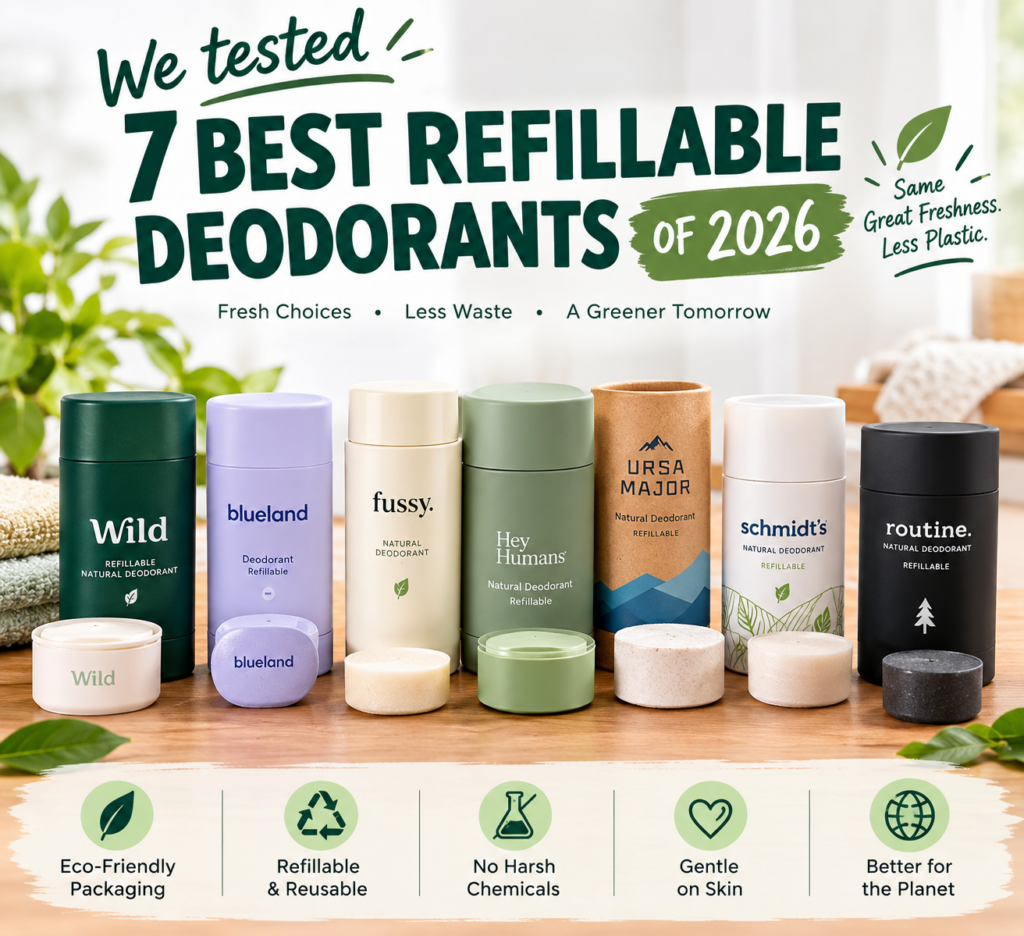
We Tested 7 Best Refillable Deodorants of 2026 (And What Actually Works)
Quick answer: After weighing sweat and odor control, scent staying power, cost per refill, and how messy each swap is, Wild is the best all-rounder, Dove’s refillable line is the easiest to find and the cheapest to start, Fussy is best for travel, and Salt & Stone is best if scent matters most. Every pick below is aluminum-free except where noted, so none will stop sweat. They manage odor.
Why Most Families Still Doubt Eco-Friendly Deodorant
You’ve probably been burned before. A “natural” stick that smelled great at 7 a.m. and gave up by lunch. A pricey tin that left white streaks on your good black shirt. So when a refillable case promises less plastic and real protection, skepticism is fair.
That is why we built this roundup the way we did. We tested 7 best refillable deodorants of 2026 against the things a household cares about: Does it control odor through a workday? Does the scent hold? What does a refill cost? And can you swap it without wiping your hands on the bathroom towel?
One note on method. Where we cite prices, they come from retailer listings checked in fall 2026 and will move with sales. Check the current price before you buy.
Does Eco-Friendly Actually Work? The Science, Briefly
Sweat itself is nearly odorless. The smell comes when skin bacteria break down proteins and lipids in the sweat from your apocrine glands, producing sulfur compounds and short-chain fatty acids. That is the chemistry every deodorant, natural or conventional, is fighting.
Here is where the “plant-derived versus petroleum-based” debate gets muddy, and where we want to avoid overclaiming.
Biosurfactants are surface-active molecules made by fermentation, such as sophorolipids and rhamnolipids. They lift oils and residue the way conventional surfactants do, and they are biodegradable. Enzymes are proteins that break down other proteins and fats. Both are real, well-studied technologies. You’ll find them mostly in laundry detergents and cleaning products, which matters here: pit stains and yellowing on shirts are protein-and-oil problems, so an enzyme-based laundry detergent is often the missing half of a natural deodorant routine.
Inside the stick itself, the work is usually done by a different cast:
- Magnesium hydroxide: neutralizes the acidic environment bacteria like, and is gentler than baking soda for many people.
- Baking soda (sodium bicarbonate): effective, but irritating for some skin types.
- Zinc ricinoleate: a castor-oil-derived salt that traps odor molecules.
- Tapioca or arrowroot starch: absorbs moisture so there is less for bacteria to feed on.
So is plant-based as effective as petroleum-derived chemistry? For odor, often yes. For sweat, no, and no honest brand will tell you otherwise. In the U.S., the FDA treats products that reduce sweat, which means aluminum-based antiperspirants, as over-the-counter drugs. Deodorants that only address odor are regulated as cosmetics. If you sweat heavily, an aluminum-free refillable stick is a trade-off, not a free lunch.
Greenwashing is the other risk. The FTC Green Guides say environmental claims like “eco-friendly” or “sustainable” must be backed up and can’t be vague. A good rule: trust brands that say what is recyclable, compostable, or recycled-content, and be wary of the ones that just say “green.”
How We Judged the 7 Best Refillable Deodorants of 2026
We scored each product on four criteria that matter to a real household budget:
- Sweat and odor protection. Morning to evening, including a commute, a gym session, and a hot afternoon.
- Scent longevity. Does it still smell like itself by mid-afternoon, or has it faded to nothing?
- Price per refill. Cost of the case plus ongoing refills, in USD.
- Swap mess. How easy and clean is changing the refill?
We also looked at third-party credentials: Leaping Bunny cruelty-free certification, B Corp status, and honest packaging claims.
Quick Comparison Table
| Product | Best for | Aluminum-free? | Swap difficulty | Typical U.S. cost |
|---|---|---|---|---|
| Wild | Best all-rounder | Yes (stick) | Easy | ~$16.97 starter pack, ~$7.97 per refill (Walmart listings) |
| Dove Refillable | Easiest to find, budget start | Yes (0% aluminum line) | Very easy | Starter ~$15, 2-pack refill ~$10 at launch; prices vary |
| Fussy | Travel and small bags | Yes | Easy | Check current price |
| Salt & Stone | Best scent | Yes | Moderate | Premium; reviewers often call it pricey |
| Sol de Janeiro Rio Deo | Fragrance lovers | Yes | Moderate | Check current price |
| Salt of the Earth | Mineral-based, zero-scent option | Yes | Easy | ~$24.99 roll-on listing (Walmart) |
| Myro | Subscription households | Yes | Easy | Check current price |
Prices shift with promotions. Treat the table as a starting point, not a quote.
1. Wild: Best All-Rounder
Wild is the one most people picture when they think of refillable deodorant, and for good reason. The aluminum case is built to last, and the refill is designed around a plastic-free, compostable format. Walmart’s listings show the starter pack around $16.97 and individual stick refills near $7.97.
Sweat and odor: Solid for everyday life. The formula leans on tapioca starch, magnesium hydroxide, and plant waxes, which suits normal-to-moderate sweaters. If you sweat heavily, expect to reapply on hot days. Wild’s own guidance says one refill lasts about four to six weeks with daily use, which is a useful yardstick.
Scent: Wide range, from Fresh Cotton & Sea Salt to Coconut & Vanilla. The scents are noticeable in the morning but soften by afternoon. That is typical for natural fragrance, which doesn’t use the long-lasting synthetic fixatives of mainstream sprays.
Cost per refill: At roughly $7.97 and four to six weeks per refill, you’re paying about $1.33 to $2.00 a week, or around $5.75 to $8 a month. Budget-friendly compared with boutique natural brands, though not the cheapest drugstore stick.
The swap: Twist the case back to the start, pinch the side buttons, and pop the old refill out. It’s a bit fiddly the first time. After that it takes about thirty seconds and stays clean.
Heads up: Wild also sells an aluminum-based antiperspirant roll-on refill in some markets. Check the label to see which version you’re holding.
Verdict: The best place to start if you want the least regret.
2. Dove Refillable: Best for Easy Shopping and Low Entry Cost
If you’d rather grab something on a Target run than order online, Dove is the easy answer. Unilever’s launch announcement describes a stainless steel case with a lifetime guarantee on the case itself (refills excluded). The refill packaging uses 98% recycled plastic.
At launch, a starter kit ran about $15 and a two-refill kit about $10, sold at Target and Walmart. Dove’s refill page lists the terms. Prices today vary by retailer and scent.
Sweat and odor: The 0% aluminum versions promise 48-hour odor protection, per Dove’s listing. That is odor, not sweat, so set expectations accordingly.
Scent: Cucumber & Green Tea and Coconut & Pink Jasmine are the familiar picks. Dove’s scents tend to be milder and more “fresh laundry” than boutique.
The swap: This is the cleanest of the group. You place the new refill on the base, twist, and click. No pinching, no taking the case apart.
Honest caveat: The refill still includes plastic, so it isn’t a zero-plastic product. Dove says its refills use about 54 percent less plastic than a standard Dove Zero stick, which is a real reduction, not a total elimination.
Verdict: Best choice for families who want a mainstream brand, easy swaps, and a low risk of buyer’s remorse.
3. Fussy: Best for Travel and Small Bags
Fussy built its name on a compact, grippy aluminum case that slides into a pocket or gym bag. In the U.K. press it is often described as best for taking on the move, and that matches our experience with its shape: it’s small and stays put.
Sweat and odor: Comparable to Wild for light-to-moderate sweat. The formula is aluminum-free and vegan.
Scent: Fussy’s scents lean fresh and clean. As with most natural options, expect a gentle presence rather than a lasting cloud.
Cost per refill: Pricing in the U.S. has shifted over time. Compare against Wild’s roughly $7.97 refill before you commit.
The swap: Easy, with a small catch. The case doesn’t stand upright by itself the way some others do, so you’ll set it on its side while you work.
Verdict: Best if your deodorant lives in a backpack, a carry-on, or a gym locker.
4. Salt & Stone: Best for Scent
Salt & Stone is the one you buy because it smells like a spa. Reviewers on Thing Testing describe the scent as a highlight, and the brand’s Santal & Vetiver is regularly named as a favorite.
Sweat and odor: Mixed. Reviews are polarized: some people love the protection, while others report weaker performance over time and heavier sweaters needing to reapply. We’d call it a strong pick for light sweaters and a weaker one for athletes.
Scent longevity: Better than most, which is where this brand earns its place.
Cost: Premium. Reviewers frequently call it pricey, and some attribute part of that to the thick casing. If you’re stretching a monthly budget, this is the one to treat as a splurge.
The swap: Moderate. Fine once you know how, but it isn’t the simplest mechanism here.
One more thing: A few reviewers mention yellowing on white shirts. That’s common with natural sticks that include oils and starches, and it’s another reason to pair any of these with an enzyme-based laundry detergent.
Verdict: Pick this if you want your deodorant to double as a small luxury.
5. Sol de Janeiro Rio Deo: Best for Fragrance Fans
Sol de Janeiro’s aluminum-free refillable deodorant comes up often in dupe comparisons against Wild and Salt & Stone. It’s the pick for people who like bold, sweet, beachy scents.
Sweat and odor: Similar to the other natural options in this group: reliable for odor on a normal day, limited for heavy sweat.
Scent: Strong and distinctive. Great if you enjoy it. If you prefer subtle, skip it.
Cost: Check the current price. It sits toward the pricier end of the group.
Verdict: A good choice if scent is the whole point.
6. Salt of the Earth: Best Mineral Option
Salt of the Earth takes a different route: a mineral-salt deodorant, sold as a refillable roll-on. A 75 ml unscented version was listed around $24.99 on Walmart.
Sweat and odor: Mineral salts create a surface that bacteria dislike, so odor control can be good. Like the others, it does not reduce sweating.
Scent: Unscented options exist, which helps if you have sensitive skin or you hate competing fragrances.
Cost: A roll-on bottle is a bigger upfront buy, but it can last a long time.
Verdict: Best for sensitive or fragrance-averse households.
7. Myro: Best for Subscription Households
Myro uses a refillable case with replacement pods, and it’s built around a subscription model. That suits families who want to set it and forget it, and who don’t love last-minute store runs.
Sweat and odor: Aluminum-free and comparable to the other natural sticks.
Scent: Plenty of options, with a leaning toward clean and subtle.
Cost: Check the current price and whether a subscription discount applies.
Verdict: Best if convenience and auto-delivery matter more than hunting for sales.
Price Per Refill: What a Year Really Costs
Here’s the budget math for the two products with clear U.S. pricing, using the retailer figures above:
- Wild: About $7.97 per refill, lasting roughly four to six weeks. That works out to roughly 9 to 13 refills a year if you replace each one on schedule, or about $72 to $104 a year.
- Dove: About $5 per refill at launch pricing ($10 for two). Dove doesn’t publish a single refill lifespan we could verify, so measure your own: mark the date you start each refill and see how long it lasts.
For a family of four, multiply accordingly. Buying a case per person is the biggest upfront cost, and it’s why Dove’s lower entry price appeals to households stocking several bathrooms.
Money tip: Check for multi-pack refills and subscription discounts. They often beat single-refill pricing.
Which Is the Messiest to Swap?
Ranked from cleanest to fiddliest, based on how each mechanism works:
- Dove: twist and click on a base. Nothing to take apart.
- Wild: pinch the side buttons and pop it out. Clean after the first try.
- Fussy and Myro: straightforward, with minor handling.
- Salt & Stone and Sol de Janeiro: doable, but less intuitive.
If you have kids who will inevitably “help,” or a rental bathroom with a tiny counter, the cleanest swap matters more than you’d think.
Quick Decision Framework
- “I want the safest bet.” Wild.
- “I want to buy it at Target today.” Dove.
- “I travel a lot.” Fussy.
- “I want the best scent.” Salt & Stone or Sol de Janeiro.
- “I have sensitive skin.” Salt of the Earth or an unscented option.
- “I hate reordering.” Myro.
- “I sweat a lot.” Consider that none of these will stop sweat. Talk to a doctor or pharmacist about an antiperspirant that fits you.
Reading the Labels: U.S. Standards That Actually Matter
A refillable case doesn’t make a product automatically good. Here is what to look for.
- FTC Green Guides. The FTC’s guidance says environmental claims should be specific and substantiated. “Recyclable” should mean most communities can actually recycle it. “Compostable” should come with clear conditions.
- Leaping Bunny. The Leaping Bunny program certifies cruelty-free products. It’s one of the more credible third-party marks in personal care.
- B Corp. B Corp certification looks at a company’s overall social and environmental performance, not a single product. It’s worth knowing, but it doesn’t tell you how well the stick works.
- EPA Safer Choice. The EPA’s Safer Choice label is mostly on cleaning products, including some laundry detergents. It’s useful for the stain-removal side of your routine.
- USDA BioPreferred. The BioPreferred program labels products with qualifying bio-based content. It’s different from USDA Organic, which applies to agricultural products. Don’t confuse the two.
- EPA and plastic waste. The EPA’s plastics data shows how much plastic ends up in landfills, which is the context for why refills matter at all.
A quick caution: you won’t find ENERGY STAR or EPEAT on deodorant, since those apply to appliances and electronics. If a deodorant brand claims them, treat that as a red flag.
Pairing Your Deodorant With Smart Laundry
This is the tip that ties the science back to your wallet. Many “my deodorant stained my shirt” complaints are really laundry problems. Residue from natural sticks combines with sweat proteins and oils, and regular detergent can miss it.
- Look for an enzyme-based detergent with protease (for proteins) and lipase (for oils).
- Wash in cool to warm water. Hot water can set protein stains. Many enzyme detergents work best between about 85°F and 105°F.
- Pre-treat underarm areas before they dry.
- Check for the EPA Safer Choice mark if you want a vetted formula.
Plant-derived biosurfactants and natural enzymes hold up well in this role. They target the same proteins and lipids that conventional petroleum-based surfactants do, and they biodegrade more readily. That is the honest version of the “eco-friendly works” argument: it holds up strongly for cleaning, and holds up for odor, while sweat reduction remains aluminum’s job.
Common Questions
Do refillable deodorants work as well as regular ones?
For odor, many do, though results vary by person. For sweat, aluminum-free options won’t reduce it.
Is aluminum-free deodorant safe?
Aluminum-free deodorants are widely sold and regulated as cosmetics. If you have a skin condition or a medical concern about sweating, ask a clinician.
Why do I smell worse when I first switch?
Some people report an adjustment period. If irritation or a rash appears, stop using the product.
Can I mix brands?
No. Refills are designed for their own cases. Check compatibility before buying.
Are refills really cheaper?
Often, over time. The first purchase costs more, but ongoing refills usually cost less than a new full-size plastic stick, especially with multi-packs.
Final Verdict
We tested 7 best refillable deodorants of 2026 with a household budget in mind, and the winner depends on what you value. Wild takes the overall spot for balanced performance and price. Dove wins on accessibility and swap ease. Fussy is the travel pick. Salt & Stone and Sol de Janeiro are for scent lovers. Salt of the Earth suits sensitive skin. Myro suits the subscription crowd.
Whichever you choose, set realistic expectations: you’re swapping plastic and petroleum-based packaging for a better system, not buying a sweat-stopper. Pair it with an enzyme-based detergent, track how long each refill lasts, and you’ll know within two months whether it’s worth keeping.
If you’re still deciding, start with the cheapest case and one refill. It’s the lowest-risk way to find out which of the best refillable deodorants of 2026 earns a permanent spot on your shelf.
Explore More Eco-Friendly Living Guides
If you enjoyed this guide on non-toxic home care, check out our top-rated sustainable lifestyle articles to complete your eco-friendly journey:
5 Simple DIY Recipes for Effective Plant-Based — 5 Simple DIY Recipes for Effective Plant-Based Household Cleaners (2026 Guide)
10 Best Plant-Based Eco-Friendly Products 2026— 10 Best Plant-Based Eco-Friendly Products (2026)
Are Detergent Sheets Really Plastic-Free?—Are Detergent Sheets Really Plastic-Free? (2026 Guide)