
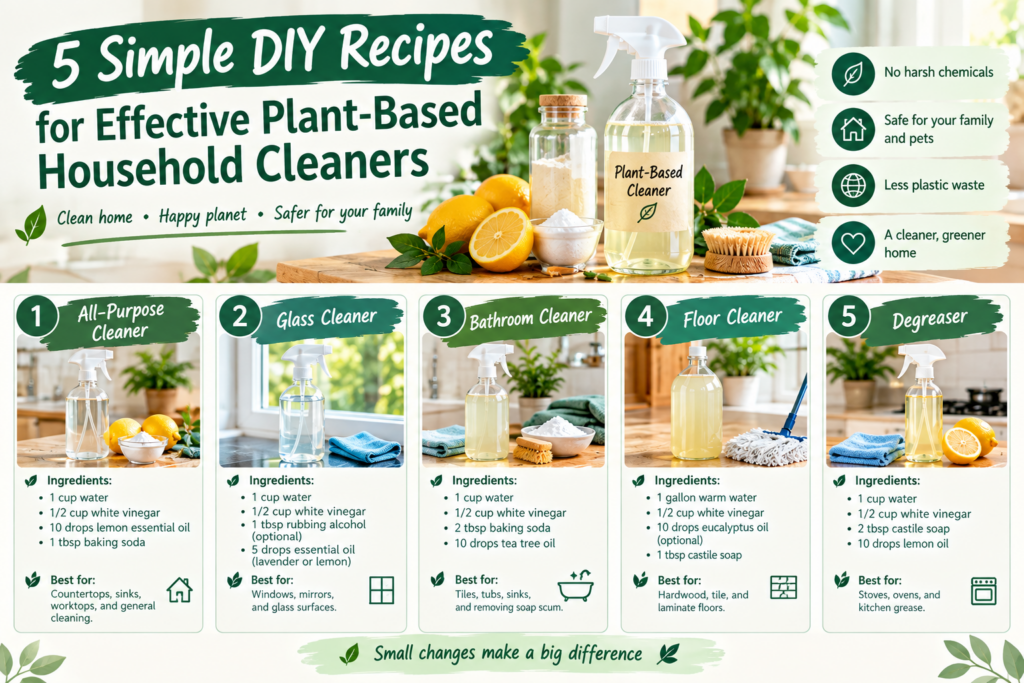
5 Simple DIY Recipes for Effective Plant-Based Household Cleaners (2026 Guide)
Quick Answer: The five most useful plant-based DIY cleaners are an all-purpose vinegar-citrus spray, a baking soda scrub paste, a castile soap multi-surface cleaner, a streak-free vinegar glass cleaner, and a lemon-salt scouring mix for tough spots. Together they cost roughly $0.35 to $0.70 per batch, use ingredients from any U.S. grocery store, and cover most everyday cleaning. They clean well. They do not disinfect, and that distinction matters (more on that below).
Why More American Households Are Making Their Own Cleaners
Walk down the cleaning aisle at any Target or Walmart and you’ll see the same thing: shelves of $4 to $9 bottles, each promising to handle one specific surface. A typical family can easily spend $300 to $500 a year on sprays, wipes, and specialty cleaners. Most of those bottles are mostly water.
That’s the budget angle. There’s a second one, which is waste. Single-use plastic trigger bottles pile up fast. A DIY approach lets you buy a few concentrated pantry staples and refill the same bottles for years.
And there’s a third: ingredient control. If you have a toddler who licks things, a dog that drags its nose across the floor, or a rental where you’re scrubbing grout every weekend, knowing exactly what’s in the bottle is genuinely useful.
Here’s the honest framing, though. “Plant-based” and “DIY” are not magic words. Some naturally derived ingredients are irritating (citrus oils can trigger skin reactions, for example), and some of the most effective cleaners are simple synthetics. What DIY plant-based cleaning offers is simplicity, low cost, and transparency. That’s a strong enough pitch on its own.
What “Plant-Based” Actually Means (and What It Doesn’t)
Before the recipes, a quick reality check, because this is where a lot of blog content oversells.
The term isn’t regulated for cleaning products. The Federal Trade Commission’s Green Guides (16 CFR Part 260) tell marketers not to make vague or unqualified environmental claims like “eco-friendly” or “green.” There is no federal definition of “plant-based” for a cleaner. A bottle can say it and still contain a mix of plant-derived and petroleum-derived ingredients.
Certifications are more reliable than front-label buzzwords. If you buy rather than make, these are worth knowing:
- EPA Safer Choice: A voluntary program where EPA reviews every ingredient in a product against human health and environmental criteria. You can browse certified products by category.
- USDA Certified Biobased Product: Verifies the percentage of renewable, biologically derived content. It says nothing about toxicity on its own.
- USDA Organic: Applies to agricultural ingredients and is rarely relevant to cleaners.
- B Corp: Certifies the company’s social and environmental practices, not the formula in the bottle.
For DIY, none of those labels apply because you’re the manufacturer. That puts the responsibility on you to follow a few basic safety rules, which we’ll cover after the recipes.
The Pantry Toolkit: What You Actually Need
You don’t need 20 ingredients. Seven cover everything in this guide.
| Ingredient | Approx. Cost (U.S. grocery) | What It Does |
|---|---|---|
| Distilled white vinegar (5% acidity) | $3 to $4 per gallon | Cuts mineral deposits, soap scum, light grease |
| Baking soda | $1 to $2 per lb | Mild abrasive, deodorizer |
| Liquid castile soap (unscented or peppermint) | $9 to $14 per 16 oz | Plant-oil-based soap, lifts dirt and grease |
| Rubbing alcohol (70% isopropyl) | $2 to $4 per pint | Speeds drying for streak-free glass |
| Fresh lemons or bottled lemon juice | $0.50 to $0.80 each | Mild acid, helps with some stains |
| Coarse kosher or sea salt | $2 to $3 per box | Natural scrubbing grit |
| Distilled water | $1 to $1.50 per gallon | Prevents mineral spotting, extends shelf life |
Optional: Essential oils (lavender, lemon, or sweet orange). Use sparingly, and read the safety section first if you have pets.
Gear: Two or three 16 oz glass or HDPE (#2) spray bottles, a funnel, a permanent marker, and masking tape for labels. Dark-tinted bottles hold up better when a recipe includes citrus or essential oils.
Start-up cost: The full toolkit runs about $25 to $35. After that, each batch costs pennies.
Recipe 1: All-Purpose Vinegar-Citrus Spray
Best for: Kitchen counters (non-stone), stovetops, sinks, appliance exteriors, tile, and light bathroom cleanup.
Do not use on: Granite, marble, travertine, limestone, or other natural stone. Also skip it on unsealed grout, cast iron, and waxed wood.
Ingredients:
- 1 cup distilled white vinegar (5% acidity)
- 1 cup distilled water
- Peels from 2 oranges or lemons
- Optional: 10 drops lemon or sweet orange essential oil
Instructions:
- Pack the citrus peels into a clean glass jar.
- Cover with the vinegar, seal, and let it infuse for 1 to 2 weeks at room temperature, away from direct sunlight.
- Strain out the peels (they’re good in the compost bin).
- Mix the infused vinegar with the distilled water in a spray bottle.
- Label with the date and contents.
How to use it: Spray, let sit for 30 to 60 seconds, wipe with a damp microfiber cloth. For sticky buildup, let it sit 3 to 5 minutes.
Cost per batch: About $0.60. Shelf life: 4 to 6 weeks.
Why it works: Acetic acid in vinegar dissolves alkaline mineral deposits like hard water film and light soap scum. The citrus peels add scent and a small amount of d-limonene, a natural solvent that helps with greasy residue.
Pro tip: Hard water is a real issue in much of the Southwest, Midwest, and Florida. If your area has it, a stronger 2:1 vinegar-to-water ratio works better on shower glass and faucets. Rinse afterward.
Recipe 2: Baking Soda Scrub Paste
Best for: Cool oven interiors, stovetop grime, stainless steel sinks, bathtubs, ceramic tile, and burnt-on pots.
Do not use on: Polished or glossy surfaces that scratch easily, such as some acrylic tubs or brushed aluminum. Test a small hidden spot first.
Ingredients:
- ½ cup baking soda
- 2 to 3 tablespoons liquid castile soap (enough to form a spreadable paste)
- 1 tablespoon water, if needed
- Optional: 5 drops lavender essential oil
Instructions:
- Combine baking soda and castile soap in a small bowl.
- Stir until it reaches a thick, toothpaste-like consistency. Add water a few drops at a time if it’s too stiff.
- Store in a small lidded jar.
How to use it: Apply with a sponge or old toothbrush. Let it sit 10 to 15 minutes on tougher spots, then scrub in small circles and rinse thoroughly.
Cost per batch: About $0.70. Shelf life: Use within a week, since it can dry out and harden.
Why it works: Baking soda (sodium bicarbonate) is a mild abrasive, soft enough to avoid scratching most household surfaces but firm enough to lift grime. It’s also a useful deodorizer.
Real-world example: A cookie sheet with baked-on grease from a few Thanksgivings ago? Coat it in the paste, add a splash of hot water, and let it sit overnight. In the morning, most of the residue wipes off with a sponge.
Important: Don’t bother mixing this paste with vinegar. They largely neutralize each other, so you lose cleaning power, and the fizzing reaction can build pressure in a sealed container. Used one after the other on a surface, they’re fine.
Recipe 3: Castile Soap Multi-Surface Cleaner
Best for: Hardwood floors (damp-mop only, never soaked), sealed stone, laminate, painted walls, and baseboards. This is the gentlest recipe on the list.
Ingredients:
- 2 cups warm distilled water
- 1 tablespoon liquid castile soap
- Optional: 5 to 10 drops essential oil (skip if you have pets)
Instructions:
- Add the water to a spray bottle first. This prevents excess foaming.
- Add the castile soap.
- Swirl gently (don’t shake) to combine.
How to use it: Spray lightly and wipe with a microfiber cloth. For floors, use a spray mop with a washable pad, working in small sections.
Cost per batch: About $0.35. Shelf life: 2 to 3 weeks. With no acid or alcohol, this recipe is more prone to microbial growth, so make small batches.
Why it works: Castile soap is a true soap made by saponifying plant oils, typically olive, coconut, or hemp. Soap molecules grab onto oils and dirt and let water carry them away.
One caution: Don’t combine castile soap with vinegar or lemon juice in the same bottle. Acid breaks soap down into a curdled, oily residue that leaves a film on surfaces.
Floor tip: Hardwood manufacturers often void warranties if floors are over-wetted. Wring the mop until it’s barely damp, then dry any standing moisture with a clean towel.
Recipe 4: Streak-Free Glass and Mirror Cleaner
Best for: Windows, mirrors, shower doors, stainless steel appliances, and car interiors.
Ingredients:
- 1 cup distilled water
- 1 cup white vinegar
- 1 tablespoon 70% isopropyl (rubbing) alcohol
- Optional: 1 teaspoon cornstarch for stubborn streaks (shake before each use)
Instructions:
- Combine all ingredients in a spray bottle.
- Shake gently.
- Label clearly.
How to use it: Spray lightly. Wipe with a clean, lint-free microfiber cloth or crumpled newspaper. Buff in straight lines, not circles.
Cost per batch: About $0.40. Shelf life: 3 months or more, thanks to the alcohol and acid.
Why it works: Vinegar cuts film. Alcohol speeds evaporation, which prevents the water spotting that causes streaks. Distilled water leaves no mineral residue.
Pro tip: Never clean windows in direct sun. The solution dries too fast and streaks no matter how good your recipe is. An overcast morning or shaded afternoon works best.
Honest note: Rubbing alcohol isn’t plant-based in the strict sense. If you want a fully plant-derived version, leave it out. The cleaner still works. It just takes a bit more buffing.
Recipe 5: Lemon-Salt Scouring Mix
Best for: Cutting boards (wood and plastic), copper pots, stained mugs, light rust spots on non-porous surfaces, and sink basins.
Do not use on: Natural stone, coated non-stick pans, aluminum, or anything with a delicate finish.
Ingredients:
- ¼ cup coarse kosher or sea salt
- 1 lemon, halved
Instructions:
- Sprinkle salt generously over the surface.
- Use the cut side of the lemon as a scrubber, pressing and twisting.
- Let it sit 5 to 10 minutes on stains.
- Rinse well with warm water.
Cost per use: About $0.60 to $0.80. Shelf life: Make fresh each time.
Why it works: Salt provides coarse mechanical scrubbing. Citric acid in the lemon breaks down some stains and mineral deposits and deodorizes a bit.
Cutting board tip: Rinse wood boards, dry them upright, and give them a monthly coat of food-grade mineral oil to prevent cracking.
Fair warning: Lemon-salt mixes can discolor some metals over time. This is a spot treatment, not an everyday cleaner.
Quick Comparison: Which Recipe Should You Use?
| Cleaning Task | Best Recipe | Avoid On | Cost/Batch |
|---|---|---|---|
| Kitchen counters (laminate, sealed) | Recipe 1 | Granite, marble | ~$0.60 |
| Baked-on grease | Recipe 2 | Soft or polished finishes | ~$0.70 |
| Hardwood or laminate floors | Recipe 3 | Overly wet application | ~$0.35 |
| Windows and mirrors | Recipe 4 | Tinted film (check manufacturer) | ~$0.40 |
| Cutting boards, copper | Recipe 5 | Natural stone, aluminum | ~$0.60 |
| Bathroom soap scum | Recipe 1 (stronger ratio) | Natural stone | ~$0.60 |
Quick decision framework:
- Mineral deposits or soap scum? Use acid (vinegar or lemon).
- Grease or general grime? Use soap (castile).
- Stuck-on residue? Use an abrasive (baking soda or salt).
- Glass or mirrors? Use the vinegar-alcohol mix.
- Natural stone anywhere? Skip acid entirely. Stick with castile soap and water.
Cleaning vs. Disinfecting: What the EPA Actually Says
This is the part many DIY blogs skip, and it matters most for families.
Cleaning removes dirt, germs, and impurities from surfaces. Sanitizing lowers the number of germs to a level considered safe by public health standards. Disinfecting kills a high percentage of specific germs on surfaces, and it’s the one the EPA regulates.
Products that claim to kill germs must be registered with the EPA under the Federal Insecticide, Fungicide, and Rodenticide Act (FIFRA) and carry an EPA registration number. Homemade mixes aren’t registered and can’t make disinfecting claims. Vinegar, for example, isn’t on EPA’s lists of approved disinfectants for pathogens like norovirus or influenza.
What that means in practice:
- For everyday cleaning, DIY recipes work well. Soap and water physically remove most germs from surfaces. The CDC’s cleaning and disinfecting guidance explains when each step is appropriate.
- For high-risk situations, use an EPA-registered disinfectant and follow the label’s contact time. That includes raw meat or poultry juices, bodily fluids, a household member with a contagious illness, and diaper-changing areas.
- To find a registered product, check EPA’s List N. Some registered options use plant-derived active ingredients such as thymol or lactic acid.
This isn’t a reason to skip DIY. It’s a reason to use each tool for what it’s good at.
Safety Rules You Shouldn’t Skip
Plant-based doesn’t automatically mean harmless. Follow these every time.
1. Never mix cleaners with bleach or ammonia.
Vinegar plus bleach releases chlorine gas. Ammonia plus bleach produces toxic chloramine vapors. The CDC and Poison Control both warn against combining household cleaners. If you’ve used a bleach product, rinse the surface thoroughly before any DIY spray.
2. Don’t put hydrogen peroxide and vinegar in one bottle.
Together they form peracetic acid, which can irritate skin, eyes, and lungs. Use them one after the other with a water rinse in between, or just pick one.
3. Label everything.
Use waterproof labels with the contents and date. Never reuse a food or drink container, and keep every bottle out of children’s reach. If someone swallows or inhales a cleaner, call Poison Control at 1-800-222-1222.
4. Be careful with essential oils around pets.
Cats are especially sensitive. The ASPCA Animal Poison Control Center lists tea tree (melaleuca) oil, citrus oils, and others as potentially toxic to cats and dogs. If you have pets, skip essential oils in floor and surface cleaners, or check with your vet first. Unscented castile soap is a safer baseline.
5. Test first.
Try any new cleaner on a hidden spot, wait 24 hours, and check for discoloration or damage.
6. Ventilate.
Open a window. Even mild vinegar fumes bother some people, especially those with asthma.
7. Use distilled water when you can.
Tap water can introduce minerals and bacteria, which shortens shelf life.
8. Know your surfaces.
Don’t use acidic cleaners on natural stone, and don’t use abrasive pastes on glossy finishes. If you rent, check your lease before experimenting on fixtures or flooring.
How Much Can You Really Save?
Here are the numbers for a typical U.S. household using store-bought products.
| Product Type | Store-Bought Avg. | DIY Equivalent | Savings/Bottle |
|---|---|---|---|
| All-purpose spray (32 oz) | $4.50 | ~$0.60 | ~$3.90 |
| Glass cleaner (23 oz) | $3.75 | ~$0.40 | ~$3.35 |
| Soft scrub (24 oz) | $5.00 | ~$0.70 | ~$4.30 |
| Floor cleaner (32 oz) | $6.00 | ~$0.35 | ~$5.65 |
If a family replaces four to six of each type per year, that’s roughly $60 to $120 saved annually. Not a retirement plan, but it adds up on a tight household budget.
You also cut plastic. Reusing the same spray bottles for years, instead of buying new ones every month or two, can keep an estimated 20 to 40 bottles out of the recycling stream or landfill each year.
When Store-Bought Makes More Sense
DIY isn’t right for every situation. Buy a commercial product when:
- You need a registered disinfectant. Flu season, a household illness, or raw poultry cleanup.
- You’re dealing with heavy mold or mildew. Per EPA mold guidance, patches larger than about 10 square feet call for professional remediation rather than a DIY scrub.
- The problem is commercial-grade. Heavy rust, years of limescale on a shower head, or stubborn grease.
- You simply don’t have time. Your time has value, too.
What to look for when you buy:
- The EPA Safer Choice label for fully reviewed ingredient safety
- The USDA Certified Biobased label for renewable content percentages
- Full ingredient disclosure. Some states, including California and New York, now require cleaning product makers to list ingredients.
- Cautious claims. Be skeptical of vague phrases like “all-natural” or “non-toxic” with no explanation. The FTC Green Guides specifically discourage them.
- Independent ratings such as the EWG Guide to Healthy Cleaning as a cross-reference. Its methodology differs from regulatory standards, so treat it as one input, not the final word.
Storage and Shelf Life Cheat Sheet
| Recipe | Container | Storage Spot | Use Within |
|---|---|---|---|
| All-Purpose Vinegar-Citrus | Glass or HDPE spray bottle | Cool cabinet | 4 to 6 weeks |
| Baking Soda Paste | Lidded jar | Under sink | 1 week |
| Castile Soap Spray | Spray bottle | Cool cabinet | 2 to 3 weeks |
| Glass Cleaner | Spray bottle | Any shelf | 3 months |
| Lemon-Salt | Make fresh | N/A | Single use |
General tips:
- Keep bottles out of direct sunlight and away from heat above 100°F.
- If a mixture smells off, looks cloudy, or grows anything, toss it.
- Wash bottles with hot, soapy water between batches.
Frequently Asked Questions
Are DIY plant-based cleaners as effective as store-bought ones?
For everyday cleaning, yes. They handle grease, soap scum, mineral deposits, and general grime well. For disinfecting, no. Only EPA-registered products can make that claim.
Can I use vinegar on granite or marble countertops?
No. Acid can etch and dull natural stone. Use a few drops of castile soap in warm water instead, and dry with a soft cloth.
Is it safe to mix baking soda and vinegar?
It’s safe, but not useful as a cleaner, since they neutralize each other. Use them in sequence on a surface rather than mixed together.
Do I need distilled water?
Not strictly, but it extends shelf life and prevents spotting on glass. If your tap water is soft and clean, it works in a pinch.
Are essential oils safe around kids and pets?
It depends on the oil and concentration. Many are irritating or toxic to cats and dogs. When in doubt, leave them out.
How do I know if a homemade cleaner has gone bad?
Cloudy appearance, a strange smell, slime, or visible growth. Discard it and wash the bottle.
Will DIY cleaners work in a rental?
Usually, yes. Check your lease and test in an inconspicuous spot, since a landlord can charge you for damaged finishes or fixtures.
Where can I buy castile soap?
Most major U.S. grocers, Target, Whole Foods, and online retailers carry it. A 16 oz bottle runs about $9 to $14 and makes roughly 30 to 50 batches of spray cleaner.
Getting Started: A Simple First-Week Plan
Don’t try to make all five on day one.
Day 1: Buy distilled white vinegar, baking soda, and castile soap. Total: about $15.
Day 2: Make the glass cleaner (Recipe 4). It’s the easiest, and the results are immediate.
Day 3: Start your citrus-vinegar infusion (Recipe 1). It needs 1 to 2 weeks.
Days 4 to 7: Try the baking soda paste (Recipe 2) on one stubborn spot, and the castile soap spray (Recipe 3) on a floor or wall.
By the end of the week you’ll know what suits your home. Keep what works. Skip what doesn’t.
Sources and Further Reading
- EPA Safer Choice and certified product search
- EPA List N: Registered Disinfectants
- EPA: Mold Cleanup in Your Home
- FTC Green Guides and 16 CFR Part 260
- USDA BioPreferred Program
- USDA Organic Standards
- CDC: Cleaning and Disinfecting
- Poison Control: 1-800-222-1222
- ASPCA Animal Poison Control
- B Corp Certification
- EWG Guide to Healthy Cleaning
Guidelines and product listings change, so check current versions of these resources.
Final Takeaway
You don’t need a pantry full of specialty products to keep a home clean. Five simple recipes, a handful of inexpensive ingredients, and a basic understanding of what each one does can handle most of what a busy household throws at it.
The goal isn’t perfection or purity. It’s choosing tools that fit your budget, your surfaces, and your family’s needs, and knowing when to reach for something stronger.
Start with one recipe. See how it goes. Then build from there.
Disclaimer: This content is for general informational purposes and is not a substitute for professional advice. Always follow manufacturer care instructions for your surfaces and appliances, and consult your doctor, veterinarian, or Poison Control for health or safety questions.
Explore More Eco-Friendly Living Guides
If you enjoyed this guide on non-toxic home care, check out our top-rated sustainable lifestyle articles to complete your eco-friendly journey:
 10 Best Eco-Conscious Clothing Brands in 2026 — Discover ethical fashion brands that prioritize sustainable fabrics and fair trade practices.
- Sustainable Fashion 2026: The Ultimate Guide to Eco-Friendly Style — Learn how to build a timeless capsule wardrobe without compromising on ethics or quality.
10 Best Plastic Free Laundry Detergents in US
—Best Safe Choices for Your Home