

Plant-Based vs. Traditional Cleaners 2026: Do Bio-Enzymes Actually Cut Through Grease?
Quick Answer (Featured Snippet Block)
Do bio-enzyme cleaners cut grease as well as traditional cleaners? For everyday kitchen grease, yes. Plant-derived biosurfactants and enzymes (lipases, proteases, amylases) break down fats, proteins, and starches at the molecular level. In routine household use, they perform comparably to conventional petroleum-based degreasers. Where they still lag is heavy, baked-on, polymerized grease (the film on a range hood or oven door), where a strong alkaline degreaser remains faster. The deciding factor is usually dwell time, water temperature, and the type of soil, not whether the formula is “natural.”
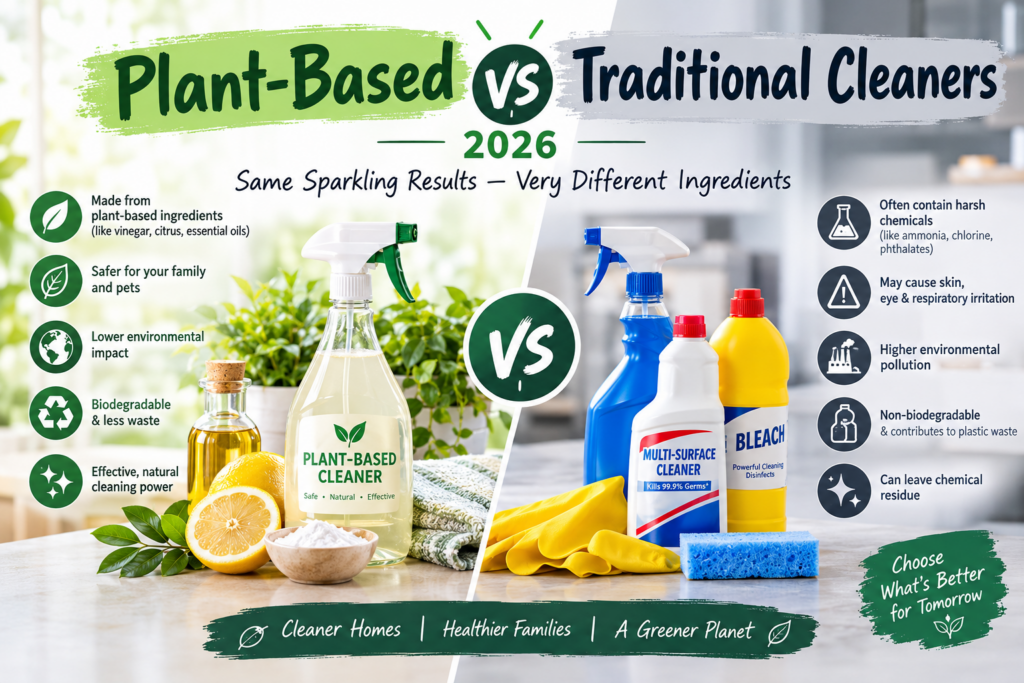
At a Glance: Plant-Based vs. Traditional Cleaners (2026)
| Factor | Plant-Based / Bio-Enzyme | Traditional (Petroleum-Based) |
|---|---|---|
| Fresh cooking grease | Excellent with 5-10 min dwell time | Excellent, often instant |
| Baked-on, polymerized grease | Fair; needs repeat applications | Strong, especially alkaline formulas |
| Protein stains (egg, milk, blood) | Excellent (proteases are built for this) | Good, but hot water can “set” some stains |
| Drain and odor maintenance | Very good for ongoing upkeep | Fast but harsh on pipes and septic bacteria |
| Speed | Slower; works over minutes to hours | Faster; works in seconds to minutes |
| Typical cost per bottle | $4-$9 (ready-to-use); $12-$25 (concentrate starter kit) | $3-$7 |
| Fumes and skin irritation | Typically low | Can be high (ammonia, glycol ethers) |
| Septic-system friendliness | Generally good | Varies by formula |
| Packaging and waste | Refills and concentrates are common | Mostly single-use trigger bottles |
The Skepticism Is Fair (And Mostly Earned)
Let’s be honest about where the doubt comes from.
Many of us tried a “green” cleaner a decade ago, sprayed it on a greasy stovetop, wiped, and watched it smear around like a bad science experiment. The bottle said “natural.” The grease said “nice try.”
That experience wasn’t imagined. Early plant-based products often relied on little more than citrus oil, vinegar, or soap flakes. They handled dust and fingerprints. They fell apart on a Sunday-bacon-and-fried-chicken kind of mess.
Marketing didn’t help. For years, eco-labeling in the U.S. leaned on leaf imagery and vague words like “green” or “pure” without much behind them. That’s why the Federal Trade Commission’s Green Guides exist. They warn companies that broad, unqualified claims like “eco-friendly” are likely to mislead shoppers. The guides have been under review in recent years, so check the FTC’s page for the latest version.
So if you’ve been burned, your skepticism is reasonable. The better question for 2026 is this: has the chemistry actually changed?
It has. Here’s how.
How Grease Actually Works (A 60-Second Chemistry Refresher)
Kitchen grime is rarely just one thing. It’s usually a layered mix of:
- Lipids: cooking oils, butter, animal fat
- Proteins: splattered egg, meat juices, dairy
- Starches: pasta water, sauces, flour
- Everything that landed on top: dust, pet dander, airborne particles
Fat and water don’t mix. That’s the whole problem. To remove grease, a cleaner needs a molecule with one end that loves oil and another that loves water. That molecule is a surfactant (short for “surface-active agent”).
Surfactants wrap around oil droplets, lift them off the surface, and let water carry them away. Every cleaner you’ve used, from dish soap to laundry detergent, relies on this principle. The American Cleaning Institute publishes plain-language explainers on how surfactants work if you want to go deeper.
The difference between “traditional” and “plant-based” is largely where the surfactant comes from and what else is added to help it work.
Traditional Cleaners: What’s Actually in Them
Conventional degreasers typically use some combination of:
- Petrochemical-derived surfactants (such as alcohol ethoxylates and linear alkylbenzene sulfonates, or LAS)
- Solvents like glycol ethers, which dissolve grease directly
- Alkaline builders such as sodium hydroxide or sodium metasilicate, which turn fats into soap-like compounds through a reaction called saponification
- Fragrance and dyes
These ingredients are effective. Alkaline degreasers in particular are very good at chewing through hardened grease. The tradeoffs show up elsewhere: stronger fumes, more skin and eye irritation, and a bigger environmental footprint depending on sourcing and biodegradability.
“Traditional” doesn’t mean “unsafe.” Household cleaning products sold in the U.S. fall under several frameworks, including the Consumer Product Safety Commission and, for products that claim to disinfect, the EPA. Used as directed, they’re generally safe. They’re just not the only option anymore.
Plant-Based Cleaners: What’s Different in 2026
Modern plant-derived formulas are no longer built on vinegar and good intentions. The upgrade comes from two categories of ingredients.
1. Biosurfactants and Plant-Derived Surfactants
- Alkyl polyglucosides (APGs): made from plant sugars (often corn or coconut) combined with fatty alcohols. They foam well, rinse clean, and are gentle on skin.
- Coco-glucoside and decyl glucoside: common, mild APG variants.
- Sophorolipids and rhamnolipids: true biosurfactants, produced by fermentation with yeast or bacteria. They’re newer to mainstream cleaning aisles and still pricier, but they’re showing up more in premium and refill-focused brands.
- Sodium coco-sulfate and similar coconut-derived sulfates: effective degreasing surfactants from renewable feedstocks.
One honest caveat: “plant-derived” is not the same as “harmless” or “fully natural.” Many plant-based surfactants are still processed chemically. What changes is the starting material (renewable plants instead of crude oil) and, often, how readily the molecule breaks down after it goes down the drain. Performance is similar because the function is the same.
2. Enzymes
This is where plant-based cleaners genuinely differ from the old guard.
Enzymes are proteins that act as biological catalysts. Each targets a specific kind of mess, like a key that fits only one lock:
| Enzyme | What It Targets | Where You’ll Notice It |
|---|---|---|
| Lipase | Fats and oils (lipids) | Greasy pans, stovetop splatter, grease traps |
| Protease | Proteins | Egg, dairy, blood, spit-up, pet accidents |
| Amylase | Starches | Pasta pots, oatmeal bowls, baby food |
| Cellulase | Plant fibers | Fabric care, brightening and softening |
| Mannanase | Gums and thickeners (guar, locust bean) | Sauces, ice cream, salad dressing stains |
Enzymes aren’t new. Laundry detergents have used them for decades, and many mainstream detergents on U.S. shelves already contain them. What’s changed is the cost, stability, and variety of enzymes available to formulators, which makes it easier to build them into kitchen and bathroom sprays and concentrates.
Why this matters for grease: a lipase doesn’t just emulsify fat the way a surfactant does. It chemically breaks triglycerides (the main component of cooking fat) into smaller pieces: fatty acids and glycerol. Smaller pieces are easier for surfactants to lift and rinse away. Surfactants and enzymes work as a tag team.
Do Bio-Enzymes Really Cut Grease? What the Evidence Suggests
Short version: yes, with conditions.
Where bio-enzyme cleaners perform well:
- Fresh to moderately aged kitchen grease. Stovetop splatter, countertop film, greasy dishes, and the sticky residue on cabinet fronts near the range.
- Protein-heavy messes. Here enzymes can outperform harsh cleaners. Hot water and aggressive chemicals can “cook” proteins onto a surface, while proteases dissolve them.
- Drain and trap maintenance. Enzyme-based drain products work best as ongoing preventive care, gradually breaking down organic buildup before it becomes a clog.
- Odor sources. Rather than masking smells, enzymes break down the organic matter producing them. That’s why they’re popular for pet messes, garbage cans, and diaper pails.
Where they struggle:
- Baked-on, polymerized grease. When cooking oil is heated repeatedly, it oxidizes and cross-links into a varnish-like layer. That’s chemically different from fresh grease, and lipases don’t handle it well. Strong alkaline degreasers still win here.
- Cold, rushed jobs. Enzymes need time and moderate warmth (roughly 90°F to 130°F is a common effective range for many household enzyme systems). A two-second spray-and-wipe on a cold surface will underperform.
- Fully blocked drains. Enzymes are maintenance tools, not emergency plungers.
A plant-based enzyme spray isn’t magic, but it isn’t weak either. It’s a different tool that rewards a slightly different technique.
A Fair Test You Can Run at Home
Don’t take a blog’s word for it. (Including this one.) This kitchen experiment costs almost nothing.
What you’ll need:
- Your current conventional degreaser
- A plant-based or enzyme cleaner you’re considering
- Two microfiber cloths
- A timer
- A stovetop, backsplash, or baking sheet with comparable grease
The method:
- Pick two spots of similar grease on the same surface. Side-by-side tiles or two halves of a baking sheet work well.
- Spray each product on its own spot, using the same number of sprays.
- Set a timer for 5 minutes and leave both alone. Don’t wipe early. This is the step most people skip with plant-based formulas.
- Wipe each with a clean, damp microfiber cloth.
- Compare the results, then repeat once on any spot that didn’t clear.
If the plant-based formula clears the spot in one or two passes, you have a winner for routine use. If it needs three or four, keep the conventional product for the toughest jobs and use the enzyme cleaner for maintenance.
Decoding Labels: What the Claims Actually Mean
Walking down the cleaning aisle at Target, Walmart, or Costco can feel like reading a foreign language. Here’s a practical guide to the labels you’ll see most.
EPA Safer Choice
The EPA Safer Choice program certifies products whose ingredients meet specific human health and environmental criteria, reviewed by a third party. It’s one of the more meaningful signals on a U.S. cleaning product. It doesn’t mean the product is the most powerful degreaser on the shelf, only that the ingredients have been vetted. You can browse the Safer Choice product directory before you shop.
EPA-Registered Disinfectants (and the “Natural” Gap)
Cleaning and disinfecting are not the same thing.
- Cleaning removes dirt, grease, and some germs from surfaces.
- Disinfecting kills germs, and in the U.S., products that make disinfecting or sanitizing claims must be registered with the EPA under the federal pesticide law known as FIFRA.
Most enzyme-based degreasers are cleaners, not disinfectants. That’s fine for grease. But for raw chicken juices on a cutting board or a stomach bug in the bathroom, you need an EPA-registered disinfectant and must follow the contact time on the label. The EPA maintains a list of selected registered disinfectants you can check.
USDA Certified Biobased
The USDA BioPreferred Program offers a “USDA Certified Biobased Product” label that shows the percentage of renewable biological ingredients in a product. It measures biobased content, not safety or performance. A high percentage is a positive sourcing signal, but it doesn’t guarantee the product cleans well.
A Note on “USDA Organic”
The USDA Organic seal applies to agricultural products, like food. It does not generally apply to household cleaning products. Be skeptical of a cleaner that uses it as a headline claim, and check exactly what the claim covers.
B Corp Certification
B Corp certification, awarded by the nonprofit B Lab, evaluates a company’s overall social and environmental performance, from governance to labor practices. It’s a company-level credential, not a product-level one. It says something about the brand, not about whether the spray in your hand will lift bacon grease.
“Non-toxic,” “Natural,” “Eco-Friendly”
These are the words the FTC’s Green Guides specifically warn about. There’s no single federal definition of “natural” for cleaning products. Treat these terms as a starting point for questions, then flip the bottle and read the ingredient list.
Ingredient Disclosure Laws
A few states, including California and New York, require ingredient disclosure for certain cleaning products, on the label, online, or both. That has pushed many national brands toward more transparency. If a brand makes its ingredients hard to find, consider that a yellow flag.
The Real Cost Comparison: What Your Household Budget Sees
“Eco” often gets treated as a luxury. In reality, the math is more nuanced.
| Product Type | Typical Upfront Cost | Approx. Uses per Container | Approx. Cost per Use |
|---|---|---|---|
| Conventional trigger-spray degreaser (22-32 oz) | $3-$7 | 60-100 | $0.05-$0.10 |
| Ready-to-use plant-based spray (16-26 oz) | $4-$9 | 40-80 | $0.07-$0.20 |
| Plant-based concentrate (refill pod or tablet) | $12-$25 starter kit; $3-$6 per refill | 4-10 bottles of finished spray per refill | $0.04-$0.15 |
| DIY (vinegar, castile soap, water) | $5-$12 for starter ingredients | Varies widely | $0.02-$0.08 |
These are general U.S. retail ranges and vary by retailer, brand, and region. Treat them as ballpark figures.
A plant-based ready-to-use spray is often a bit more expensive than a conventional one. A plant-based concentrate or refill system can come out equal or cheaper over a year, because you pay for active ingredients rather than for water and a new plastic bottle every time.
A realistic household example:
A family of four goes through roughly one bottle of kitchen degreaser every 6 weeks, about 8-9 bottles a year.
- Conventional at $5/bottle: about $40-$45 per year.
- Ready-to-use plant-based at $7/bottle: about $56-$63 per year.
- Concentrate system, $15 starter kit plus six refills at $4: about $39 in the first year, then roughly $24 per year since you reuse the bottle.
The savings aren’t dramatic. We’re talking tens of dollars, not hundreds. But the waste reduction is visible: fewer plastic trigger bottles heading to the recycling bin (or, let’s be honest, the trash).
Other ways bio-enzyme cleaners can save money:
- Fewer specialty products. One enzyme cleaner may handle kitchen messes, pet accidents, and trash can odors.
- Less need for gloves and fume-clearing ventilation. Minor, but real in small apartments.
- Gentler on surfaces. Harsh solvents can dull some finishes over time, and replacing a cloudy countertop costs a lot more than a $6 spray.
Renters, Homeowners, and Families: Who Benefits Most?
Renters
You’re likely cleaning to protect a security deposit, often $1,000-$2,500 depending on the lease. Gentle but effective cleaners help you avoid damaging finishes like laminate counters, old grout, or sealed wood. Poor ventilation in small apartments also makes low-fume products appealing. Enzyme cleaners suit move-out cleaning of kitchen grease and pet odors, as long as you allow dwell time.
Homeowners
You have more surfaces and more variety: stone countertops, stainless appliances, grills, garage floors, septic systems. Check compatibility before using any acidic or citrus-based cleaner on natural stone like granite or marble, since acids can etch some stones. If you’re on a septic system, enzyme-based products are generally a better match than solvent-heavy ones, though you should always check the manufacturer’s guidance for your system.
Families with Kids and Pets
This group often cares most about low-fume formulas and fewer harsh residues on surfaces where kids eat, crawl, and play. Enzyme cleaners shine on pet accidents, spit-up, and food spills. Still, “plant-based” doesn’t mean “safe to swallow.” Store all cleaning products out of reach, keep them in original containers, and save the number for Poison Help: 1-800-222-1222, free and available 24/7 across the U.S.
Common Mistakes That Make Plant-Based Cleaners Seem Weak
Before you write off a product, check whether you made one of these errors.
- Wiping too soon. Enzymes need minutes, not seconds.
- Using ice-cold or boiling water. Warm water helps enzymes work. Boiling water can denature them, destroying their structure so they stop working.
- Mixing products. Combining an enzyme cleaner with bleach or a strong disinfectant can deactivate the enzymes, and mixing certain chemicals can create dangerous fumes. Never combine bleach with ammonia or acids.
- Using it past its shelf life. Enzymes degrade over time. Check the date and store the product away from heat and direct sunlight.
- Expecting it to disinfect. Cleaning isn’t disinfecting.
- Skipping the pre-wipe. Thick grease should be scraped or wiped off first. Enzymes work best on a thin film.
- Diluting concentrates incorrectly. Too little underperforms. Too much wastes money and leaves residue. Follow the label.
Quick Decision Framework: Which Cleaner Should You Use?
Choose a plant-based or enzyme cleaner if:
- You’re cleaning everyday kitchen grease, countertops, or cabinet fronts
- You deal with pet messes, baby messes, or food odors
- You want lower fumes in a small or poorly ventilated space
- You’re on a septic system (confirm with the product maker)
- You want to cut plastic bottles with concentrates or refills
Choose a traditional alkaline degreaser if:
- You’re tackling baked-on oven grease or range-hood buildup
- You need results in under a minute and can’t wait for dwell time
- You’re cleaning heavy-duty garage or grill surfaces
Choose an EPA-registered disinfectant if:
- You’re cleaning up raw meat juices, bodily fluids, or after illness
- You need to kill germs, not just remove dirt
Use both strategically if:
- You want enzyme cleaner for weekly maintenance and a stronger degreaser a few times a year for deep-clean jobs
Environmental Impact: What’s Real and What’s Marketing
Plant-based doesn’t automatically mean better for the planet.
Potential advantages of plant-derived cleaners:
- Renewable feedstocks. Plants regrow; crude oil doesn’t.
- Faster biodegradability. Many APGs and biosurfactants break down more readily in wastewater treatment and natural waterways.
- Lower aquatic toxicity. Certain solvents and surfactants in conventional products can harm fish and aquatic life at higher concentrations.
- Less packaging when concentrates or refills are used.
Where “plant-based” gets complicated:
- Land and water use. Growing palm or coconut for surfactants carries its own footprint, including deforestation concerns in some supply chains. Look for sourcing statements like RSPO (Roundtable on Sustainable Palm Oil) certification, which addresses palm oil specifically.
- Processing energy. Turning plants into surfactants still takes energy and chemical processing.
- Shipping weight. Ready-to-use sprays are mostly water, and shipping water isn’t great for emissions. That’s another point for concentrates.
- Greenwashing. A green label, leaf icon, or the word “natural” proves nothing. Look for third-party certifications like EPA Safer Choice and USDA Certified Biobased.
The direction of plant-based chemistry is good, but you still need to read beyond the front label.
What About “Green” Appliances and Related Certifications?
You may see ENERGY STAR and EPEAT mentioned in “green home” conversations. They sometimes get mixed in with cleaning products, so a quick clarification:
- ENERGY STAR covers the energy efficiency of appliances and electronics, like dishwashers and washing machines. It doesn’t certify cleaning products. But it matters here: running an ENERGY STAR-certified dishwasher or washer with an enzyme-containing detergent can help you wash effectively at lower temperatures, which cuts energy use.
- EPEAT (including the Gold tier) rates the environmental performance of electronics like computers and displays. It’s not relevant to cleaning products.
If a cleaning brand claims ENERGY STAR or EPEAT status for a spray bottle, treat that as a red flag. Those programs don’t work that way.
Practical Tips to Get the Most From Enzyme Cleaners
- Spray, then walk away. Give it 5-10 minutes on grease. Start the coffee. Then wipe.
- Warm your water. Tap water at roughly 100°F-120°F is plenty. You don’t need steam.
- Use a microfiber cloth. It physically lifts loosened grease better than paper towels or old sponges, and it’s reusable.
- Rinse food-contact surfaces. Especially cutting boards and high chair trays.
- Spot test. Try the product on a hidden corner of painted wood, stone, or sealed surfaces first.
- Store properly. Keep enzyme products out of hot cars and sunny windowsills.
- Add gentle scrubbing. A non-scratch pad does more than doubling the spray.
- Buy concentrates once, then refill. You pay more upfront and save over time.
Troubleshooting: When Your Plant-Based Cleaner “Isn’t Working”
| Problem | Likely Cause | Fix |
|---|---|---|
| Grease smears instead of lifting | Not enough dwell time, or too much grease at once | Wipe off excess, re-spray, wait 5-10 minutes |
| Sticky film remains | Concentrate mixed too strong | Rinse with warm water; dilute properly next time |
| No effect on stovetop buildup | Polymerized (baked-on) grease | Use a stronger alkaline degreaser, or a baking soda paste with gentle scrubbing |
| Product smells off | Enzymes or preservatives degraded | Check the date; replace it |
| Cloudy streaks on glass or stainless | Hard water minerals or too much product | Buff dry with microfiber; use less product |
| Weak performance in winter | Cold surface or cold water | Warm the surface with hot water first, then apply |
FAQ: Quick Answers
Are plant-based cleaners really as strong as chemical cleaners?
For routine household grease and protein soils, many perform comparably when you allow proper dwell time. For heavy, baked-on grease, conventional alkaline degreasers are still faster.
Do enzyme cleaners kill germs?
Not by themselves. Unless the product carries an EPA registration number and makes disinfecting claims, treat it as a cleaner, not a disinfectant.
Are plant-based cleaners safe for pets and kids?
They’re often gentler, but “safe” depends on the exact ingredients and how you store and use them. Keep all cleaners out of reach, and call Poison Help at 1-800-222-1222 after any swallowing or exposure.
Can I use enzyme cleaners on granite or marble?
Check the label. Many are pH-neutral and fine for sealed stone, but some formulas contain acids or citrus extracts that can etch natural stone. Spot-test first.
Do they work in cold water?
They work better in warm water. Cold temperatures slow enzyme activity noticeably.
Are they worth it on a tight budget?
Concentrates and refills can match or beat conventional costs over a year. Ready-to-use sprays tend to cost a bit more. If money is tight, buy one good concentrate and skip multiple specialty products.
Does “biodegradable” mean harmless to the environment?
No. It means the ingredients break down over time under certain conditions. It doesn’t say how fast, into what, or how toxic the product is before it breaks down.
How can I tell if a green claim is trustworthy?
Look for third-party certifications (EPA Safer Choice, USDA Certified Biobased), read the full ingredient list, and be wary of vague terms like “natural” or “eco-friendly” with nothing behind them.
The Bottom Line
Do bio-enzymes cut through grease? Yes, for the messes most households deal with week to week. They do it differently from traditional cleaners, using biology and patience instead of brute-force solvents, and they reward people who give them a few minutes to work.
They’re not a perfect replacement for every job. Baked-on oven grease and disinfecting tasks still call for stronger or EPA-registered products. The smartest approach for most American families, renters, and homeowners in 2026 is practical rather than ideological:
- Use enzyme and plant-based cleaners for daily and weekly upkeep.
- Keep one strong degreaser for the occasional deep clean.
- Keep an EPA-registered disinfectant for germ-risk situations.
- Buy concentrates or refills to cut plastic waste and stretch your budget.
- Read labels beyond the front panel, and trust third-party certifications over marketing language.
That mix saves money, reduces waste, and gets your kitchen clean without making you choose between your values and your results.
Explore More Eco-Friendly Living Guides
If you enjoyed this guide on non-toxic home care, check out our top-rated sustainable lifestyle articles to complete your eco-friendly journey:
5 Simple DIY Recipes for Effective Plant-Based — 5 Simple DIY Recipes for Effective Plant-Based Household Cleaners (2026 Guide)
10 Best Plant-Based Eco-Friendly Products 2026— 10 Best Plant-Based Eco-Friendly Products (2026)
Are Detergent Sheets Really Plastic-Free?—Are Detergent Sheets Really Plastic-Free? (2026 Guide)