
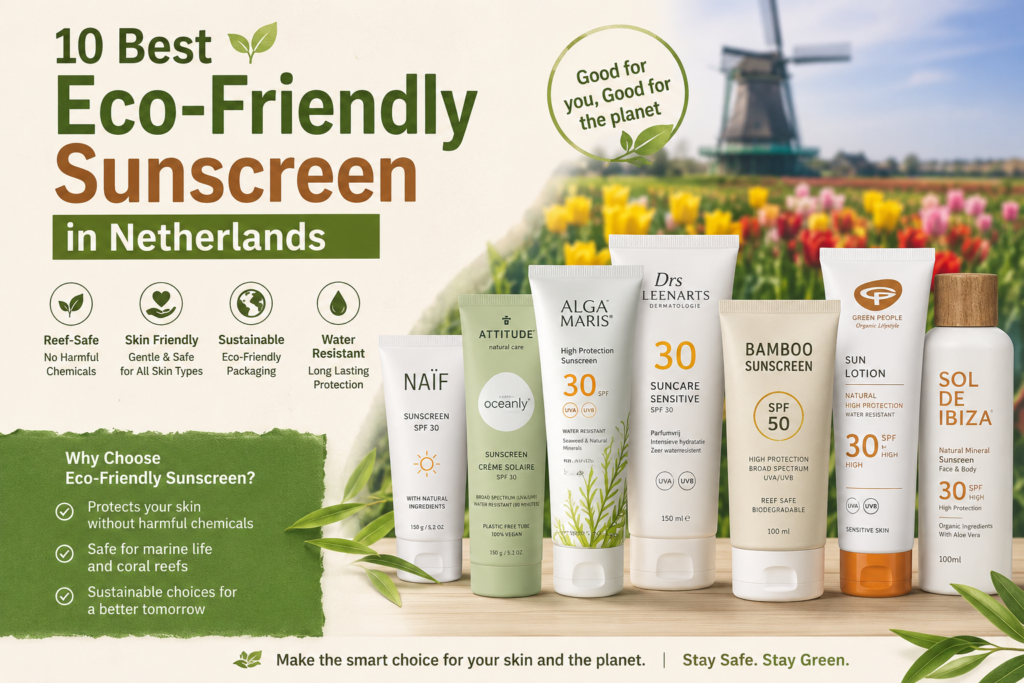
10 Best Eco-Friendly Sunscreen in Netherlands
Finding a sunscreen that protects your skin without creating unnecessary environmental impact is becoming more important for many people in the Netherlands. Whether you are spending a sunny afternoon in Amsterdam, cycling along the coast, or planning a summer holiday abroad, choosing the right sunscreen is about more than simply picking a high SPF.
This guide to the 10 Best Eco-Friendly Sunscreen in Netherlands focuses on practical factors Dutch consumers can actually use when comparing products, including UV protection, mineral filters, ingredients, water resistance, packaging, skin feel, and environmental claims. We also look at what terms such as reef-safe, ocean-friendly, mineral sunscreen, and eco-friendly really mean, rather than assuming that a green label automatically makes a product sustainable.
For Dutch shoppers, EU cosmetic requirements are an important starting point. Sunscreens sold in the European Union are regulated as cosmetic products, and sunscreen claims should provide clear and meaningful information about the level of protection offered.
If you are also travelling from the Netherlands to the United States, Hawaii is worth special attention. Hawaii has prohibited the sale and distribution of sunscreens containing oxybenzone or octinoxate without a prescription since January 1, 2021. This is why checking the actual ingredient list can be more useful than relying only on marketing terms such as “reef safe.”
The goal here is simple: help you find an eco-conscious sunscreen that offers reliable sun protection while fitting your skin type, lifestyle, budget, and sustainability priorities.
Why Switch to Eco Sunscreen?(Waarom kiezen voor duurzame zonnebrand)
Sunscreen is something most people use without thinking twice about it. But once you start looking at the ingredients, packaging, and environmental claims, the choice becomes a little less straightforward. For Dutch consumers, especially those who spend time cycling, walking, gardening, swimming or travelling, an eco-conscious sunscreen can be a practical alternative to simply choosing the highest SPF on the shelf.
The idea behind the 10 Best Eco-Friendly Sunscreen in Netherlands is not that every “green” sunscreen is automatically better. Terms such as eco-friendly, reef-safe, ocean-friendly and natural can mean different things, so it is worth looking beyond the front of the bottle.
Better awareness of ingredients
One reason people switch to eco sunscreen is to understand exactly what they are putting on their skin and what may eventually wash off into water. Mineral sunscreens commonly use UV filters such as zinc oxide or titanium dioxide, while other products rely on organic UV filters.
Importantly, a product being mineral does not automatically make it environmentally harmless, and a chemical sunscreen is not automatically unsafe. The formula, concentration, packaging, application and environmental context all matter.
In the Netherlands and across the EU, sunscreen products are regulated as cosmetics, with requirements around UV protection, claims and consumer information. The European Commission says sunscreen protection should cover dangerous UV radiation and that claims should be clear and based on standardized criteria.
Why reef-safe matters when travelling?
This is particularly relevant for Dutch travelers heading to tropical destinations. A sunscreen that is easy to buy in the Netherlands may not meet local rules elsewhere.
Hawaii is a good example. State law prohibits the sale and distribution of non-prescription sunscreens containing oxybenzone or cinoxate.
That does not mean every sunscreen without these two ingredients is automatically “reef-safe.” Hawaii’s own environmental guidance has also encouraged consumers to check ingredient lists rather than relying only on marketing language.
So, if you are searching from the US for queries such as “best reef-safe sunscreen,” “Hawaii sunscreen ingredients,” or “sunscreen safe for coral reefs,” checking the actual INCI ingredient list is a much better habit than trusting a green badge on the packaging.
Eco sunscreen can also mean less waste
Sustainability is not only about UV filters.
For a Dutch shopper, the packaging can be just as interesting. Some brands use recycled plastic, cardboard packaging, refill systems or smaller packaging designs to reduce material use. Others focus on concentrated formulas that require less packaging.
Still, “plastic-free” or “zero-waste” should not be treated as proof that a sunscreen is environmentally superior. A useful comparison looks at the whole product—ingredients, packaging, durability, transport and how effectively you can use it without excessive waste.
Skin protection still comes first
There is one point where sustainability should never compromise your decision: adequate sun protection.
An eco-friendly sunscreen is only useful if you apply enough of it and reapply when needed. Water resistance, SPF level, UVA protection, skin type and your planned activity should all be considered before environmental features.
For someone spending a normal summer day in the Netherlands, the best product may be different from the one you would choose for a long beach day in Spain, Greece or Hawaiʻi.
That is why this list focuses on a balance of sun protection, ingredients, usability and sustainability, rather than simply picking products because they carry an “eco” label.
What Makes SPF Microplastic-Vrij & Reef-Safe?
If you are shopping for sunscreen in the Netherlands, you may come across terms such as microplastic-vrij, reef-safe, ocean-friendly or mineral sunscreen. They sound reassuring, but they are not interchangeable. A closer look at the ingredients and the product claims can tell you much more than the label on the front of the bottle.
For our 10 Best Eco-Friendly Sunscreen in Netherlands, we consider environmental claims alongside the things that matter most in everyday use: reliable UV protection, ingredients, skin feel, water resistance and packaging.
What does microplastic-vrij actually mean?
“Microplastic-vrij” simply means free from intentionally added microplastic particles, but consumers should be careful with broad marketing claims.
The EU has introduced restrictions on intentionally added synthetic polymer microparticles under its chemicals legislation, with different transition periods depending on the product and substance. ECHA explains that the restrictions are aimed at reducing the use of intentionally added microplastics in consumer and professional products.
For Dutch shoppers, this makes the ingredient list worth checking. Instead of choosing a product solely because it says “plastic-free,” look for transparent ingredient information and credible sustainability claims.
And there is another detail people sometimes miss: microplastic-free does not mean plastic-free packaging. A sunscreen can avoid intentionally added microplastic particles while still being sold in a conventional plastic tube.
What does reef-safe mean?
“Reef-safe” is one of the trickier sunscreen terms because there is no single worldwide definition that applies to every market.
If you see an American search such as “best reef-safe sunscreen,” “reef-safe sunscreen for Hawaii,” or “Hawaii sunscreen ingredients,” the local rules matter. Hawaiʻi restricts the sale and distribution of sunscreens containing oxybenzone or octinoxate, subject to the statutory prescription exception.
That is different from the rules governing sunscreens sold in the Netherlands. In the EU, permitted UV filters are listed under the Cosmetics Regulation, including specific conditions and concentration limits.
So, a sunscreen being legally sold in the Netherlands does not automatically mean it satisfies every destination’s local environmental requirements.
Does mineral sunscreen automatically mean reef-safe?
Not necessarily.
Mineral sunscreens often use zinc oxide or titanium dioxide as UV filters. These ingredients are widely used in sun-protection products, but the word “mineral” alone does not prove that a particular formula has no environmental impact.
The same principle applies to natural, clean and ocean-friendly. These descriptions can be useful starting points, but they should not replace checking the actual formulation and the manufacturer’s evidence behind its environmental claims.
A simple checklist for Dutch shoppers
Before buying an eco-conscious sunscreen, check:
- SPF: Is the protection level appropriate for your skin and planned exposure?
- UVA protection: Look beyond the SPF number alone.
- UV filters: Check which filters are actually used.
- Microplastic claim: Look for credible ingredient information rather than relying only on a green label.
- Packaging: Consider whether the tube or container is recyclable, contains recycled material or uses unnecessary layers.
- Water resistance: Useful for swimming and active days, but reapplication is still important.
- Travel destination: Check local sunscreen regulations before travelling, particularly to places such as Hawaiʻi.
- Skin compatibility: An environmentally preferable product is not a good choice if it irritates your skin or is unpleasant enough that you avoid using it.
The line is simple: microplastic-vrij and reef-safe are useful search terms, but neither should be treated as a guarantee of overall sustainability. For Dutch consumers, the smarter approach is to combine transparent ingredients, credible claims, effective UV protection and sensible packaging choices.
Top 10 Duurzame Zonnebrand
Choosing an eco-friendly sunscreen in the Netherlands is not simply about finding a bottle with a green label. We looked at the things that matter in real life: UV protection, formula, skin comfort, packaging, sustainability credentials and how useful the product is for different types of Dutch consumers.
Our 10 Best Eco-Friendly Sunscreen in Netherlands list includes Dutch brands as well as European options that are relevant to shoppers in the Netherlands. The list is also useful if you are travelling to the US or Hawaiʻi, where sunscreen regulations can differ from European requirements.
1. Naïf Natural Sunscreen SPF 30 / 50 — Best Overall Dutch Pick
Naïf is a natural skincare brand from the Netherlands and is a strong option for shoppers who prefer a locally familiar brand.
Its sunscreen range is designed for everyday sun protection, making it a practical choice for Dutch families and outdoor use. If sustainability is important to you, check the current packaging and ingredient information before buying, as formulations and packaging can change.
Best for: Families and everyday Dutch use
Why consider it: Dutch brand, natural-skincare focus, SPF 30/50 options
2. Loveli Natural Sun Protection — Best for a Minimalist Routine
Loveli is another Netherlands-based name worth considering if you prefer a more minimalist approach to personal care.
The brand has built its identity around natural skincare and refill-oriented thinking. For environmentally conscious shoppers, that wider brand philosophy can be just as interesting as the sunscreen itself.
Best for: Conscious shoppers who prefer minimalist personal care
Why consider it: Dutch brand and sustainability-focused approach
3. Dr. Jetske Ultee Suncover SPF 30 / 50 — Best Dermatologist-Led Option
Dr. Jetske Ultee stands out for consumers who put skin protection ahead of trendy “clean beauty” language.
Suncover is designed for the face and body and protects against both UVA and UVB radiation. The brand says the formula is water resistant, perfume-free and suitable for adults and children. Its Suncover product is also described by the company as a non-profit product.
Best for: Families and people who prioritise evidence-led skincare
Why consider it: UVA/UVB protection, water resistance, perfume-free options and dermatologist-led development
4. Food for Skin SPF 30 — Best Dutch Mineral Option
Food for Skin is particularly interesting for shoppers looking for a mineral sunscreen made in the Netherlands.
Its SPF 30 sunscreen uses non-nano, uncoated zinc oxide as the mineral UV filter. The company also states that the product is fragrance-free, suitable for face and body, and packaged in a tube made with 100% post-consumer recycled plastic.
Best for: Shoppers looking for a Dutch mineral sunscreen
Why consider it: Non-nano zinc oxide, fragrance-free formula and recycled-plastic packaging
5. Witlof Skincare SPF 30 — Best for Sustainability-Minded Shoppers
Witlof Skincare is worth a look if you want to explore smaller Dutch skincare brands rather than choosing only large international names.
For this product, check the latest ingredient list and packaging information before purchase. That is especially important when sustainability is one of your main buying criteria.
Best for: Consumers who like independent Dutch skincare brands
Why consider it: Local brand perspective and sustainability-oriented positioning
6. Drs Leenarts Suncare — Best Dutch Dermatology Brand
Drs Leenarts combines a dermatology-led approach with a strong sustainability focus.
The company became a Certified B Corporation in October 2024, with B Lab reporting an overall B Impact Score of 92.3. That gives consumers a more concrete sustainability signal than an unverified “eco” badge alone.
Best for: Consumers who value independently verified sustainability credentials
Why consider it: Dutch dermatology brand and B Corp certification
7. Suntribe Mineral Sunscreen — Best for Zero-Waste-Minded Buyers
Suntribe is a useful choice for people specifically interested in mineral UV filters and lower-impact packaging options.
Suntribe’s current products include non-nano mineral formulas using zinc oxide and, depending on the product, titanium dioxide. Its SPF 30 product is marketed as reef-safe and states 0% microplastics; the company also provides the full ingredient list online.
One important distinction: packaging differs between products, so do not assume every Suntribe sunscreen uses the same packaging format.
Best for: Mineral-sunscreen users and environmentally conscious travellers
Why consider it: Mineral filters, transparent ingredient information and sustainability-focused product design
8. The Ohm Collection Sun Safe — Best Natural-Style Alternative
The Ohm Collection is another option for shoppers who prefer naturally positioned skincare.
Before choosing it specifically for reef travel, check the current formula and the environmental requirements of your destination. “Reef-safe” is not a universal legal certification, and different destinations can apply different standards.
Best for: Shoppers interested in natural-style sunscreen
Why consider it: Alternative to conventional sunscreen brands
9. MÁDARA Plant Stem Cell SPF 30 / 50 — Best Mineral Face Option
MÁDARA is a strong European option for consumers who want mineral sunscreen with a skincare-focused formula.
The SPF 30 Plant Stem Cell Age-Defying Face Sunscreen uses mineral UV filters and provides broad-spectrum UVA/UVB protection. The current formula is described as 100% mineral and without synthetic UV filters or nano zinc oxide. It also carries a COSMOS Natural certification.
MÁDARA also says its packaging uses recycled materials and that its primary tubes, bottles and flacons have been recyclable since 2006.
Best for: Face-focused daily sunscreen users
Why consider it: Mineral SPF, COSMOS Natural certification and sustainability-focused packaging
10. Green People Scent-Free Sun Cream SPF 30 — Best for Sensitive Skin
Green People is a useful choice for people who find fragrance-heavy sunscreens uncomfortable.
Its Scent Free SPF30 is marketed as natural, organic and suitable for sensitive skin. The current formula includes non-nano zinc oxide alongside other UV filters, and the brand describes the product as vegan, cruelty-free and unscented.
The brand also specifically states that the product is free from oxybenzone and octinoxate, which may be relevant when comparing products for travel to destinations with restrictions on those ingredients.
Best for: Sensitive and fragrance-averse skin
Why consider it: Unscented formula, organic ingredients and transparent ingredient information
A Quick Way to Choose:
| If you want… | Consider |
|---|---|
| A Dutch everyday option | Naïf |
| A Dutch mineral sunscreen | Food for Skin |
| Dermatologist-led skincare | Dr. Jetske Ultee Suncover |
| A verified sustainability credential | Drs Leenarts |
| Mineral + microplastic-focused claims | Suntribe |
| Mineral face sunscreen | MÁDARA |
| Sensitive-skin option | Green People |
What About “Reef-Safe” for US and Hawaiʻi Travel?
If you are buying sunscreen in the Netherlands but travelling to the United States, do not assume that European availability equals compliance with every local rule.
Hawaiʻi’s law restricts the sale and distribution of sunscreens containing oxybenzone or octinoxate, subject to the statutory prescription exception. That is why travellers searching for terms such as “best reef-safe sunscreen,” “Hawaii sunscreen,” or “reef-safe sunscreen for Hawaii” should check the actual ingredient list before travelling.
Just as importantly, reef-safe is not a universal certification. A product can avoid ingredients restricted in Hawaiʻi without being automatically “environmentally safe” in every marine environment.
For Dutch shoppers, the safest approach is simple: choose a sunscreen with reliable UVA/UVB protection first, then compare its ingredients, packaging and sustainability evidence rather than trusting environmental marketing alone.
Hoe Kies Je de Beste Duurzame Zonnebrand?
Een duurzame zonnebrand kiezen klinkt eenvoudig, totdat je voor het schap staat en tientallen opties ziet: mineraal, biologisch, microplasticvrij, reef-safe, vegan, navulbaar… Welke claim zegt nu echt iets?
Voor deze 10 Best Eco-Friendly Sunscreen in Netherlands kijken we daarom verder dan alleen het etiket. Een goede keuze moet in de eerste plaats voldoende bescherming tegen UVA en UVB bieden. Daarna kun je kijken naar de ingrediënten, verpakking, huidtype en de onderbouwing van duurzaamheidsclaims.
1. Physical/Mineral (Non-Nano Zinc) vs. Chemical UV Filters
Een van de eerste keuzes is het type UV-filter.
Minerale zonnebrand gebruikt bijvoorbeeld zinkoxide of titaniumdioxide als UV-filter. Producten met non-nano zinkoxide zijn populair bij consumenten die specifiek op zoek zijn naar een minerale formule.
Chemische of organische UV-filters werken op een andere manier en worden veel gebruikt in moderne zonnebrandformules. Het is te simpel om te zeggen dat de ene categorie altijd “veilig” is en de andere niet. Voor consumenten in Nederland is het belangrijker om te controleren welke UV-filters daadwerkelijk in het product zitten en of het product voldoet aan de Europese cosmeticaregels.
Praktische tip: kies eerst een product met betrouwbare UVA- en UVB-bescherming dat je prettig vindt om dagelijks te gebruiken. Duurzaamheid komt daarna als belangrijke extra factor.
2. Packaging Matters: Aluminum Tins, Sugarcane Tubes and Glass Bottles
Duurzaamheid stopt niet bij de ingrediënten. De verpakking telt ook mee.
Je kunt bijvoorbeeld aluminium blikjes, gerecycled plastic, biobased tubes, glazen verpakkingen of navulsystemen tegenkomen. Elk materiaal heeft zijn eigen voor- en nadelen op het gebied van productie, transport, gebruik en recycling.
Een sugarcane-based tube betekent bovendien niet dat de volledige verpakking uit suikerriet bestaat. Kijk daarom altijd naar wat de fabrikant precies bedoelt met een biobased of gerecyclede verpakking.
Hetzelfde geldt voor glas. Een glazen fles kan aantrekkelijk klinken vanuit duurzaamheidsoogpunt, maar is zwaarder tijdens transport en niet altijd de meest praktische keuze voor een strandtas.
Waar je op kunt letten:
- Is de verpakking recyclebaar in Nederland?
- Bevat de verpakking gerecycled materiaal?
- Is er onnodige extra verpakking?
- Biedt het merk een navuloptie?
- Worden duurzaamheidsclaims duidelijk uitgelegd?
Zo voorkom je dat je alleen op een mooi groen ontwerp of een “eco” logo afgaat.
3. Waar te koop in Nederland?
Voor Nederlandse consumenten hoeft duurzame zonnebrand niet moeilijk te vinden te zijn. Je kunt verschillende merken tegenkomen bij drogisterijen, natuurwinkels, gezondheidswinkels en gespecialiseerde webshops.
Bekende winkelketens zoals Holland & Barrett en Etos kunnen interessant zijn voor consumenten die producten eerst in een fysieke winkel willen bekijken. Voor biologische en natuurlijk georiënteerde producten kan Ekoplaza Stratumsedijk – biologische supermarkt eveneens een optie zijn.
Het assortiment verschilt echter per filiaal en kan regelmatig veranderen. Controleer daarom vóór aankoop de actuele beschikbaarheid en vooral de ingrediëntenlijst, SPF, UVA-bescherming en verpakkingsinformatie.
Online kopen geeft je vaak meer mogelijkheden om ingrediënten en duurzaamheidsinformatie rustig te vergelijken. Dat is vooral handig wanneer je specifiek zoekt naar termen als:
- duurzame zonnebrand Nederland
- microplasticvrije zonnebrand
- minerale zonnebrand SPF 30
- reef-safe sunscreen
- beste zonnebrand voor gevoelige huid
- eco-friendly sunscreen Netherlands
4. Reis je naar de VS of Hawaï? Controleer de ingrediënten
Voor een vakantie in de Verenigde Staten is het verstandig om niet alleen naar de term “reef-safe” te kijken.
Hawaï heeft sinds 2021 beperkingen op de verkoop en distributie van zonnebrandmiddelen met oxybenzone of octinoxate, met een uitzondering voor producten die op recept worden verstrekt.
Dat maakt vragen als “What sunscreen is reef-safe in Hawaii?”, “best reef-safe sunscreen” en “Hawaii sunscreen ingredients” relevant voor Nederlandse reizigers.
Let wel: een product zonder oxybenzone en octinoxate is daarmee niet automatisch wereldwijd gecertificeerd als “reef-safe”. De term heeft geen universele betekenis. Controleer daarom altijd de actuele regels van je bestemming én de volledige ingrediëntenlijst.
5. Kijk verder dan één duurzaamheidsclaim
De beste duurzame zonnebrand is niet noodzakelijk degene met de meeste groene claims op de verpakking.
Een betere aanpak is om het hele product te bekijken:
UV-bescherming → ingrediënten → huidcomfort → verpakking → duurzaamheidsclaims → prijs → gebruiksgemak.
Als een zonnebrand prettig aanvoelt, voldoende bescherming biedt en je hem consequent gebruikt, heb je uiteindelijk meer aan dat product dan aan een “perfect” duurzaam product dat je nauwelijks wilt aanbrengen.
Dat is ook de reden waarom we in deze gids niet alleen naar één milieukenmerk kijken. Voor Nederlandse consumenten gaat het om een realistische balans tussen huidbescherming en een bewustere productkeuze.
FAQ – Veelgestelde Vragen over Zonnebrand
1. Wat is de beste eco-friendly zonnebrand in Nederland?
Er is niet één zonnebrand die voor iedereen de beste keuze is. De juiste optie hangt af van je huidtype, SPF-behoefte, ingrediënten, gebruik en hoeveel waarde je hecht aan verpakking en duurzaamheid.
In onze 10 Best Eco-Friendly Sunscreen in Netherlands vergelijken we daarom verschillende opties in plaats van alleen naar één “groene” claim te kijken. Let vooral op goede UVA- en UVB-bescherming, een formule die je prettig vindt en duidelijke informatie over de ingrediënten. De Europese Commissie benadrukt dat zonnebrandproducten consumenten duidelijke informatie moeten geven over hun beschermingsniveau en correct gebruik.
2. Is minerale zonnebrand beter voor het milieu?
Niet automatisch.
Minerale zonnebrand gebruikt UV-filters zoals zinkoxide of titaniumdioxide. Sommige consumenten kiezen hiervoor omdat deze filters ook populair zijn bij mensen die een reef-conscious sunscreen zoeken.
Maar “mineraal” betekent niet automatisch “duurzaam”. Kijk ook naar de verpakking, productie, transport, gebruik en de onderbouwing van de duurzaamheidsclaims.
3. Wat betekent “microplasticvrij” bij zonnebrand?
Microplasticvrij verwijst meestal naar het vermijden van bepaalde opzettelijk toegevoegde synthetische polymeerdeeltjes. Het betekent echter niet automatisch dat het hele product of de verpakking volledig vrij is van kunststof.
Als dit voor jou belangrijk is, kijk dan naar de actuele ingrediëntenlijst en de uitleg van de fabrikant. Een duidelijke claim met onderbouwing is waardevoller dan alleen een groot “eco” logo op de voorkant.
4. Is “reef-safe” hetzelfde als “rifvriendelijk”?
Nee, niet helemaal.
“Reef-safe” is geen universele wereldwijde certificering. De betekenis van de term kan per merk en markt verschillen. Daarom is het verstandig om de ingrediënten te controleren in plaats van alleen op de woorden “reef-safe” of “ocean-friendly” te vertrouwen.
Dit is vooral relevant wanneer je vanuit Nederland naar een tropische bestemming reist.
5. Welke zonnebrand mag je gebruiken in Hawaii?
Hawaï heeft specifieke regels rond zonnebrand. De staat verbiedt de verkoop en distributie van zonnebrandmiddelen met oxybenzone of octinoxate, met de wettelijke uitzondering voor producten die op recept worden verstrekt. De Hawaiʻi Division of Aquatic Resources adviseert bezoekers bovendien om zonnebrand zonder deze twee ingrediënten te gebruiken.
Daarom is het verstandig om vóór vertrek de ingrediëntenlijst van je zonnebrand te controleren.
Voor zoekopdrachten zoals “best reef-safe sunscreen for Hawaii”, “Hawaii sunscreen ingredients” en “what sunscreen can I use in Hawaii?” is dezelfde praktische regel belangrijk: controleer de ingrediënten en de actuele lokale voorschriften.
6. Is SPF 50 altijd beter dan SPF 30?
Niet per definitie.
Een hogere SPF kan extra UVB-bescherming bieden, maar SPF is niet het enige waarop je moet letten. UVA-bescherming is eveneens belangrijk, en een zonnebrand moet correct en voldoende worden aangebracht.
De Europese Commissie adviseert dat consumenten producten kiezen met bescherming tegen de relevante UV-straling en duidelijke informatie over de mate van bescherming.
Voor dagelijks gebruik in Nederland kan SPF 30 voor sommige situaties voldoende zijn, terwijl SPF 50 een logische keuze kan zijn bij sterkere blootstelling, een vakantie of een gevoelige huid.
7. Is natuurlijke zonnebrand geschikt voor een gevoelige huid?
Dat hangt van de formule af.
“Natuurlijk” betekent niet automatisch dat een product geschikt is voor iedere gevoelige huid. Parfum, bepaalde plantenextracten of andere ingrediënten kunnen bij sommige mensen irritatie veroorzaken.
Heb je een gevoelige huid, kijk dan vooral naar een eenvoudige formule, parfumvrije opties en ingrediënten die je huid goed verdraagt. Test bij twijfel eerst een kleine hoeveelheid.
8. Welke verpakking is het meest duurzaam: aluminium, glas of biobased plastic?
Er is geen universele winnaar.
Aluminium kan sterk en recyclebaar zijn. Glas is goed te recyclen, maar is zwaarder en daardoor minder handig voor reizen. Biobased plastic kan een deel van fossiele grondstoffen vervangen, maar “biobased” betekent niet automatisch composteerbaar of volledig plasticvrij.
Voor Nederlandse consumenten is het daarom slimmer om te kijken naar de volledige verpakking: materiaal, gerecycled aandeel, recyclebaarheid en hoeveel extra verpakking wordt gebruikt.
9. Waar kan ik duurzame zonnebrand kopen in Nederland?
Duurzame en natuurlijke zonnebrand is verkrijgbaar via verschillende drogisterijen, natuurwinkels en online winkels. Het assortiment verschilt echter per winkel en seizoen.
Je kunt onder andere zoeken bij bekende Nederlandse retailers zoals Etos, Holland & Barrett en Ekoplaza, maar controleer vóór aankoop altijd de actuele productinformatie.
Online vergelijken kan handig zijn wanneer je specifiek zoekt naar:
- duurzame zonnebrand Nederland
- microplasticvrije zonnebrand
- minerale zonnebrand SPF 30 of SPF 50
- reef-safe sunscreen
- zonnebrand voor gevoelige huid
- eco-friendly sunscreen Netherlands
10. Kan ik Nederlandse eco-zonnebrand meenemen naar de VS?
In principe kun je een product meenemen, maar lokale regels en bestemmingseisen kunnen verschillen. Vooral wanneer je naar Hawaï reist, is het verstandig om vooraf de ingrediëntenlijst te controleren.
Een product dat in Nederland legaal wordt verkocht, voldoet niet automatisch aan iedere lokale regel in de Verenigde Staten.
11. Is zonnebrand zonder oxybenzone automatisch reef-safe?
Nee.
Het vermijden van oxybenzone is relevant voor Hawaï, maar het ontbreken van één ingrediënt maakt een product niet automatisch wereldwijd “reef-safe”. De Hawaiʻi Division of Aquatic Resources adviseert specifiek om producten zonder oxybenzone en octinoxate te gebruiken, maar benadrukt ook het belang van verantwoord gedrag rond koraalriffen.
Daarom is “zonder oxybenzone” een ingrediëntclaim, geen universele milieucertificering.
12. Waar moet ik uiteindelijk op letten bij het kopen van eco-friendly sunscreen?
Maak het jezelf eenvoudig. Kijk eerst naar:
SPF + UVA-bescherming → huidtype → ingrediënten → waterbestendigheid → verpakking → duurzaamheidclaims → prijs.
Een zonnebrand die je prettig vindt en consequent gebruikt, is in de praktijk waardevoller dan een product met indrukwekkende eco-claims dat je nauwelijks wilt aanbrengen.
Dat is de kern van deze lijst: goede zonbescherming combineren met een bewustere keuze voor huid, product en verpakking.
Conclusie & Eindoordeel:
Een goede duurzame zonnebrand hoeft niet perfect te zijn op elk vlak. Voor de meeste mensen in Nederland is het belangrijker dat de zonnebrand betrouwbare UVA- en UVB-bescherming biedt, prettig aanvoelt en consequent wordt gebruikt. Daarna kun je kijken naar de ingrediënten, verpakking en de manier waarop een merk zijn duurzaamheidsclaims onderbouwt.
Na het vergelijken van verschillende merken in deze 10 Best Eco-Friendly Sunscreen in Netherlands-gids zijn vooral Nederlandse en Europese opties interessant voor consumenten die bewust willen kopen zonder in te leveren op dagelijkse zonbescherming.
Onze belangrijkste conclusie
Naïf is een logische keuze voor wie graag bij een Nederlands merk blijft. Dr. Jetske Ultee past goed bij consumenten die een dermatologisch onderbouwde benadering belangrijk vinden. Food for Skin is interessant voor wie specifiek naar een Nederlandse minerale optie kijkt, terwijl Drs Leenarts opvalt door de combinatie van dermatologie en een onafhankelijke B Corp-certificering.
Voor een minerale, meer sustainability-focused keuze zijn Suntribe en MÁDARA het bekijken waard. Wie vooral een parfumvrije optie voor een gevoelige huid zoekt, kan Green People overwegen.
Maar er is geen universele nummer één.
Waar moet je als Nederlandse consument uiteindelijk op letten?
Gebruik deze eenvoudige volgorde:
1. UVA + UVB-bescherming
2. Geschikte SPF voor jouw situatie
3. Ingrediënten die je huid goed verdraagt
4. Waterbestendigheid wanneer je die nodig hebt
5. Verpakking en recyclebaarheid
6. Controleer duurzaamheidsclaims
De Europese Commissie benadrukt dat zonnebrandproducten bescherming tegen relevante UVA- en UVB-straling moeten bieden en dat informatie over bescherming en correct gebruik duidelijk moet zijn.
Ga je vanuit Nederland naar de VS of Hawaï?
Dan is een extra controle verstandig. Hawaï heeft specifieke beperkingen op zonnebrandmiddelen met oxybenzone en octinoxate, met een uitzondering voor producten die op recept worden verstrekt.
Zoek je bijvoorbeeld naar “best reef-safe sunscreen for Hawaii” of “Hawaii sunscreen ingredients”, kijk dan altijd naar de daadwerkelijke ingrediëntenlijst. De Hawaiʻi Division of Aquatic Resources merkt bovendien op dat “reef safe” geen door een overheidsinstantie gereguleerde claim is.
Kort gezegd: kies niet alleen de zonnebrand met het groenste etiket. Kies een product dat je huid goed beschermt, dat je daadwerkelijk prettig vindt om te gebruiken en waarvan de duurzaamheidsclaims controleerbaar zijn. Dat is voor de meeste Nederlandse consumenten een veel realistischer én verstandigere duurzame keuze.
About the Author:
Hi, I’m Govind Singh, a passionate blogger and digital content creator who enjoys researching practical topics around sustainable living, eco-friendly products, and conscious consumer choices. I’m not a dermatologist or professional skincare consultant. Instead, I focus on researching product information, ingredient lists, sustainability claims, and reliable guidance from official and trusted sources.
For articles such as 10 Best Eco-Friendly Sunscreen in Netherlands, my aim is to make product research easier for everyday readers—especially Dutch consumers who want to understand terms such as mineral sunscreen, microplastic-free, reef-safe, UVA/UVB protection, and sustainable packaging.
I also compare European guidance with relevant international information, such as U.S. and Hawaiʻi sunscreen requirements, when it is useful for readers who travel. My goal is simple: provide clear, practical and transparent information so readers can make more informed sunscreen choices without relying only on marketing claims.
Recommended External Resources.
| Resource | Waarom relevant voor het artikel |
|---|---|
| European Commission – Sunscreen Products | Achtergrond over sunscreen, UV-bescherming en EU-regels. |
| ECHA – Allowed UV Filters in Cosmetics | Officiële EU-informatie over toegestane UV-filters en voorwaarden. |
| NVWA – Cosmetica | Nederlandse informatie over veiligheidseisen en toezicht op cosmetica, waaronder zonnebrand. |
| NVWA – SPF Zonnebrandmiddelen Onderzoek | Sterke bron voor je SPF-sectie; NVWA onderzocht in 2023 of zonnebrandmiddelen de SPF op het etiket daadwerkelijk haalden. |
| NVWA – Tips voor cosmetica consumenten | Handige bron over ingrediënten, etiketten, irritatie en allergische reacties. |
| ECHA – Zinc Oxide as UV Filter | Relevant voor je uitleg over mineral sunscreen en zinc oxide. |
zero waste kitchen products 2026
Wetgeving Energieakkoord 2026