
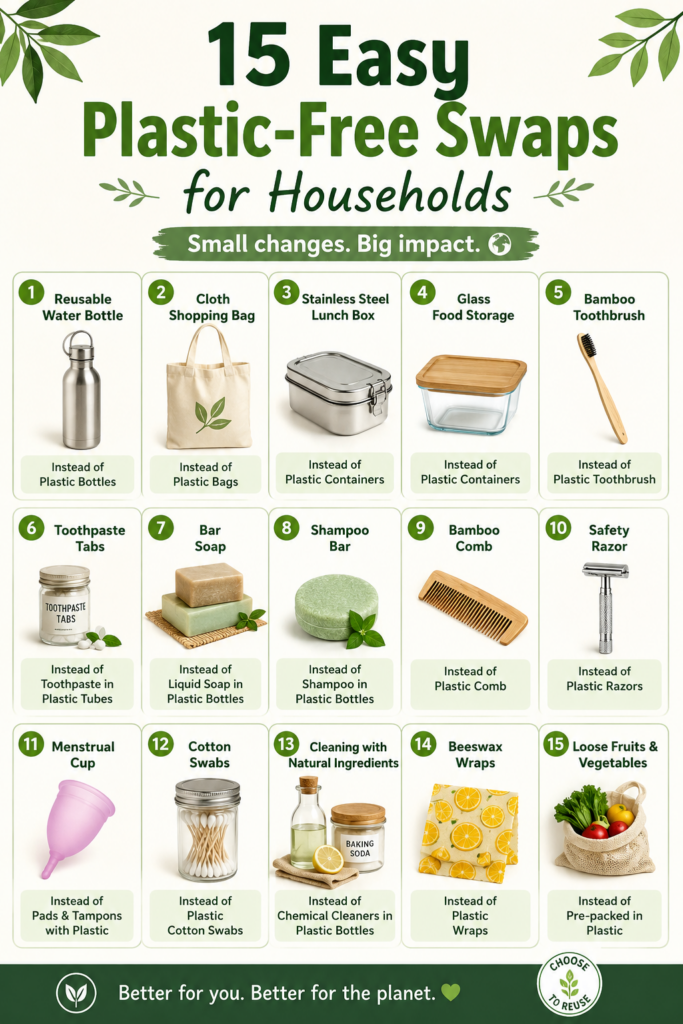
15 Easy Plastic-Free Swaps for Households
Cutting down on plastic at home does not mean throwing out everything you own and starting again. For most Australian families, renters and homeowners, the easiest approach is to replace a few everyday disposable items with practical reusable alternatives when they need replacing.
These 15 Easy Plastic-Free Swaps for Households focus on simple changes you can make in the kitchen, bathroom, laundry and while shopping. Think reusable shopping bags, glass food containers, refillable cleaning products, washable alternatives to disposable kitchen items and other small swaps that can fit into a normal Australian household routine.
There is a good reason to start with everyday items. Australia is continuing to reduce problematic and unnecessary single-use plastics, with governments working towards more consistent approaches across states and territories. At the same time, recycling is not a complete solution on its own. The Australian Government recommends reducing and reusing where possible and checking local recycling instructions because kerbside rules can vary between councils.
The goal is not to create a “perfect” plastic-free home. It is to buy less disposable stuff, reuse what you already have, and choose durable alternatives that make sense for your budget and lifestyle. Some swaps may save money over time, while others are simply an easy way to reduce the amount of waste leaving your home.
In this guide, we’ll look at 15 realistic plastic-free swaps for Australian households, including what to replace, what to use instead, where each swap makes the most sense, and a few things to check before buying a supposedly “eco-friendly” alternative.
Why Plastic-Free Swaps Matter for Australian Homes in 2026
For many Australian households, reducing plastic waste is no longer about trying to live a completely “plastic-free” life. It is about noticing the things that get used once, thrown away and quickly replaced — then finding a practical alternative that can be used again and again.
That might mean keeping a reusable shopping bag in the car, switching from disposable food wrap to reusable containers, or choosing a refill option when you next run out of household cleaning products. Small changes can be easier to maintain than a complete lifestyle overhaul.
Australia has also been taking action on problematic and unnecessary single-use plastics through national, state and territory measures. However, the rules are not identical everywhere. Different states and territories have introduced their own restrictions and phase-outs, while local recycling arrangements can also vary.
That is why these 15 Easy Plastic-Free Swaps for Households focus on everyday choices rather than unrealistic promises. The aim is simple: buy fewer disposable products, get more use from the things you already own and make sensible replacements when something reaches the end of its useful life.
The Impact of Single-Use Plastics on Australian Wildlife & Beaches
Australia’s coastline and waterways make plastic litter a particularly visible issue. Lightweight packaging, bags, food containers, takeaway items and other discarded plastics can escape household and commercial waste streams and become litter.
For wildlife, the problem is not simply how much plastic exists. The type, size and location of the litter matter too. Animals can become entangled in larger items or mistake smaller pieces for food.
That is one reason prevention matters. Recycling has an important role, but it cannot recover every plastic item, and not every product belongs in a kerbside recycling bin. Australian Government guidance encourages households to reduce waste and check local recycling requirements rather than assuming every plastic item is recyclable.
There is also a practical household lesson here: the best waste is often the waste you never create in the first place.
Replacing a disposable item with a durable reusable one can therefore make sense when the replacement is actually used repeatedly. Buying a new “eco” product every few months simply because it looks greener is a different story.
Joining the Plastic Free July Movement All Year Round
Plastic Free July has helped turn plastic reduction into a simple challenge that people can understand: look at the disposable plastic products you use and see which ones you can avoid.
But you do not have to wait until July.
Australian families can use the same idea throughout the year by choosing one household category at a time. Start with shopping bags this month. Look at food storage next month. Then tackle bathroom products, cleaning supplies or takeaway habits.
This approach is especially useful for renters because most of these changes do not require permanent alterations to a home. Homeowners can take the same approach, while families can involve children by making simple swaps part of the normal household routine.
The Australian Government’s packaging framework is also moving towards better packaging design, with a focus on increasing recyclability and reducing the amount of packaging that becomes litter.
Still, there is an important distinction between government policy and personal household choices. A product being subject to a plastic restriction does not automatically mean every alternative is environmentally perfect. Materials, manufacturing, transport, durability and end-of-life disposal all matter.
For shoppers, that means a useful rule of thumb is:
Use what you already have → reuse it for as long as practical → replace disposable products thoughtfully → check how the replacement should be disposed of.
Why This Matters in Australia?
Plastic rules can differ between states and territories. For example, government reporting shows that jurisdictions have introduced different restrictions covering products such as shopping bags, straws, cutlery, expanded polystyrene food packaging and other single-use plastics.
So an Australian guide should not simply copy advice written for the United States or United Kingdom and replace a few words with “Australia”. What is accepted in a household recycling service, what products are restricted and what disposal options are available can depend on where you live.
That is why, before putting an item into your recycling bin, it is sensible to check your local council’s current recycling guidance.
The goal of going plastic-free does not have to be perfection. For most households, the more realistic goal is less single-use plastic, fewer unnecessary purchases and more thoughtful reuse.
Kitchen & Food Storage Swaps: Ditching Single-Use Cling Wrap
The kitchen is often the easiest place to notice how much disposable packaging a household goes through. A roll of cling wrap, a handful of produce bags or another takeaway container may seem insignificant on its own. Over a year, though, those small habits can add up.
The good news is that you do not need to replace everything at once. For Australian families, renters and homeowners, a few practical food-storage and shopping swaps can reduce the amount of single-use plastic coming into the kitchen without making everyday life complicated.
One important point: plastic-free does not automatically mean environmentally better. A reusable product only makes sense if you actually use it repeatedly and look after it. The material, durability, cleaning requirements and eventual disposal all matter.
Swap 1: Beeswax Wraps Instead of Cling Wrap
If cling wrap is something you reach for several times a week, beeswax wraps can be a useful reusable alternative for certain foods.
They work particularly well for covering bowls, wrapping sandwiches, protecting cut fruit and keeping snacks covered. After use, most beeswax wraps can be wiped or washed according to the manufacturer’s instructions and used again.
There is a catch, though. Beeswax wraps are not a universal replacement for cling wrap. You should follow the manufacturer’s food-use instructions and avoid using them in situations where the material is unsuitable, such as direct contact with very hot food.
For Australian shoppers, it is also worth checking exactly what the wrap contains. Some products marketed as “beeswax wraps” contain cotton fabric coated with beeswax, plant oils and resin, while formulations vary between brands.
Best for: sandwiches, snacks, fruit, bowls and everyday food covering.
Not ideal for: hot food or uses specifically excluded by the manufacturer.
Money tip: If you already own containers with lids, use those first. Buying another reusable product is not automatically a saving.
Swap 2: Glass Containers & Silicone Lids for Leftovers
Leftovers are where a reusable container can earn its place in the kitchen.
Instead of covering a half-used meal with cling wrap or transferring food into a disposable container, use a durable glass container with a suitable reusable lid. Glass can also make it easier to see what is sitting in the fridge, which may help prevent forgotten leftovers.
For Australian households, the important consideration is food safety and intended use. Food Standards Australia New Zealand (FSANZ) advises that food-contact packaging should be fit for its intended purpose and clean and undamaged. Temperature, food type, storage time, freezing, microwaving and cleaning can all affect whether packaging is suitable.
So before putting a glass container or silicone lid in the microwave, freezer or dishwasher, check the manufacturer’s instructions.
Glass has another advantage: it is durable, but it is not indestructible. A cracked or badly damaged container should not continue to be used for food storage.
Best for: leftovers, meal preparation, fridge storage and pantry organisation.
Check before buying: food-contact suitability, lid material, microwave/freezer instructions and dishwasher compatibility.
Swap 3: Reusable Mesh Produce Bags for Coles & Woolworths Shopping
Fruit and vegetables are another simple place to reduce disposable plastic.
Reusable mesh produce bags can be used for apples, carrots, leafy vegetables, herbs and other loose produce. They are particularly handy if you regularly buy unpackaged fruit and vegetables from supermarkets or local markets.
There is a useful Australian detail here: not every reusable produce bag is actually plastic-free. Some are made from polyester or recycled polyester. For example, a current Coles reusable mesh produce bag is listed as polyester, while Woolworths says its own reusable produce bags contain at least 80% recycled materials.
That does not make them useless. Their main benefit is that they can replace a stream of single-use produce bags with something designed to be used repeatedly.
If you shop at Coles or Woolworths, keep a few clean bags in your shopping trolley, car or near the front door. That simple habit is often more effective than buying an expensive “zero-waste” kit and forgetting it at home.
Best for: loose fruit, vegetables, herbs and some bulk foods.
Practical tip: Wash reusable produce bags according to their care instructions and allow them to dry properly between uses.
Important: Some produce or products may still need specific packaging for hygiene or food-safety reasons. Woolworths, for example, notes that some products continue to be packed in produce or reusable bags for food-safety reasons.
Swap 4: Stainless Steel Bento Boxes for School & Work Lunches
For families with school-age children, lunchboxes can be one of the most useful long-term swaps.
A sturdy stainless steel bento box can replace disposable sandwich bags, cling wrap and single-use snack packaging for many everyday lunches. It is also useful for adults taking lunch to work.
The biggest advantage is simple: one lunchbox can be used hundreds of times if it is looked after properly.
Choose a size that matches the food you actually pack. A huge lunchbox that comes home half-empty every day is not necessarily a better purchase.
Look for:
- food-contact-safe materials
- a secure lid
- easy-to-clean compartments
- a size suitable for school bags or work bags
- clear manufacturer instructions for washing
- replacement parts if seals or lids eventually wear out
Again, durability matters more than the label. A reusable lunchbox that survives years of daily use is likely to be more useful than a cheaper product that needs replacing frequently.
Quick Kitchen Swap Checklist:
Before buying another “eco-friendly” kitchen product, ask yourself:
| Question | What to look for |
|---|---|
| Can I reuse something I already own? | Existing containers, jars or lunchboxes |
| Is it genuinely designed for repeated use? | Durable construction and care instructions |
| Is it food-safe? | Clear manufacturer information and intended-use guidance |
| Can it handle my normal routine? | Freezer, dishwasher or microwave compatibility where required |
| Will I actually use it? | Convenient size, storage and cleaning |
| Is it really plastic-free? | Check the complete material list |
| What happens at the end of its life? | Reuse, repair, recycling or appropriate disposal |
Australia’s food-packaging guidance is worth keeping in mind here. FSANZ says packaging used with food should be appropriate for its intended purpose, and consumers should follow manufacturer instructions for conditions such as freezing, heating and dishwashing.
Estimated Savings: How Much Could These Kitchen Swaps Save?
The exact saving depends heavily on what you currently buy, how often you use it and the price of your replacement products. So it is better to treat the figures below as illustrative estimates, not guaranteed savings.
| Swap | Possible household saving* | Biggest factor |
|---|---|---|
| Cling wrap → reusable wraps | ~$10–$40/year | How frequently you use cling wrap |
| Disposable food bags → reusable containers | ~$20–$60/year | Lunches and food storage habits |
| Single-use produce bags → reusable bags | ~$5–$20/year | Shopping frequency |
| Disposable lunch packaging → reusable lunchbox | ~$20–$80/year | School/work lunch habits |
*Illustrative ranges only. Actual savings vary by household, product prices, replacement frequency and how long reusable products last.
There is another way to look at the calculation. Instead of asking “Is this reusable product cheaper?”, ask:
Purchase price ÷ realistic number of uses = approximate cost per use.
That simple calculation can make shopping decisions much clearer.
For example, a $20 reusable product used 200 times costs roughly 10 cents per use. A $20 product used only 10 times costs $2 per use.
The cheaper-looking option is not always the cheaper option in the long run.
A Small Australian Kitchen Can Make a Big Difference
Australia is moving towards packaging systems that place greater emphasis on packaging being recovered, reused, recycled and safely reprocessed. The Australian Government’s 2026 packaging framework also recognises that packaging plays an important role in protecting products and reducing food waste.
That does not mean every household needs to eliminate every piece of plastic.
A more realistic approach is to start with the disposable products you use repeatedly. If cling wrap disappears from your shopping list because you have a container or reusable wrap that works for the job, that is a meaningful change. If you already have perfectly good containers, there is no need to replace them simply because a new product is marketed as “plastic-free”.
The most useful swap is usually the one you will keep using.
For Australian households, that is the real purpose behind these 15 Easy Plastic-Free Swaps for Households: fewer unnecessary disposables, more reuse and smarter purchasing decisions — without turning the kitchen into a complicated zero-waste project.
Bathroom & Personal Care Swaps
The bathroom can be surprisingly plastic-heavy. Shampoo bottles, conditioner bottles, toothbrushes, razor cartridges and sunscreen packaging can quietly add to the amount of waste a household produces.
The good news is that bathroom swaps are often easy to introduce because many products are replaced regularly anyway. Rather than throwing out everything you already own, a better approach is to finish what you have and choose a lower-waste option when it is time for a replacement.
For Australian households, this part of our 15 Easy Plastic-Free Swaps for Households focuses on practical alternatives that can reduce disposable packaging without turning the bathroom into a complicated zero-waste project.
Swap 5: Solid Shampoo & Conditioner Bars
A shampoo bar is one of the simplest alternatives to a conventional shampoo bottle.
Instead of buying another liquid shampoo in a plastic bottle, you use a concentrated solid bar that is usually sold with little or no conventional plastic packaging. Conditioner bars are available too, although the experience can vary considerably between products and hair types.
For families, the biggest advantage is convenience. A bar takes up little space, does not involve a pump bottle and can be useful when travelling.
But don’t buy one just because the label says “zero waste”.
Look at the ingredients, packaging, expected lifespan and storage requirements. A shampoo bar that becomes soft and disappears quickly may not be good value compared with one that lasts for months.
Storage matters too. Keep the bar somewhere where excess water can drain away. Leaving it sitting in a puddle can shorten its useful life.
Best for: households wanting to reduce shampoo and conditioner bottle waste.
Australian buyer tip: Look for clear ingredient information and packaging claims that explain exactly what is being reduced or avoided. “Plastic-free packaging” and “plastic-free product” are not necessarily the same thing.
Money-saving idea: Work out the cost per wash rather than comparing the shelf price alone. A $15 bar used for 60 washes costs about 25 cents per wash.
Swap 6: Bamboo Toothbrushes & Toothpaste Tablets
Toothbrushes are another everyday item that gets replaced regularly.
A bamboo-handled toothbrush can reduce the amount of conventional plastic in the handle, while toothpaste tablets can remove the need for a traditional toothpaste tube in some households.
However, there is an important detail that is easy to overlook: a bamboo toothbrush is not automatically completely plastic-free.
Many toothbrushes still have synthetic bristles, and some products may contain other materials. Check the manufacturer’s material information rather than relying only on the word “bamboo” on the front of the package.
Toothpaste tablets also deserve a little research. Check the ingredients, directions and packaging before buying. They may be a convenient low-packaging option for adults and older children, but taste, texture and fluoride content can differ from conventional toothpaste.
For families, especially those with children, don’t choose a product purely because it has less packaging. Oral health comes first. The Australian Dental Association recommends using fluoride toothpaste as part of good oral hygiene, so check the product’s fluoride information and suitability for the person using it.
Best for: adults and families looking to reduce bathroom packaging while maintaining their normal brushing routine.
Before buying: check bristle material, fluoride content, ingredients, age suitability and disposal instructions.
Swap 7: Safety Razors vs Disposable Plastic Razors
If disposable plastic razors are a regular item on your shopping list, a reusable metal safety razor can be an interesting alternative.
The handle is designed to be kept and reused, while only the blade is replaced. That means you are no longer throwing away the entire plastic razor every time the blade becomes blunt.
There is a learning curve.
A safety razor requires more care and attention than a disposable cartridge razor, particularly when you’re getting used to the angle and pressure. It may not be the right choice for every person in the household.
For Australian renters and busy families, the practical question is simple: will you actually use it safely and consistently?
If the answer is yes, a durable metal razor can be a long-term alternative to repeatedly purchasing disposable plastic handles and cartridges.
Used blades should also be handled responsibly. Never put loose razor blades directly into a recycling bin. Follow local disposal guidance or use an appropriate sharps/blade container where available.
Best for: adults comfortable with a reusable shaving system.
Not necessarily best for: anyone who wants the quickest, lowest-maintenance shaving option.
Swap 8: Zinc Sunscreen in Lower-Packaging Tins
Sunscreen needs a slightly different approach in an Australian plastic-reduction guide.
Australia’s UV exposure makes sunscreen an important part of everyday sun protection, so reducing packaging should never mean compromising on sun protection. The TGA recommends choosing sunscreen with SPF 30 or higher and checking the label for broad-spectrum protection.
Some mineral sunscreens use zinc oxide as an active ingredient and are sold in aluminium tins or other lower-plastic packaging. Zinc oxide is a mineral sunscreen ingredient recognised by the TGA.
But be careful with the phrase “reef-safe.”
There is no need to assume that a product is environmentally harmless simply because it says “reef-safe” on the label. Instead, check the complete ingredient list, packaging claims and manufacturer’s evidence.
For therapeutic sunscreens sold in Australia, the regulatory details matter. Sunscreens with a primary purpose of UV protection are generally regulated as therapeutic goods, and regulated products need to be included in the Australian Register of Therapeutic Goods (ARTG). The product label should carry an AUST number where applicable.
This is particularly relevant when buying sunscreen online. A nice-looking “natural”, “mineral” or “reef-friendly” label should not be your only reason for choosing a product.
What to check:
- SPF rating
- Broad-spectrum protection
- AUST number where applicable
- Active ingredients
- Directions and warnings
- Packaging material
- Whether the product suits your intended use
The TGA also continues to monitor sunscreen performance and has taken action on products where there were concerns about claimed SPF levels. That makes checking current product information more important than simply trusting marketing language.
Quick Bathroom Swap Checklist
Before replacing your usual bathroom products, run through this quick checklist:
| What to check | Why it matters |
|---|---|
| Can I finish my current product first? | Avoids unnecessary waste |
| Is the replacement genuinely reusable or lower-packaging? | Look beyond marketing claims |
| What materials are actually used? | “Bamboo” or “plastic-free” may describe only part of the product |
| Will it work for my household? | A swap only helps if you keep using it |
| Is it safe for its intended use? | Particularly important for oral care and sunscreen |
| Can I easily dispose of it at the end of its life? | Check local Australian disposal options |
| Is the product good value? | Compare cost per use, not just shelf price |
| Are environmental claims specific and supported? | Avoid vague “green” claims |
A Better Way to Think About Bathroom Swaps
It is tempting to search for the product with the biggest environmental claim.
In practice, the better question is often much simpler:
“Will this product replace something disposable that I regularly buy?”
If a shampoo bar replaces six plastic bottles over its useful life, it has a clear practical purpose. If a reusable razor stays in your bathroom for years, that is different from buying a new “eco” razor every few months.
The same principle applies to sunscreen. Choosing an aluminium tin can reduce certain packaging materials, but the priority remains reliable sun protection. TGA guidance makes clear that Australians should continue using sunscreen and other sun-protection measures such as shade, protective clothing, hats and sunglasses.
For Australian families, renters and homeowners, the most sensible bathroom strategy is therefore not perfection. Use what you already own, replace disposable products when they run out, choose durable alternatives where they genuinely fit your routine, and check the claims before paying extra for a “green” label.
That approach keeps these 15 Easy Plastic-Free Swaps for Households practical rather than turning them into an expensive shopping list.
Laundry, Cleaning & Backyard Swaps
Laundry day, cleaning day and even hanging out the washing can create more household waste than you might notice. Plastic detergent bottles, disposable cleaning products, synthetic sponges and short-lived clothes pegs are all easy to overlook because they are part of normal household routines.
The good news is that you don’t need to replace everything in one weekend.
For Australian families, renters and homeowners, the more practical approach is to replace the items you use regularly as they run out or wear out. That keeps the upfront cost manageable and avoids creating unnecessary waste simply to buy a “greener” replacement.
These next four swaps in our 15 Easy Plastic-Free Swaps for Households focus on products that can fit into an ordinary Australian laundry, kitchen-cleaning routine and backyard.
Swap 9: Stainless Steel Pegs for the Aussie Sun
Clothes pegs spend a lot of time outdoors, and Australia’s strong sunlight can be tough on materials.
If you’ve ever found a plastic peg that has become brittle, faded or snapped after sitting on the clothesline, you already know the problem. Stainless steel pegs are a durable alternative designed to be reused rather than regularly replaced.
They are particularly worth considering if your clothesline is outside and gets plenty of direct sun.
However, “stainless steel” does not automatically mean a peg will last forever. Construction quality, spring design, exposure to weather and how the pegs are stored all affect their lifespan.
Before buying, check:
- the grade and construction of the stainless steel
- whether the spring is corrosion-resistant
- how strongly the peg grips clothing
- whether it is suitable for outdoor use
- whether the manufacturer provides care instructions
For renters, this is an easy swap because it requires no change to the clothesline itself.
Best for: outdoor clotheslines, balconies and households that regularly replace broken plastic pegs.
Money-saving tip: Don’t replace a full set of working plastic pegs just for the sake of it. Use them until they need replacing, then gradually move to a longer-lasting option.
Swap 10: Laundry Detergent Sheets or Strips
Laundry detergent sheets are becoming popular with people who want to reduce bulky detergent bottles and simplify laundry storage.
The basic idea is straightforward: a pre-measured sheet or strip contains detergent that dissolves during the wash. There is no large liquid bottle to store, and the lightweight format can be convenient for renters, students, travellers and smaller homes.
But there is an important distinction:
A detergent sheet is not automatically plastic-free.
Check the actual ingredients and packaging rather than relying on the product’s front-of-pack marketing. Some products may use plastic-based packaging or water-soluble polymers, while others use different formulations.
Performance matters too. A product that requires extra detergent, a second wash or stain treatment for normal loads may not be the best value.
Before switching, compare:
- cost per wash
- recommended dosage
- packaging material
- ingredients
- suitability for cold washes
- suitability for front-loader or top-loader machines
- fragrance and sensitive-skin options
- manufacturer’s disposal instructions
If you are trying to save money, calculate the cost per load, not the price of the packet.
For example, if a $20 pack provides 40 washes, the basic detergent cost is about 50 cents per load.
That makes it much easier to compare sheets with your existing liquid or powder detergent.
Swap 11: Refillable Cleaning Spray Concentrates or Tablets
Cleaning sprays are another area where households can end up buying the same plastic bottle again and again.
A refill system can change that routine. Instead of purchasing a new ready-to-use spray bottle every time, you keep the bottle and add a concentrated refill, tablet or other formulation according to the manufacturer’s instructions.
For many Australian households, this can be particularly useful for kitchens, bathrooms and general surface cleaning.
But don’t assume every refill tablet has the same environmental profile.
Check what the refill is made from, how it is packaged and what happens to the packaging after use. Also follow dilution instructions carefully. Using more concentrate than recommended does not necessarily make a surface cleaner, and it can increase product use and cost.
For families with young children or pets, storage matters as well. Keep concentrates and cleaning products according to the label directions and away from children.
A simple rule: reuse the spray bottle for as long as it remains suitable and in good condition.
You also don’t need five different products for every room if one appropriately labelled product can safely handle the job. Fewer products can mean less packaging, less cupboard clutter and fewer repeat purchases.
Swap 12: Natural-Fibre Sponges & Wooden Dish Brushes
The humble kitchen sponge is easy to ignore until it starts falling apart.
Instead of relying entirely on conventional synthetic sponges that need frequent replacement, some households choose natural-fibre sponges, plant-based scrubbers or wooden dish brushes.
These options can make sense when they are durable enough for your cleaning routine and can be maintained properly.
A wooden dish brush, for example, can be a convenient option for scrubbing dishes and pots, while replaceable brush heads may allow you to keep the handle and replace only the worn part.
Still, “natural” should not be treated as a synonym for “better”.
Look at the complete product. What is the brush head made from? Is there plastic in the handle or binding? How long is the product expected to last? Can any part be replaced?
Those details matter more than the colour of the packaging or a leaf printed on the label.
The ACCC’s guidance is relevant here: environmental claims should be accurate, specific and supported by reasonable grounds. Broad claims such as “eco-friendly” or “sustainable” can create a misleading impression if important limitations are left out.
So rather than asking, “Is this sponge eco-friendly?”, ask:
“What am I replacing, how long will this alternative last, and what will happen to it when I am finished with it?”
That is a much more useful purchasing question.
Quick Laundry & Cleaning Swap Checklist:
Before buying a replacement, run through this quick checklist:
| Check | Why it matters |
|---|---|
| Can I keep using what I already own? | Avoids unnecessary purchases |
| Will the replacement last longer? | Durability can matter more than marketing |
| What is the product actually made from? | “Natural” does not describe every component |
| Is the packaging recyclable locally? | Recycling options can vary |
| How much does it cost per use? | Helps compare real household costs |
| Does it work with my washing machine or cleaning routine? | Avoids wasted purchases |
| Are environmental claims specific? | Makes comparison easier |
| Are there safety or storage instructions? | Particularly important for concentrates and cleaning products |
What About Plastic-Free Laundry Products That Still Contain Plastic?
This is where shopping labels can become confusing.
A product may advertise itself as “plastic-free” because its outer packaging contains no conventional plastic, while another component may still contain a synthetic material. Conversely, a reusable product may contain some plastic but replace hundreds of disposable items over its useful life.
There is no single label that tells you the complete environmental story.
For Australian consumers, this is particularly worth remembering because the ACCC says businesses need to make environmental claims that are truthful, accurate and supported by reasonable grounds. It also warns against broad claims that can give consumers an exaggerated impression of environmental benefits.
That does not mean you should avoid every product described as “eco” or “plastic-free”. It means you should look for specific information behind the claim.
For example:
More useful:
“Bottle made from 100% recycled plastic.”
Less useful:
“Good for the planet.”
The first statement tells you what aspect of the product is being discussed. The second leaves the consumer guessing.
A Practical Australian Approach to Laundry & Cleaning.
You don’t need a picture-perfect zero-waste laundry room.
Maybe your current detergent works well and you have half a bottle left. Finish it.
Maybe your plastic pegs are still perfectly usable. Keep them.
Maybe a refillable cleaning bottle makes sense because you use the same spray every week. Try it when the current bottle runs out.
That gradual approach is usually easier on the household budget and avoids the irony of throwing away usable products simply to create a more “plastic-free” cupboard.
And when you do buy something new, look beyond the label.
Durability + repeated use + sensible pricing + realistic disposal = a better household decision.
That is the real idea behind these 15 Easy Plastic-Free Swaps for Households. The goal isn’t to create a perfect plastic-free home overnight. It is to make everyday purchases more deliberate and reduce disposable waste where a practical alternative genuinely works.
On-the-Go & Everyday Aussie Lifestyle Swaps
Plastic waste does not only come from the kitchen bin. A takeaway coffee on the way to work, a bottle bought after school sport, or a handful of plastic shopping bags can quietly add up over time.
The good news is that these are some of the easiest habits to change. You do not need to completely redesign your lifestyle. A good reusable cup, a bottle that you actually enjoy carrying, and a sturdy shopping bag can cover a surprising number of everyday situations.
For Australian families, renters and homeowners, these simple changes are also practical because they fit naturally into routines that are already happening — the morning coffee run, supermarket trip, school pickup or weekend outing.
Swap 13: KeepCups & Reusable Coffee Cups for Cafe Culture
For many Australians, grabbing a coffee is part of the daily routine. If that sounds familiar, carrying a reusable coffee cup can be one of the simplest plastic-waste reductions to make.
A reusable cup does not have to be fancy. The best one is usually the cup you remember to take with you.
Look for a durable cup that is comfortable to hold, easy to wash and has a secure lid. If you regularly carry it in a backpack or work bag, leak resistance matters more than having the most stylish design.
A practical tip: keep one cup at home and another in your car or work bag if you frequently forget it. That small bit of redundancy can make the habit much easier to maintain.
What Australian coffee drinkers should know?
There is no single national rule forcing every café to accept a customer’s reusable cup. FSANZ says food businesses are responsible for food safety and that businesses can have their own policies for accepting customer-provided reusable cups and containers.
So, if a café says it cannot accept your cup under its current hygiene procedure, it is better to respect that policy rather than assume every café operates the same way.
For a reusable cup you use every day, cleanliness matters too. Wash it properly, pay attention to the lid and seals, and allow it to dry rather than leaving old coffee residue sitting inside.
Best for: Daily café runs, commuters, university students and office workers.
What to check before buying:
- Secure, leak-resistant lid
- Easy-to-clean interior and lid
- Comfortable size for your usual coffee order
- Dishwasher compatibility if you prefer easy cleaning
- Durable construction for regular use
And remember, “reusable” does not automatically mean “plastic-free”. Some reusable coffee cups contain plastic components such as lids, seals or insulating layers. If your specific goal is to reduce plastic, focus on avoiding disposable cups and buying a product designed for long-term reuse, rather than judging the cup only by its material.
Swap 14: Insulated Stainless Steel Water Bottles
An insulated stainless steel bottle is another everyday swap that can pay off simply because it replaces something you might otherwise buy repeatedly.
Think about a normal Australian summer. You leave home with cold water, spend the afternoon outside, and discover that the water in a thin disposable bottle has become warm. A good insulated bottle can make carrying your own water much more appealing.
For families, a durable bottle can also be useful for school, sport, work, road trips and weekends away.
When choosing one, consider the size, weight, opening, cleaning and insulation rather than simply buying the largest bottle available. A huge bottle is not particularly useful if nobody wants to carry it.
A better buying checklist
Choose a bottle that has:
- Food-contact-safe materials from a reputable manufacturer
- A lid that does not leak
- A wide enough opening for easy cleaning
- Replaceable seals or parts where available
- A size that fits your normal routine
- Clear manufacturer instructions for cleaning and use
Food-contact safety is worth paying attention to with any reusable drink container. FSANZ advises consumers to use clean, undamaged, food-safe packaging and to follow manufacturer instructions for conditions such as cleaning, heating or other intended uses.
That is especially relevant if your bottle has multiple materials or components. “Stainless steel” on the product title does not necessarily mean every part of the bottle is stainless steel.
Money-saving angle: instead of buying bottled water whenever you are out, fill your reusable bottle before leaving home where practical. The biggest saving often comes from changing the habit, not from buying an expensive bottle.
Best for: Families, school kids, gym users, commuters, tradies and anyone spending time outdoors.
Swap 15: Reusable Canvas Tote Bags for Grocery Runs
Reusable shopping bags are hardly a new idea in Australia, but they remain one of the easiest swaps to make.
Most Australian states and territories have introduced restrictions or bans on certain single-use plastic shopping bags, although the exact rules differ between jurisdictions.
That means the reusable bag is now less of an “eco accessory” and more of a normal part of shopping life.
A strong canvas tote can be particularly useful for heavier groceries. Keep a few where you will actually remember them — near the front door, in the car, or beside your usual shopping bag storage area.
The trick is not owning ten reusable bags.
It is remembering the two or three you already have.
Canvas does not automatically mean zero environmental impact
This is an important distinction when shopping for sustainable products.
A reusable canvas bag can be a useful alternative to disposable shopping bags, but manufacturing any new product requires materials and energy. The environmental benefit comes largely from using a reusable bag repeatedly rather than treating it as another disposable item.
So if you already have reusable bags at home, use them until they are genuinely worn out. There is little benefit in replacing perfectly good bags just because a newer one is marketed as “eco-friendly”.
Also check the bag’s construction. Some canvas-style shopping bags contain synthetic fibres, plastic coatings or synthetic handles.
Best for: Supermarket trips, farmers’ markets, weekend shopping and carrying heavier items.
Quick On-the-Go Swap Checklist
| Everyday habit | Simple swap | What to look for |
|---|---|---|
| Takeaway coffee | Reusable coffee cup | Secure lid, easy cleaning |
| Buying bottled water | Insulated stainless steel bottle | Durable, food-safe, easy to wash |
| Grocery shopping | Reusable canvas tote | Strong handles and stitching |
| School/sports outings | Reusable bottle + bag | Lightweight and practical |
| Daily commute | Cup + bottle kept ready | Make them easy to remember |
The easiest way to make these swaps stick
You do not have to change everything on Monday morning.
Start with the item you use most often. If you buy takeaway coffee five days a week, start with the reusable cup. If bottled drinks are the bigger habit, start with the water bottle. If supermarket bags keep piling up at home, keep reusable totes somewhere you will see them before leaving.
This is really the point of 15 Easy Plastic-Free Swaps for Households: making everyday choices a little less disposable without turning your home into a zero-waste project overnight.
And one final Australian reality check: plastic-reduction rules and recycling arrangements can vary between states, territories and councils. Australia’s governments are working towards greater consistency on problematic and unnecessary plastics, but local rules still matter.
Use what you already own. Reuse it well. Replace it when necessary. Then dispose of it according to your local council’s instructions.
That approach is usually more practical — and far more sustainable — than constantly buying new products labelled “eco-friendly”.
Cost vs Savings Breakdown: Budgeting Guide for Australian Families
Going plastic-free does not have to mean spending a lot of money.
In fact, some of the most effective changes cost absolutely nothing. You can reuse what you already own, stop accepting unnecessary packaging, carry a shopping bag you already have, or refill a bottle instead of buying another drink while you are out.
For Australian families, the bigger question is not always “What is the cheapest eco-friendly product?” It is often “Will I actually use this enough to make the purchase worthwhile?”
That is a much better way to think about the cost of the 15 Easy Plastic-Free Swaps for Households.
Australia’s waste and packaging rules are also changing, but households should not assume that every product labelled “recyclable”, “compostable” or “eco-friendly” is automatically the better choice. Recycling arrangements can differ between councils, while environmental claims should be specific and supported by evidence. The Australian Competition and Consumer Commission (ACCC) advises businesses that environmental claims need to be truthful, accurate and based on reasonable grounds.
So before buying another “green” product, ask a simpler question:
Will this replace something disposable often enough to justify buying it?
$0 AUD Swaps: Free Habits That Reduce Household Waste
The cheapest plastic-free swap is usually the one you already own.
You do not need to start by filling an online shopping cart. Look around the house first.
A few examples:
| $0 swap | What you can do instead |
|---|---|
| Disposable shopping bags | Take existing reusable bags |
| Bottled water | Refill a bottle you already own |
| Cling wrap | Use containers with existing lids |
| Disposable takeaway cutlery | Carry cutlery from home where practical |
| Extra produce bags | Buy loose fruit and vegetables where practical |
| Disposable cleaning bottles | Reuse suitable bottles until they need replacing |
| New storage products | Use containers you already have |
This approach is particularly useful for renters and families on a tight budget. You are reducing waste without creating another expense.
The “use it up first” rule
One mistake people sometimes make when trying to live more sustainably is replacing perfectly usable products too early.
If you already own plastic food containers, shopping bags or a reusable drink bottle, there is generally little reason to throw them away simply because you want a more sustainable alternative.
Use them.
Look after them.
Replace them when they are genuinely worn out.
That is often more sensible than creating additional waste just to start a new “plastic-free” routine.
The Australian Government’s household recycling guidance similarly encourages people to reduce consumption, reuse items and buy products made to last. It also points out that recycling rules can vary from one local council to another.
Under $30 AUD: Affordable Swaps That Can Pay for Themselves
The under-$30 category is where many households can make practical changes without committing to expensive sustainable products.
Depending on the product, retailer and size, you may find reusable produce bags, basic reusable coffee cups, shopping totes, wooden dish brushes, reusable sponges or simple refill systems within this range.
Prices change, so treat $30 AUD as a budgeting guide rather than a fixed market price.
The real calculation is usage.
For example, imagine a household spends $5 several times a month on disposable convenience items that could reasonably be replaced by something reusable. A $20 reusable product would not necessarily “save money” immediately, but repeated use can eventually make the purchase worthwhile.
A simple way to calculate your own payback is:
Payback period = Purchase price ÷ average amount saved per month
For example:
$20 reusable product ÷ $5 monthly saving = 4 months
After that point, the financial benefit depends on how long the product remains usable and whether you continue using it instead of buying disposable alternatives.
This is only an illustration — actual savings will depend on your household’s shopping habits, local prices and product lifespan.
Good under-$30 candidates
Reusable shopping bags:
Especially useful if you regularly shop at supermarkets or markets and already have a habit of taking bags with you.
Reusable coffee cup:
Potentially worthwhile for frequent café customers, but check whether your preferred cafés accept reusable cups and whether the cup is convenient enough that you will actually carry it.
Wooden dish brush:
A straightforward replacement when your existing plastic dish brush reaches the end of its useful life.
Reusable produce bags:
Useful for shoppers who frequently buy loose fruit and vegetables. Just remember that a reusable bag can contain synthetic fibres, so “reusable” and “plastic-free” are not always the same thing.
Refill cleaning products:
Can reduce the number of disposable bottles you purchase, but compare the refill price with your existing cleaning products rather than assuming every concentrate is cheaper.
Long-Term Investment Swaps for High Household Savings
Some swaps cost more upfront but make sense when you look at years rather than weeks.
A quality insulated stainless steel bottle is a good example. If it becomes the bottle your family uses for school, work, sport and travel, its value comes from replacing repeated purchases of disposable drinks.
The same principle applies to durable shopping bags, long-lasting food-storage containers and other reusable household products.
But there is an important distinction:
Higher price does not automatically mean higher savings.
A $70 reusable product that sits in a cupboard is a poor investment. A $20 product used several times a week may deliver much more practical value.
Before buying a more expensive swap, consider:
- How frequently will we use it?
- Can more than one family member use it?
- Is it easy to clean?
- Can parts be replaced?
- Is it durable enough for Australian conditions?
- Will we still want to use it in two or three years?
- What happens when it eventually reaches the end of its life?
A Simple Australian Household Budgeting Strategy
If you are starting your plastic-reduction journey from scratch, you do not need to buy all 15 swaps at once.
Try this three-step approach:
Step 1 — Start at $0
Change habits using things you already own.
Step 2 — Replace items as they wear out
When a disposable or broken household item needs replacing, look for a durable alternative.
Step 3 — Spend strategically
Only invest more money where you know the product will get regular use.
This makes sustainable living feel much less like another household bill.
What About “Eco-Friendly” Claims?
Price is not the only thing to check.
Australian consumers increasingly see terms such as eco-friendly, sustainable, biodegradable, compostable and plastic-free on household products. These terms can mean very different things depending on the product and its materials.
The ACCC warns against broad or vague environmental claims that could mislead consumers. A claim should be clear about what part of the product or packaging it applies to and should have reasonable evidence behind it.
For example, a product described as “plastic-free packaging” may still contain plastic components elsewhere in the product. Likewise, a reusable product made partly from synthetic materials is not necessarily a completely plastic-free product.
That is why the smarter approach is to check:
Material → durability → actual use → packaging → end-of-life options.
Not just the marketing label.
Quick Cost vs Savings Guide:
| Swap type | Typical upfront cost | Best financial strategy |
|---|---|---|
| Reuse what you already own | $0 | Change the habit first |
| Basic reusable bags | Low | Keep them where you remember them |
| Reusable coffee cup | Low–medium | Use regularly |
| Produce bags | Low | Use repeatedly rather than replacing |
| Wooden cleaning tools | Low | Replace worn-out plastic tools |
| Stainless steel bottle | Medium | Choose durable, long-term use |
| Quality food-storage system | Medium | Buy only what your household needs |
| Premium reusable products | Medium–high | Calculate expected frequency of use |
Bottom line: The most sustainable purchase is not necessarily the cheapest one or the most expensive one. It is often the product that replaces a disposable item repeatedly, lasts well and does not end up forgotten in a cupboard.
For Australian households trying to reduce waste while keeping an eye on the family budget, that is a much more realistic goal than trying to become completely plastic-free overnight.
Common Plastic-Swapping Mistakes to Avoid in Australia
Trying to reduce plastic waste is a positive step, but there is a trap that is easy to fall into: buying a whole new collection of “eco” products and assuming the job is done.
It can happen to anyone.
You replace your old shopping bags, food containers, cleaning products and bathroom items all at once. A few weeks later, the cupboard is full of things you are not using, while the perfectly usable products you already owned are sitting in the bin.
That is not really the goal.
For Australian families, renters and homeowners, the smarter approach is usually reduce first, reuse what you have, replace gradually, and check how an item should actually be disposed of.
The following mistakes are worth avoiding as you work through the 15 Easy Plastic-Free Swaps for Households.
Mistake 1: Assuming Every “Eco” Product Is Actually Better
A green label, leaf symbol or the words “eco-friendly” can create a strong first impression.
But marketing language is not the same thing as evidence.
The ACCC says environmental and sustainability claims in Australia must be truthful, accurate and based on reasonable grounds. It also warns that broad claims such as “green”, “eco-friendly” and “sustainable” can be misleading when they do not clearly explain the environmental benefit.
So instead of asking:
“Does this look eco-friendly?”
ask:
“What exactly is this product claiming, and can I verify it?”
Check the material, durability, packaging, intended use and end-of-life instructions.
A reusable product that lasts for years and gets used regularly may be a sensible purchase. A supposedly sustainable product that gets forgotten in a cupboard is a different story.
How to Spot Soft Plastics & Eco-Faking (Greenwashing)
What counts as soft plastic?
Soft plastics are generally flexible packaging materials that can be scrunched or folded. Common examples include:
- Bread bags
- Biscuit and snack packets
- Rice and pasta bags
- Some plastic film
- Some food packaging
- Certain plastic shopping bags
The important point for Australian households is that soft plastic should not automatically go into your yellow-lid recycling bin.
Current Australian Government recycling guidance lists plastic bags and soft plastics such as bread bags, biscuit packets and rice and pasta bags among items that should not go into kerbside recycling. Recycling arrangements can also vary between councils.
So don’t make this common mistake:
“It’s plastic, and it has a recycling symbol, so I’ll put it in the recycling bin.”
Not necessarily.
Check the Australasian Recycling Label (ARL) where available and follow your local council’s instructions. The ARL provides disposal information for different parts of packaging and is designed to make recycling instructions easier for Australian consumers to understand.
How to recognise greenwashing?
Greenwashing is basically when environmental marketing creates a better impression than the product or business can reasonably support.
Watch out for claims such as:
- “100% eco-friendly”
- “Completely green”
- “Zero impact”
- “Sustainable” with no explanation
- “Plastic-free” when only the packaging is plastic-free
- “Recyclable” without explaining where or how
- “Compostable” without stating the required composting conditions
These claims are not automatically false simply because the words appear on a product. The problem is the overall impression and whether the claim is accurate and adequately supported.
The ACCC specifically advises businesses to avoid broad, unqualified environmental claims and to explain conditions where an environmental benefit only applies in certain circumstances.
A simple greenwashing test for shoppers
Before buying, use the 5-question check:
- What material is it actually made from?
- What part of the product is the environmental claim about?
- Can I use it repeatedly?
- Can I realistically recycle, reuse or dispose of it correctly in Australia?
- Is the claim specific enough to understand?
If the product cannot answer those questions clearly, slow down before spending your money.
Mistake 2: Throwing Away Existing Plastic Items Too Early
This is probably the most overlooked mistake.
You decide to reduce plastic, look around the house and suddenly feel that every plastic container, lunch box or shopping bag needs to disappear.
It doesn’t.
If an existing plastic item is safe, usable and already serving a purpose, using it for longer can be more sensible than throwing it away and buying a replacement immediately.
The Australian Government’s household recycling advice encourages reducing consumption, reusing products and buying items that are durable and can be reused, repaired, repurposed or recycled.
Think “replace at end of life”, not “replace everything today”
Imagine you have:
- A plastic lunch box that is still perfectly usable
- Several reusable shopping bags
- Plastic food containers with working lids
- A reusable water bottle
- Cleaning bottles that can safely be reused
There is no need to create a pile of waste just because you have discovered a different material you prefer.
Instead, make a simple rule:
Use → Maintain → Reuse → Replace when necessary → Dispose correctly
That approach is especially practical for Australian renters and families trying to control household spending.
When should you actually replace a plastic item?
Consider replacing it when it is:
- Cracked or damaged
- Difficult to clean properly
- No longer suitable for its intended use
- Missing important parts
- Showing significant wear
- Unsafe according to the manufacturer’s instructions
For food-contact items, follow the manufacturer’s instructions and use your judgement about condition and intended use.
The goal is not to create a perfect plastic-free home overnight.
It is to reduce unnecessary disposable plastic over time.
Mistake 3: Confusing “Reusable” With “Plastic-Free”
These two terms are often treated as though they mean the same thing.
They don’t.
A reusable coffee cup might contain a plastic lid or silicone seal. A reusable shopping bag might contain synthetic fibres. A bamboo toothbrush can have synthetic bristles.
That does not make these products useless.
It simply means the claim should be precise.
If your goal is to reduce single-use plastic, a reusable product can still be a very practical swap even if it contains some plastic components.
This distinction makes your sustainability decisions more realistic.
Mistake 4: Buying Too Many Reusable Products
There is a funny side to sustainable shopping: sometimes the attempt to reduce waste creates more stuff.
One reusable bottle becomes three.
One tote bag becomes twelve.
The kitchen ends up with several types of wraps, containers and storage products.
Before buying another item, ask:
“Do I already own something that can do this job?”
If the answer is yes, use it first.
Australia’s Department of Climate Change, Energy, the Environment and Water recommends asking whether you really need something before buying it, whether it can be borrowed or rented, how long it will last and whether it can be repaired, reused or repurposed.
That is good advice for both your rubbish bin and your household budget.
Mistake 5: Assuming “Recyclable” Means You Can Put It in the Yellow Bin
This is another common Australian recycling mistake.
A product may technically be recyclable somewhere without being accepted in your local kerbside recycling system.
Those are two different things.
Australia does not have one universal recycling system that works identically everywhere. Council services and accepted materials can differ by location.
Before putting something in the yellow bin:
Check the ARL → Check your council’s rules → Clean and prepare the item correctly → Recycle only if accepted
If an item is not accepted in your kerbside recycling, look for an appropriate alternative collection or disposal option.
When you are unsure, don’t guess.
A Better Mindset for Plastic-Free Swaps
The most useful lesson from these mistakes is simple:
Plastic reduction is a process, not a shopping challenge.
You do not need a completely plastic-free house to make progress.
Start with the disposable products your household uses frequently. Replace those gradually. Keep using durable products you already own. And be sceptical of environmental claims that sound impressive but do not tell you much.
For Australian households, this approach also fits better with the country’s current recycling reality. The Australian Government recommends reducing, reusing and buying products made to last, while also stressing that recycling rules differ between councils.
Quick Plastic-Swapping Mistake Checklist:
| Common mistake | Better approach |
|---|---|
| Buying everything at once | Make swaps gradually |
| Throwing usable plastic away | Use it until it needs replacing |
| Trusting “eco-friendly” on the label | Look for specific claims and evidence |
| Putting soft plastics in the yellow bin | Check ARL and local council rules |
| Assuming recyclable = kerbside recyclable | Check where it can actually be recycled |
| Buying too many reusable products | Use what you already own |
| Treating reusable as plastic-free | Check the complete product materials |
| Choosing the cheapest option every time | Consider durability and frequency of use |
The Australian rule of thumb.
If you remember only one thing from this section, make it this:
Don’t replace useful products just to feel more sustainable. Replace disposable habits first.
That is the practical heart of the 15 Easy Plastic-Free Swaps for Households approach — fewer unnecessary purchases, more reuse, less single-use plastic and better decisions about what happens to products at the end of their useful life.
And when a brand makes a big environmental promise, take a moment to look beyond the green packaging. In Australia, the ACCC continues to treat misleading environmental claims and greenwashing as an important consumer-protection issue.
Frequently Asked Questions About Plastic-Free Living in Australia
Plastic-free living can sound complicated when you first start looking into it. Do you need to remove every plastic item from your home? Are reusable products really better? What belongs in the yellow-lid recycling bin?
For most Australian households, the answer is more practical than you might expect.
You do not need to create a completely plastic-free home overnight. Start by reducing the single-use items you use regularly, make better use of products you already own and learn how your local council handles different waste streams.
Here are some of the most common questions Australian families, renters and homeowners ask about reducing plastic at home.
1. What are the easiest plastic-free swaps for an Australian household?
Start with the items you use frequently and throw away regularly.
Simple options include:
- Reusable shopping bags instead of disposable bags
- A reusable coffee cup for takeaway coffee
- A refillable water bottle instead of buying bottled water
- Reusable food containers instead of disposable packaging
- Wooden dish brushes instead of disposable plastic alternatives
- Reusable cloths instead of disposable cleaning wipes
- Reusable produce bags where they suit your shopping habits
You do not have to make all the changes at once.
The 15 Easy Plastic-Free Swaps for Households approach works best when you choose a few high-use items first and gradually build better habits around them.
The Australian Government recommends reducing consumption, reusing products and buying items designed to last rather than simply focusing on recycling after the waste has already been created.
2. Is it possible to have a completely plastic-free home in Australia?
For most households, completely eliminating plastic is neither necessary nor particularly realistic.
Plastic is used in many areas of modern life, including food packaging, electronics, appliances, medical products and household equipment.
A more useful goal is to reduce unnecessary and single-use plastic.
For example, carrying a reusable bottle every day can be a realistic change. Throwing away every plastic item already in your home simply because you want a “plastic-free” lifestyle is usually not.
Think progress rather than perfection.
3. Are reusable products actually better than single-use plastic?
They can be, particularly when they are used repeatedly for a long time.
The important word is repeatedly.
Buying a reusable bottle and leaving it in a cupboard does not replace many disposable bottles. A bottle that you carry to work, school, sport and weekend outings has a much clearer practical purpose.
Before buying a reusable product, ask:
Will I use it often enough to replace something disposable?
Also consider durability, cleaning, repairability and what happens when the product eventually reaches the end of its useful life.
4. Should I throw away my existing plastic containers to become plastic-free?
No — not simply because they are plastic.
If an existing container, lunch box, shopping bag or bottle is still suitable for its intended purpose, continuing to use it can be more sensible than throwing it away and immediately buying a replacement.
The Australian Government specifically recommends considering whether something can be reused, repaired or repurposed before buying or disposing of items.
A practical rule is:
Use what you own → maintain it → reuse it → replace it when necessary → dispose of it correctly.
This is particularly helpful for families and renters who want to reduce waste without increasing their household expenses.
5. Can I put soft plastics in my yellow recycling bin in Australia?
Generally, no — but always check your local council’s current instructions.
Australian Government guidance lists plastic bags and soft plastics such as bread bags, biscuit packets and rice and pasta bags among items that do not belong in kerbside recycling. Recycling services differ between councils, so local instructions matter.
This is one reason you should not assume that every plastic item showing a recycling symbol belongs in your yellow-lid bin.
Look for the Australasian Recycling Label (ARL) where available and check your council’s recycling information.
6. What is the Australasian Recycling Label (ARL)?
The Australasian Recycling Label is a packaging label designed to help consumers understand how different parts of packaging should be disposed of.
It can distinguish between disposal pathways, including items that are recyclable through particular systems or only under certain conditions.
However, the presence of a recycling symbol does not mean you should automatically put the item into your household recycling bin.
Best practice: check the label, then check your local council’s accepted-material list.
Australia does not have a single identical kerbside recycling system everywhere, so local instructions remain important.
7. How can I tell if a “green” product is actually environmentally friendly?
Look past the front of the packaging.
Words such as “eco-friendly”, “green” and “sustainable” can sound reassuring, but they do not tell you exactly what environmental benefit a product provides.
The ACCC says environmental claims should be truthful, accurate and supported by reasonable grounds. It also warns that broad, unqualified environmental claims can create a misleading impression.
Before buying, check:
- What is the product made from?
- What exactly is the environmental claim?
- Does the claim apply to the product, packaging or both?
- Is there evidence behind the claim?
- How long can the product realistically be reused?
- What happens when it reaches the end of its life?
A specific claim is generally more useful than a vague green slogan.
8. Does “plastic-free” always mean there is no plastic in the product?
No. Check the entire product, not just the headline claim.
For example, a product may be marketed around a plastic-free feature while still containing synthetic components, coatings, adhesives or packaging.
This is why it is useful to distinguish between:
Plastic-free → intended to indicate no plastic within the stated scope.
Plastic-reduced → uses less plastic than an alternative.
Reusable → designed to be used multiple times.
These are different claims.
When researching the swaps in this guide, the most useful question is often not “Is this absolutely plastic-free?” but “Does this help me avoid a disposable plastic item regularly?”
9. Are bamboo toothbrushes completely plastic-free?
Not necessarily.
The handle may be made from bamboo, but the bristles can be made from synthetic materials.
So if a product is marketed as a “plastic-free toothbrush”, check what the manufacturer means by that claim and look at the complete materials list.
This is a good example of why sustainability shopping requires a little more than reading the product title.
10. Are reusable coffee cups accepted at every Australian café?
No. Individual cafés can have their own procedures.
Reusable cups also need to be clean and suitable for hygienic use.
If your regular café accepts reusable cups, make the habit easy: keep the cup near your keys, in your work bag or somewhere you will see it before leaving home.
For food-contact products generally, FSANZ says food businesses must use packaging that is fit for its intended purpose and not likely to contaminate food. Consumers should also use clean, undamaged, food-safe packaging and follow manufacturer instructions for conditions such as cleaning, freezing or heating.
11. Is stainless steel a good alternative to disposable plastic water bottles?
A durable stainless steel bottle can be a practical reusable option.
Its biggest advantage for an everyday household is not simply the material. It is the fact that one bottle can be used repeatedly for school, work, exercise, travel and outdoor activities.
Look for:
- Durable construction
- A secure lid
- Easy cleaning
- Appropriate food-contact materials
- A size you will actually carry
- Replacement seals or parts where available
As with any reusable food or drink container, follow the manufacturer’s instructions for cleaning and intended use.
12. How can Australian families reduce plastic waste without spending much money?
Start with $0 swaps.
You can:
- Use existing reusable shopping bags
- Carry water from home
- Reuse suitable containers
- Avoid unnecessary packaged purchases
- Choose loose produce where practical
- Repair or continue using durable items
- Borrow or share items that you rarely need
The Australian Government’s household guidance encourages people to ask whether they really need something, whether it can be borrowed or rented, how long it will last and whether it can be repaired, reused or repurposed.
This approach can reduce both household waste and unnecessary spending.
13. Is “compostable” the same as “biodegradable” or recyclable?
No. These terms describe different things.
A product labelled compostable may require particular composting conditions to break down properly. “Biodegradable” is a broader description and does not automatically tell you how quickly something will break down or what conditions are required.
Likewise, something being recyclable does not mean it belongs in your local kerbside recycling bin.
For Australian households, always look for the disposal instructions and check local council requirements rather than relying on a single word printed on the packaging.
14. What is the best first step if I want to reduce single-use plastic?
Pick one habit that happens almost every day.
For example:
Buy takeaway coffee every morning? → Carry a reusable cup.
Buy bottled water regularly? → Take a refillable bottle.
Forget shopping bags? → Keep two reusable bags in the car or near the front door.
Use disposable cleaning wipes? → Try washable cleaning cloths.
The best swap is often the one that fits naturally into your existing routine.
You do not need to transform the entire household in one weekend.
15. Does plastic-free living save money?
It can, but there is no universal saving figure.
The result depends on what you currently buy, how frequently you use disposable products and how long your reusable alternatives last.
A $20 reusable item that replaces something you regularly purchase can potentially pay for itself over time. A $50 product that rarely gets used may not.
That is why the best approach is to calculate your own household payback:
Purchase price ÷ estimated monthly saving = approximate payback period
Use this as a budgeting tool rather than a guarantee.
16. What should renters do if they cannot change their home’s waste system?
Renters can still make plenty of practical changes.
You do not need to remodel a kitchen or install a special recycling system.
Focus on portable habits:
- Carry reusable shopping bags
- Use a refillable bottle
- Take a reusable coffee cup
- Buy durable food containers
- Reduce unnecessary packaging
- Separate waste according to your local collection arrangements
- Use council-approved disposal options
If you live in an apartment or rental property, check the building’s waste instructions as well as your council’s guidance.
17. What is the most realistic way to start plastic-free living in Australia?
Start small and replace habits, not everything in your house.
Choose two or three high-use swaps. Give yourself time to make them automatic. Then move on to the next items.
A practical starting point could be:
Week 1: Reusable shopping bags + water bottle
Week 2: Reusable coffee cup
Week 3: Reusable food-storage option
Week 4: Replace one disposable cleaning product
The aim is not to create a picture-perfect zero-waste home.
It is to gradually make disposable plastic less normal in your everyday routine.
Quick FAQ: Plastic-Free Living in Australia
| Question | Short answer |
|---|---|
| Can I become completely plastic-free? | It is possible to reduce plastic substantially, but completely eliminating it is usually impractical. |
| Should I throw away old plastic products? | No. Use suitable existing products until they need replacing. |
| Can soft plastics go in the yellow bin? | Generally no; check your local council’s current rules. |
| Is reusable the same as plastic-free? | No. Some reusable products contain plastic components. |
| Is every “eco-friendly” claim trustworthy? | Check what the claim actually means and whether it is supported. |
| Does recyclable mean kerbside recyclable? | No. Disposal depends on the material and local recycling system. |
| What’s the cheapest way to start? | Begin with free habit changes and products you already own. |
| What is the easiest swap? | Choose a frequently used disposable item and replace it with a durable reusable option. |
Recommended External Resources
- Australian Government – Tips for Recycling at Home
Household waste reduction, reuse, recycling aur local council recycling rules ke liye.
Australian Government – Tips for Recycling at Home - Australian Government – Plastics & Packaging
Australia mein problematic and unnecessary plastics aur national plastic actions samajhne ke liye.
Australian Government – Plastics and Packaging - Australian Government – Australasian Recycling Label (ARL)
Packaging ko correctly recycle/dispose karne ka guidance.
Australian Government – Australasian Recycling Label - ACCC – Environmental & Sustainability Claims
“Eco-friendly”, “sustainable”, “recyclable” jaise environmental claims aur greenwashing ko samajhne ke liye.
ACCC – Environmental and Sustainability Claims - Food Standards Australia New Zealand (FSANZ) – Food Packaging
Reusable food containers aur food-contact packaging ke safety considerations ke liye.
FSANZ – Food Packaging
Final Takeaway
Plastic-free living in Australia does not have to be expensive, extreme or complicated.
Use what you already have. Reduce the disposables you rely on most. Buy fewer, better-used products when replacements are genuinely needed. And when it comes to recycling, check the rules that actually apply where you live.
That is the practical idea behind these 15 Easy Plastic-Free Swaps for Households: small changes that can fit into real Australian homes, real family budgets and real everyday routines.
There is no prize for having the most sustainable-looking kitchen.
The better outcome is simply creating less unnecessary waste, one ordinary habit at a time.
About the Author
Hi, I’m Govind Singh, a blogger and digital content creator with an interest in sustainable living, eco-friendly products and practical household choices. I enjoy researching everyday topics and turning information from reliable sources into simple, useful guidance for readers.
I’m not a professional sustainability consultant or environmental scientist. My approach is to research information from trusted Australian and international sources, including the Australian Government Department of Climate Change, Energy, the Environment and Water (DCCEEW), Australian Competition and Consumer Commission (ACCC), Food Standards Australia New Zealand (FSANZ), and other recognised organisations, and then present the information in a straightforward and practical way.
For articles such as 15 Easy Plastic-Free Swaps for Households, my focus is on realistic changes that Australian families, renters and homeowners can make in everyday life — from reducing single-use plastic and household waste to reusing existing products, choosing durable alternatives and understanding Australian recycling and packaging guidance.
I also believe that sustainable living does not always mean buying a new “eco-friendly” product. Sometimes the better choice is to use what you already own, repair something, reuse it for longer or simply buy less. My goal is to provide clear, transparent and practical information that helps readers make more informed choices for their homes, budgets and everyday routines.
Where regulations, recycling systems or product claims can vary across Australia, I encourage readers to check the latest guidance from their local council and relevant Australian authorities before making a decision.
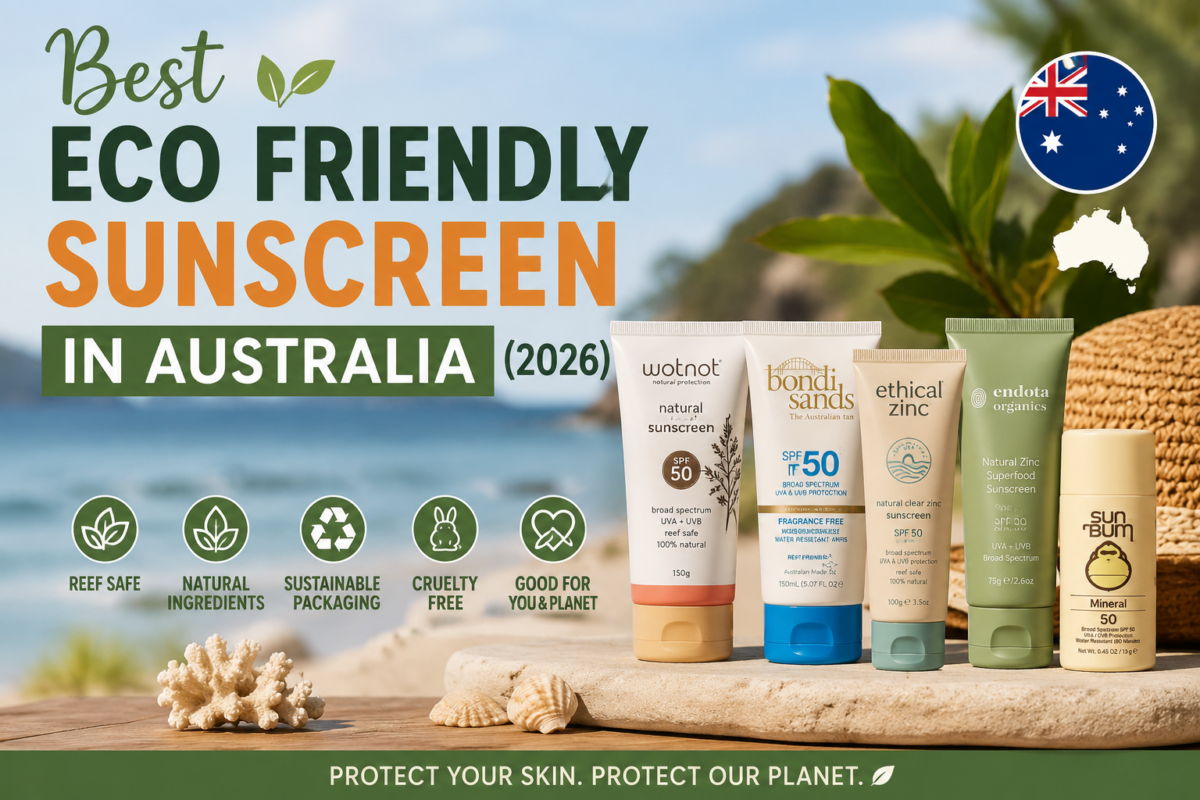
Best eco friendly sunscreen in Australia 2026
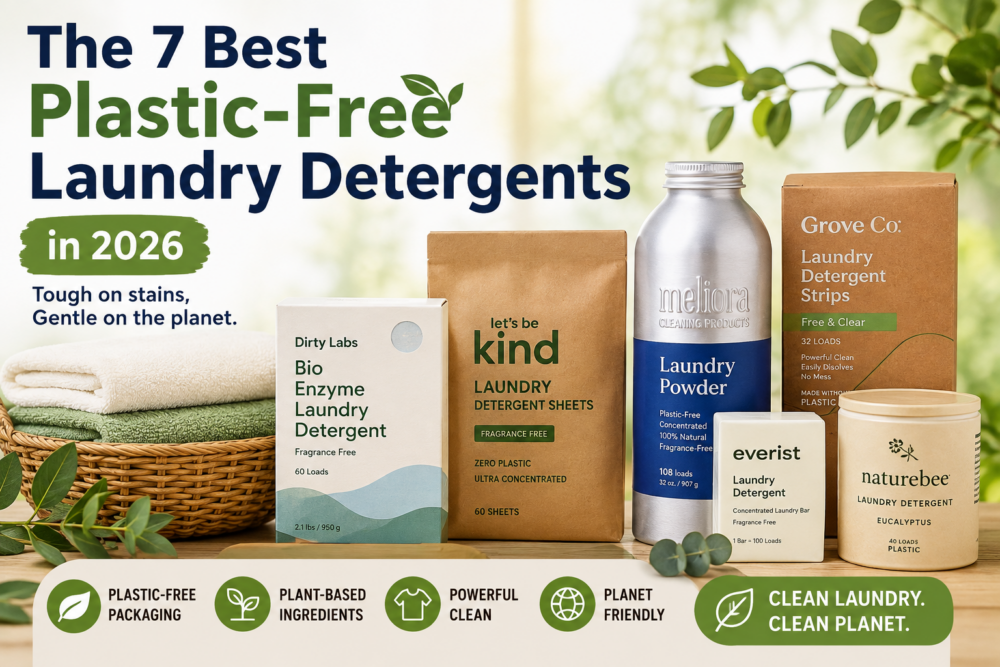
7 Best Plastic-Free Laundry Detergents in 2026