
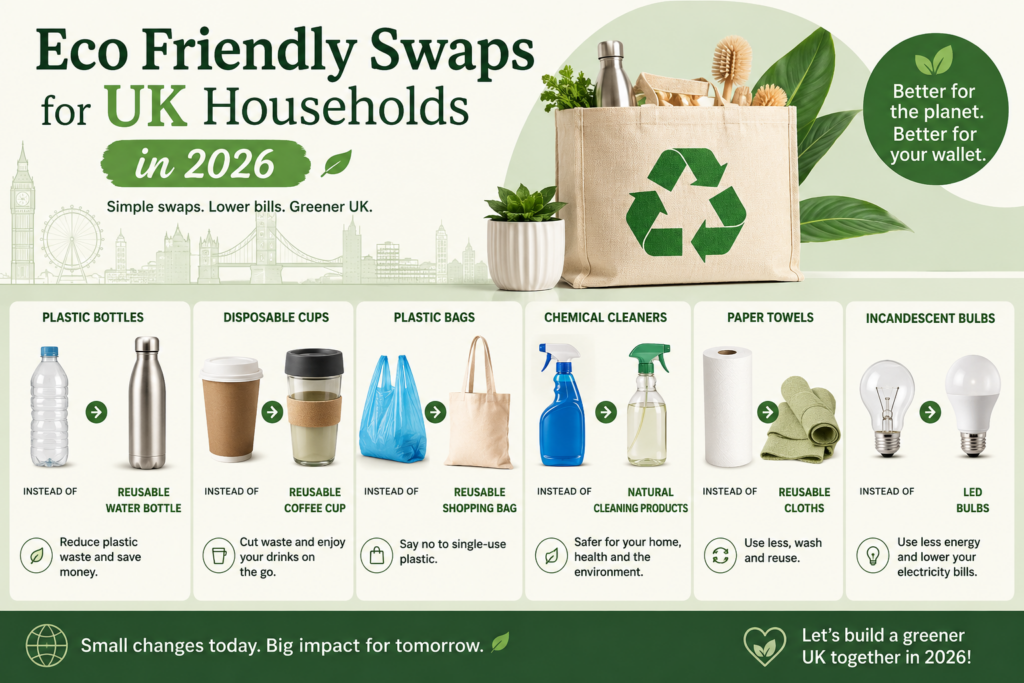
Eco Friendly Swaps for UK Households in 2026
Making your home more sustainable in 2026 does not mean replacing everything you own or spending a fortune on “green” products. For most UK households, the biggest difference can come from simple swaps that fit into routines you already have — from using refillable cleaning products and reusable kitchen items to washing clothes at lower temperatures and choosing energy-efficient appliances.
There is also a practical reason to rethink everyday household habits this year. In England, new Simpler Recycling rules came into force from 31 March 2026, including separate collection requirements for food and garden waste, paper and card, dry recyclables and residual waste.
At the same time, reducing energy use remains an important part of running a more efficient home. UK guidance recommends straightforward measures such as using LED lighting, improving insulation, managing heating and choosing efficient appliances.
The good news? You do not have to become completely zero-waste overnight. The most useful Eco Friendly Swaps for UK Households in 2026 are the ones that are affordable, realistic and easy to keep using. This guide focuses on those everyday changes — including kitchen, laundry, bathroom, cleaning, energy and shopping swaps — so you can reduce waste, potentially cut household costs and make your home a little greener without making life unnecessarily complicated.
Why Eco-Friendly Swaps Matter for UK Homes in 2026
For many UK households, living more sustainably is no longer just about buying a bamboo toothbrush or carrying a reusable shopping bag. In 2026, Eco Friendly Swaps for UK Households in 2026 are becoming more practical because everyday decisions around waste, energy and household consumption can affect both environmental impact and the cost of running a home.
UK Simpler Recycling Rules: What Changed in 2026?
One of the biggest changes for households in England came into effect on 31 March 2026 under the government’s Simpler Recycling programme. Waste collectors must, by default, provide separate collections for food and garden waste, paper and card, other dry recyclable materials, and residual waste. The requirements apply to households, including flats.
That makes some everyday eco-friendly habits even more relevant. Keeping a small food-waste caddy in the kitchen, separating cardboard from general rubbish and checking what your local council accepts can make recycling much easier.
However, there is an important UK-wide distinction: recycling collection systems are not identical across England, Scotland, Wales and Northern Ireland. Local councils can have different collection arrangements, so households should check their own council’s guidance before putting an item in a particular bin. GOV.UK also advises residents to check their local authority for the waste services available in their area.
Quick takeaway: Don’t assume that a recycling symbol automatically means an item belongs in your household recycling bin. Local collection rules matter.
Sustainability vs Household Energy and Utility Costs
There is another reason UK homeowners and renters are looking more closely at everyday swaps: household running costs.
Energy-efficient choices can be useful because they can reduce unnecessary electricity or gas consumption without requiring major lifestyle changes. Simple examples include replacing older bulbs with LEDs, avoiding unnecessary standby use, washing clothes at appropriate lower temperatures and choosing efficient appliances when an existing appliance needs replacing.
Energy prices also remain a real consideration for households. Ofgem announced in August 2026 that its energy price cap for a typical dual-fuel household paying by direct debit would rise from £1,663 to £1,723 per year from October 2026, although actual bills depend on how much energy a household uses and how it pays.
This is where a good eco-friendly swap needs to be practical. The cheapest option is not automatically the greenest, and an expensive “eco” product is not necessarily better simply because it carries a sustainability claim.
A more sensible approach is to ask three questions before making a swap:
- Will I use it regularly?
- Can I reuse, repair or refill it?
- Could it reduce waste or energy use without costing significantly more?
For example, switching from disposable cleaning bottles to a refill system may reduce packaging waste, while using a draught excluder or improving insulation can address energy loss more directly than buying another gadget.
The Real Goal: Smaller Changes That Stick
Sustainable living works best when it fits real life. A busy family in Manchester, a renter in London, a student household in Edinburgh or a retired couple in Cardiff may all have completely different budgets, homes and council collection systems.
That is why the best Eco Friendly Swaps for UK Households in 2026 are not necessarily the trendiest ones. They are the swaps that people can afford, understand and continue using.
Start with one room. Change one habit. Keep the useful swaps and forget the ones that create unnecessary expense or hassle.
That approach can make sustainable living feel less like a challenge and more like a normal part of running a UK home.
Kitchen & Food Waste Swaps (Saving Money on Food & Packaging)
The kitchen is often one of the easiest places to start making practical Eco Friendly Swaps for UK Households in 2026. You do not need to replace every plastic container or buy expensive “zero-waste” products. A few sensible changes to how you store food, shop for groceries and clean your kitchen can reduce packaging waste while helping you get more value from the food you already buy.
This matters because food waste is not just an environmental issue. It is money going straight into the bin. WRAP’s 2026 Household Food Management Survey found that cost-of-living pressures continue to influence how UK households buy and manage food, while food waste remains a significant household issue.
1. Swap Single-Use Food Storage for Reusable Containers
Cling film, disposable food bags and single-use takeaway containers can quickly pile up in a busy kitchen. A practical alternative is to use reusable containers, washable silicone bags or durable glass containers for leftovers and packed lunches.
You do not have to throw away perfectly usable plastic containers simply because they are plastic. Use what you already own first. When something becomes damaged or needs replacing, consider a durable reusable option.
For a typical UK household, useful swaps include:
- Disposable food bags → reusable food-storage bags
- Cling film → reusable covers or lidded containers
- Disposable takeaway containers → washable lunch boxes
- Single-use sandwich bags → reusable sandwich pouches
- Individual snack packaging → one larger pack stored in a reusable container
There is another advantage here: good food storage can help prevent food from being forgotten at the back of the fridge. WRAP research highlights the connection between food storage, packaging and food waste, showing that better storage practices can help keep some fresh foods usable for longer.
Money-saving tip: You do not need a matching set of premium glass containers. A mixture of existing tubs, jars and a few durable containers can do the job perfectly well.
2. Try Refillable and Concentrated Cleaning Products
Kitchen cleaning products are another area where packaging can build up quickly. Instead of repeatedly buying a new spray bottle, some households can switch to a refillable bottle with concentrated cleaning liquid or tablets.
The basic idea is simple:
Buy the bottle once → refill it → reuse it.
Concentrated products can also mean less packaging and fewer bulky bottles to store. But check the instructions carefully and dilute products exactly as recommended. More concentrated does not automatically mean better cleaning.
When comparing products, look beyond words such as “eco”, “natural” or “green”. Check the ingredients, packaging, refill system, instructions and the manufacturer’s claims. A refill only makes sense if you actually use it and the replacement system is convenient enough to maintain.
3. Meal Planning Can Cut Food Waste and Grocery Spending
Meal planning sounds obvious, but it can make a surprisingly practical difference.
Before doing the weekly shop, take five minutes to check the fridge, freezer and cupboards. What needs using first? What meals can be built around those ingredients?
For example:
Monday: leftover vegetables + rice
Tuesday: fresh meal
Wednesday: leftovers
Thursday: freezer meal
Friday: simple meal using ingredients that need using
It does not need to be a rigid seven-day plan. A flexible plan can work better, particularly for families whose schedules change.
WRAP’s latest research found that difficulties judging the right quantity to buy and changes to planned meals are among the factors associated with household food waste.
A simple shopping list can therefore be an eco-friendly tool as well as a budgeting tool.
4. Understand “Use By” vs “Best Before”
This is one swap that costs absolutely nothing: learn what the date labels actually mean.
A “use by” date is about food safety. The Food Standards Agency advises that you should not eat food after its use-by date, even if it looks or smells fine.
A “best before” date is mainly about quality. After this date, food may still be safe to eat if it has been stored correctly, although its taste, texture or freshness may have changed.
That distinction matters because throwing away perfectly usable food simply because it has passed a best-before date can create unnecessary waste.
A practical kitchen routine is:
Use by → follow the safety date.
Best before → consider quality, storage and the condition of the food.
When in doubt about a food’s safety, follow official Food Standards Agency guidance rather than relying on smell or appearance alone.
5. Buy Only What Your Household Is Likely to Use
Bigger packs can look cheaper per kilogram, but they are not always cheaper if part of the food ends up in the bin.
WRAP’s recent research shows that many households choose larger packs because they perceive them as better value, while buying the right quantity remains an important part of reducing food waste.
For smaller households, buying loose fruit and vegetables where available can be particularly useful. You can choose three apples instead of buying a large bag when you know you will not finish it.
This is a good example of an eco-friendly swap that is also financially sensible:
Buy what you need → store it properly → use it before it goes to waste.
Quick Kitchen Swap Checklist:
| Instead of… | Try… |
|---|---|
| Cling film | Reusable containers or covers |
| Disposable food bags | Washable reusable bags |
| New cleaning bottles every time | Refill or concentrate systems |
| Unplanned weekly shopping | Flexible meal planning |
| Throwing out food after “best before” | Check quality and official guidance |
| Automatically buying large packs | Choose a quantity your household can use |
| Throwing leftovers away | Plan a leftover meal |
The goal is not to create a picture-perfect zero-waste kitchen. The best Eco Friendly Swaps for UK Households in 2026 are the ones that fit normal life. If a reusable container gets used hundreds of times, a refill actually gets refilled, and a simple meal plan prevents food from being wasted, those small decisions can add up over time.
Bathroom & Personal Care Swaps
The bathroom is a surprisingly good place to make small sustainability changes. It is also where households use plenty of water and go through a steady stream of bottles, packaging and disposable products. For UK households, the most useful swaps are not necessarily the ones with the fanciest packaging. They are the ones that reduce waste, save water or simply last longer.
That is the practical idea behind Eco Friendly Swaps for UK Households in 2026: make one change, see whether it works for your routine, and keep it if it does.
1. Soap and Shampoo Bars vs Refillable Bottles
A shampoo or soap bar can remove the need for a plastic bottle altogether. For someone who already gets on well with bar products, it is a straightforward switch.
Shampoo bars are particularly useful for reducing packaging, but they are not automatically the best choice for everyone. Hair type, ingredients, storage and how long the bar lasts all matter. If a bar does not suit your hair and ends up unused, there is little environmental benefit.
A refillable liquid shampoo or body wash can be another sensible option. You keep the dispenser and buy a larger refill when needed. WRAP’s Refillable Certified standard is designed to help identify refillable systems that have been assessed against criteria intended to reduce environmental impacts compared with single-use alternatives.
Simple rule: choose the format you will actually use repeatedly rather than buying something simply because it looks “eco-friendly”.
2. Reduce Plastic in Everyday Hygiene
Bathroom bins can fill up with disposable packaging and personal-care waste surprisingly quickly. Depending on your household, alternatives can include reusable cotton pads, refillable hand wash, plastic-free soap packaging and products sold with minimal packaging.
But “plastic-free” should not be treated as a magic sustainability label. Look at the complete product:
- How long will it last?
- Can the packaging be recycled locally?
- Is there unnecessary packaging?
- Does the product need to be replaced frequently?
- Is the refill genuinely reducing packaging?
- Can you buy it locally rather than ordering small items individually?
This matters because an eco claim on the front of a package does not tell you everything about a product’s environmental impact.
For UK shoppers, durability and actual usage are often more useful measures than marketing language. A product that lasts for months and gets used every day may be a better practical choice than a fashionable alternative that you replace frequently.
3. Install a Water-Efficient Showerhead
If you want a bathroom swap that can affect both water use and the energy needed to heat that water, look at the shower.
Waterwise says showers, toilets and baths account for around half of household water use. It also notes that low-flow showerheads can use around 6 litres per minute, compared with roughly 10–15 litres per minute for a standard showerhead.
That does not mean you should immediately buy the lowest-flow showerhead available. Check compatibility with your shower system and make sure the product still provides a comfortable flow.
A shorter shower is another no-cost option. In fact, Waterwise estimates that reducing shower time by one minute a day could save a family of four around £95 a year in water and energy costs, based on its stated assumptions.
Try this first: time your normal shower for a few days. If it is regularly 10–15 minutes, reducing it slightly may be easier — and cheaper — than buying another bathroom gadget.
4. Add Tap Aerators
A tap aerator is a small attachment fitted to the end of a tap. It mixes air with the water and can reduce the amount of water flowing through the tap while maintaining a useful stream.
For households looking for inexpensive eco-friendly bathroom swaps in the UK, this is worth considering because it can be a relatively simple change. Waterwise says tap aerators can reduce tap water use and estimates that they can potentially halve the water used through taps, with possible savings on both water and energy bills.
Some UK water companies also provide water-saving devices such as aerators or efficient showerheads to eligible customers, so it is worth checking your water company’s website before buying one.
5. Check Water Efficiency, Not Just the Product Design
A bathroom product can look sustainable without actually using less water.
When buying a showerhead or tap, look for clear information about flow rate and water efficiency rather than relying only on phrases such as “eco”, “green” or “water saving”. Waterwise is also supporting stronger water-efficiency standards and labelling to make it easier for UK consumers to compare products.
This is particularly useful when comparing products online, where attractive product descriptions can sometimes tell you more about the marketing than the actual performance.
Quick Bathroom Swap Checklist:
| Everyday choice | More sustainable alternative |
|---|---|
| Bottled shower gel | Soap bar or refill system |
| Bottled shampoo | Shampoo bar or refillable bottle |
| Disposable cotton pads | Reusable washable pads |
| New hand-wash bottle each time | Refillable dispenser |
| High-flow shower | Water-efficient showerhead |
| Uncontrolled tap flow | Tap aerator |
| Long showers | Slightly shorter showers |
| “Eco” marketing alone | Check actual materials, durability and water use |
The takeaway: you do not need to turn your bathroom into a zero-waste showroom. Start with the swap that makes sense for your household. A refill bottle that gets refilled, a showerhead that genuinely reduces flow and a product that lasts longer are all more meaningful than simply buying something labelled “eco”.
That is what makes Eco Friendly Swaps for UK Households in 2026 practical: the aim is not perfection. It is making everyday choices that are easier on resources without making everyday life unnecessarily difficult.
Energy & Utility Swaps (Cutting UK Energy Bills)
For most UK households, sustainability becomes much more appealing when it can also help reduce everyday energy use. You do not necessarily need solar panels, a new boiler or expensive smart-home technology to make a difference. Sometimes the cheapest improvements are the least complicated ones.
That is where Eco Friendly Swaps for UK Households in 2026 can make practical sense. Start with the places where your home is losing heat or using electricity unnecessarily, then work down to everyday habits such as lighting and laundry.
1. Start With Draught-Proofing Before Bigger Upgrades
If your home feels cold even when the heating is on, look for the obvious gaps first.
Draught-proofing means reducing unwanted airflow through places such as gaps around doors, windows, floorboards and other openings. According to the Energy Saving Trust, stopping unwanted draughts can help reduce heat loss and lower energy bills.
Simple fixes can include:
- Fitting draught excluders around external doors
- Sealing suitable gaps around window frames
- Using curtains or thermal blinds where appropriate
- Checking letterboxes and other openings for unnecessary airflow
- Using a chimney draught excluder if a fireplace is not being used
There is a small but important point here: do not block ventilation that your home needs for health and safety. Trickle vents, extractor fans and other intentional ventilation should not simply be sealed because you are trying to stop draughts.
For renters, this can be especially useful. You may not be able to install new insulation, but a removable draught excluder or better curtains can be a relatively simple starting point.
2. Think About Insulation in the Right Order
Insulation is a bigger commitment than changing a light bulb, so it is worth understanding what your property actually needs.
Loft insulation, cavity wall insulation or solid-wall insulation can reduce heat loss, but the right solution depends on the age and construction of the building. The Energy Saving Trust recommends looking at the characteristics of your home rather than treating one insulation method as suitable for everyone.
If you own your property, professional advice can help before paying for a major insulation project.
If you rent, ask your landlord or letting agent about existing insulation and available energy-efficiency improvements. Avoid spending heavily on permanent alterations without checking what your tenancy allows.
The practical approach: fix cheap, obvious draughts first, then investigate larger insulation improvements when they make sense for the property.
3. Switch Older Bulbs to LEDs
Lighting is one of the easiest household swaps because there is very little behaviour change involved.
If you still have older, less efficient bulbs, replacing them with LEDs can reduce electricity use. You also do not need to replace every working bulb in your house immediately. A more sensible approach is to switch bulbs as they fail, particularly if you are trying to keep upfront spending low.
And remember the simple habit that costs nothing: turn lights off when you leave a room.
Energy Saving Trust estimates that turning off lights when they are not needed can save around £7 a year in Great Britain and £9 in Northern Ireland, based on its current assumptions.
The individual saving may not look huge, but LED lighting plus sensible usage can become one of those low-effort changes that works quietly in the background.
4. Cut Unnecessary Standby Power
Modern homes are full of devices that remain plugged in when nobody is using them — TVs, games consoles, speakers, chargers, computers and kitchen appliances.
Standby consumption varies considerably by device, so there is no single saving figure that applies to every household. Instead of unplugging everything obsessively, focus on devices that genuinely do not need to remain powered.
A switched extension lead can make this easier for a home entertainment setup or desk.
For example:
TV + games console + speakers → one switched extension lead → switch off when finished.
Just be careful with appliances that need continuous power or settings, such as some medical equipment, refrigeration appliances and systems that need to maintain a connection.
5. Wash Clothes at 30°C When Suitable
Laundry is another area where a small change can reduce energy use without changing the way your clothes look.
For everyday clothing that is not heavily soiled, a 30°C wash can be a useful alternative to hotter cycles. Energy Saving Trust recommends washing clothes at 30°C instead of higher temperatures and reducing unnecessary washing-machine use.
Its current guidance estimates that washing at 30°C and doing one fewer wash each week could save around £26 a year in Great Britain and £32 in Northern Ireland, based on its stated assumptions.
Of course, some loads need a different approach. Follow the care label, and choose an appropriate cycle when clothes are heavily soiled or when hygiene requirements call for it.
6. Make Better Use of Your Washing Machine’s Eco Cycle
An eco programme can look confusing because it often takes longer than a normal wash.
Longer does not necessarily mean more energy. Eco programmes are designed to use less energy and water by changing factors such as temperature and cycle behaviour. Energy Saving Trust recommends using an eco cycle where appropriate, particularly for normally soiled laundry.
Also try to avoid regularly running half-empty loads when you could wait for a fuller load.
Your washing machine’s energy label can also help when you eventually need to replace it. Current UK appliance labels use an A to G efficiency scale for applicable appliances, while washing-machine labels provide information such as energy use per 100 washes, water consumption and programme duration.
Quick Energy-Saving Swap Checklist:
| Instead of… | Try… |
|---|---|
| Cold draughts around doors | Draught excluders and suitable sealing |
| Ignoring obvious heat-loss areas | Check insulation options for your property |
| Older inefficient bulbs | LED lighting |
| Leaving unnecessary devices on standby | Switch off suitable devices at the plug |
| Washing lightly soiled clothes hot | 30°C where appropriate |
| Running frequent half-load washes | Wait for a fuller load |
| Ignoring the washing-machine Eco programme | Use Eco mode when suitable |
| Buying an appliance based only on price | Compare its energy label and running costs |
A More Realistic Way to Save Energy:
The best energy-saving routine is rarely about doing everything at once.
Start with the changes that cost little or nothing. Draught-proof a troublesome door. Turn unused lights off. Switch suitable electronics off at the plug. Try 30°C laundry. Then, when an appliance eventually needs replacing, look at its energy efficiency rather than focusing only on the purchase price.
That is the practical side of Eco Friendly Swaps for UK Households in 2026. A greener home does not have to mean an expensive renovation. For many households, it is simply about wasting less energy while making the home work a little more efficiently.
Low-Cost Eco Swaps for Renters (No Permanent Changes)
Renting a home should not mean giving up on sustainable living. In fact, some of the easiest Eco Friendly Swaps for UK Households in 2026 cost very little and do not require drilling holes, replacing fixtures or making permanent changes to the property.
For renters, the smartest approach is simple: work with the home you have. Focus on portable products, everyday habits, reuse and improvements that can move with you when the tenancy ends.
1. Choose Portable Eco-Friendly Improvements
One of the biggest advantages of renting is that many useful changes can be completely temporary.
Instead of installing something permanently, look for alternatives that can be removed when you move out. For example:
- Use a removable draught excluder around an external door.
- Choose washable rugs instead of replacing flooring.
- Use reusable food-storage containers rather than built-in kitchen storage.
- Add thermal curtains or suitable window coverings where permitted.
- Use LED bulbs in compatible fittings.
- Keep refillable cleaning bottles and reusable household products.
- Use a clothes-drying rack instead of relying on a tumble dryer for every load.
These are small changes, but they can make a rented home more comfortable and reduce reliance on disposable products.
2. Check With Your Landlord Before Making Permanent Changes
This is one area where renters should be cautious.
Painting, drilling, changing fixtures, installing equipment or making other alterations may require permission depending on your tenancy agreement and the property. Some landlords or housing providers have specific procedures for requesting improvements.
Don’t assume that a sustainability upgrade is automatically allowed just because it is environmentally friendly.
If you want to make a permanent improvement, check your tenancy agreement first and ask the landlord or housing provider for written permission where required.
For council or social housing, the rules can be particularly specific. For example, some councils require tenants to obtain permission before carrying out certain improvements or alterations.
For renters, this simple habit can prevent an eco-friendly project from turning into a deposit problem later.
3. Use Second-Hand Furniture Before Buying New
Furniture is another area where renters can save money and reduce waste at the same time.
Instead of furnishing an entire flat with new items, look at pre-owned furniture first. Charity shops, furniture reuse organisations, community groups and reputable second-hand marketplaces can all be worth checking.
WRAP highlights furniture as a major reuse opportunity in the UK. Its research has found that a significant proportion of furniture reaching household waste and recycling centres is reusable either in its existing condition or with minor repair.
For a rented home, second-hand furniture can be particularly practical because you may not want to spend heavily on furniture for a property you expect to leave in a few years.
Good candidates include:
- Dining tables and chairs
- Bookshelves
- Bedside tables
- Storage units
- Desks
- Coffee tables
- Mirrors and picture frames
- Lamps and other non-integrated furnishings
Before buying, check the condition carefully. Look for signs of damp, mould, structural damage, pests or unsafe electrical components.
Cheap does not always mean good value. A sturdy second-hand table that lasts for years is usually a better purchase than a very cheap item that needs replacing next year.
4. Give Existing Furniture a Second Life
You do not always have to buy something new — even if “new” means second-hand.
Look around your home first.
Could that old bedside table become a plant stand? Could an unused shelf provide kitchen storage? Could a chair from another room replace one you were about to buy?
Reuse is one of the simplest forms of circular living because the product remains in use instead of becoming waste. WRAP describes reuse as using products again for their original purpose and identifies financial as well as environmental benefits.
For renters, this has an extra advantage: you can improve the look and function of your home without committing to permanent renovation.
5. Try Eco Decor That Moves With You
Sustainable decorating does not have to involve a new kitchen, fitted wardrobes or major DIY.
Choose items that can travel with you:
- Second-hand artwork
- Pre-owned mirrors
- Houseplants in reusable pots
- Vintage or second-hand lamps
- Washable cushion covers
- Reclaimed or second-hand wooden accessories
- Reusable storage baskets
- Second-hand rugs in good condition
This approach can also make a rented property feel more personal without changing the actual structure of the home.
A useful rule is:
Decorate the room, not the building.
In other words, focus on furniture, textiles and accessories that you can take with you when your tenancy ends.
6. Borrow or Share Items You Rarely Use
Not everything needs to be owned.
If you only need a carpet cleaner once or twice a year, buying one may not make much sense. The same applies to certain DIY tools, garden equipment, camping items and specialist kitchen appliances.
Ask friends, neighbours or local community groups whether you can borrow an item before buying one.
Sharing can reduce the number of products that need to be manufactured in the first place, while saving you storage space and money.
For renters living in smaller UK flats, that second benefit can be just as important as the environmental one.
7. Make Your Next Purchase a “Long-Term” Purchase
A common mistake with eco-friendly shopping is replacing perfectly usable items simply because a newer version is marketed as sustainable.
You don’t need to do that.
If your existing chair works, keep it. If your plastic storage box is still perfectly usable, use it. If your curtains are doing their job, there is no need to replace them simply because another material is trending.
When something genuinely needs replacing, look for:
Durability → repairability → reusability → sensible price → end-of-life options.
This approach is often more realistic than trying to make every purchase “zero waste”.
Renter-Friendly Eco Swap Checklist:
| Instead of… | Try… |
|---|---|
| Permanent draught-proofing without permission | Removable draught excluders |
| Buying all-new furniture | Good-quality second-hand pieces |
| Replacing usable furniture | Repair, reuse or rearrange it |
| Permanent decorative changes | Portable eco décor |
| Buying rarely used equipment | Borrow or share |
| Disposable household products | Reusable alternatives |
| Replacing everything at once | Upgrade only when something needs replacing |
The Bottom Line for UK Renters:
You do not need to own your home to make it more sustainable.
For many renters, the best approach is to concentrate on portable, affordable and reversible changes. Buy less, reuse more, choose second-hand furniture where practical and ask permission before making permanent alterations.
That makes Eco Friendly Swaps for UK Households in 2026 much more realistic for people living in rented flats, terraces, HMOs and other temporary homes.
The biggest win may not be one dramatic renovation. It could simply be taking a second-hand desk instead of buying a new one, using the same storage boxes for years, or carrying your reusable habits from one rental property to the next.
Long-Term Investments for UK Homeowners
Some eco-friendly home improvements are not really “swaps” in the everyday sense. They are long-term investments. Solar panels, home battery storage and heat pumps can require several thousand pounds upfront, so they deserve more thought than simply replacing a household product.
For UK homeowners, the sensible approach is to look at the whole picture: the property, current energy use, installation cost, available grants, expected lifespan and how long you plan to stay in the home.
That is an important part of Eco Friendly Swaps for UK Households in 2026. Going greener does not mean buying the most expensive technology available. It means choosing an upgrade that makes sense for your particular home.
1. Solar Panels: A Longer-Term Energy Swap
Solar PV can be an attractive option for homeowners with a suitable roof and enough daylight exposure.
The basic idea is straightforward: your panels generate electricity during daylight hours, allowing you to use some of that electricity at home instead of buying all of your power from the grid.
The financial picture becomes more interesting when you use more of your solar electricity yourself. Excess generation can also potentially be exported to the grid through the Smart Export Guarantee (SEG), where eligible suppliers pay generators for exported electricity.
However, solar should not be sold as a guaranteed way to “eliminate your electricity bill”. Generation varies with the weather, roof orientation, shading, system size and household consumption.
Before signing a contract, check:
- Estimated annual solar generation
- Roof condition and available space
- Shading from trees or nearby buildings
- Expected installation and maintenance costs
- Your household’s daytime electricity use
- SEG export options
- Warranty terms
- Whether scaffolding or other additional work is required
Practical tip: If your roof is already in poor condition, deal with that before installing panels. Removing a solar system later to repair the roof can add unnecessary cost.
2. Is Battery Storage Worth Adding?
A home battery can store electricity generated by solar panels and make it available later, such as in the evening when household demand may be higher.
That can increase the amount of your own solar generation that you use rather than exporting it. Government analysis published in 2026 also highlights battery storage as a way to store excess solar generation for later use and potentially reduce electricity imported from the grid.
But a battery is not automatically the right choice for every household.
The economics depend on factors such as:
Battery price + installation → usable capacity → electricity consumption → solar generation → tariff structure → export payments.
A battery can be particularly interesting for households that generate plenty of solar electricity during the day but use much more electricity in the evening.
If you are considering solar and battery storage together, ask installers to provide separate figures for:
- Solar-only installation
- Solar + battery installation
- Expected annual generation
- Expected self-consumption
- Expected export
- Battery usable capacity
- Warranty and degradation information
That makes it easier to compare the additional cost of the battery rather than simply accepting a bundled package.
3. Heat Pumps: A Bigger Change Than a New Boiler
Heat pumps work differently from conventional gas or oil boilers. Instead of generating heat by burning fuel, they move heat from one place to another using electricity.
For the right property and heating system, they can be an important part of reducing reliance on fossil-fuel heating.
But this is not a DIY-style eco swap. The suitability of the home matters.
Before installation, homeowners should consider:
- Existing insulation
- Radiator size and heating distribution
- Hot-water requirements
- Available outdoor space
- Electrical requirements
- Heat-loss calculations
- Installer qualifications
- Total installation cost
- Whether planning or other permissions apply
A proper assessment is more useful than choosing a heat pump simply because it is being promoted as a greener alternative.
4. What Is the Boiler Upgrade Scheme in 2026?
For eligible property owners in England and Wales, the Boiler Upgrade Scheme (BUS) can help reduce the upfront cost of certain low-carbon heating installations.
As of 2026, the standard grant is £7,500 for an air-to-water heat pump or ground-source heat pump, while an air-to-air heat pump can receive £2,500 under the scheme. Biomass boilers have a £5,000 grant.
There is also a higher £9,000 grant for eligible off-gas-grid properties installing an air-to-water or ground-source heat pump, available from 21 July 2026 until 31 March 2027 under the updated scheme. Eligibility depends on the property and existing heating system.
The key point is that the grant is not simply £7,500 or £9,000 off any heat pump you choose. The property, existing heating system, technology and installer must meet the scheme requirements.
The government guidance also states that the installer must commission and install the heat pump within 120 days of applying for the grant.
5. Do Not Choose a Heat Pump on Grant Size Alone
A grant can make a major difference to the upfront price, but it should not be the only reason to install a heat pump.
For example, if your home needs insulation improvements first, spending the entire budget on the heating system may not produce the result you expect.
A better sequence can be:
Assess the home → understand heat loss → improve efficiency where appropriate → compare heating options → check BUS eligibility → obtain several quotes.
Also ask installers what their quotation includes. The headline installation price may not tell you whether electrical work, radiator upgrades, hot-water changes or other necessary work is included.
6. Solar + Battery + Heat Pump: Think About the Whole Home
These technologies can work together, but they should not automatically be purchased as a package.
A homeowner might generate electricity with solar during the day, store some surplus in a battery and use electricity for a heat pump. The overall system can potentially reduce reliance on grid electricity and fossil-fuel heating.
But the economics depend heavily on the individual property.
A large solar array does not automatically make a large battery worthwhile. Likewise, installing a heat pump does not automatically mean that adding solar will produce the fastest financial return.
Think in systems, not gadgets.
Before investing thousands of pounds, understand how much energy your home currently uses and when you use it.
Long-Term Investment Checklist:
| Upgrade | Best suited to | What to check first |
|---|---|---|
| Solar PV | Homes with suitable roofs | Roof condition, shading, generation and cost |
| Battery storage | Homes wanting more solar self-use | Solar output, usage pattern, battery cost and warranty |
| Air-source heat pump | Suitable homes replacing existing heating | Heat loss, insulation, radiators and installation quote |
| Ground-source heat pump | Properties with suitable land/ground-loop options | Land, installation complexity and total cost |
| BUS grant | Eligible property owners | Technology, existing heating system and scheme eligibility |
The Bottom Line for Homeowners:
Long-term eco improvements can be worthwhile, but they are not one-size-fits-all purchases.
If your budget is limited, you do not have to jump straight into solar, batteries or a heat pump. Start with the improvements that make sense for your home, then consider larger investments when the numbers work.
For homeowners who are planning to stay in their property for many years, Eco Friendly Swaps for UK Households in 2026 can go beyond reusable products and energy-saving habits. The bigger opportunity may be creating a home that uses less energy, generates some of its own electricity and relies less on fossil-fuel heating.
The smartest upgrade is not necessarily the one with the biggest headline grant or the newest technology. It is the one that fits the property, the budget and the way the household actually uses energy.
The 5-Step Waste Hierarchy: Refuse, Reduce, Reuse, Repair, Recycle
When people hear “eco-friendly living”, the first thing that often comes to mind is recycling. But recycling is not always the best place to start.
A better way to think about household waste is to ask: Can I avoid creating the waste in the first place? Can I use what I already have for longer?
That thinking is at the heart of the waste hierarchy. For UK households, it provides a useful framework for making everyday decisions — and it fits naturally with the practical approach behind Eco Friendly Swaps for UK Households in 2026.
1. Refuse: Don’t Buy What You Don’t Need
The simplest waste is the waste you never create.
Before buying something, ask yourself:
“Do I actually need this?”
That question can stop unnecessary packaging, impulse purchases and products that spend most of their life sitting in a cupboard.
You might refuse:
- Extra shopping bags when you already have reusable ones
- Promotional freebies you are unlikely to use
- Excessive packaging where a lower-packaging option is available
- Duplicate kitchen gadgets
- Disposable products when a suitable reusable alternative already exists
This is particularly useful when shopping online. A “green” product is still another product that needs materials, manufacturing, packaging and transport.
2. Reduce: Buy Less and Choose Better
If you genuinely need something, the next question is whether you can use less of it.
For example, instead of buying several cheap storage boxes that may break quickly, one durable set may be enough. Instead of buying a large quantity of food because the unit price looks lower, buy an amount your household can realistically use.
Reducing consumption does not have to feel restrictive. Sometimes it simply means buying more deliberately.
It can also save money. You are not paying for products, packaging or services that you do not really need.
3. Reuse: Keep Products in Use
Reuse comes before recycling for a reason.
A product that can continue doing its original job does not need to be turned into raw material and manufactured into something else yet.
WRAP describes reuse as using products again for the same purpose and highlights financial as well as environmental benefits. Its guidance also identifies furniture, electrical items, books and other household goods as important opportunities for reuse.
Think about everyday examples:
- Reuse glass jars for food storage
- Pass unwanted furniture to someone who needs it
- Buy second-hand furniture
- Donate clothes in good condition
- Reuse cardboard boxes where practical
- Keep using storage containers that are still perfectly functional
- Sell or give away unwanted electrical items rather than automatically throwing them away
A product does not become “better for the planet” simply because it is made from a fashionable sustainable material. Keeping a perfectly usable product in service can be the better choice.
4. Repair: Fix It Before Replacing It
Repair is often overlooked because buying something new can seem easier.
A loose chair leg. A broken zip. A faulty kettle switch. A scratched piece of furniture.
Sometimes the fix is surprisingly small.
WRAP’s work on product reuse and repair emphasises the value of keeping products in use for longer. For textiles specifically, its research indicates that repair can extend clothing lifespans and reduce the need for new production.
Before replacing an item, ask:
Can I repair it myself?
If not:
Can a local repair service fix it for a reasonable price?
For UK households, this can also support local tradespeople and repair businesses while keeping useful products out of the waste stream.
Of course, repair is not always the right answer. If an appliance is unsafe, uneconomical to repair or beyond a sensible working life, replacement may make more sense. Sustainability should not mean ignoring safety or practicality.
5. Recycle: Use It When the Earlier Options Don’t Work
Recycling still matters. It is simply not the first option.
When an item genuinely reaches the end of its useful life, recycling can recover materials and keep them in circulation.
But there is one important UK lesson: recycling rules are not identical everywhere.
What your local authority accepts can vary, so check your council’s collection guidance rather than assuming that every item with a recycling symbol belongs in your household recycling bin. WRAP has highlighted consumer confusion around what can and cannot be recycled, which is one reason correct sorting matters.
Poorly sorted recycling can also create contamination problems.
So the better sequence is:
Refuse → Reduce → Reuse → Repair → Recycle
Not:
Buy → Use → Throw away → Recycle
Why Repairing and Reusing Can Beat Buying a “Green” Product?
This is one of the most important ideas in sustainable shopping.
Imagine you already own a perfectly functional plastic food container. You see a new bamboo-fibre or “eco” storage set online and decide to replace the old one.
It may feel like an environmentally friendly purchase.
But what happens to the old containers?
If they are still usable, replacing them simply creates another consumption cycle. The new product has also required raw materials, manufacturing, packaging and transportation.
In many situations, using what you already own for longer is the more sensible choice.
The same principle applies to furniture, clothing, electrical goods and household décor.
WRAP’s reuse guidance specifically identifies substantial opportunities for household furniture and electrical items to be reused, including products that may only need minor repairs.
A Simple Decision Tree for UK Households.
Before buying or binning something, run through these five questions:
| Question | Best action |
|---|---|
| Do I need it at all? | Refuse |
| Can I buy or use less? | Reduce |
| Can I use it again? | Reuse |
| Can it be fixed? | Repair |
| Has it reached the end of its useful life? | Recycle |
This small mental checklist can prevent a surprising number of unnecessary purchases.
The Practical Takeaway:
You do not need to become a zero-waste household overnight.
Start with one habit: don’t replace something simply because a newer product has a greener label.
Use the mug you already own. Repair the jacket. Buy the second-hand book. Reuse the storage jar. Donate furniture that no longer fits your home. And when something genuinely reaches the end of its useful life, recycle it through the correct local route.
That is the more realistic side of Eco Friendly Swaps for UK Households in 2026. The goal is not to keep buying “eco” replacements. It is to consume more thoughtfully, keep useful products in use for longer and create less waste in the first place.
Cost vs Savings Breakdown: Budgeting Guide for UK Households
Going greener does not have to mean spending more money.
In fact, some of the most useful Eco Friendly Swaps for UK Households in 2026 cost absolutely nothing. Others might cost £10–£20 but last for years. Then there are bigger improvements — such as solar panels, battery storage or a heat pump — where the upfront price can be significant and the financial benefit may take years to build.
The trick is knowing which type of swap you are looking at.
Instead of asking, “What is the most eco-friendly product I can buy?”, ask:
“What will this cost me, how long will it last, and what will I realistically save?”
£0 Eco Swaps: Change the Habit, Not the Shopping Basket
You do not need a budget to start.
Some of the most effective household changes are simply changes in behaviour.
Free swaps worth trying:
- Turn lights off when rooms are not being used.
- Wash suitable clothes at 30°C.
- Use your washing machine when you have a fuller load.
- Air-dry clothes when practical instead of using the tumble dryer every time.
- Plan meals around food already in the fridge.
- Use leftovers rather than automatically throwing them away.
- Carry reusable shopping bags you already own.
- Reuse jars, containers and boxes that are still useful.
- Switch off suitable appliances at the plug when they are not needed.
- Repair or donate usable items instead of replacing them.
These changes may look almost too simple, but that is their advantage. There is no shopping required and no new product that eventually becomes waste.
Energy Saving Trust, for example, recommends measures such as washing clothes at 30°C, using appliances carefully and switching off lights when they are not needed.
Best for: students, renters, families on a tight budget and anyone who wants to start immediately.
Under £20: Small Purchases That Can Last
The next category is for inexpensive products that can replace repeated disposable purchases or reduce household energy use.
Examples include:
- Reusable food-storage bags
- Durable food containers
- Refillable cleaning bottles
- Reusable cleaning cloths
- LED bulbs
- Draught excluders
- Tap aerators
- Reusable shopping bags
- Simple clothes-drying racks
- Reusable personal-care products where suitable
The exact price varies by product and retailer, so it is better to compare cost per use rather than simply looking at the ticket price.
For example, an £8 reusable product used hundreds of times can make more sense than repeatedly buying a £2 disposable alternative.
LED lighting is a good UK example. Energy Saving Trust’s 2026 guidance estimates that upgrading all halogen lights to LEDs costs around £18 for a typical example and could save around £45 a year in Great Britain and £55 in Northern Ireland, under its stated assumptions.
That is a much clearer way to think about an eco purchase:
Small upfront cost → repeated use → potential ongoing saving.
£20–£100: Practical Home Efficiency Improvements
Once you move beyond basic reusable products, you can start looking at small home-efficiency upgrades.
Draught-proofing is one example.
Energy Saving Trust says professional draught-proofing of windows and doors can cost around £250 for a whole house, while DIY draught-proofing can be considerably cheaper.
For a homeowner, the decision might therefore look like this:
DIY first → identify the biggest draughts → improve them → consider professional work if needed.
Other purchases in this range might include better thermal curtains, hot-water cylinder insulation, efficient drying equipment or selected water-saving devices.
But do not buy something just because the product page says “energy saving”.
Check whether your home actually needs it.
High-Investment Swaps: Think in Years, Not Weeks
Solar panels, battery storage, insulation upgrades and heat pumps belong in a different category.
These are not impulse purchases.
A £10 reusable bottle and a £10,000 home-energy project should never be judged using the same payback expectations.
Solar Panels:
Solar PV can reduce the amount of electricity you need to buy from the grid by generating electricity at home. Depending on your circumstances, excess electricity may also be exported through the Smart Export Guarantee (SEG).
The financial return depends on factors including:
- Installation cost
- Roof orientation and shading
- System size
- Household electricity consumption
- How much solar electricity you use yourself
- Export payments
- Future electricity prices
So avoid treating a generic online “solar payback calculator” as a guarantee.
Your actual home matters.
Battery Storage:
A battery can store surplus electricity for later use. It may be particularly useful where a household generates solar electricity during the day but uses more electricity in the evening.
But the battery itself has an upfront cost, and its financial value depends on your electricity usage, solar generation, tariff and export arrangements.
Before buying one, ask an installer to show the numbers with and without the battery.
That simple comparison can reveal whether the additional investment is actually worthwhile for your household.
Heat Pumps:
Heat pumps can involve a much larger initial investment than everyday eco swaps.
For eligible properties in England and Wales, the Boiler Upgrade Scheme currently provides grants of up to £7,500 for eligible air-to-water, ground-source and water-source heat pumps. An additional £1,500 is available for certain eligible off-gas-grid properties, bringing the potential grant to £9,000 until March 2027.
That does not mean every household will receive £9,000.
Eligibility conditions apply, and the £9,000 level is particularly relevant to qualifying off-gas-grid properties.
The important budgeting question is therefore not:
“How big is the grant?”
It is:
“What will I actually pay after the grant, and what will running the new system cost?”
You should also consider insulation, heat-loss performance, radiator requirements, installation quality and the expected lifetime of the system.
A Simple Cost-vs-Savings Framework
Use this before buying an eco-friendly product or committing to a larger home upgrade.
| Swap | Typical budget level | Potential benefit | Payback |
|---|---|---|---|
| Turning lights off | £0 | Lower electricity use | Immediate |
| Washing at 30°C | £0 | Lower laundry energy use | Immediate |
| Meal planning | £0 | Less food waste | Potentially immediate |
| Reusable containers | Under £20 | Less disposable packaging | Depends on usage |
| LED bulbs | Under £20–£30 for a small replacement | Lower lighting electricity use | Often relatively quick |
| Draught excluder | Low cost | Less unwanted heat loss | Depends on home |
| Tap aerator | Low cost | Lower water use | Depends on usage |
| Solar PV | High investment | Generate household electricity | Long-term |
| Battery storage | High investment | Store electricity for later use | Highly household-specific |
| Heat pump | High investment | Low-carbon heating | Long-term; depends on property and energy use |
Prices and savings vary by household, product, location and energy tariffs. Treat these figures as budgeting categories rather than guaranteed returns.
Don’t Confuse “Cheaper” With “More Sustainable”
There is a common trap in eco-friendly shopping: assuming the newest sustainable product must be better than something you already own.
It may not be.
If your existing saucepan works perfectly, keep using it. If your plastic lunch box is still in good condition, there is little reason to replace it simply because a bamboo version is trending online.
The environmental cost of manufacturing, transporting and packaging a replacement still exists.
In many cases:
Use what you own → repair it → reuse it → replace it when necessary.
That approach also happens to be good for the household budget.
WRAP’s work on reuse highlights the environmental and financial value of keeping products in use for longer rather than automatically sending them into the waste stream.
Where Should a UK Household Start?
If your budget is £0, start with habits.
If you have £10–£20, choose one durable item you will use regularly.
If you have £100+, look at practical home-efficiency improvements and compare their expected benefits before spending.
If you are considering a £5,000+ investment, slow down. Get quotes, check grants, understand the technology and calculate the numbers for your own property.
That is a much more realistic way to approach Eco Friendly Swaps for UK Households in 2026.
You do not need to buy your way into sustainable living. In many homes, the best first step is simply using less, wasting less and making the things you already own last longer.
Common Eco-Swapping Mistakes to Avoid
Making your home more sustainable does not mean replacing everything you already own. In fact, one of the easiest mistakes with Eco Friendly Swaps for UK Households in 2026 is buying too many new “eco” products without considering what happens to the old ones.
A genuinely greener approach is usually more practical: use what you have for longer, replace items when they wear out, and choose a better alternative when you actually need one.
1. Falling for Greenwashing
The word eco-friendly can make a product sound better than it really is. But a green label, leaf symbol or phrase such as “100% natural” does not automatically mean a product has a lower overall environmental impact.
The UK Competition and Markets Authority (CMA) says environmental claims should be truthful, clear, supported by evidence and should not hide important information. Its Green Claims Code also warns businesses against broad claims such as “green” or “sustainable” when they cannot be properly substantiated.
For UK shoppers, a simple rule is useful:
Don’t buy the label. Check the claim.
Before choosing an eco-labelled product, ask:
- What exactly makes this product better for the environment?
- Is the claim backed by evidence?
- Does the benefit apply to the whole product or only its packaging?
- How long is the product expected to last?
- Can it be repaired, reused or refilled?
- What happens when I eventually throw it away?
- Can I actually recycle it through my local council’s system?
For example, a cleaning bottle might say “recyclable”, but that does not necessarily tell you whether every component can be recycled through your household recycling collection. The CMA specifically advises consumers to consider disposal as well as the product itself.
A better habit: look for specific, measurable information rather than vague marketing language. “Made with 80% recycled plastic” tells you considerably more than simply “planet friendly”.
2. Throwing Away Working Plastic Items Just to Buy “Eco” Products
This is probably one of the most overlooked mistakes.
Imagine you already have a set of plastic food containers that are clean, safe and still working perfectly. Replacing all of them with bamboo, stainless steel or glass containers might look like a sustainable upgrade, but throwing away usable products creates another environmental cost.
The greener choice may simply be to keep using what you already own.
The same applies to:
- Plastic storage boxes
- Reusable water bottles
- Food containers
- Washing-up brushes
- Laundry baskets
- Kitchen utensils
- Cleaning bottles
- Furniture and household storage
- Working electrical appliances
There is no environmental prize for owning the most “eco-looking” kitchen.
If an existing item is safe and functional, use it until it reaches the end of its useful life. Then consider a longer-lasting or lower-waste replacement.
3. Replacing Everything at Once
Another common mistake is turning sustainability into a shopping list.
You do not need to buy new reusable bags, storage jars, cleaning products, bamboo toothbrushes, refill bottles and energy-saving gadgets all in one weekend.
Start with the items you replace most frequently.
For a typical UK household, that might mean switching disposable products to reusable versions, reducing unnecessary packaging, improving lighting efficiency or making small changes to laundry and food-waste habits.
This approach is usually easier on the household budget too.
4. Assuming “Natural” Automatically Means Sustainable
Natural materials can have environmental benefits, but natural does not mean impact-free.
A product can contain bamboo, cotton, wood or other natural materials and still require energy, water, transport and packaging during its life cycle.
That is why the better question is not:
“Is this product natural?”
Instead ask:
“Will this product last longer, reduce waste or replace something I regularly throw away?”
That shift in thinking makes sustainable shopping much more practical.
5. Ignoring What Happens at the End of the Product’s Life
An eco swap is not finished when you buy the replacement.
Think about disposal before purchasing it.
In the UK, recycling arrangements can differ between councils, so a product labelled “recyclable” should not automatically be assumed to belong in your household recycling bin. Check your local council’s guidance before putting unusual materials or mixed packaging out for collection.
This matters particularly for products containing several materials, such as pumps, coated packaging, composite materials and items combining plastic with bamboo or metal.
The CMA’s consumer guidance recommends looking beyond the front-of-pack claim and considering both the product and its disposal.
6. Confusing Buying Less With Buying “Greener”
Sometimes the most sustainable purchase is no purchase at all.
If your kettle works, keep it. If your coat still keeps you warm, wear it. If your storage boxes are doing the job, there is little reason to replace them simply because a new version has greener packaging.
This is where the Refuse, Reduce, Reuse, Repair and Recycle approach becomes useful.
Before buying an eco alternative, pause for a moment and ask:
“Do I actually need to replace this?”
If the answer is no, keeping and using the existing product may be the better swap.
A Simple UK Greenwashing Check.
When comparing eco-friendly products in 2026, use this quick five-question test:
| Question | What to look for |
|---|---|
| What is the claim? | A specific environmental benefit |
| Is there evidence? | Reliable information or certification |
| How long will it last? | Durability and repairability |
| What happens after use? | Reuse, recycling or disposal options |
| Do I need it now? | Avoid replacing a perfectly usable item |
The goal of Eco Friendly Swaps for UK Households in 2026 is not to encourage more consumption with greener packaging. It is to help households make fewer, better and more useful changes.
That is often where sustainability becomes realistic: not in a perfect-looking kitchen, but in the everyday decisions to buy less, waste less and keep useful things in use for longer.
30-Day Sustainable Home Challenge: A Simple Checklist for UK Families
Going sustainable does not have to mean changing your entire lifestyle overnight. For most UK households, the easiest approach is to make one small change, see how it fits into everyday life, and then move on to the next.
This 30-Day Sustainable Home Challenge is designed around that idea. You do not need to buy a cupboard full of “eco” products. Use what you already have, reduce waste where you can, and spend money only where a replacement genuinely makes sense.
By the end of 30 days, you should have a home that is a little less wasteful, more energy-conscious and easier to manage — without turning sustainability into another expensive chore.
Week 1: Start With What You Already Have
Day 1 — Do a household audit
Walk through your kitchen, bathroom, bedroom and utility area. Make a note of products you regularly throw away, waste energy with, or replace frequently.
Day 2 — Create a “use it first” box
Put nearly-finished toiletries, cleaning products and food that needs using soon in one visible place. The aim is simple: finish what you already own before buying replacements.
Day 3 — Stop one unnecessary purchase
Before buying something new today, ask: Do we actually need it? If the answer is no, leave it.
Day 4 — Reuse your shopping bags
Keep reusable bags near the front door, in your car or wherever you normally remember them. The trick is making reuse convenient.
Day 5 — Check your food cupboard
Look for items approaching their best-before dates and plan one meal around them.
Day 6 — Start a leftovers night
Instead of letting small portions disappear into the fridge, make one meal from leftovers or freeze what you cannot eat.
Day 7 — Have a no-buy Sunday
Try going one full day without buying non-essential household products. It is a surprisingly useful reset.
Week 2: Reduce Kitchen and Bathroom Waste
Day 8 — Replace disposable kitchen habits
Where practical, use washable cloths, containers and reusable alternatives you already own.
Day 9 — Review food packaging
When your usual products run out, look for options with less unnecessary packaging or larger refill formats — but only if your household will actually use them.
Day 10 — Organise the fridge
Keep food visible and store products according to the manufacturer’s or food-safety guidance. Better organisation can make forgotten food easier to spot.
Day 11 — Check use-by and best-before dates
Remember that these labels do not mean the same thing. Use-by dates are about food safety, while best-before dates generally relate to quality.
Day 12 — Try a lower-waste cleaning routine
Finish your existing cleaning products first. For future purchases, consider concentrated or refillable products where they are genuinely convenient and suitable.
Day 13 — Reduce shower time
Try shortening one shower. If you are considering a water-saving showerhead, check its actual flow rate rather than relying only on the words “eco” or “water saving”.
Day 14 — Check for bathroom leaks
Look around taps, toilet connections and visible pipework. A small leak is easy to ignore until it becomes a bigger problem.
Week 3: Make Your Home More Energy Efficient
Day 15 — Switch to LEDs when bulbs need replacing
Do not throw away working bulbs simply for the sake of upgrading. Replace them as they reach the end of their useful life.
Day 16 — Wash at a lower temperature
Try a 30°C laundry cycle where the clothes and detergent instructions allow it. This is one of the easiest energy-saving habits to test.
Day 17 — Run fuller washing loads
Avoid running the washing machine for just a few items unless necessary. Check the appliance’s instructions for suitable load sizes.
Day 18 — Use the Eco programme
Try your washing machine or dishwasher’s Eco setting. It may take longer, but it is designed to use resources efficiently.
Day 19 — Switch off unnecessary standby power
Look around your home for devices that remain powered when nobody is using them. Switch off what is practical and safe to switch off.
Day 20 — Find the draughts
Check doors, windows and other obvious areas where cold air enters. A removable draught excluder can be a simple option for renters.
Day 21 — Dry clothes without the tumble dryer
When the weather and space allow, use a washing line, clothes horse or drying rack. In colder weather, make sure indoor drying is properly ventilated to help manage moisture.
Week 4: Waste, Reuse and Smarter Buying
Day 22 — Check your local recycling rules
Do not assume that something is recyclable simply because its packaging says so. Check your local council’s guidance.
In England, household recycling collections are changing under Simpler Recycling, with the system requiring standardised collections for key waste streams from 31 March 2026. However, the exact collection arrangements and rules still depend on where you live.
Day 23 — Start a small food-waste check
Keep a note of food that gets thrown away for one day. Do not judge the household — just identify the pattern. Bread, leftovers, fruit and vegetables are often useful places to start looking.
Day 24 — Repair one item
Choose something small that has been sitting around waiting for attention. Sew it, tighten it, clean it or replace a simple worn part if practical.
Day 25 — Give one unwanted item a second life
Donate, sell, gift or pass on something you no longer need instead of automatically putting it in the bin.
Day 26 — Create a household reuse shelf
Keep useful jars, containers, bags or packaging that you regularly reuse in one organised place. Avoid keeping everything “just in case” — the aim is useful reuse, not clutter.
Day 27 — Review your cleaning products
Count how many different products you actually use. You may find that several specialist bottles perform similar jobs.
Day 28 — Plan your next eco purchase
Choose one item that genuinely needs replacing. Look at durability, repairability, packaging, materials and end-of-life options — not just the word “eco”.
Day 29 — Calculate what changed
Look back at the last month. Which habits were easy? Which ones saved money? Which ones were inconvenient? Keep the habits that realistically fit your family.
Day 30 — Choose your five permanent swaps
Pick five changes you are happy to continue for the next six months.
Your 30-Day Sustainable Home Checklist:
| Day | Action | Done ✓ |
|---|---|---|
| 1 | Audit household habits | ☐ |
| 2 | Create a use-it-first box | ☐ |
| 3 | Avoid one unnecessary purchase | ☐ |
| 4 | Reuse shopping bags | ☐ |
| 5 | Check the food cupboard | ☐ |
| 6 | Use or freeze leftovers | ☐ |
| 7 | Have a no-buy day | ☐ |
| 8 | Reduce disposable kitchen items | ☐ |
| 9 | Review packaging | ☐ |
| 10 | Organise the fridge | ☐ |
| 11 | Check food date labels | ☐ |
| 12 | Review cleaning products | ☐ |
| 13 | Reduce shower time | ☐ |
| 14 | Check for leaks | ☐ |
| 15 | Replace bulbs with LEDs when needed | ☐ |
| 16 | Try a 30°C wash | ☐ |
| 17 | Run fuller laundry loads | ☐ |
| 18 | Try the Eco programme | ☐ |
| 19 | Reduce unnecessary standby power | ☐ |
| 20 | Find and reduce draughts | ☐ |
| 21 | Air-dry clothes where practical | ☐ |
| 22 | Check local recycling rules | ☐ |
| 23 | Track food waste | ☐ |
| 24 | Repair one item | ☐ |
| 25 | Reuse or donate one item | ☐ |
| 26 | Create a reuse shelf | ☐ |
| 27 | Simplify cleaning products | ☐ |
| 28 | Research your next replacement | ☐ |
| 29 | Review your progress | ☐ |
| 30 | Choose five permanent swaps | ☐ |
The Golden Rule: Don’t Try to Be Perfect
A sustainable home is not one where every product is labelled “green”. It is a home where useful things are kept in use, unnecessary waste is reduced and new purchases are made with a little more thought.
That is the real purpose behind Eco Friendly Swaps for UK Households in 2026.
If your family completes only 15 of these 30 days, that is still progress. The habits that survive after the challenge are more valuable than a perfect checklist that lasts for a weekend.
Frequently Asked Questions About Eco Friendly Swaps for UK Households in 2026
What is the easiest eco swap to start with?
The easiest eco swap is usually one that costs little or nothing and fits naturally into your existing routine. For many UK households, this could mean washing clothes at 30°C when suitable, drying clothes on a rack instead of using the tumble dryer, switching lights off when rooms are not in use, or using reusable bags and containers you already own.
There is no need to replace your entire home with “eco” products. Start with one habit that you can repeat every week.
For example, Energy Saving Trust estimates that washing at 30°C and reducing washing-machine use by one cycle per week could save around £26 a year in Great Britain, under its stated assumptions.
Best starting point: choose a swap that saves waste or energy without requiring a major purchase.
How do the new 2026 UK recycling rules affect my household bin setup?
The answer depends on where you live in the UK.
In England, the Simpler Recycling system came into force for households from 31 March 2026. By default, councils must provide separate collection arrangements for:
- Food and garden waste
- Paper and card
- Other dry recyclable materials, including glass, metal and plastic
- Residual, non-recyclable waste
Food waste is generally intended to be collected weekly, although some councils have transitional arrangements.
This means many households in England may need to rethink how they organise their kitchen bins. A small food-waste caddy, a container for paper and card, and a separate recycling bin can make sorting easier.
However, do not assume that the same system applies everywhere in the UK. Scotland, Wales and Northern Ireland have their own waste policies and local collection arrangements.
The safest approach is to check your council’s current recycling guidance before changing your bin setup or putting an unfamiliar material into the recycling.
Quick tip: keep a small “check before recycling” note on your phone for items you are unsure about. It is better to check once than contaminate an entire recycling collection.
Are eco-friendly swaps actually cheaper in the long run?
Sometimes — but not automatically.
A reusable product can become cheaper than repeatedly buying disposable versions, while energy-efficiency changes can reduce household running costs. But a more expensive product is not necessarily more sustainable or better value.
For example, Energy Saving Trust currently recommends practical measures such as reducing unnecessary standby electricity, using lower-temperature laundry cycles, avoiding unnecessary tumble-dryer use and improving draught-proofing. The financial benefit depends on the household, appliance, energy use and local circumstances.
A simple way to judge an eco swap is to consider:
Purchase price + expected lifespan + running cost + maintenance − likely savings
Also consider whether you need to buy the item at all.
If your existing plastic food containers, clothes, furniture or household equipment are still safe and useful, continuing to use them may be better than throwing them away and purchasing a supposedly greener replacement.
That is one of the most important principles behind Eco Friendly Swaps for UK Households in 2026: sustainability is not about buying more products; it is about making better use of what you already have.
Should I replace plastic household products with bamboo or glass?
Not necessarily.
If a plastic container is durable, safe and still being used regularly, there may be little environmental benefit in throwing it away simply because bamboo or glass is marketed as a greener alternative.
When the item eventually needs replacing, compare durability, expected lifespan, repairability, manufacturing materials, packaging and disposal options.
The best choice is often the product that you will actually use for years.
How can I avoid greenwashing when buying eco-friendly products in the UK?
Look for specific and understandable environmental claims rather than relying on words such as “green”, “planet friendly” or “sustainable”.
Ask what the claim actually means, whether there is supporting evidence and whether it refers to the whole product or only one component, such as its packaging.
UK consumers can also refer to the Competition and Markets Authority’s Green Claims Code when assessing environmental marketing claims. The guidance emphasises that environmental claims should be accurate, clear and properly supported.
A good rule is simple:
If you cannot work out why a product is better for the environment, don’t assume that the green label makes it better.
Do I need to buy new products to make my home more sustainable?
No.
In many cases, the most sustainable “swap” is to keep using what you already own.
Repair a loose chair, reuse a storage container, wear an existing coat for another season and finish your current cleaning products before experimenting with replacements.
This also makes sustainable living more affordable. You can then spend money selectively on improvements that genuinely make sense for your home, such as efficient lighting, draught-proofing or other energy-saving measures.
What is the best eco swap for a UK renter?
For renters, start with changes that do not require permanent alterations.
Good options include:
- LED bulbs when existing bulbs need replacing
- Reusable food containers
- Lower-temperature laundry
- Clothes drying racks
- Draught excluders where appropriate
- Reducing standby electricity
- Buying second-hand furniture
- Repairing rather than replacing household items
Before making permanent changes to fixtures, insulation or heating systems, check your tenancy agreement and speak to your landlord where necessary.
What should UK families prioritise first: recycling, energy or reducing waste?
There is no single answer for every household.
A useful order is to start with avoiding unnecessary consumption, then reuse and repair what you already own, reduce food and energy waste, and recycle materials when they genuinely reach the end of their useful life.
For many households, small energy habits can be particularly practical because they can reduce both resource use and running costs. Energy Saving Trust notes that heating and hot water account for a large share of household energy use, making home energy efficiency an important area to consider.
The key is consistency rather than trying to make every part of your home perfectly sustainable at once.
Recommended External Resources
If you want to take your Eco Friendly Swaps for UK Households in 2026 a step further, these UK resources are worth bookmarking:
- GOV.UK – Simpler Recycling in England
Official guidance explaining the 2026 household recycling requirements in England, including food waste, paper and card, dry recyclables and residual waste. Simpler Recycling: Household Recycling in England - GOV.UK – Simpler Recycling: 2026 Update
Useful for understanding how the new recycling system came into force across England from 31 March 2026. Simpler household recycling rules come into force across England - Competition and Markets Authority – Green Claims Code
A useful reference when checking whether environmental claims made by brands are specific, clear and supported by evidence. Green Claims Code for Shoppers - CMA – Making Green Claims
The CMA’s guidance explains how businesses should comply with UK consumer law when making environmental claims. The guidance was updated in January 2026. Making Green Claims: Getting it Right Across the Supply Chain - Energy Saving Trust – Energy at Home
Practical guidance covering energy-saving habits, insulation, solar panels, battery storage, heat pumps and other home energy improvements. Energy at Home – Energy Saving Trust - Energy Saving Trust – Quick Energy-Saving Tips
Helpful for everyday changes such as using less hot water, reducing tumble-dryer use, washing clothes at lower temperatures and avoiding unnecessary standby electricity. Quick Tips to Save Energy at Home - WRAP – Household Food Management Survey 2026
Provides UK evidence on household food waste, shopping habits, food storage and the challenges families face when trying to reduce waste. Understanding Household Food Waste in the UK – WRAP
A Useful Tip Before You Make a Swap
Do not treat these resources as a reason to buy more “eco” products. Use them to make better-informed decisions.
For recycling, check your local council’s current collection guidance. For energy improvements, consider your property’s condition and how you actually use energy. And when a brand makes a strong environmental claim, look for specific evidence rather than relying on green packaging or marketing language.
That approach is more realistic for UK households — and usually much better for the wallet as well.
About the Author:
Hi, I’m Govind Singh, a blogger and digital content creator with an interest in sustainable living, eco-friendly products and practical household choices. I enjoy researching everyday topics and turning information from reliable sources into simple, useful guidance for readers.
I’m not a professional sustainability consultant or environmental scientist. My approach is to research information from trusted sources such as GOV.UK, the Competition and Markets Authority (CMA), Energy Saving Trust, WRAP and other recognised organisations, and then present it in a straightforward way.
For articles such as Eco Friendly Swaps for UK Households in 2026, my focus is on practical changes that UK families can realistically make — from reducing household waste and improving energy efficiency to reusing everyday products and understanding the 2026 recycling changes in England.
I also believe that being more sustainable does not always mean buying a new “eco” product. Sometimes the better choice is to repair something, reuse what you already own or simply buy less. My goal is to provide clear, transparent and practical information that helps readers make more informed choices for their homes, budgets and everyday routines.
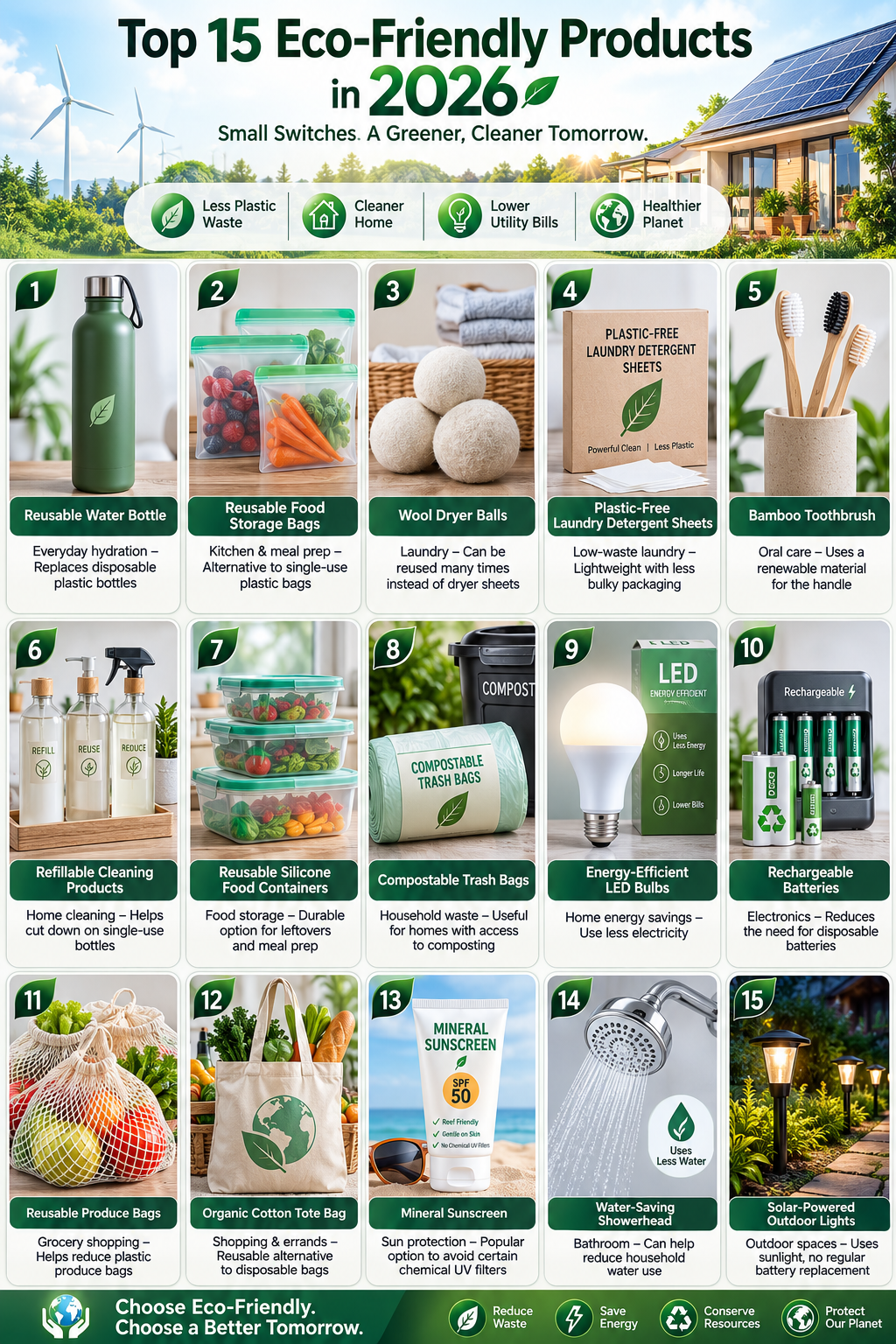
15 Best eco-friendly products in 2026
Eco friendly packaging ideas for clothing brand