
Salderingsregeling Net Metering Netherlands2026: What Solar Owners Need to Know
Updated: August 15, 2026
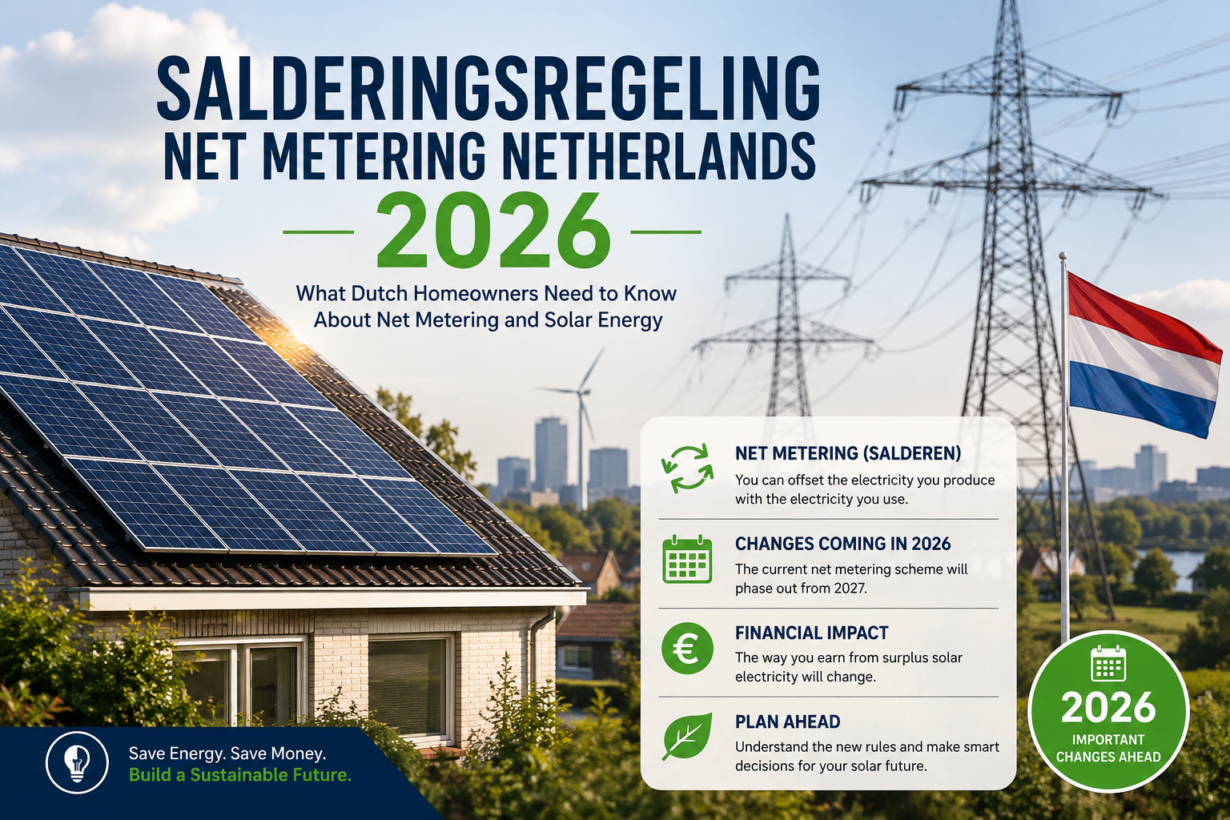
If you have solar panels in the Netherlands, 2026 is an important year. The salderingsregeling net metering Netherlands 2026 is still in effect, but the Dutch government’s net-metering scheme will end on January 1, 2027. Until December 31, 2026, eligible households and small businesses can still offset electricity they send to the grid against electricity they use from the grid.
From 2027, the system will change. When you send surplus solar electricity back to the grid, your energy supplier will pay you a feed-in compensation instead of allowing you to offset that electricity through the current net-metering system.
For homeowners with solar panels, this change raises several important questions. Is it still worth having solar panels in the Netherlands? What will happen to the electricity you send back to the grid? Should you use more of your solar electricity during the day? Do you need a home battery? And how should you choose an energy contract for your solar panels in 2026?
This guide explains salderingsregeling net metering Netherlands 2026 in simple language. It covers the current salderingsregeling, how salderen zonnepanelen 2026 works, what feed-in compensation means, how terugleverkosten can affect your energy bill, and why self-consumption will become more important after 2026.
Quick Answer: What Is Salderingsregeling Net Metering Netherlands2026?
The salderingsregeling net metering Netherlands 2026 allows eligible households and small businesses to offset electricity they use from the grid with electricity they send back to the grid. The current government scheme remains available until December 31, 2026, and it will end on January 1, 2027.
Until the end of 2026, people with solar panels can continue to use the existing balancing system. When a home generates electricity on a sunny day and sends surplus electricity to the grid, that electricity can be balanced against electricity taken from the grid later, according to the applicable rules.
From 2027, the system will change. People with solar panels can still send surplus electricity to the grid, but they will no longer be able to use those exported kilowatt-hours to reduce their later electricity consumption under the government salderingsregeling. Instead, the energy supplier will provide a feed-in compensation, known in Dutch as terugleververgoeding. Until 2030, this compensation must be at least 50% of the supplier’s electricity price, excluding energy tax and VAT.
The main lesson for homeowners is simple:
2026 is the final year of the current net-metering system. After 2026, using more of your own solar electricity directly will become more important.

Table of Contents:
- Quick Answer: What Is the Salderingsregeling in 2026?
- What Is de Salderingsregeling in the Netherlands?
- How Does Salderen Zonnepanelen 2026 Work?
- What Changes After 2026?
- What Happens to Solar Electricity Sent to the Grid?
- Why Is the Dutch Net-Metering Scheme Ending?
- Why Self-Consumption Will Become More Important
- Are Solar Panels Still Worth It After 2026?
- What Should Solar Owners Do in 2026?
- Do You Need a Home Battery After 2026?
- How Energy Contracts Affect Solar Savings
- Pros and Cons of the 2026 Situation
- Frequently Asked Questions
- Conclusion
What Is de Salderingsregeling in the Netherlands?
Salderingsregeling is the Dutch name for the government scheme that allows electricity sent to the grid to be offset against electricity taken from the grid.
The scheme was introduced to encourage households and small businesses to install solar panels. Under the current rules, electricity you send to the grid can be balanced against electricity you use from the grid. In Dutch, this process is called salderen.
A simple example:
Imagine a home with zonnepanelen on the roof.
On a sunny afternoon, the panels may produce more electricity than the household needs. The extra electricity is then sent to the grid.
In the evening, the situation can be different. The household may need electricity while the solar panels are producing very little or nothing.
Under the 2026 system, the electricity sent to the grid can be offset against electricity taken from the grid, according to the applicable rules.
For example, if a household sends 2,500 kWh to the grid and uses 2,500 kWh from the grid during the relevant period, those amounts can be balanced under the current system.
This is also why solar electricity generated during the summer can be relevant when looking at electricity used during the winter.
Is your summer solar electricity physically stored in the grid?
No. Net metering does not mean your electricity supplier stores your summer electricity and gives that same electricity back to you in winter.
The electricity grid has to balance supply and demand continuously. The salderingsregeling is mainly a billing system that determines how electricity sent to and taken from the grid is treated on your energy bill.
What if you produce more electricity than you use?
This is where things become slightly different. Under the current system, you can salderen electricity up to the amount of electricity supplied to you by your energy supplier. If you send more electricity to the grid than you use, the remaining electricity receives a terugleververgoeding, or feed-in compensation. The amount depends on your energy contract.
So, even in 2026, an exported kilowatt-hour does not necessarily have the same financial value in every situation.
How Does Salderen Zonnepanelen 2026 Work?
The term salderen zonnepanelen 2026 describes the current arrangement for solar-panel owners during the final year of the government net-metering scheme.
For eligible small connections, the system remains available until the end of 2026.
The basic process looks like this:
Solar panels generate electricity → the home uses some → surplus goes to the grid → electricity is later taken from the grid → eligible amounts are balanced through salderen.
This is why the current system can make solar electricity financially attractive even when solar production and household consumption happen at different times.
Example: solar production during the day.
Suppose your solar panels generate electricity mainly between late morning and afternoon.
You may be:
- working outside the home;
- shopping;
- travelling;
- at school;
- using relatively little electricity.
Your panels can therefore produce more electricity than the house needs.
That surplus is exported.
In the evening, household electricity demand may increase because people return home, cook dinner, use lighting, watch television or charge devices.
Under the 2026 salderen zonnepanelen 2026 rules, the timing difference is financially less important because exported electricity can be offset against electricity taken from the grid, within the applicable rules.
Why 2027 changes the calculation.
After the end of the scheme, the same household may export electricity during the afternoon and buy electricity again in the evening.
But the exported electricity will no longer be used to cancel the later electricity purchase.
Instead:
Solar electricity used directly → avoids buying electricity
Solar electricity exported → receives feed-in compensation
This makes the timing of electricity consumption much more important.
Smart meters and solar panels:
From 2026, households that feed electricity into the grid need a smart or digital meter under the applicable rules.
For solar owners, meter information can be useful because it helps show how much electricity is consumed and how much is returned to the grid.
That information becomes particularly valuable when preparing for the post-2026 system.
What Changes After 2026?
The most important date for anyone researching salderingsregeling net metering Netherlands 2026 is January 1, 2027.
That is when the government net-metering scheme ends.
The difference can be summarized like this:
| Solar electricity situation | 2026 | From 2027 |
|---|---|---|
| Electricity used directly at home | Valuable | Even more important |
| Electricity sent to the grid | Can be used for salderen | Receives feed-in compensation |
| Later electricity purchased | Can be offset under current scheme | Paid separately |
| Government salderingsregeling | Available | Ends |
| Feed-in compensation | Applies to electricity beyond saldering | Applies to exported electricity |
| Self-consumption | Helpful | Increasingly important |
The government says that from 2027, owners of solar panels will receive compensation from their energy supplier for electricity they return to the grid. Until 2030, the compensation must be at least 50% of the supplier’s electricity price excluding taxes.
This does not mean that every supplier will pay the same amount.
Your energy contract still matters.
What happens to energy tax?
After 2026, households will pay energy tax and VAT on electricity purchased from the supplier.
Electricity generated by the household and used directly is different. The government and ACM explain that directly self-generated and consumed electricity does not carry the same supplier purchase costs and taxes as electricity bought from the grid.
This is another reason direct use of zonnestroom becomes more valuable.
What Happens to Solar Electricity Sent to the Grid?
The end of the salderingsregeling net metering Netherlands 2026 does not mean that solar owners have to stop exporting electricity.
You can still send surplus electricity to the grid.
The financial treatment simply changes.
Before January 1, 2027:
Electricity supplied to the grid can be offset against electricity consumed from the grid under the current salderen system.
After January 1, 2027:
The supplier no longer offsets exported electricity against electricity consumed later.
Instead, you receive a terugleververgoeding.
The exact rate is determined according to your energy contract, while the government has established a minimum compensation rule through 2030.
This creates an important difference.
If your home uses 1 kWh of solar electricity directly, you avoid buying 1 kWh from your supplier.
If you export 1 kWh, you receive a feed-in payment.
The two values can be different.
That is why households should think about when they use electricity, not only how much they generate.
Why Is the Dutch Net-Metering Scheme Ending?
The Dutch government has several reasons for ending the salderingsregeling.
One reason is the cost of salderen. According to the government, the scheme can increase costs for energy suppliers, and those costs can eventually affect electricity prices, including for people who do not have solar panels.
Another reason is tax revenue. When households use the current net-metering system, the government collects less energy tax on the electricity that is effectively offset through salderen.
The government also wants households to use more of the electricity they generate themselves instead of sending large amounts of surplus power back to the grid.
This matters because solar panels produce most of their electricity during daylight hours. When many homes generate electricity at the same time, a large amount of surplus solar power can flow into the grid.
According to the government’s explanation, ending salderen is expected to encourage households to use more of their own solar electricity. It may also help reduce pressure on the electricity system during periods when solar production is high.
There is also a technology-related reason for the policy change.
Solar panels have become more affordable and more efficient over time. The government expects solar power to remain attractive even without the current net-metering benefit.
So, the direction of Dutch energy policy is changing.
Instead of mainly rewarding households for balancing electricity they produce and consume over time, the system is moving toward using more of the electricity you generate yourself.
Why Self-Consumption Will Become More Important?
One of the most important ideas for salderen zonnepanelen 2026 and the years that follow is self-consumption.
Self-consumption simply means using the electricity your solar panels generate directly in your home instead of sending it back to the grid.
For example, imagine your solar panels are producing electricity at 1 p.m. while your dishwasher is running. Some of that solar power can be used directly by the dishwasher.
If you run the dishwasher late at night, your solar panels may not be producing much electricity. In that case, your home will need to take electricity from the grid.
Milieu Centraal says households currently use around 30% of the electricity generated by their solar panels directly on average. It also recommends using more solar electricity while the sun is shining.
Simple Ways to Increase Self-Consumption
You do not necessarily need expensive technology to use more of your own solar electricity.
A simple approach is to shift some flexible electricity use toward daylight hours, when your panels are producing power.
For example:
- Run the washing machine when your solar panels are producing plenty of electricity.
- Use the dishwasher during periods of good solar production.
- Charge an electric vehicle during the day when practical.
- Schedule suitable appliances to run during sunny hours.
- Use smart controls where they make sense for your home.
- Monitor your solar production and household electricity use.
- Consider whether a heat pump or hot-water system can make better use of daytime solar electricity.
The goal is not to use electricity simply because your panels are producing it.
The goal is to move flexible electricity demand toward the hours when your solar panels are generating power.
Why Is Self-Consumption Important After 2026?
The financial value of self-consumption could become more important after the end of the salderingsregeling.
Electricity you use directly from your solar panels can reduce the amount of electricity you would otherwise need to buy from the grid.
Electricity you do not use and send back to the grid will receive a feed-in compensation instead.
Because the electricity price you pay for grid electricity and the compensation you receive for exported electricity are not necessarily the same, using more of your own zonnestroom can become financially attractive.
RVO also identifies self-consumption as an important factor in the economics of residential solar after the end of the salderingsregeling.
Are Solar Panels Still Worth It After 2026?
Yes, but the calculation needs to be more realistic.
The end of salderingsregeling net metering Netherlands 2026 does not mean solar panels stop producing valuable renewable electricity.
The Dutch government states that solar panels can remain financially attractive after 2026, although the payback period may become longer.
RVO’s 2025 Solar PV Monitor also shows why the calculation is changing. It reports that the future economics of household solar depend increasingly on the percentage of electricity that is used directly by the household.
What affects the financial value?
Several factors matter.
Installation cost: The lower the initial system cost, the easier it can be to recover the investment.
Solar production: Roof direction, shading, panel orientation and system design affect generation.
Household electricity consumption:
A household that consumes electricity can potentially use more of its own solar production.
Self-consumption:
Higher direct use generally improves the value of generated electricity under the post-2026 system.
Electricity prices: If electricity purchased from the grid becomes expensive, avoiding those purchases can have greater value.
Feed-in compensation: Electricity exported to the grid will receive a payment after 2026.
Feed-in costs: Terugleverkosten can reduce the financial benefit of exporting electricity.
Energy contract: The supplier and contract terms affect the final calculation.
How long do solar panels last?
The Dutch government states that solar panels have an average lifespan of around 25 years.
That is important when considering a system in 2026.
You should not evaluate a solar installation only by asking:
“How much can I save during the remaining months of salderen?”
A better question is:
“How will this system perform financially and environmentally over its entire operating life?”
What Should Solar Owners Do in 2026?
If you already have solar panels, there is no reason to panic.
Instead, use 2026 to understand your household’s actual electricity pattern.
1. Check annual electricity consumption.
Look at your recent energy bills.
Find out:
- how much electricity you purchase;
- how much your panels generate;
- how much electricity you return to the grid;
- how much electricity you use directly.
These numbers are more useful than generic online calculations.
2. Check your energy contract.
Look for:
- electricity purchase price;
- feed-in compensation;
- terugleverkosten;
- contract type;
- contract end date;
- conditions applying after January 1, 2027.
ACM says suppliers use different methods for feed-in costs, making contracts harder to compare for households with solar panels.
3. Understand your export volume.
If you send a large share of your solar electricity to the grid, the end of salderen may have a larger effect on your household economics.
If you already use a large share yourself, the transition may be easier.
4. Shift flexible electricity use.
Move suitable activities toward sunny hours.
This can include:
- washing;
- dishwashing;
- EV charging;
- water heating;
- some heating-related loads.
5. Do not automatically buy a battery.
A battery can increase self-consumption, but it has a purchase cost.
Calculate the expected benefit before making a decision.
6. Check your meter.
From 2026, a smart or digital meter is required for feeding electricity back to the grid under the applicable rules.
Make sure your solar installation and meter information are correctly registered.
Do You Need a Home Battery After 2026?
No.
A thuisbatterij, or home battery, is not mandatory simply because the salderingsregeling ends.
A battery stores electricity so that it can potentially be used later.
For example:
Afternoon:
Solar production is high → surplus electricity charges the battery.
Evening:
Solar production is low → stored electricity can be used.
This can increase self-consumption.
However, a battery is not automatically profitable.
What affects battery economics?
You should consider:
- battery purchase price;
- usable capacity;
- expected lifespan;
- electricity consumption;
- solar production;
- charging and discharging losses;
- electricity prices;
- feed-in compensation;
- available financing;
- future energy-market conditions.
RVO’s monitoring information shows several ways households can increase solar self-use, including smart EV charging, a heat-pump boiler and home batteries.
The best choice depends on the household.
For some homes, simply running appliances during sunny hours may provide a useful improvement without buying a battery.
For others, a battery may become more attractive.
How Energy Contracts Affect Solar Savings.
Energy contracts are becoming increasingly important for anyone researching salderingsregeling net metering Netherlands 2026.
The electricity price alone does not tell you whether an energy contract is attractive for a household with solar panels.
You also need to examine the treatment of electricity returned to the grid.
Electricity purchase price:
This is what you pay when you need electricity from the grid.
Feed-in compensation:
This is what the supplier pays for electricity you return to the grid.
Terugleverkosten:
These are charges associated with returning electricity to the grid.
ACM explains that suppliers can charge these costs, and the amount and method can differ between suppliers.
Contract type:
Your feed-in compensation can behave differently depending on whether you have a fixed, variable or dynamic contract.
For a dynamic contract, for example, the feed-in payment can change with electricity-market prices.
What happens at the 2027 boundary?
If your energy contract continues from 2026 into 2027, check its terms carefully.
ACM explains that the government scheme legally ends on January 1, 2027. Suppliers cannot simply postpone that statutory end date. However, contract terms can still matter for how the billing is handled.
This is why a household should compare the complete annual cost, rather than looking at one advertised electricity rate.
Can You Still Install Solar Panels in 2026?
Yes.
There is no government rule that stops households from installing solar panels because the salderingsregeling is ending.
The important question is whether the installation makes sense under both the remaining 2026 rules and the post-2026 system.
A buyer should consider:
- Installation cost.
- Expected solar generation.
- Household electricity demand.
- Direct self-consumption.
- Feed-in compensation.
- Feed-in costs.
- Electricity prices.
- Roof conditions.
- Future electricity demand.
- Expected system lifetime.
The government currently states that there is no general subsidy for residential solar panels, while a 0% VAT rate applies to solar panels installed on homes and their associated outbuildings under the stated conditions.
Therefore, anyone planning an installation should check the current financial rules before purchasing.
What Does This Mean for Dutch Households?
The end of salderen zonnepanelen 2026 is best understood as a change in the way solar electricity is valued.
The panels themselves do not change.
The sun does not change.
Your electricity production does not suddenly stop.
What changes is the financial relationship between electricity generated, electricity exported and electricity purchased.
Before 2027, the government scheme makes annual balancing particularly valuable.
After 2026, households have a stronger reason to:
- use solar electricity directly;
- shift flexible demand;
- understand their energy contract;
- monitor electricity export;
- consider smart energy management;
- evaluate battery storage carefully.
This is also relevant to the wider Dutch electricity system.
The government’s legislative documents explain that greater self-consumption can reduce the amount of solar electricity being fed into the grid during sunny periods.
In other words, the policy is encouraging households to become more active energy users rather than simply treating the electricity grid as a place to export daytime solar production.
Pros and Cons of the 2026 Situation.
Advantages:
The current net-metering system is still available.
Eligible users can continue to benefit from salderen until the end of 2026.
Solar panels continue to generate renewable electricity.
The policy change does not affect the basic operation of photovoltaic panels.
The 2027 transition is now clear.
The end date is January 1, 2027.
Direct solar use can reduce electricity purchases.
This remains useful both before and after the scheme ends.
Solar technology has a long operating life.
The government states that solar panels have an average lifespan of about 25 years.
Disadvantages:
The old financial benefit ends in 2027.
Exported electricity can no longer be offset against later electricity consumption.
Feed-in compensation may be lower than the electricity purchase price.
This makes self-consumption more important.
Feed-in costs can reduce savings.
These charges vary between suppliers and contracts.
Future payback periods are more difficult to generalize.
Households have different consumption patterns and solar systems.
Energy contracts require more attention.
Solar owners need to compare more than just the electricity price.
Frequently Asked Questions.
1.Is the salderingsregeling still available in the Netherlands in 2026?
Yes. The current salderingsregeling net metering Netherlands 2026 remains available for eligible households and small businesses through December 31, 2026. The government scheme ends on January 1, 2027.
2.What does salderen zonnepanelen 2026 mean?
.Salderen zonnepanelen 2026 refers to the current system under which eligible solar owners can offset electricity supplied to the grid against electricity consumed from the grid.
3.What happens to solar panels after January 1, 2027?
Solar panels continue to work normally. What changes is the billing system. Electricity exported to the grid can no longer be offset against later electricity purchases through the government scheme. Instead, the supplier pays a feed-in compensation.
4.How much will I receive for electricity exported after 2026?
Until January 1, 2030, the compensation must be at least 50% of the supplier’s electricity price excluding energy tax and VAT. The actual rate depends on the applicable contract.
5.Are solar panels still worth buying after 2026?
They can be. The financial result depends on installation cost, electricity prices, solar generation, self-consumption, feed-in compensation and feed-in costs. Official Dutch sources continue to recognize solar panels as potentially financially attractive after the end of the scheme.
6.Should every Dutch household buy a home battery?
No. A battery can increase self-consumption, but its financial benefit depends on the household’s electricity use, solar production, battery cost and future electricity prices.
7.What are terugleverkosten?
Terugleverkosten are charges that an energy supplier may apply when customers return electricity to the grid. The amount and method can vary by supplier and contract.
8.Why is self-consumption more important after 2026?
Because electricity used directly can reduce the amount purchased from the grid, while exported electricity receives a separate feed-in payment. After the end of salderen, those two values are no longer balanced in the same way.
Conclusion:
The salderingsregeling net metering Netherlands 2026 is still available for solar-panel owners, but 2026 is the final year of the current scheme. From January 1, 2027, electricity sent back to the grid will no longer be offset against electricity used later.
This does not mean solar energy is becoming less useful. It means the way solar electricity is valued is changing.
After 2026, using more of your own solar electricity will become increasingly important. Running appliances during sunny hours, charging an electric vehicle during the day, and managing energy use carefully can help households get more value from their solar panels.
A thuisbatterij may be useful for some homes, but it is not automatically necessary.
If you are considering zonnepanelen, look beyond salderen zonnepanelen 2026 and think about your long-term electricity use, energy contract, feed-in compensation and self-consumption.
The Dutch solar market is moving toward using more of the energy you generate yourself rather than relying mainly on net metering.
So the clearest takeaway is:
2026 is the final year of the Dutch salderingsregeling, but solar panels remain relevant beyond 2026. The key is understanding how your home will use and value solar electricity after the rules change.
About the Author:
I am not a professional expert in sustainable technology, renewable energy, climate science, or environmental policy. I regularly read information from trusted public sources such as government websites, research organizations, educational institutions, newspapers, technical reports, and other publicly available resources. The purpose of these articles is to collect practical information in simple language and present it in a way that helps readers understand sustainability-related topics more easily and make informed decisions in everyday life.
Solar Panels in Netherlands 2026
TOPCon vs HJT Solar Panels Efficiency 2026
Recommended External Sources.
1. Rijksoverheid — Salderingsregeling
Official Dutch government information about the end of the scheme and the 2027 rules.
2. ACM ConsuWijzer — Salderen en terugleveren
Consumer guidance covering salderen, feed-in compensation and feed-in costs.
3. RVO — Solar energy and energy savings
Official information about the financial value of generating and using solar electricity.
4. Milieu Centraal — Using more solar electricity yourself
Practical consumer guidance on increasing self-consumption.
Editorial note: This article reflects information available from Dutch government, ACM, RVO and Milieu Centraal sources checked in August 2026. Energy contracts, supplier charges and electricity prices can change, so readers should verify current terms before making a financial decision.