
Wetgeving Energieakkoord 2026: New Energy Rules in the Netherlands
The Dutch energy system is entering an important new phase in 2026. The Energiewet 2026 Nederland is changing how electricity and gas markets work, while solar-panel owners, energy consumers, and households face a wider shift toward a more flexible and renewable energy system. Understanding these changes is important if you live in the Netherlands, have solar panels, are planning a heat pump or EV charger, or are simply looking for a better energy contract.
One important clarification is needed: Wetgeving Energieakkoord 2026 is not the official name of one new Dutch law. The original Energieakkoord dates back to 2013, while the new Energiewet came into force on January 1, 2026. Together with the Klimaatakkoord, solar-energy policies, grid rules, and the end of the salderingsregeling after 2026, these developments are shaping the next stage of the Dutch energy transition.
Table of Contents:
Quick Answer: What Is Wetgeving Energieakkoord 2026?
The phrase Wetgeving Energieakkoord 2026 is useful as a search term, but it should not be confused with the name of one official Dutch law. The Energieakkoord voor duurzame groei was a 2013 agreement covering energy saving, renewable energy, and sustainable growth. The major energy law that actually came into force in 2026 is the Energiewet, which replaced the former Electricity Act and Gas Act.
The Energiewet 2026 Nederland affects how electricity and gas markets operate, how suppliers provide contracts, how consumers receive energy information, and how the electricity system can respond to a changing energy mix.
For households, some of the most visible 2026 changes include clearer energy bills, new model contracts, rules around solar electricity feed-in costs, and changes designed to make the energy system more flexible. At the same time, the end of the Dutch salderingsregeling from 2027 remains an important consideration for solar-panel owners.
What Is the Energieakkoord?
The Energieakkoord voor duurzame groei was a Dutch agreement published in 2013. It brought together the government and organisations including employers, trade unions, and environmental groups.
Its focus was broader than electricity alone. The agreement included measures related to:
- energy efficiency;
- renewable energy;
- energy saving;
- wind power;
- building renovation;
- employment and sustainable economic growth.
The original agreement contained 159 measures and was intended to support the transition toward a more sustainable energy system.
This distinction matters when researching Wetgeving Energieakkoord 2026.
The Energieakkoord itself should not be described as a new 2026 law. Instead, Dutch energy policy has developed through several layers of agreements, laws, regulations, climate targets, and European rules.
The later Klimaatakkoord, agreed in 2019, became another major part of Dutch climate policy. It set out measures intended to reduce greenhouse-gas emissions and support the energy transition.
So, when someone searches for wetgeving Energieakkoord 2026, they may actually be looking for the current laws and regulations that influence the goals originally associated with the Dutch energy transition.
What Is the Energiewet 2026 Nederland?
The Energiewet is the key legal development to understand in 2026.
It came into force on January 1, 2026, replacing the previous Electricity Act 1998 and Gas Act. The new framework updates the rules for the electricity and gas markets and provides a legal structure better suited to a changing energy system.
Why was a new law needed?
The Dutch energy system is changing quickly. Electricity is increasingly important for:
- solar panels;
- wind farms;
- electric vehicles;
- heat pumps;
- home batteries;
- industrial electrification;
- flexible electricity use.
At the same time, the Netherlands is dealing with limited electricity-grid capacity in some areas.
The new Energiewet therefore has significance beyond traditional electricity and gas supply. It is part of the legal framework for a more flexible and increasingly renewable energy system.
The Dutch government has also described the law as supporting greater flexibility in energy use and better use of available grid capacity.
What Changed on January 1, 2026?
Several important changes became relevant from the start of 2026.
1. The Energiewet replaced older electricity and gas laws
The first major change is structural.
Instead of relying primarily on separate legislation for electricity and gas, the Netherlands now has the Energiewet as the central framework.
The transition also required changes to technical and market rules. In 2026, the ACM established new electricity and gas codes to align the system with the new law.
2. New model energy contracts
The new law changed the framework for modelcontracten.
The ACM established new model contracts for energy suppliers. These include variable and fixed contract options, with the new framework applying from January 1, 2026. The ACM expected suppliers to offer the new model contracts by April 1, 2026.
This is particularly relevant to consumers comparing energy suppliers.
3. Clearer energy bills
From January 1, 2026, household energy bills must include a short overview showing the most important information in understandable language.
The goal is to make it easier for consumers to understand what they are paying for and compare energy contracts.
This is a practical change that may matter more to many households than the legal terminology itself.
4. Changes for households with solar panels
Solar-panel owners remain an important group affected by the evolving Dutch energy rules.
The ACM’s 2026 model-contract rules allow terugleverkosten, or feed-in costs, to be included in the relevant model contracts. The ACM also requires feed-in costs in the model contract to be calculated per kilowatt-hour of electricity fed into the grid.
This means solar owners should not look only at the headline electricity price when comparing contracts.
What Does the New Energy Law Mean for Households?
For an average household, the legal changes may not look dramatic when switching on a light or heating a home. Their effect becomes clearer when you look at energy contracts, solar panels, electricity use, and the grid.
Energy bills should become easier to understand.
A clearer bill can help consumers identify:
- electricity consumption;
- gas consumption;
- supplier charges;
- network-related charges;
- taxes and other costs;
- important contract information.
This is useful because the final energy bill is influenced by several components, not simply the wholesale electricity or gas price.
The Dutch government notes that energy costs are affected by international energy prices, taxes, network costs, changes in energy demand, and geopolitical developments.
Energy contract comparison becomes more important.
A household choosing between fixed, variable, or dynamic pricing needs to consider more than the advertised price per kilowatt-hour.
For example, a household with solar panels may have different costs from a household that buys electricity from the grid throughout the day.
The ACM has specifically highlighted that energy contracts can be difficult to compare because suppliers may handle solar feed-in costs differently.
Therefore, a sensible comparison should look at the whole contract rather than one attractive tariff.
How Will the Energiewet 2026 Affect Energy Prices in the Netherlands?
The Energiewet 2026 Nederland does not set one fixed electricity or gas price for Dutch households. Instead, it changes the rules for how the energy market operates, how suppliers offer contracts, and how consumers receive information about their energy costs.
This means the law can influence the way consumers compare and manage energy costs, but it does not mean that every household will automatically see a lower energy bill.
Several factors will continue to affect energy prices in the Netherlands, including wholesale energy prices, taxes, network charges, supplier costs, household consumption, and international energy-market conditions.
What could change for consumers?
The practical impact can be seen in several areas:
| Factor | Possible Impact on Your Energy Bill |
|---|---|
| Energy contract | Fixed, variable, and dynamic contracts can have different price risks |
| Solar panels | Terugleverkosten can affect the economics of exporting electricity |
| Energy consumption | Using less electricity or shifting usage can reduce costs |
| Grid charges | Network costs remain part of the overall energy bill |
| Wholesale prices | Changes in European energy markets can influence supplier prices |
| Taxes and levies | Government energy taxes can affect the final household bill |
| Dynamic pricing | Consumers may benefit from cheaper periods but face price fluctuations |
Will the Energiewet make electricity cheaper?
Not necessarily.
The main purpose of the Energiewet is to provide a modern legal framework for the Dutch energy market. It is not a law that guarantees lower electricity or gas prices.
For consumers, the bigger benefit may be better information and clearer market rules. From 2026, energy bills must provide important information in a clearer format, making it easier for households to understand their costs.
This can help consumers make better decisions when choosing an energiecontract.
Why solar households need to look beyond the electricity price
For households with solar panels, the price shown by an energy supplier is only part of the calculation.
You should also check:
- how much you pay for electricity from the grid;
- how much you receive for electricity you export;
- whether the supplier charges terugleverkosten;
- your fixed monthly charges;
- how much electricity your household uses directly.
This is becoming more important because the Dutch salderingsregeling ends after 2026.
As a result, self-consumption of solar electricity can become increasingly important when evaluating household energy costs.
Could flexible electricity use save money?
Potentially, yes.
The Netherlands is moving toward a more flexible electricity system. Households with an EV, heat pump, home battery, or smart energy-management system may have more opportunities to shift electricity consumption to periods when electricity is cheaper.
For example, instead of automatically charging an EV immediately after arriving home, a household with a suitable dynamic contract and smart charger could potentially charge during a lower-price period.
However, this is not a guaranteed saving. Dynamic prices can also rise, so consumers should understand the risks before choosing such a contract.
The bigger picture:
The effect of the Energiewet should therefore be viewed as part of a wider change in the Dutch energiesysteem.
The Netherlands is adding more renewable electricity while electricity demand is also increasing. Solar panels, wind farms, heat pumps, EVs, batteries, and industrial electrification all affect how electricity is produced and consumed.
The long-term challenge is not simply to produce more renewable energy. The system also needs sufficient grid capacity, flexible demand, storage, and consumers who can respond to changing electricity prices.
Bottom line: The Energiewet 2026 does not guarantee cheaper energy. Its importance is that it creates updated rules for the energy market while the Netherlands moves toward a more renewable, flexible, and increasingly electrified energy system.
Expert or Official Perspective:
For a topic involving legislation, consumer rights, energy contracts, and renewable-energy policy, official sources are more useful than unsupported commentary.
The Rijksoverheid explains the government’s energy and climate policies, while the Autoriteit Consument & Markt (ACM) regulates and publishes information about energy suppliers, contracts, consumer protection, and market rules.
The official legislation database is also essential when checking whether a particular provision is actually in force.
The current legal record confirms that the Energiewet entered into force on January 1, 2026, while later amendments and implementation changes can have their own effective dates.
That last point is important: energy legislation can change over time. A blog published today should not be treated as a permanent substitute for the current legal text.
What Does It Mean for Solar Panel Owners?
Solar energy remains a major part of Dutch renewable-energy policy.
The Dutch government identifies solar power as one of the important energy sources needed to reach a climate-neutral energy system. The national policy framework also supports solar generation alongside wind power.
However, 2026 is an important transition period for solar households.
The salderingsregeling ends after 2026.
One of the biggest issues for Dutch solar owners is the end of the salderingsregeling.
The Dutch government states that the net-metering scheme will be abolished after 2026. This means solar owners should not assume that the financial model that applied during earlier years will continue indefinitely.
This does not automatically mean that solar panels become a bad investment.
Instead, the economics increasingly depend on how much electricity a household uses itself, what it receives for exported electricity, the costs charged by the supplier, and the household’s overall electricity consumption.
Self-consumption becomes more valuable.
Imagine a household generating electricity during the day.
If the household can use that electricity directly for:
- washing machines;
- dishwashers;
- heat pumps;
- electric vehicle charging;
- home batteries;
it can reduce the amount of electricity it needs to purchase from the grid.
This makes zelfverbruik—self-consumption—an increasingly useful concept for solar households.
The best approach will depend on the household’s consumption pattern and contract.
Feed-in costs matter.
The ACM has found that suppliers can charge feed-in costs for solar electricity under the applicable rules. It has also pointed out that these costs can make contract comparisons difficult.
So, before choosing an energy contract, a solar owner should check:
- the electricity purchase price;
- the compensation for exported electricity;
- feed-in costs;
- fixed charges;
- contract duration;
- whether pricing is fixed, variable, or dynamic.
What Does the Law Mean for Energy Contracts?
The Energiewet 2026 Nederland also matters when choosing an energy contract.
The new model-contract framework introduced both variable and fixed model-contract options. The ACM states that the new model contracts formally apply from January 1, 2026, with suppliers expected to offer them by April 1, 2026.
Fixed contracts:
A fixed contract provides a defined energy price for an agreed period, subject to the specific terms of the contract.
The advantage is greater price predictability.
The disadvantage is that a household may not automatically benefit when market prices fall.
Variable contracts:
Variable contracts can change according to the contract conditions.
They can offer more flexibility than a fixed contract, but households need to accept greater uncertainty about future prices.
Dynamic contracts:
Dynamic contracts can follow short-term wholesale market prices.
This can create opportunities for households that are able to shift electricity use to cheaper periods.
However, the ACM warns that dynamic contracts also expose consumers to the risk of strongly changing prices.
For someone with a heat pump, EV, battery, or smart energy-management system, flexibility can therefore become more important.
Why Is Grid Capacity Important in 2026?
One of the biggest challenges for the Dutch energy transition is not simply producing renewable electricity. It is also moving and using that electricity when and where it is needed.
This is where netcongestie, or grid congestion, becomes important.
The Netherlands is expanding its electricity infrastructure while demand for electricity is increasing.
More households are adopting:
- heat pumps;
- electric cars;
- induction cooking;
- solar panels;
- battery storage.
Businesses are also electrifying equipment and processes.
The government has therefore been working on both grid expansion and smarter use of existing capacity.
A new connection waiting list:
From July 1, 2026, households requesting a new or heavier electricity connection may face a waiting list in relevant situations.
A heavier connection can be needed when installing equipment such as a heat pump, induction cooking system, or EV charger.
This is an important practical issue for anyone planning a major home-energy upgrade.
If you are considering several electrical technologies at once, it is sensible to check your available connection capacity before committing to an installation.
How Does the 2026 Energy Policy Support Renewable Energy?
The Netherlands is continuing its broader transition away from fossil fuels.
The government aims for a clean energy system by 2050 and sees renewable energy such as solar and wind as important parts of that transition.
Solar energy:
Solar panels are already an important part of the Dutch energy landscape.
The government has stated that solar and wind energy on land together were targeted to produce at least 35 TWh of renewable electricity in 2030 under the Klimaatakkoord framework.
Wind energy:
Wind power is another major part of the transition.
The Netherlands has favorable conditions for offshore wind because of its North Sea location, relatively shallow waters, ports, and nearby industrial demand.
Sustainable heating:
The energy transition also includes heat.
The government is working toward buildings using sustainable heating sources by 2050, including heat networks and heat pumps.
This matters because electrification increases pressure on the electricity grid.
A successful energy transition therefore requires more than renewable generation. It also needs stronger networks, flexible demand, energy efficiency, storage, and better coordination.
Energieakkoord vs Energiewet vs Klimaatakkoord.
These three terms are easy to mix up.
| Term | What it means | Main relevance |
|---|---|---|
| Energieakkoord | 2013 agreement for sustainable growth | Energy saving and renewable-energy policy |
| Klimaatakkoord | 2019 national climate agreement | Measures to reduce emissions and support climate goals |
| Energiewet | Dutch energy law effective from 2026 | Legal framework for electricity and gas markets |
| Salderingsregeling | Solar net-metering scheme | Financial treatment of electricity generated by households |
| Energiebesparing | Energy saving | Reducing energy demand and costs |
| Netcongestie | Grid congestion | Limited available electricity-grid capacity |
The difference is important for accurate SEO content as well.
Calling the Energiewet the “new Energieakkoord law” would be misleading.
A better explanation is that the Energiewet is one of the important legal developments supporting the Netherlands’ evolving energy system, while the Energieakkoord and Klimaatakkoord are policy agreements with different histories and purposes.
The original Energieakkoord dates from 2013, while the Klimaatakkoord dates from 2019.
What Should Consumers Do in 2026?
You do not need to understand every article of the Energiewet to make sensible household energy decisions.
Instead, focus on the parts that affect your situation.
If you have solar panels:
Check your current energy contract.
Pay attention to:
- feed-in costs;
- export compensation;
- electricity purchase price;
- fixed charges;
- contract duration;
- your expected self-consumption.
Do not judge a contract only by the lowest electricity tariff.
If you are buying solar panels:
Consider your household’s electricity use during the day.
A system designed around realistic consumption can be more useful than simply choosing the largest possible installation.
Also consider future electricity demand from an EV, heat pump, or other appliances.
If you are installing a heat pump or EV charger:
Check your electricity connection and local grid situation before installation.
In 2026, grid availability can be an important practical constraint in some areas.
If you are changing energy contracts
Compare the full annual cost.
Look beyond:
- promotional bonuses;
- headline tariffs;
- estimated monthly payments.
Check the contract conditions and how solar electricity is treated.
If you are struggling with energy costs:
Do not wait until unpaid bills become a serious problem.
The Dutch government has introduced additional measures around clearer bills and support for households facing payment difficulties.
Pros and Cons of the 2026 Energy Changes
Potential benefits:
Better consumer information
Clearer energy bills can make it easier to understand energy costs.
More standardized model contracts
New model contracts give consumers a more consistent basis for comparison.
A modern legal framework
The Energiewet brings electricity and gas regulation into a newer legal framework suited to a changing energy system.
More attention to flexibility
The changing system creates opportunities to shift electricity consumption to different times.
Support for the renewable transition
The broader policy direction continues to support solar, wind, sustainable heating, and energy efficiency.
Potential challenges:
Energy contracts can still be complicated
Solar feed-in costs and different pricing structures make comparison difficult.
Grid congestion
Not every household can necessarily increase its electricity connection immediately.
Changing solar economics
The end of saldering after 2026 means solar owners need to think more carefully about self-consumption and contract terms.
More responsibility for consumers
Consumers may need to pay closer attention to their contract, electricity usage, and solar generation.
Frequently Asked Questions.
1. What is Wetgeving Energieakkoord 2026 in the Netherlands?
Wetgeving Energieakkoord 2026 is commonly used as a search term for Dutch energy policy and legislation in 2026. It is not the official name of one new law. The key new legislation is the Energiewet, which came into force on January 1, 2026.
2. What is the Energiewet 2026 Nederland?
The Energiewet is the new Dutch energy law that replaced the previous Electricity Act and Gas Act. It provides updated rules for the electricity and gas markets, energy suppliers, consumers, and the changing Dutch energy system.
3. Will the Energiewet 2026 make energy cheaper in the Netherlands?
Not automatically. The Energiewet does not set a fixed electricity or gas price. Household costs still depend on energy-market prices, taxes, network charges, supplier rates, consumption, and contract conditions.
4. What does the Energiewet 2026 mean for solar panel owners?
Solar owners need to pay closer attention to energy contracts, terugleverkosten and the amount of electricity they use themselves. The end of the salderingsregeling after 2026 also makes self-consumption more important.
5. Does the salderingsregeling end in 2026?
Yes. The Dutch net-metering scheme (salderingsregeling) will be abolished after 2026. From 2027, solar-panel owners will no longer be able to offset electricity fed into the grid against electricity taken from the grid in the same way as under the current scheme.
6. What should Dutch households check before choosing an energy contract in 2026?
Compare the complete contract rather than only the electricity price. Check the fixed charges, contract duration, feed-in costs, compensation for exported solar electricity, and whether the contract is fixed, variable, or dynamic.
7. Why is grid congestion important under the Dutch energy transition?
Netcongestie can limit the amount of electricity that can be transported through the local grid. This can affect households planning higher electricity demand from technologies such as heat pumps, EV chargers, or other electrical equipment.
8. Is the Energieakkoord the same as the Energiewet?
No. The Energieakkoord was a 2013 agreement focused on sustainable growth, energy saving, and renewable energy. The Energiewet is legislation that came into force in 2026. They are related to the Dutch energy transition but are not the same thing.
Conclusion
The biggest mistake when researching Wetgeving Energieakkoord 2026 is treating it as the name of one new Dutch energy law.
The reality is more nuanced.
The original Energieakkoord was a 2013 agreement focused on sustainable growth, energy saving, and renewable energy. The later Klimaatakkoord became an important part of Dutch climate policy. In 2026, the major legal development is the Energiewet, which came into force on January 1 and replaced the former electricity and gas laws.
For households, the practical issues are easier to identify than the legal terminology: understand your energy contract, check how solar feed-in costs are handled, consider self-consumption if you have solar panels, and check grid capacity before planning major electrical upgrades.
The Dutch energy transition is also bigger than one law. Solar power, wind energy, sustainable heating, energy efficiency, flexible electricity use, and grid modernization all have to work together.
For readers in the Netherlands, 2026 is therefore less about one isolated rule and more about understanding how the country’s energiesysteem is changing—and how those changes affect everyday energy decisions.
About the Author:
I am not a professional expert in sustainable technology, renewable energy, climate science, or environmental policy. I regularly read information from trusted public sources such as government websites, research organizations, educational institutions, newspapers, technical reports, and other publicly available resources. The purpose of these articles is to collect practical information in simple language and present it in a way that helps readers understand sustainability-related topics more easily and make informed decisions in everyday life.
note: This article reflects information available from Dutch government, ACM, RVO and Milieu Centraal sources checked in August 2026. Energy contracts, supplier charges and electricity prices can change, so readers should verify current terms before making a financial decision.
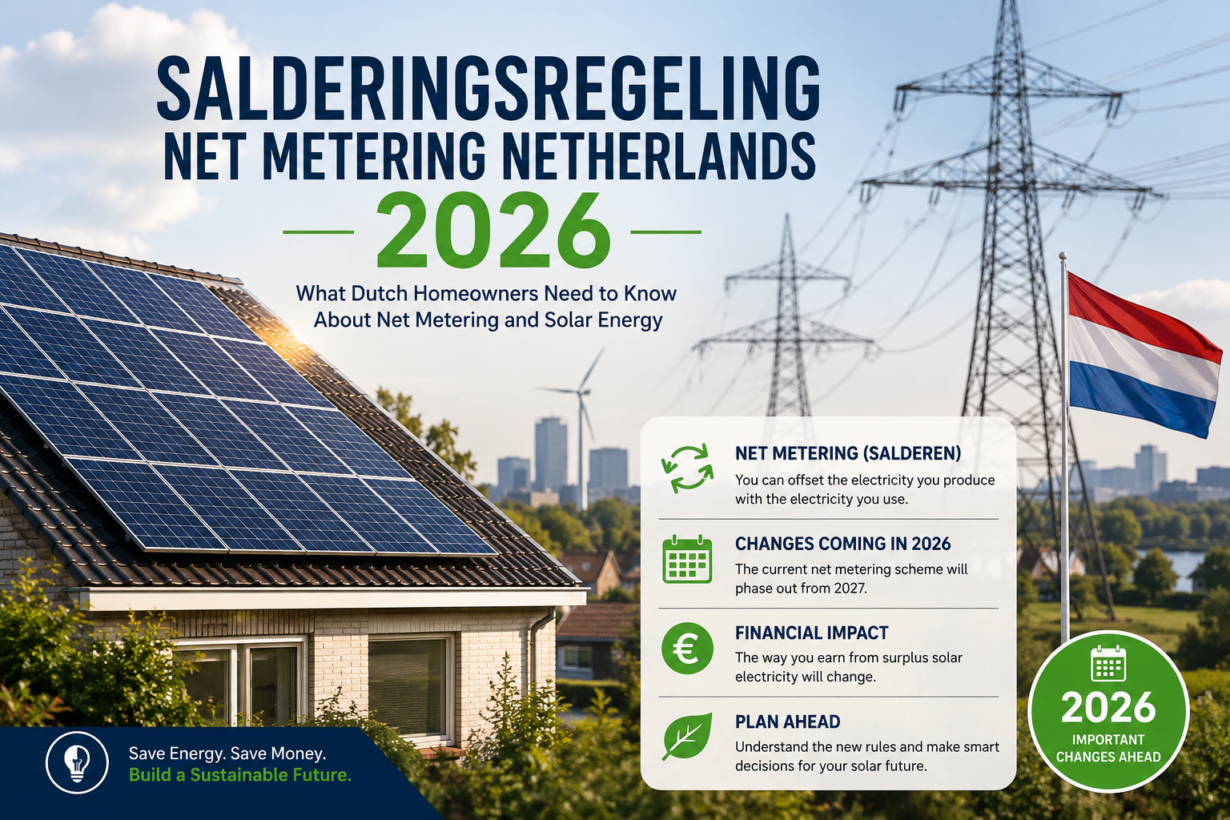
salderingsregeling net metering Netherlands2026
Solar Panels in Netherlands 2026
Recommended External Sources
- Rijksoverheid – Measures for affordable and sustainable energy
- Rijksoverheid – Energieakkoord voor duurzame groei
- Rijksoverheid – Klimaatakkoord
- ACM – New model energy contracts
- ACM – Solar feed-in costs and contract comparison
- ACM – New electricity and gas codes under the Energiewet
- Official Dutch legislation database – Energiewet